Explore top 10 tips to secure your open-source projects now. Read More
×



Server Security data privacy automation
data privacy automation Every system admin has lived through the same Monday morning ritual. A queue of forty tickets, half of them password resets, permission errors, or disk space warnings that any experienced technician could resolve in under two minutes. The other half require actual judgment. For years, automation promised that software would eventually sort the two apart on its own. That promise is now being tested in production Linux environments. . Early results are reshaping how IT teams think about tier-1...
 Jul 17, 2026

Privacydata collection automation
data collection automation You're running a web scraping project to collect pricing data from e-commerce sites. You set up a pool of datacenter proxies, launch your scripts, and within minutes — banned . CAPTCHAs everywhere. Your data pipeline stops before it really begins. . It's a frustrating scenario that plays out daily in ad verification, market research, and multi-account management. The website doesn't know you're doing legitimate research or monitoring. It just sees traffic coming from IP ranges it recognizes as...
Jul 17, 2026

Security Trends security advisory social engineering
security advisory social engineering Business Email Compromise used to be a numbers game — mass-blasted emails, broken English, an obvious "URGENT WIRE TRANSFER" subject line. That era is over. Generative AI has turned BEC into a tailored, low-noise operation that mimics writing style, voice, and even video presence. This piece looks at what's actually changed under the hood, what defenders are testing in response, and why so many organizations are still structurally unprepared for it. . The Infrastructure Problem Nobody Wants to...
Jul 17, 2026

Security Trends cybersecurity Linux documentation
cybersecurity Linux documentation Linux operating systems have gained prominence due to their stability, adaptability, and excellent security options. In the case of developing documentation, designing cybersecurity dashboards, or educational material, visuals are of vital importance when it comes to making things clear. The use of icons allows one to understand the message regarding alerts, authorization, encryption, authentication, or the state of the system just by looking at the visual cue without having to read long...
Jul 17, 2026
Security Vulnerabilities security advisory linux distribution
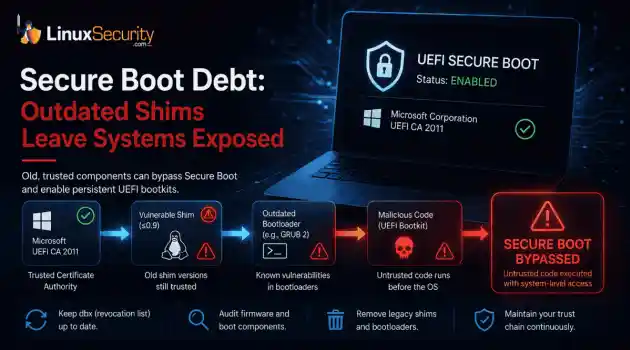
security advisory linux distribution ESET researchers identified 11 old and forgotten Linux UEFI shim bootloaders at versions 0.9 and below that can be used to bypass UEFI Secure Boot on any UEFI-based machine that trusts Microsoft’s Microsoft Corporation UEFI CA 2011 third-party certificate authority, regardless of the installed operating system (OS). Reported shims can be exploited to execute untrusted code during system boot, enabling attackers to deploy malicious UEFI bootkits even on systems with UEFI Secure Boot enabled.....
Jul 16, 2026
 Refine news
X Clear Filters
Get the latest News and Insights
Get the latest Linux and open source security news straight to your inbox.
Community Poll
Is continuous patching actually viable?
Loading...
Explore Latest Linux Security news
We found 255 articles for you...
77
 security measuressysadmin practicescredential management
Running Proxies Safely on Linux: A Hardening Guide for System Administrators
Proxies are a standard component of a Linux administrator's toolbox. You can use them to see how services respond in various locations, to run route monitoring checks, and to retrieve public data for internal tooling. However, a proxy is an outbound tunnel with credentials attached, and on a multi-user server, it is a security risk that should be treated with the same caution as SSH or sudo. This post explains the practical measures that prevent a proxy setup from becoming a weak point in an otherwise hardened host. . Keep credentials clear of places where they frequently leak. Don't put your credentials where they can be seen by anyone. Most of the time, something simple goes wrong: proxy credentials get hardcoded into a script, a systemd unit, or a cron job . This means that every user on the box can read them, and they will always be there in shell history and backups. As if they were any other secret. Keep them in a secrets manager or, at the very least, a file that is owned by root and has tight permissions. Add them to the program at runtime using environment variables that are set to the service user's scope, and never commit them to a repository. For fixed servers, IP allowlisting is better if your service supports it because it removes the password from the connection and only lets requests come from addresses that you have registered. Choose a provider whose sourcing you can defend On Linux, you are used to knowing exactly what your software does. Extend that instinct to your proxy vendor. Residential proxy networks route traffic through real consumer connections, and the reputable ones source those exits from consenting participants and document where their pools operate. Reputable providers are transparent about how their residential IP pools are sourced, where they operate, and the options they offer. They should also provide clear documentation and guidance on secure residential proxy use , so you understand how to deploy the service responsibly Isolate the proxypath from everything else Do not let one credential and one route serve every purpose. Give each job its own scoped account so a leak or a runaway is contained. Where possible, run proxy-using tools under a dedicated unprivileged service user with no login shell, so a compromise of the tool does not hand an attacker a general foothold. If a job only needs HTTPS, do not provision a SOCKS credential that can tunnel arbitrary TCP out of your network, because that is precisely the capability an intruder would love to find lying around. Watch DNS and prevent leaks A classic mistake is routing HTTP through the proxy while DNS still resolves locally, which leaks your lookups and can defeat the geo-targeting you set up the proxy for in the first place. Confirm that name resolution follows the proxy path when it should, test it explicitly rather than assuming, and log egress at the host so you can see where traffic actually goes. A quick check comparing the exit address the provider reports against public geolocation confirms the route is behaving before you trust it in production. Log, alert, and assume the credential will eventually leak Instrument the proxy layer like any other service. Record request volume per credential and alert on spikes that signal a runaway job, and on traffic to countries you never target, which is the fingerprint of a stolen credential in someone else's hands. A proxy credential seen coming from an unfamiliar host at an odd hour deserves the same response as a leaked API key, because functionally that is what it is. Rotate on a schedule so that even an undetected leak has a limited lifespan. Maintain compliance with the regulations. Technical hardening does not excuse misuse. Maintain automatic fetching on public pages, follow robots directions, keep request rates low enough so that no target is burdened, and keep personal data out of everything you collect. An arrangement that is both technically tight and operationally restricted may be performed forever withoutcausing problems and explained to a security reviewer without hesitation. Anyone who administers Linux professionally is familiar with the through-line: least privilege , explicit configuration, true logging, and no secrets in the open. Apply similar practices to the proxy layer, and it will become just another well-managed component of the system, rather than the silent exception that undoes the rest of your hardening. . Learn effective strategies to manage proxies safely on Linux, ensuring secure configurations and better credential practices.. Linux Proxies Hardening Guide, Secure Proxy Management, System Administrator Practices, Credential Security, Outbound Traffic Best Practices. . Anthony Pell
 Jul 16, 2026
•
Jul 16, 2026
• Server Security
76
 risk managementsecurity practicessecurity measures
OpenSSF: Security Baseline Initiative Enhances Open-Source Protection
Open Source Security Foundation (OpenSSF) recently unveiled its Security Baseline initiative to assist Linux security admins and developers in incorporating essential security measures into open-source projects. This set of guidelines, available on February 25, offers three tiers of practices explicitly tailored for project maturity levels, ensuring open-source software provides consistent and dependable protection from day one. . Understanding and following these guidelines means taking proactive measures against vulnerabilities while strengthening user trust in projects. Operating at version 20250225, the OSPS Baseline outlines basic security for open-source projects, serving as a practical guide for developers and project maintainers. This initiative encourages security awareness within communities so everyone can collaborate to refine and improve practices. Adding this guideline into your workflow can make the open-source ecosystem safer while aligning yourself with broader community efforts to remain vigilant against security threats. Let's take a closer look at this initiative, its significance, and practical measures you can take to adhere to these guidelines while overcoming implementation challenges. Understanding the Security Baseline Initiative On February 25, OpenSSF introduced its Security Baseline initiative, providing an organized framework for securing open-source projects according to their level of maturity. Since open-source software development involves collaborative efforts without central oversight, maintaining consistent standards can be challenging. Thankfully, the Security Baseline offers three guidelines that ensure basic security fundamentals are always met. This design makes this initiative particularly advantageous for diverse projects ranging from fledgling developments to mature software offerings. Why Tiered Guidelines Matter Security in software development cannot be addressed with one-size-fits-all solutions. Projects vary significantly incomplexity, size, and sensitivity - therefore, security frameworks and solutions must reflect this diversity. The Security Baseline's tiered guidelines were specifically tailored to this reality to enable projects at various stages of maturity to adopt appropriate security practices at different points during their journeys. This scalability ensures burgeoning projects start with manageable security goals while adding more sophisticated measures as they expand. As a result, it supports projects as they develop, facilitating sustained security improvement over their lifecycles. Building Trust in Open-Source Software One of the main objectives of the Security Baseline is to build trust in open-source software by assuring its security is comparable with proprietary solutions. Security breaches and vulnerabilities can erode trust in an open-source project and prompt users to seek alternatives. By adhering to OpenSSF guidelines, developers can demonstrate their dedication to user and stakeholder security and position projects favorably in trust-driven ecosystems. Engaging the Linux Security Community in This Initiative Linux security admins will play an instrumental role in adopting and implementing the OpenSSF Security Baseline. As security leaders within their projects, these individuals are in an ideal position to advocate for and integrate this set of guidelines into existing workflows, thus leading initiatives prioritizing security from their inception and creating an atmosphere that values proactive risk management practices. The Security Baseline allows Linux admins to interact with and engage with the broader security community. With its active maintenance and open-source nature, there is room for collaboration and contribution - and community members are encouraged to provide feedback, suggest improvements, and refine the guidelines in response to emerging security threats or advancements in technology. A Practical Guide to Implementation Implementing the Security Baseline within aproject begins with understanding the project's security needs and maturity level. This includes a current security posture assessment, gap analysis, and selecting appropriate tier levels from guidelines to address those gaps. Newer projects might focus on security measures like secure coding practices or vulnerability scanning . In contrast, more mature ones could focus more heavily on advanced threat modeling and incident response plans. Open-source initiatives provide greater flexibility when applying these guidelines, enabling administrative teams to tailor practices according to their operational environment. By carefully considering each tier, projects can create an adaptive security strategy that scales with their growth while responding quickly to changing risks. Overcoming Common Challenges Adopting new security guidelines can be challenging for projects with limited resources or stretched teams. One key solution lies in education and awareness: ensuring all contributors understand why security is necessary and how it can be incorporated into their work without disrupting the workflow. Collaboration is another vital asset. Networking with other projects and developers who have successfully applied the guidelines can provide invaluable practical insight and experiences to guide your efforts. This community-centric approach to open-source development fosters increased collective security through shared knowledge. Our Final Thoughts: Understanding The Path Forward As the open-source community expands, its security challenges will also grow. To meet this need, the OpenSSF Security Baseline initiative was formed. By adopting its guidelines, we Linux security admins and developers can increase our projects' security while protecting ourselves from emerging threats and building trust between ourselves and users. The journey towards comprehensive open-source security is complex yet rewarding. Initiatives like Security Baseline are helping the open-source community meet challengeshead-on while making sure open-source software remains an enduring platform for innovation now and in the future. Have you adopted the OpenSSF Security Baseline guidelines in your open-source development workflow? Let us know on X @lnxsec ! . Bolster the resilience of open-source applications by implementing multi-level protocols from the OpenSSF framework, aimed at reducing vulnerabilities and fostering confidence.. OpenSSF, security practices, open-source guidelines, risk management, Linux admin. . Brittany Day
Feb 27, 2025
•
Organizations/Events

83
 security advisorysecurity measuresmalware
Linux: Auto-Color Malware Advisory - Advanced Evasion Tactics Explored
A newly discovered Linux malware variant dubbed Auto-Color is making headlines, targeting universities and government organizations across North America and Asia. Palo Alto Networks Unit 42 discovered a sophisticated Linux backdoor that uses advanced evasion techniques to hide within standard system processes, making detection and remediation efforts harder than they otherwise should be. . As admins, we must remain alert for suspicious activity that might signal its presence on our networks and systems. Auto-Color infiltrates systems through compromised software repositories and targeted phishing attacks targeting administrators with admin privileges, giving threat actors access to system resources without admins' knowledge. Attackers can manipulate these resources to gain unauthorized access and control over target systems, potentially compromising sensitive data. By maintaining tight access controls, trusting only reliable sources when selecting software sources, and being vigilant in watching for abnormal system behaviors that indicate compromise, we Linux admins can better safeguard our environments against this emerging menace. Let's examine how Auto-Color works in greater detail and discuss practical measures you can take to safeguard your Linux infrastructure and critical data against it. Understanding Auto-Color's Evasion Techniques Auto-Color Flow Diagram (source: Paloalto) Auto-Color's most worrying trait is its ability to blend seamlessly into standard system processes, making it exceptionally hard to detect. Traditional security measures may fail to recognize this malware due to sophisticated obfuscation strategies that bypass typical security scans. Auto-Color excels at concealing its tracks by merging into legitimate processes to avoid raising alarms. Linux security admins should depend upon more innovative detection methods to mitigate attacks. Anomaly Detection Systems that track for any abnormal patterns or behaviors within their network are critical indetecting Auto-Color. Regular manual audits of system processes are also helpful in detecting any unusual activities that automated systems might have missed. The Path of Infection How does Auto-Color penetrate Linux systems? The malware spreads through compromised software repositories and phishing strategies targeting administrators with elevated privileges. Its dual attack vector allows it to spread directly onto individual systems and indirectly via trusted sources of software downloads. Securing system software and tools by procuring them from reliable, verified repositories is a fundamental way of combatting this threat. Furthermore, raising awareness among users about phishing attacks and using multi-factor authentication can add extra layers of protection against such attempts. Administrators should pay particular attention when receiving suspicious requests for login credentials or unusual updates. These could indicate that someone is trying to commit fraud against your system. Examining Auto-Color's Impact Auto-Color can have devastating consequences on compromised systems. Once it infiltrates, Auto-Color malware can monitor and alter user activity, steal sensitive data, and execute arbitrary commands - providing attackers with total control to steal valuable information while disrupting operations and creating significant system damage. One of the most troubling aspects of this threat is its use in larger botnet activities. By commandeering multiple systems, attackers can launch widespread attacks, amp up their impact, and avoid detection - an impactful disruption for organizations that rely on continuous operations. Reinforcing Your Defenses Due to the nature of Auto-Color, strengthening system defenses is of utmost importance. Implementing strict access controls ensures that only authorized users can perform high-level operations, thus decreasing the chances of a successful attack. Furthermore, regularly updating and patching all software components will closevulnerabilities that malware attacks can exploit. Backing up data regularly is another essential component of an effective defense strategy. Doing this allows systems to remain functional even after they have been compromised by ensuring data can be restored with minimal loss. Backups should ideally be stored offline or in an encrypted cloud environment to avoid being targeted by malware attacks. The Importance of Incident Response Planning No matter how robust your defenses may be, breaches can still happen. A comprehensive incident response plan enables organizations to respond rapidly and effectively when security incidents arise. This plan should include protocols for detecting malware attacks, quickly alerting stakeholders, and returning systems to normal operations. Training and drills are critical to ensure each team member understands their role during an emergency. Regular sessions help keep security protocols top-of-mind among everyone involved and enable a quick response during an incident. Our Final Thoughts on Mitigating the Auto-Color Linux Malware Threat Auto-Color represents a sophisticated and potentially devasting malware threat to our Linux systems. With advanced evasion techniques combined with its ability to spread through both repository downloads and phishing emails, Auto-Color is an impressively persistent adversary. Yet, by understanding its operation and taking appropriate security precautions, Linux admins can protect their systems effectively against it. From tight access controls and frequent software updates to proactive anomaly detection and robust incident response plans, many strategies exist to mitigate the risks posed by Auto-Color. Staying informed and prepared , keeping systems updated, and informing users about threats like Auto-Color are all part of maintaining a strong security posture. . Stay vigilant against Auto-Color malicious behavior targeting Linux environments and learn crucial strategies to counter its sophisticated methods.. LinuxMalware, Auto-Color, Threat Mitigation, Attack Prevention, Security Practices. . Brittany Day
Feb 26, 2025
•
Hacks/Cracks
78
 security advisorysecurity measuresLinux kernel
Qualcomm: Spectre Vulnerability Mitigation Efforts in Linux
We Linux security admins have a new challenge on our hands: it was recently discovered that Qualcomm Snapdragon X Plus and Elite processors - found in laptops, tablets, cellphones, and other embedded devices - are still vulnerable to Spectre-related attacks . Despite its prominence in the industry, this vulnerability arises because Qualcomm has not upstreamed the necessary patches for appropriately treating these affected CPU cores in the mainline Linux kernel. . Spectre vulnerabilities exploit the speculative execution feature of most modern CPUs, allowing attackers to access sensitive data across various processes. Given how critical a role security plays in maintaining system integrity, addressing this oversight on Qualcomm’s part is essential. While Linux distro support for these processors is very limited , if Qualcomm CPUs in your Linux system are exploited due to these Spectre vulnerabilities, it could mean unauthorized access to sensitive data, like personal files or passwords, by malicious users. This kind of breach could lead to identity theft or even financial loss, making it crucial to address these security issues promptly. To help you understand this risk and secure your systems against it, I'll explain the recently discovered issue, the patch series proposed to address it, and offer practical recommendations for fellow security-conscious Linux admins. Understanding Efforts to Mitigate this Issue Douglas Anderson, a diligent Google engineer, has taken the initiative to address these vulnerabilities by initiating a patch series . He aims to ensure that these Qualcomm CPU cores are aptly managed with the necessary Spectre security measures, mainly focusing on Spectre-BHB (Branch History Buffer) . Anderson’s patches strive to insulate these CPUs from potential exploits by mitigating the identified vectors through which Spectre could abuse speculative execution. It's pretty remarkable that fixing a hardware problem requires a software patch, as opposed to fixing theCPU directly or simply buying another one. Nonetheless, Anderson's task isn’t straightforward. Qualcomm’s CPUs are derivatives of ARM cores, yet they come with unique MIDR (Main ID Register) values, making it challenging to pinpoint appropriate patches. These cores' variety and custom nature necessitate a deep understanding and a precise approach to patching. Some of his initial patches are speculative and might not compile successfully, highlighting the indispensable need for Qualcomm’s direct involvement. Their expertise and detailed knowledge of their processor architectures are crucial to refining and ensuring the effectiveness of these mitigations. Challenges in Mitigation Efforts One of the primary challenges in addressing these vulnerabilities is identifying which patches are appropriate for the myriad Qualcomm CPUs affected. With CPUs being derivatives of ARM cores, the unique MIDR values introduce complexity. Implementing a one-size-fits-all patch seems unattainable without comprehensive information on each core type and its specific vulnerabilities. This dilemma has necessitated an element of trial and error in Anderson's patches. Thus, Qualcomm's active participation isn't just beneficial; it’s essential. Their input can help validate patches, ensuring they compile correctly and deliver the desired level of protection. Community Proposals for a Proactive Security Approach The broader Linux community, including key contributors like ARM Linux engineer Will Deacon, has suggested more proactive approaches to handling these vulnerabilities. Deacon has proposed a significant paradigm shift: rather than assuming CPUs are safe unless proven otherwise, the new approach would treat all unknown CPUs as vulnerable by default. This would invert the current model, necessitating CPU vendors to step forward to explicitly declare their CPUs unaffected if that is true. This proposed shift aims to push CPU vendors, like Qualcomm, to be more proactive about acknowledging and addressingproduct vulnerabilities. By assuming a default state of vulnerability, the burden of proof shifts to the vendors, encouraging them to engage more actively with the kernel community and ensure that mitigations are properly applied to their CPUs. Hoping for Qualcomm's Intervention The Linux community is eagerly awaiting Qualcomm’s intervention. The ideal scenario would be for Qualcomm to deeply involve itself in the patching process, recognizing the severity of the vulnerabilities and the importance of securing its processors. Without their active participation, the risk remains high that some CPUs might remain unpatched or inadequately patched, leaving security gaps for potential attackers to exploit. Practical Recommendations for Linux Admins Given this evolving situation, Linux security admins should take several steps to protect their systems effectively. Firstly, monitor updates closely. It's crucial to stay informed about the latest mainline kernel updates , especially those related to security patches for Qualcomm CPUs. The community’s efforts are ongoing, and new patches will likely emerge as more information becomes available and Qualcomm potentially steps up its involvement. Vendor coordination is another key area. By pushing for expedited mitigation processes and ensuring the newest security patches are applied, administrators can significantly enhance the security posture of their systems. Clear communication channels with the vendor can facilitate a faster, more effective response to vulnerabilities. Admins should also evaluate their assumptions. The proposed changes in how vulnerabilities are presumed and handled in the kernel could impact both performance and security measures. Awareness of these changes and their implications will help us make informed decisions about system configuration and maintenance. Finally, testing and validation are critical. Before deploying new patches in a production environment, they should be thoroughly tested in a safe, controlled setting.This will help ensure they compile correctly and do not introduce additional issues. Testing can identify potential conflicts or performance impacts that might arise, allowing administrators to address these problems preemptively. Our Final Thoughts on Addressing Security Threats in Qualcomm Processors on Linux The road to securing Qualcomm processors in the Linux ecosystem is paved with challenges, but the collective efforts of the community and engineers like Douglas Anderson signal hope. By addressing these vulnerabilities head-on and fostering greater cooperation with Qualcomm, the Linux community can continue to ensure robust, secure systems. For Linux security admins, staying informed and proactive will be key to navigating and mitigating these emerging threats effectively. . Meltdown affects Intel processors on macOS; discover potential hazards and preventive measures to safeguard confidential information.. Qualcomm CPU Security, Spectre Threat, Linux Kernel Updates, CPU Patch Management, Security Admin Best Practices. . Brittany Day
Dec 18, 2024
•
Vendors/Products
83
 security measuresthreat detectioncritical infrastructure
WolfsBane: Gelsemium APT Targets Linux Systems with Advanced Backdoor
WolfsBane, the latest Linux variant of the Gelsevirine backdoor, marks a historic turning point in cybersecurity. Attributed to the Gelsemium advanced persistent threat (APT) group, this Linux-based threat broadened their focus from being exclusively Windows-centric since 2014. With sophisticated cyber espionage campaigns by this APT group dating back to 2014, this recent shift to targeting Linux systems is an alarming move considering Linux's widespread deployment across critical infrastructure environments and enterprises. . WolfsBane's discovery illustrates Gelsemium's evolving tactics and indicates a trend of threat actors expanding their operational capabilities to exploit various operating systems. As organizations increasingly rely on Linux servers for robustness and stability, this presents cybersecurity defenses with an overwhelming challenge—they must now adapt by improving detection and mitigation strategies against multi-platform APTs. In this article, I'll explore this emerging threat, compare WolfsBane to its Windows-focused counterpart, and offer practical advice for securing your systems against these evolving attacks. Understanding the Significance of This Discovery WolfsBane, a new Linux backdoor associated with the Gelsemium APT group, marks a significant new development in cybersecurity threats. Gelsemium was previously best known for its Windows malware, including the Gelsevirine backdoor, which has been active since 2014. WolfsBane represents an evident shift by China-affiliated threat actors towards targeting Linux environments, highlighting several key points. WolfsBane indicates that, as endpoint protection and detection tools improve on Windows systems, threat actors have increasingly focused on exploiting vulnerabilities on Linux systems. This change broadens the attack surface, necessitating organizations with multi-platform environments to strengthen security measures across different operating systems. Furthermore, WolfsBane's sophisticated mimicry of Windowsfunctions and persistence mechanisms shows the commitment of threat actors to maintaining access to compromised systems over an extended period. Gelsemium's Tactics and Tools for Success WolfsBane employs a multi-stage infection chain composed of a dropper, launcher, and backdoor. The dropper, disguised as a "cron" file, impersonates legitimate command scheduling tools to facilitate the injection of malicious components into the target system. Once executed as root, it places its launcher and backdoor in the hidden directory $HOME/.Xl1, establishes persistence by configuring systemd services or changing SELinux configuration files, and ensures backdoor execution upon system startup via manipulating system service files while communicating with command-and-control (C&C) servers. This, in turn, facilitates remote command execution and system manipulation via communication channels with its C&C servers. Researchers also identified FireWood, another Linux backdoor not directly associated with Gelsemium tools; its connection may not be established, yet its presence indicates potential cross-APT group collaboration or "digital quartermastering." Web shells found during analysis provide attackers with remote control over compromised web servers, allowing initial access and further exploitation of web shells compromised during an attack. Comparative Analysis: WolfsBane vs. Gelsevirine Despite being tailored for distinct operating systems, Gelsevirine, WolfsBane's Windows counterpart, shares many similarities in structure and functionality. Both variants employ embedded custom libraries for network communication specific to each protocol. Command execution mechanisms in both versions employ hashed command names linked to handler functions for execution. Configuration structures remain consistent across both versions, with some fields being specific to either operating system. At the same time, domains previously flagged as indicators of compromise (IoC) tie WolfsBane back into this infrastructure asused by Gelsevirine. While the core functionalities remain similar, differences arise primarily based on which operating systems they target. Persistence management techniques vary due to differences between Linux and Windows systems regarding how services and security features operate. Furthermore, specifics regarding payload delivery and execution depend on specific system directories or execution contexts for Linux versus Windows systems. Who Is at Risk? WolfsBane targets East and Southeast Asian entities, particularly those operating critical infrastructure or possessing valuable information. Any organization running Linux servers exposed to the Internet—government institutions and agencies, financial services sectors, healthcare providers, educational institutions, and technology/telecommunications firms could all be at risk of WolfsBane attacks. Practical Mitigation Advice for Administrators WolfsBane poses a severe threat to Linux system security, so administrators should take various measures to mitigate its risks and fortify their defenses against it. Admins seeking to strengthen endpoint security must implement comprehensive Endpoint Detection and Response (EDR) solutions capable of detecting abnormal activities on Linux-based systems and alerting them of suspicious or anomalous behaviors. Conducting periodic security audits and continuous monitoring are effective ways of quickly detecting unauthorized changes or any suspicious activity that might threaten security. As part of a secure system configuration, hardening Linux servers by following best practices like disabling unnecessary services and restricting root access is crucial. Furthermore, regularly reviewing and securing systemd service configurations helps protect them against being used maliciously by attackers, guaranteeing only legitimate services start up automatically at boot-up time. One effective network security measure is implementing network segmentation to protect critical systems against potentialcompromise. Moreover, network- and host-based intrusion detection systems (IDSs) are essential to monitoring network traffic for malicious activity, and tracking lists of known malicious domains with network security appliances for proactive blocking is another crucial measure. Regularly revising incident response plans is essential to minimizing damage should an attack occur. This should involve training staff members on responding effectively in case of potential breaches and conducting regular backups to allow system recovery should a compromise occur. Advanced authentication practices, such as mandating multi-factor authentication for all remote access points and administrative accounts, further strengthen security by adding another layer of protection. Implement strong SSH key management practices, including regular key rotation and restricting SSH access only to authorized users. Applying the latest security patches is crucial for vulnerability management. Conducting periodic vulnerability scans is also critical, as doing so helps identify and address security vulnerabilities within a Linux infrastructure. Our Final Thoughts on the WolfsBane Backdoor & Its Implications for Linux Security WolfsBane highlights the ever-evolving tactics employed by advanced persistent threat actors like Gelsemium, which continually adapt to an ever-evolving security landscape. Organizations must remain vigilant and proactive with their security practices across all operating systems to prevent the risks posed by these sophisticated attacks and protect critical infrastructure against possible compromise. Implementing the practical measures we've discussed will go a long way in securing your Linux systems against WolfsBane attacks. . ShadowsLyre's emergence underscores the dynamic tactics of Belladonna, revealing a shift in focus toward Windows platforms.. WolfsBane Backdoor, Gelsemium APT, Linux Malware, Cyber Threats, System Security. . Anthony Pell
Nov 25, 2024
•
Hacks/Cracks
78
 security measuresOpenShiftKubernetes
Explore OpenShift 4.17: AI Capabilities, Edge Computing, Security Focus
OpenShift has long been recognized as an outstanding platform for container orchestration and cloud-native app development, providing Linux administrators with a compelling suite of tools. With version 4.17's release, OpenShift continues its groundbreaking performance by unveiling numerous innovative features designed to strengthen AI integration, edge computing capabilities, and security measures - reinforcing Red Hat's commitment to providing cutting-edge solutions that address modern IT environments' changing demands. . In this article, I'll introduce the key new features of OpenShift 4.17 , exploring their impactful advances to operational efficiency, low latency workloads, and security measures. From AI-powered OpenShift Lightspeed virtual assistant to Red Hat Device Edge enhancements and security tools, we will show how these updates allow administrators to optimize infrastructures, drive AI initiatives, and ensure secure yet agile operations in an increasingly complex tech landscape. Introduction to OpenShift & Its Advantages for Linux Admins Red Hat's OpenShift Kubernetes distribution has steadily evolved into a robust platform that facilitates container orchestration and improves the cloud-native application management experience. Built upon Kubernetes, OpenShift seeks to offer developers and system administrators a smooth experience while simultaneously giving Linux administrators access to an enterprise-ready Kubernetes platform that simplifies deployment, management, and scaling for containerized apps. OpenShift brings many advantages to Linux administrators, beginning with comprehensive container management. Simple day-to-day operations are made simpler through its comprehensive approach to container orchestration, featuring automated rollouts and rollbacks, self-healing mechanisms, robust monitoring features, and properties that ensure optimal efficiency of operations. OpenShift also addresses security and compliance as its foundational focus. Its security architectureintegrates at every layer, from operating systems to container applications. OpenShift supports a secure environment with features like namespace isolation, role-based access control (RBAC) , and security policies to provide a protected environment for administrators to manage and deploy apps seamlessly across various cloud environments. Furthermore, its hybrid cloud approach makes OpenShift even more accommodating. OpenShift was designed flexibly, optimizing resource usage for organizations. It includes a suite of developer tools designed to streamline the application development lifecycle—from integrated CI/CD pipelines and source-to-image builds to user-friendly commands that accelerate development and deployment processes. New Features Introduced in OpenShift 4.17 OpenShift 4.17 brings several revolutionary enhancements aimed at AI integration , edge computing, and security - building upon its existing advantages. One such innovation is OpenShift Lightspeed , an AI-powered virtual assistant currently in technology preview. This assistant helps administrators troubleshoot applications and investigate cluster resources, significantly increasing operational efficiency through its intelligence and automation features. OpenShift AI 2.15 will offer new features, including a model registry for managing AI models, data drift detection to maintain model reliability, and integration with Nvidia's NIM microservices for large language model deployment and AI development and deployment processes. Red Hat Device Edge for edge computing specializes in AI-edge workloads with low latency requirements, supporting real-time data processing and decision-making at the edge with latency requirements below one millisecond for real-time processing and decision-making. Furthermore, this version expands support for Nvidia hardware through tech previews on Jetson Orin and IGX Orin platforms - two essential tools to accelerate AI workloads and boost edge performance. OpenShift 4.17 provides increasedvirtualization management through OpenShift Virtualization , including safe memory oversubscription and dynamic workload rebalancing to make managing virtual machines across multiple clusters easier. Furthermore, the Confidential Compute Attestation Operator provides native network isolation for namespaces to protect sensitive data during processing. "Red Hat AI's AI business unit offers significant improvements in terms of scalability, performance, and operational efficiency - making it possible for IT organizations to reap the benefits of powerful AI platforms without being limited by them in meeting individual business requirements," according to Joe Fernandes of Red Hat AI's AI business unit. This statement highlights Red Hat's dedication to providing enterprises with robust platforms that meet today's dynamic requirements. How to Download or Upgrade to the Latest Version of OpenShift Administrators and organizations looking to upgrade to OpenShift 4.17 can download it directly from Red Hat's official website . First, ensure a valid subscription before logging in and going directly to "Downloads. " Select "Red Hat OpenShift. " Select your infrastructure type installer from there, and follow on-screen instructions until the download completes. Upgrading existing OpenShift deployments to version 4.17 requires several steps. Before beginning, assessing whether your infrastructure is compatible with OpenShift 4.17 is essential, ensuring all custom resources or third-party integrations coexist. Back up your current OpenShift environment to protect against potential data loss and update the OpenShift client (oc) to the version that supports OpenShift 4.17. Use the OpenShift web console or CLI to initiate an upgrade and follow the step-by-step instructions in the upgrade documentation. After finishing an upgrade, thoroughly validate your environment to ensure all applications and services function as they should while addressing any potential issues as soon as they arise. Are you planning to tryOpenShift 4.17? Which new features are you most excited about? Connect with us @lnxsec, and let's discuss it ! Our Final Thoughts on the OpenShift 4.17 Release Red Hat's OpenShift continues to lead Kubernetes innovation with the release of version 4.17. By offering advanced AI capabilities, edge computing support enhancements, and strengthened security features, Red Hat provides an even more robust platform for developers and system administrators. OpenShift 4.17 equips developers and admins with all the tools necessary for success when developing cutting-edge AI apps or managing complex workloads at the edge. We encourage you to upgrade or download OpenShift 4.17 today to take advantage of these enhancements and reap the many benefits and improvements introduced in this release! It is a straightforward process that promises significant returns and benefits. . Discover the innovative features of OpenShift 4.17, such as AI integration, optimized edge computing, and strong security measures for efficient operations and management. OpenShift, Kubernetes, AI integration, edge computing, container management. . Brittany Day
Nov 15, 2024
•
Vendors/Products
210
 security advisorybuffer overflowlocal privilege escalation
X.Org: CVE-2024-9632 critical: buffer overflow privilege escalation
Longevity in computing can be beneficial and threatening. Long-standing software accumulates stability over time while becoming potentially more vulnerable. Recently, X.Org , one of the most ubiquitous display servers within the Linux ecosystem, disclosed an alarming finding : an 18-year-old local privilege escalation vulnerability has been within its code base since 2006. . To help you understand and proactively address this threat, I’ll explain how it works, its impact, who is affected, and practical measures you can implement to mitigate risk. Understanding This X.Org Flaw & Its Impact CVE-2024-9632 is a heap-based buffer overflow vulnerability that allows attackers to gain elevated privileges on impacted systems. The issue stems from a defect within the _XkbSetCompatMap function, which improperly resizes memory buffer sym_interpret without updating its size parameter properly (size_si), instead only updating num_si (which indicates how many elements can fit into its capacity). This grave oversight has far-reaching ramifications. Since its existence in 2006 and the subsequent release of xorg-server-1.1.1, which occurred shortly after, this vulnerability could potentially impact many systems that use various versions and iterations of X.Org server implementations. Versions before 21.1.14 in Xorg-server and 24.1.4 in Xwayland server implementations are most vulnerable. The risk associated with this vulnerability is significant, as it creates the basis for privilege escalation. While X.Org Server typically doesn't run with root privileges, those configured so can be leveraged by local users for privilege escalation and even remote attacks when X11 sessions are tunneled over SSH—an approach commonly taken when remote graphical interfaces are necessary. Navigating This Flaw: Practical Advice for Mitigating Risk The Linux community has responded rapidly to this issue. Leading Linux distributions have issued advisories and patches to protect users against vulnerabilities relatedto CVE-2024-9632. Users and administrators must take immediate, proactive measures to mitigate the associated risks with the X.Org Server. Updates should be installed quickly to implement patched versions such as xorg-server-21.1.14 and Xwayland-24.1.4 or later. Most Linux distributions include updated packages in their default repositories for installation via their package manager. Root access should also be restricted when running the X.Org Server implementation as root—something not typical in modern distributions—to lower the risk of privilege escalation attacks and incidents. In addition, security advisories from Linux distribution security teams and X.Org development teams must be closely followed, with swift responses made upon receipt of new recommendations or issues as soon as they arise. Adopting security best practices on systems running X.Org Server is essential. These should include regular system updates, firewall usage, and applying the principle of least privilege for user accounts so they only possess the permissions required to complete their tasks. Integrating system monitoring tools is highly recommended to increase system protection against anomalous behavior that might indicate the exploitation of this vulnerability. Alternatives like Wayland could provide greater peace of mind for those seeking an added layer of security, although compatibility issues and considerations may exist. When new issues are discovered, researchers must follow responsible disclosure practices and communicate through appropriate channels before going public with any defects. Furthermore, IT staff should receive education on the nature and potential impact of the vulnerability as well as effective mitigation strategies to build up a robust defense. Does this security bug impact your systems? Have you patched to mitigate your risk? Connect with us on X @lnxsec - we’d love to hear how this issue has affected you and how you’ve handled it. Our Final Thoughts on AddressingThis Persistent X.Org Bug CVE-2024-9632 cannot be understated: an 18-year vulnerability within critical Linux infrastructure is rarely seen, especially one capable of local privilege escalation. While a patch for CVE-2024-9632 now exists, its nature underscores the significance of ongoing monitoring, audits, and timely patch management within open-source communities. Although CVE-2024-9632's discovery may be alarming, it also offers an invaluable opportunity to reflect on and improve industry security practices. Both maintainers and users should take proactive steps to help mitigate similar threats in the future. Linux community members now face the daunting task of remediating this specific vulnerability and addressing systemic issues that enabled its existence to go unnoticed. This exploit will undoubtedly raise awareness and spur the adoption of stringent security practices throughout the open-source ecosystem. The digital landscape can become safer through concerted action by users, developers, and vendors. . The X.Org vulnerability poses serious risks to system integrity, affecting Unix-like OS graphical servers and risking data breaches and unauthorized access. X.Org security, buffer overflow risks, privilege escalation threats, Linux update policies, system security practices. . Brittany Day
Oct 30, 2024
•
Security Vulnerabilities
210
 security advisoryremote code executionsecurity measures
Google Chrome: CVE-2024-8362 Critical: Remote Code Execution Threat
Google Chrome, a widely used web browser, serves millions of internet users by connecting them to the online world. Unfortunately, severe vulnerabilities can occur that threaten the security of its users. . One recently discovered Chrome vulnerability in versions prior to 128.0.6613.119 allows remote attackers to gain control of a victim's machine by running arbitrary code that executes on their behalf, steal sensitive information, install malware or ransomware, and even obtain unauthorized entry to systems. As a result, this flaw poses a grave threat to users' privacy and security. Let's discuss this vulnerability and who it affects, as well as measures you can take to secure against it. Understanding This Chrome Vulnerability The Google Chrome vulnerability in question, CVE-2024-8362 , refers to a flaw that allows remote attackers to execute arbitrary code on an affected machine, particularly using JavaScript engine V8 as the vector for attack. By exploiting this flaw, attackers could create or embed malicious websites that exploit this bug and trigger the execution of harmful code on users' devices. Since this vulnerability involves the Google Chrome browser, millions of users across platforms—Windows, macOS, Linux, and Android—could be at risk. Given the severity of potential consequences for these millions of Chrome users worldwide, all Chrome users must immediately take steps to protect themselves and their accounts. We'll discuss these countermeasures in more detail below. Fixes and Countermeasures Chrome Security Update (Source: CyberSecurity News) Google has taken swift steps to address this vulnerability by issuing security updates. Users should update their Chrome browsers with the most up-to-date version, 130.0.6695.0, to protect themselves. At the same time, administrators and IT professionals must safeguard devices on their networks by adhering to best practices. Here are the steps administrators should take to defend against this vulnerability andsimilar threats: Prioritize Patch Deployment: Admins must prioritize installing Chrome updates as soon as they become available to ensure all Chrome devices possess essential security patches. Centralized Management: For organizations with multiple devices, centralized management tools such as Google Workspace can simplify updating and managing Chrome installations. Administrators can define policies to enforce automatic updates to reduce risks to vulnerable devices. User Education: Administrators should inform their users about the importance of updating their browsers regularly and the potential dangers of delaying these updates, emphasizing quick action toward security in your organization. Doing this will foster an environment focused on security awareness. Security Awareness Training: Regular security awareness programs can help users recognize suspicious websites, phishing attempts, and potential malware threats more quickly, reducing the risk of falling prey to attacks that exploit this vulnerability. Our Final Thoughts on This Severe Chrome Bug This Google Chrome vulnerability that allows attackers to remotely execute code poses a grave danger for millions of users worldwide, potentially leading to unauthorized access, data theft, and malware infections. Thankfully, however, Google has released updates that address this flaw, and users, particularly admins, should upgrade Chrome immediately to minimize risks and protect themselves against potential harm. Proactive vigilance and timely updates are integral to maintaining a safe browsing environment. . Keep abreast of the significant Firefox upgrade that addresses vulnerabilities related to remote code execution, enhancing your online safety.. Chrome Remote Code Execution, Browser Security Threats, Chrome Update Mitigation. . Brittany Day
Sep 15, 2024
•
Security Vulnerabilities

Get the latest News and Insights
Get the latest Linux and open source security news straight to your inbox.
Community Poll
Is continuous patching actually viable?
Search Topics
Powered By

Linux Security - Your source for Top Linux News, Advisories, HOWTOs and Feature Releases
QUICK LINKS
subscribe to newsletters!
Like staying secure? So do we.
Sign up for updates, tips, and alerts!