Explore top 10 tips to secure your open-source projects now. Read More
×



Server Security data privacy automation
data privacy automation Every system admin has lived through the same Monday morning ritual. A queue of forty tickets, half of them password resets, permission errors, or disk space warnings that any experienced technician could resolve in under two minutes. The other half require actual judgment. For years, automation promised that software would eventually sort the two apart on its own. That promise is now being tested in production Linux environments. . Early results are reshaping how IT teams think about tier-1...
 Jul 17, 2026

Privacydata collection automation
data collection automation You're running a web scraping project to collect pricing data from e-commerce sites. You set up a pool of datacenter proxies, launch your scripts, and within minutes — banned . CAPTCHAs everywhere. Your data pipeline stops before it really begins. . It's a frustrating scenario that plays out daily in ad verification, market research, and multi-account management. The website doesn't know you're doing legitimate research or monitoring. It just sees traffic coming from IP ranges it recognizes as...
Jul 17, 2026

Security Trends security advisory social engineering
security advisory social engineering Business Email Compromise used to be a numbers game — mass-blasted emails, broken English, an obvious "URGENT WIRE TRANSFER" subject line. That era is over. Generative AI has turned BEC into a tailored, low-noise operation that mimics writing style, voice, and even video presence. This piece looks at what's actually changed under the hood, what defenders are testing in response, and why so many organizations are still structurally unprepared for it. . The Infrastructure Problem Nobody Wants to...
Jul 17, 2026

Security Trends cybersecurity Linux documentation
cybersecurity Linux documentation Linux operating systems have gained prominence due to their stability, adaptability, and excellent security options. In the case of developing documentation, designing cybersecurity dashboards, or educational material, visuals are of vital importance when it comes to making things clear. The use of icons allows one to understand the message regarding alerts, authorization, encryption, authentication, or the state of the system just by looking at the visual cue without having to read long...
Jul 17, 2026
Security Vulnerabilities security advisory linux distribution
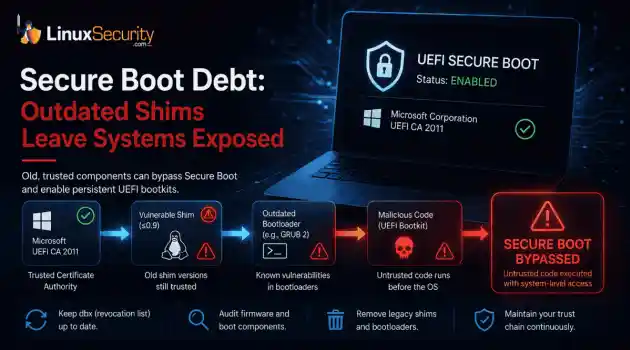
security advisory linux distribution ESET researchers identified 11 old and forgotten Linux UEFI shim bootloaders at versions 0.9 and below that can be used to bypass UEFI Secure Boot on any UEFI-based machine that trusts Microsoft’s Microsoft Corporation UEFI CA 2011 third-party certificate authority, regardless of the installed operating system (OS). Reported shims can be exploited to execute untrusted code during system boot, enabling attackers to deploy malicious UEFI bootkits even on systems with UEFI Secure Boot enabled.....
Jul 16, 2026
 Refine news
X Clear Filters
Get the latest News and Insights
Get the latest Linux and open source security news straight to your inbox.
Community Poll
Is continuous patching actually viable?
Loading...
Explore Latest Linux Security news
We found 185 articles for you...
74
 intrusion detectionsecurity risksbest practices
Intrusion Detection System Auto Response Risks and Best Practices
An intrusion detection system can identify suspicious activity. Once an alert is generated, a decision has to be made. The alert can be logged, escalated, or used to trigger some form of response. Each option carries different levels of risk, and acting too quickly can be as damaging as not acting at all. This is the space where post-detection response decisions are made. . Response feels like the logical next step. In practice, it introduces operational complexity, trust issues, and failure modes that detection alone does not. What Happens After an IDS Detects a Threat Detection has already occurred. An alert exists from intrusion detection systems (IDS) . Nothing has been blocked yet. What follows is a decision. After detection, response workflows introduce operational risk: An alert forces a choice: log it, escalate it, or respond Not every detection is accurate or actionable Automatic response is where most IDS failures occur Response is optional by design. Treating every alert as something that must trigger action is how response logic causes outages instead of stopping attacks. A common example illustrates the problem. An IDS flags unusual outbound traffic from a server late at night. No traffic has been blocked. The activity could be data exfiltration, or it could be a scheduled backup. Automatically responding could disrupt legitimate operations. Ignoring the alert could allow malicious activity to continue. This gap between seeing activity and acting on it is well established in research on post-detection response , which is treated as a distinct and complex phase rather than an extension of detection alone. What Happens After Detection: Alerting and Response Detection is already complete. Post-detection workflows begin only once an alert exists. Detection: Activity has been observed and classified. This step is finished before any response is considered. Alerting: The system records the event or notifies operators. Alerting createsvisibility. It does not mitigate risk. Response: Action may be taken automatically or deferred. This is where intrusion detection methods, after detection, introduce enforcement, and where intrusion detection's active response creates the highest potential for failure. Follow-up: Human review or downstream systems validate the alert, contain the issue, or dismiss it. Problems arise when these steps are collapsed. Treating alerting as prevention shifts decision-making into automation and removes context. This separation between visibility and mitigation is a core principle in work on intrusion response systems , where response is treated as a distinct post-detection phase rather than an extension of alerting. IDS Alerting vs Blocking: What’s the Difference? Alerting and blocking get lumped together because they sit close in the workflow. Operationally, they are distinct actions with different blast radii. Action Blast Radius Risk of Outage Best Use Case Alerting None Zero Low-confidence or high-noise signals Shunning Localized Medium Known-bad scanners or repeat sources Session Reset Session-only Low–Medium Disrupting active misuse Firewall Rule Network-wide High High-confidence, critical events Deception None Low High-value targets with unclear attribution Alerting provides visibility. Blocking intervenes. Confusing the two is how IDS deployments drift into enforcement without the controls that enforcement requires. IDS Alerting (Low Risk, High Confidence) Alerting records and surfaces activity without changing traffic flow. It is passive by design. Events are logged for review and correlation Notifications are sent to analysts or SOC tooling Alerts feed workflows without enforcing decisions This is where intrusion detection active response is least dangerous. Mistakes create noise, not outages. IDS Blocking (High Risk, High Consequence) Blocking changes system behavior. Traffic is interrupted based on the detection output. Network traffic may be dropped or redirected Access can be denied to users or services Active sessions may be terminated mid-stream At this point, intrusion detection active response becomes enforcement. Detection errors turn into user impact, broken services, or self-inflicted denial of service. Alerting scales safely. Blocking scales failure. Automated IDS Response Techniques Used After Detection Automated response is where intrusion detection's active response moves from observation into intervention. These techniques are applied only after an alert exists and are often triggered without human review. The mechanics vary. The risk profile does not. Shunning (Temporary Source Blocking) Shunning applies short-lived blocks to sources associated with an alert. Enforcement is usually limited by time, protocol, or scope, and is often carried out through external controls. The approach looks contained, but the failure modes are familiar. IP addresses are reused. Source information can be spoofed. Legitimate traffic can be caught in the same net. What starts as a narrow response can turn into collateral damage. Connection Resets and Session Termination Some systems attempt to disrupt active communication rather than block future traffic. This is typically done by forcing connection resets or tearing down sessions in progress. These actions do not stop attacks. They attempt to interrupt them. Success depends on timing, protocol behavior, and whether both endpoints honor the termination. Partial resets and failed teardowns are common, leaving attackers connected while operators assume the issue is contained. Deceptive Response (Redirection and Decoys) Deceptive response avoids blocking entirely. Instead of denying access,suspicious activity is redirected to controlled decoy environments. This approach limits the blast radius. Legitimate users are not interrupted, and production traffic is left untouched. When confidence is low, but visibility is valuable, deception allowsa response without enforcement. Deception works best when attribution is unclear, and outages are unacceptable. It trades interruption for intelligence, which is often the safer option. Firewall Integration After IDS Alerts In more aggressive setups, IDS alerts trigger rule changes in firewalls or other enforcement systems. Detection output is translated directly into access control. This is where intrusion detection active response methods carry the highest risk. Detection errors become enforcement errors. Delays, synchronization issues, and unreliable control paths all compound the problem. Once rules are pushed, rollback and accountability become operational concerns, not theoretical ones. How these response techniques are implemented depends on IDS deployment and configuration. Why Automated IDS Response Can Fail Automated response breaks when the detection output is treated as truth. Alerts are signals, not verdicts. Acting on them without friction turns uncertainty into impact. False positives stop being a tuning issue once enforcement is attached. A noisy signature that only generates alerts wastes time. The same signature tied to a response can block traffic, reset sessions, or cut off users. IDS false positives scale damage fast. In most enterprise environments, the majority of IDS alerts never represent a real compromise. When the response is automated, that noise turns into action. The cost imbalance matters. A missed alert may or may not become a breach. A self-inflicted outage causes immediate loss due to downtime, operational disruption, and SLA breaches. This asymmetry is why human review remains part of the response, even in mature programs. Spoofing pushes this further. If response logic trusts sourceattributes that can be forged, an attacker doesn’t need access to your network. They just need your IDS to react. Blocking based on spoofed packets is an easy way to cause a self-inflicted denial-of-service. Not every detection should ever trigger a response. Some signatures are meant for visibility. Others work in aggregate but fail at the event level. Ignoring trust boundaries between detection and enforcement is where intrusion detection response risks show up in production. These failure patterns are well documented in work on automated intrusion response risks , where false positives, spoofing, and over-automation consistently undermine otherwise effective detection. When IDS Should Not Respond Automatically Automatic response is not a default. In many environments, it’s the wrong move. There are clear cases where IDS should stop at alerting and hand off to a human. These are situations where confidence is low, impact is high, or attribution can’t be trusted. Automating response here increases IDS active response risks without reducing attacker capability. Common examples include: High-volume, low-confidence alerts Noise scales faster than accuracy. Automating response just amplifies false decisions. Easily spoofed traffic If source identity can’t be trusted, response logic can be turned against you. Internet-facing services with shared dependencies Blocking one signal can break unrelated users, applications, or upstream services. These cases reinforce why a human-in-the-loop still matters. Judgment, context, and awareness of downstream impact don’t compress well into rules. Newer detection models attempt to reduce noise and improve confidence, but even modern IDS approaches don’t eliminate the need for restraint. Automation may get better. The risk tradeoff doesn’t disappear. IDS vs IPS: Why Automated Response Changes the Security Model Detection and prevention are often discussed together. Operationally, they serve different roles. The distinction is straightforward: IDS provides visibility and detection IPS performs inline enforcement and prevention Automated response collapses this boundary and pulls detection closer to IDS and intrusion prevention systems behavior, even when the deployment was never designed for inline control. When an IDS starts blocking traffic or terminating sessions, it inherits enforcement risks without enforcement guarantees. Latency, fail-open behavior, and traffic integrity become concerns, even though the system was built for observation. This shift matters. Adding response to detection changes trust boundaries, failure modes, and accountability. It moves the system from visibility into control, whether that was intended or not. Operational Risks of IDS Active Response Active response adds moving parts to systems that were built to observe, not enforce. The risk isn’t theoretical. It shows up in timing, reliability, and ownership. Latency and race conditions are common. Alerts fire faster than enforcement channels can react, or arrive out of order. A response that lands late can miss the window entirely or hit the wrong target. At scale, these edge cases stop being rare. Enforcement paths also fail. Firewalls, controllers, and external systems don’t always respond when asked or respond partially. When the response is automated, there’s no pause to verify whether the action actually took effect. IDS operational risk grows when detection assumes enforcement succeeded. Change control is another pressure point. Automated actions modify live systems without the guardrails used for planned changes. Rollback is often manual, slow, or undefined. When automation fails, accountability becomes unclear, which is where intrusion detection response risks turn into organizational ones. Best Practices for Using IDS Response Safely Safe use of response starts with restraint. Alerting should be the default. Blocking should be the exception. Automation is mostdefensible when it’s limited to narrow conditions: High-confidence events with a consistent signal High-impact incidents where delay clearly increases damage Scenarios with low spoofing and attribution risk Even then, the response must be easy to disable. Systems change, traffic patterns shift, and yesterday’s safe automation can become today’s outage trigger. IDS active response best practices favor reversibility over speed. Takeaway: Detection Is Not Prevention IDS works best as a decision-support system. It provides visibility, context, and early warning. It does not provide control. Automated response trades speed for certainty. Acting faster often means acting with less context. When response logic is poorly designed, it increases risk instead of reducing it, even if detection quality is high. Detection and prevention serve different roles. Blurring them without intent or safeguards turns a visibility tool into an unreliable control point. Detection should inform decisions, not replace them. . Understand the complexities of IDS active response, risks involved and best practices to implement for effective security measures.. Intrusion Detection System, Automated Response, Security Risks, IDS Best Practices, Alert Response. . MaK Ulac
 Feb 02, 2026
•
Feb 02, 2026
• Network Security
83
 security risksuser data protectiongame hacking
Tackling Game Hacking: Security Risks Affecting Linux Gamers
Game hacking has become a pervasive issue in the gaming industry, testing notions of fairness and redefining how gamers engage with their favorite titles. Despite major advances in security, hackers stay one step ahead, exploiting every flaw. . Linux users have considerably bigger stakes. Linux, known for its flexibility and open-source nature, provides unparalleled customization while leaving the door open for attackers. Hackers have taken advantage of this openness, posing a unique challenge to gamers desiring both freedom and security. The intersection of game hacking and Linux raises pressing questions about fairness, data protection, and the safety of digital systems—questions that demand urgent attention in an increasingly vulnerable gaming landscape. The Competitive Impact of Game Hacking Considering the real impression of the game, cheating results in a significant decrease in the number of competition members in online games, which is the main concern. One tactic hackers have invented is using cheats such as aimbots, wallhacks, and script tools, which enable them to gain non-existent and unfair abilities to other players. Consequently, they do not feel as good as they are. Do not think that cheating occurs only in matches; it also infects your daily game, like the CS2 wallhack command . The map hack allows players to see through walls and thus improves their play. Any of these practices will lose players’ interest and, consequently, their revenue. In addition to the increasing number of competitive tricks, game players have to spend technical funds on measures like anti-cheat software updates, which can be one of the main causes of perishable yields. Risks to User Data and System Integrity Game hacking on Linux has its own set of issues. Most cheats and hacking tools are distributed through shady websites or obscure forums, creating a breeding ground for cybersecurity nightmares. The catch? Those showy tools that promise an advantage in your favorite gamefrequently contain nasty surprises—keyloggers, ransomware, spyware, you name it. And, despite the fact that these concerns are well-known, many gamers ignore them, believing that they will not be affected. However, as Linux gaming platforms such as Steam Proton gain popularity, hackers are taking note. The consequences of a single bad download can be devastating: stolen personal information, depleted bank accounts, and even outright identity theft. It's a steep price to pay for a swift win. Case Studies of Major Security Breaches Some memorable cyber attacks are the following: Steam Database Breach (2011): A hacker accessed Valve's Steam database, and hundreds of thousands of user accounts were compromised by this attack; sensitive financial data was exposed during the process. Riot Games Security Breach (2023): The external resource of the cybersecurity systems of Riot Games , a company responsible for many successful games, got infiltrated by hackers, resulting in updates being delayed and the revelation of some in-game codes that could put a negative impact on the company itself. Ubisoft Source Code Leak (2022): Unauthorized persons gained access to the source code of the piece, leading to their leakage, thereby revealing the company’s new intellectual property to uneducated persons. CD Projekt Red Hack (2021): Internal data theft, including the "Cyberpunk 2077" and "The Witcher 3" game source codes, along with the issuance of significant warrants, has left an indelible mark on the company's credibility and finances. These breaches are a classic case of the worst possible security lapses through game hacking and exploitation. Community and Developer Response Gaming industry players and developers are on the front lines in the battle against unauthorized intrusion. Software developers are adding security technologies like Valve Anti-Cheat , which uses efficient in-game checks and other anti-cheat systems to identify and ban hackers. They also constantlyconfigure systems and develop community report tools. Their usual actions are to ban players or send warnings. On the other hand, the gaming community takes different measures to prevent unauthorized use, such as free servers , regular updates, communication with developer management, and so on—Out-of-source developers who do their bit by creating a tighter security environment. Developers should also form partnerships with cybersecurity firms and law enforcement agencies. The measures undertaken within the entire industry, including Microsoft's Gaming Security Initiative, are meant to develop safe digital entertainment systems and cardless payments and mitigate hack incidents to the minimum level. Practical Advice for Linux Gamers One way to protect your computer is to download games and programs only from trusted sources. This might include ensuring that you do not download items that are not legal or pose a threat to your system. Get Games and Software from Trusted Sources: An example of such a platform is the Steam store. Utilize Strong & Uncommon Passwords: 2FA is a great way to increase the security of your account by requiring a second form of identification before you can log in to the service. Antivirus Safety for Linux: Linux is a very tough nut to break, but malware can also infect it. Therefore, it is important to have a good antivirus tool on the system. Keep System & Games Updated: Many security threats are known among developers, and users are usually advised to keep their systems up to date to prevent malware that takes advantage of those vulnerabilities from being installed and working. Terms and Conditions Are Unenforceable: People who are currently having fun with cheating are not concerned about the future potential downsides of using mods and trainers. A cyber-savvy gamer can also shield against threats by, for example, turning on the firewall and configuring the settings in their Linux distribution. VPN providers can then provide theprivacy layer with additional security by not only hiding an IP address but also encrypting data over networks. One of the results of the mentioned actions is the involvement of the participant in safer and more enjoyable gameplay, which in turn leads to fewer security breaches in Linux platforms. Wrapping Up: Securing Linux Gaming Against Hackers Game hacking, especially in systems with Linux, is a looming threat to fairness and security in gaming. Though positive in many aspects, the openness of Linux invites weaknesses that hackers can use to their advantage. Unchecked hacking has wide ramifications, which range from impacts on competition to serious hazards such as the theft of personal data and financial losses. These threats can be mitigated by incorporating advanced security systems, community attention, and practical safety measures. The collaboration between developers, cybersecurity professionals, and players will be required in order to make gaming safer. Gamers can have the flexibility of Linux without sacrificing security by giving priority to secure practices such as obtaining software exclusively from reputable sources and keeping computers up to date. Finally, protection of the gaming space requires cooperation that balances innovation and personalization with safety in general. . Uncover the distinct hurdles encountered by Linux gamers when it comes to game modification, while delving into strategies for safeguarding their systems.. Linux Game Hacking, Secure Gaming Linux, Cybersecurity Challenges, Game Integrity Protection, Linux User Privacy. . MaK Ulac
Dec 13, 2024
•
Hacks/Cracks

78
 security advisorysecurity risksLinux distribution
Zorin OS 17.1 Analysis: App Compatibility Insights and Security Risks
Zorin OS 17.1 , the latest release of the Linux distribution, aims to streamline the process of running Windows applications on a Linux system. By combining the Wine compatibility layer with the Bottles application , Zorin OS offers a user-friendly solution for Linux admins, infosec professionals, and sysadmins looking to harness the benefits of Linux while still enjoying their essential Windows apps. . This article critically analyzes the implications of this development, highlighting its potential long-term consequences for security practitioners. What Is the Significance of the Zorin OS 17.1 Release? A critical advantage that Zorin OS 17.1 offers is its ease of use for installing and running Windows apps on Linux. It has gained a reputation for being the most straightforward Linux distro for installing and using Windows apps. The distro includes multiple desktop layouts and plenty of pre-installed apps so you can be productive immediately. These benefits resonate with users who have struggled with complex compatibility layers and command-line tools to run Windows software on Linux distributions. The integration of Wine and Bottles is a significant development that simplifies running Windows apps on Linux. Bottles, by employing environments that encapsulate settings, libraries, and dependencies, streamline the installation and management of Windows applications. What Are the Security Implications of This Release? From a security standpoint, this release raises important questions about the implications of running Windows apps on Linux. While running Windows apps on Linux can provide security and reliability advantages over the Windows platform, it also raises concerns about the potential vulnerabilities introduced by compatibility layers like Wine. As security practitioners, it is crucial to consider the long-term consequences of using such tools and assess whether they compromise the overall security posture of the system. Furthermore, Zorin OS 17.1's expanded database fordetecting installer files for popular Windows apps must be considered. While this may facilitate the availability of alternative Linux applications, it also raises concerns about potential malicious actors manipulating these databases to distribute compromised or malware-infected applications. As security professionals, it is essential to consider the trustworthiness and security of these curated app repositories to mitigate potential threats. Our Final Thoughts on Zorin OS 17.1 Zorin OS 17.1 presents an intriguing solution for Linux users who rely on Windows applications. Its seamless integration of Wine and Bottles simplifies the installation process and enhances user productivity. However, security practitioners must critically assess the implications and long-term consequences of using compatibility layers like Wine. The potential risks associated with running Windows apps on Linux must be carefully considered to maintain the security and integrity of the system. Nonetheless, Zorin OS 17.1's efforts to bridge the gap between Windows and Linux signify a significant step in making Linux more user-friendly and accessible to a broader range of users. You can download Zorin OS 17.1 here if you'd like to give it a try! . Zorin OS 17.1 enhances the integration of Windows applications within the Linux environment while presenting significant security challenges for its user base.. Zorin OS, Windows Apps, Compatibility Layers, Infosec. . Brittany Day
Mar 18, 2024
•
Vendors/Products
209
 malwarecybersecuritysecurity risks
IceFire Ransomware Targets Linux Networks: Rising Security Risks
IceFire has changed up its OS target in recent cyberattacks, emblematic of ransomware actors increasingly targeting Linux enterprise networks, despite the extra work involved. . In recent weeks, hackers have been deploying the "IceFire" ransomware against Linux enterprise networks, a noted shift for what was once a Windows-only malware. A report from SentinelOne published today suggests that this may represent a budding trend. Ransomware actors have been targeting Linux systems more than ever in cyberattacks in recent weeks and months, notable not least because "in comparison to Windows, Linux is more difficult to deploy ransomware against, particularly at scale," Alex Delamotte, security researcher at SentinelOne, tells Dark Reading. But why, if Linux makes their job more difficult, would ransomware actors be moving increasingly toward it? The link for this article located at Dark Reading is no longer available. . The rising focus of IceFire ransomware on Linux enterprise infrastructures poses significant security challenges.. IceFire Ransomware,Linux Cyberattacks,Enterprise Network Protection,Ransomware Trends. . Brittany Day
Mar 10, 2023
•
Security Trends
209
 open source softwaresecurity risksthreat management
Protecting Open Source Software from New and Evolving Threats
Open-source software has become the foundation of the digital economy: Estimates are that it constitutes 70 to 90% of any given piece of modern software. . But while it has many advantages — it is collaborative, evolving, flexible, cost-effective — it is also rife with vulnerabilities and other security issues both known and yet to be discovered. Given the explosion in its adoption, this poses significant risk to organizations across the board. Emerging issues are compounding longstanding, traditional vulnerabilities and licensing risks — underscoring the urgency and importance of securing open-source software (OSS) code made publicly and freely available for anyone to distribute, modify, review and share. “Recently, the open-source ecosystem has been under siege,” said David Wheeler, director of open-source supply chain security at the Linux Foundation . . Free software plays a crucial role but also poses significant security threats that require immediate action. Learn more about it here.. Open Source Security, Software Risks, Collaborative Software. . Brittany Day
Aug 22, 2022
•
Security Trends
74
 network monitoringsecurity riskscost management
Explore Key Benefits of Effective Network Monitoring Solutions
Businesses rely on their networks to stay connected and productive. When something goes wrong with the network, it can cause significant disruptions in workflow. That's why it's essential to have a network monitoring system to help you detect and fix problems before they cause any damage. This post will discuss seven key benefits of network monitoring. . Fix Issues Quicker In today's fast-paced business world, downtime is not an option. That's why it's critical to have a network monitoring solution to identify and fix issues before they cause significant disruptions quickly. In the event of an issue, network monitoring can help you quickly identify the root cause and take steps to fix it. This way, you can avoid extended periods of downtime and keep your business running smoothly. Network monitoring also enables you to prioritize incoming traffic and ensure that critical applications receive the necessary amount of attention. You can use network monitoring to ensure that your website remains responsive and doesn’t experience unexpected delays. In addition to prioritizing traffic, network monitoring can help you identify issues with your network and quickly troubleshoot any problems causing slow performance or downtime. These monitoring solutions can also identify security vulnerabilities in your network. With proper network monitoring from solutions like Charles iOS, you can capture and inspect network requests and responses on your iOS device. Set up a secure network proxy for your virtual device using charles ios that enables a developer to view all of the HTTP and SSL / HTTPS traffic between their machine and the Internet. This includes requests, responses and the HTTP headers (which contain the cookies and caching information). Improve Customer Satisfaction Network monitoring can also help businesses to improve customer satisfaction. When customers access information and resources quickly and easily, they are more likely to be satisfied with their experience. By havinga monitoring system in place, businesses can quickly resolve any issues, create a positive customer experience, and build loyalty among customers. Network monitoring provides valuable insights into customer behavior and can be used to gain a deeper understanding of their needs. With increasingly advanced customer profiling, businesses can use this data to tailor their offerings and improve the experience of every single customer. Monitor social media posts, click-throughs on company websites, and other online activities to understand what customers are saying about your brand. Monitor online reviews and comments, and view Google Analytics data to get a detailed look at your customers and their experiences. Manage Changing Networks As businesses increasingly rely on networked systems, effective network monitoring has never been greater. A good network monitoring system can provide valuable insights into network performance and identify potential problems before they cause major disruptions. Perhaps most importantly, a well-designed network monitoring system can help you manage changing networks. As your business grows and evolves, your network will inevitably change to keep pace with these changes. By constantly monitoring your network, you can quickly identify and troubleshoot any changes, ensuring that your business always has the connectivity to thrive. This allows you to make adjustments to address them before they become problems affecting your customers. If you start to notice a higher-than-normal number of connectivity issues with your network during peak business hours, it could be a sign that your equipment needs to be upgraded or replaced. You can use network monitoring to identify these issues. These can include slow speeds or high levels of network traffic, which can quickly eat up bandwidth and affect network performance. You can also use network monitoring to ensure that your network hardware is still up to date and that your network configurations are still functioning as theyshould be. Identifying Security Threats Network monitoring is a critical component of any security strategy. By constantly monitoring network activity, businesses can quickly identify potential security threats and mitigate them. In many cases, network monitoring can even help to prevent attacks before they happen. By keeping a close eye on network traffic, businesses can spot suspicious activity and prevent an attack. In addition, network monitoring can help businesses identify weaknesses in their security infrastructure and address them. By constantly monitoring their networks, businesses can ensure that they are as safe as possible from constantly changing security threats. A network monitoring system can alert when a particular IP address makes a high number of connections. This means a hacker is scanning the network looking for unpatched software or vulnerabilities. It’s also possible that a single device is using a lot of bandwidth. It could be a large file transfer or a series of large images or videos uploaded to social media. What happens when the system finds numerous connections from a single device? Possibilities are the device in question is a computer that’s part of the network. Another is that the connection is to a printer, scanner, or another piece of technology connected directly to the network. Network monitoring software can alert when a device makes many connections. The system can also alert when a device makes connections to IP addresses that aren’t in the company’s network. This could indicate that the device is infected with malware or that it’s been compromised by hackers. Increase Efficiency In any organization, efficiency is key to success. Network monitoring helps ensure that essential networked systems are running smoothly and efficiently by tracking performance in real-time and providing alerts when issues arise. This proactive approach can help identify and fix problems before they cause significant downtime or impact productivity. One ofthe key benefits of network monitoring is that it can help to increase efficiency. By tracking the performance of individual devices and systems, issues can be identified and addressed quickly. Network monitoring can also provide valuable insights into resource usage. By understanding how network resources are being utilized, businesses can optimize their infrastructure to improve performance and reduce costs. End users can also be monitored to ensure they perform their tasks properly and within the allotted bandwidth. Software and hardware administrators can also be tracked to ensure maintenance tasks are performed. Network monitoring software allows administrators to receive real-time alerts when thresholds are met, such as when a given server’s memory usage exceeds a specific limit. Hardware administrators can also be alerted when a server needs to be rebooted or replaced, making it easy to avoid outages due to hardware failure. Monitoring Solutions Reduce Costs With constant monitoring of your network, you can quickly identify and resolve any issues. This reduces downtime and helps to avoid potential disruptions, but it can also save your company money. In many cases, simply being aware of a problem and having the ability to fix it quickly can be the difference between a minor issue and a major disaster. As a result, you can reduce costs and improve your bottom line. Monitoring Solutions Help to Maintain Compliance with Regulations In today's business environment, it is vital to be aware of and meet the requirements of any applicable regulations. For example, the Health Insurance Portability and Accountability Act (HIPAA) requires businesses that handle protected health information to implement security measures. Network monitoring can help you ensure compliance with these regulations. Keeping a close eye on your network can help you identify potential issues before they become problems. This will help you avoid penalties and other consequences associated with non-compliance. Network monitoring provides several essential benefits to the smooth running of your business. By identifying and addressing issues early, you can avoid costly downtime and data loss. Implementing a network monitoring solution is one of the best ways to protect your organization from malicious attacks and ensure that your systems function optimally. Final Thoughts on the Benefits of Network Monitoring Having a network monitoring system in place is crucial to organizations as it helps to detect and fix problems before there’s an opportunity to cause damage. A more efficient system can be achieved by gaining insight into the performance of the network, which in turn lowers costs while simultaneously increasing customer satisfaction. By implementing network monitoring your business will proactively solve problems before they negatively impact users. . Elevate efficiency and reduce expenses through optimized network oversight. Swiftly identify problems and improve user experience.. Network Monitoring Benefits, Performance Management, Security Strategies. . Brittany Day
Jun 10, 2022
•
Network Security
79
security risksopen source securitysoftware supply chainGoogle's Package Analysis Initiative Focuses on Mitigating Risks
The Google and OpenSSF Package Analysis project aims to reduce security risks created by developers' crazy package-updating schedules. . Google has detailed some of the work done to find malicious code packages that have been sneaked into bigger open-source software projects. The Package Analysis Project is one of the software supply chain initiatives from the the Linux Foundation's Open Source Security Foundation (OpenSSF) that should help automate the process of identifying malicious packages distributed on popular package repositories, such as npm for JavaScript and PyPl for Python. It runs a dynamic analysis of all packages uploaded to popular open-source repositories. It aims to provide data about common types of malicious packages and inform those working on open-source software supply chain security about how best to improve it. . Microsoft has outlined initiatives aimed at detecting harmful software components covertly integrated into community-driven applications.. Open Source Security, Google Package Analysis, Malicious Code Detection. . LinuxSecurity.com Team
May 05, 2022
•
Security Projects
209
security riskssoftware governancesoftware supply chainHow An Open Source Program Office Secures The Software Supply Chain
Learn how an open source program office (OSPO) - a bureau of open source experts within your organization dedicated to overseeing how your company uses, creates and contributes to free software - could helps secure your software supply chain. . It’s nearly impossible these days to build software without using open source code. But all that free software carries additional security risks. Organizations grapple with how best to secure their open source software supply chain . But there’s another problem: Many companies don’t even know how many open source applications they have — or what’s in them. The worst-case scenarios include debacles like 2021’s Log4j security vulnerability , or what happened with SolarWinds ’ proprietary Orion network monitoring product, which was infected with malware in 2020. . An open source program office (OSPO) enhances security in your software supply chain by standardizing evaluations and fostering security awareness among developers. Open Source Program Office, Software Security, Risk Management. . Brittany Day
Mar 11, 2022
•
Security Trends

Get the latest News and Insights
Get the latest Linux and open source security news straight to your inbox.
Community Poll
Is continuous patching actually viable?
Search Topics
Powered By

Linux Security - Your source for Top Linux News, Advisories, HOWTOs and Feature Releases
QUICK LINKS
subscribe to newsletters!
Like staying secure? So do we.
Sign up for updates, tips, and alerts!