Explore top 10 tips to secure your open-source projects now. Read More
×



Server Security data privacy automation
data privacy automation Every system admin has lived through the same Monday morning ritual. A queue of forty tickets, half of them password resets, permission errors, or disk space warnings that any experienced technician could resolve in under two minutes. The other half require actual judgment. For years, automation promised that software would eventually sort the two apart on its own. That promise is now being tested in production Linux environments. . Early results are reshaping how IT teams think about tier-1...
 Jul 17, 2026

Privacydata collection automation
data collection automation You're running a web scraping project to collect pricing data from e-commerce sites. You set up a pool of datacenter proxies, launch your scripts, and within minutes — banned . CAPTCHAs everywhere. Your data pipeline stops before it really begins. . It's a frustrating scenario that plays out daily in ad verification, market research, and multi-account management. The website doesn't know you're doing legitimate research or monitoring. It just sees traffic coming from IP ranges it recognizes as...
Jul 17, 2026

Security Trends security advisory social engineering
security advisory social engineering Business Email Compromise used to be a numbers game — mass-blasted emails, broken English, an obvious "URGENT WIRE TRANSFER" subject line. That era is over. Generative AI has turned BEC into a tailored, low-noise operation that mimics writing style, voice, and even video presence. This piece looks at what's actually changed under the hood, what defenders are testing in response, and why so many organizations are still structurally unprepared for it. . The Infrastructure Problem Nobody Wants to...
Jul 17, 2026

Security Trends cybersecurity Linux documentation
cybersecurity Linux documentation Linux operating systems have gained prominence due to their stability, adaptability, and excellent security options. In the case of developing documentation, designing cybersecurity dashboards, or educational material, visuals are of vital importance when it comes to making things clear. The use of icons allows one to understand the message regarding alerts, authorization, encryption, authentication, or the state of the system just by looking at the visual cue without having to read long...
Jul 17, 2026
Security Vulnerabilities security advisory linux distribution
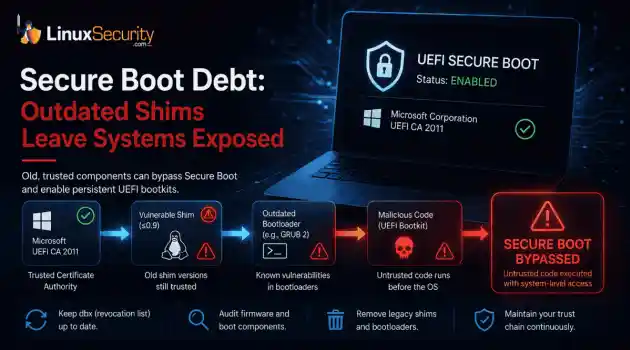
security advisory linux distribution ESET researchers identified 11 old and forgotten Linux UEFI shim bootloaders at versions 0.9 and below that can be used to bypass UEFI Secure Boot on any UEFI-based machine that trusts Microsoft’s Microsoft Corporation UEFI CA 2011 third-party certificate authority, regardless of the installed operating system (OS). Reported shims can be exploited to execute untrusted code during system boot, enabling attackers to deploy malicious UEFI bootkits even on systems with UEFI Secure Boot enabled.....
Jul 16, 2026
 Refine news
X Clear Filters
Get the latest News and Insights
Get the latest Linux and open source security news straight to your inbox.
Community Poll
Is continuous patching actually viable?
Loading...
Explore Latest Linux Security news
We found 36 articles for you...
210
 security advisorycriticalvulnerability
Oracle Linux 2025: April Critical Security Update Advisory RHSA-2025:0011-1
If you're managing an Oracle Linux system, you're well aware that vigilance is essential for staying ahead of adversaries looking to exploit unpatched vulnerabilities. Thankfully, in its April 2025 Critical Patch Update (CPU), Oracle has fixed 48 vulnerabilities that, if left unaddressed, could leave our systems vulnerable to server infiltration, privilege escalation, and the exposure of sensitive network protocols, among other risks. . These vulnerabilities range in severity, including some with high CVSS scores that carry significant potential risks. From kernel-level bugs to third-party software flaws integrated into Oracle Linux, the update addresses complex attack vectors that require thoughtful and immediate mitigations. Let’s explore the implications of the bugs fixed in this update, the urgency of applying these patches, and how we can navigate the task efficiently to secure our systems against these dangerous flaws. Understanding the Scope of This Update Oracle's April update stands out from typical patch drops in that it assesses vulnerabilities across Oracle Linux's codebase and third-party dependencies. These areas are often overlooked but can be just as vulnerable to exploitation by attackers who use these weak points to infiltrate servers, escalate privileges, or execute code arbitrarily. Oracle has shown its dedication to staying ahead of potential threats by identifying and fixing 48 new issues. However, we admins still bear responsibility for acting swiftly and updating our systems to take advantage of these bug fixes. This CPU is essential due to its breadth. Some vulnerabilities patched this month affect core functionalities, representing potential threats to enterprise systems. These include kernel security flaws and exposed network protocols . We must prioritize applying these updates to maintain system integrity and close critical security gaps. Addressing Third-Party Integration Challenges Oracle Linux admins know the importance of monitoringvulnerabilities in third-party software, especially external libraries, and dependencies that integrate into the Oracle ecosystem. Many vulnerabilities identified through routine auditing processes may go undetected due to the inherent functionality and performance requirements of these integrated components, creating risks that may escape our notice. When reviewing third-party component fixes, we often encounter challenges, including assessing compatibility and testing the performance impact of patches. Admins should validate their deployments as part of proactive planning to mitigate friction and downtime during patch rollouts. Test environments are key tools in finding potential conflicts or disruptions during rollout. The Importance of Staying On Actively Supported Versions Oracle's April update highlights the importance of operating systems that remain under active support cycles. Unsupported Oracle Linux versions no longer receive security patches and updates, leaving critical vulnerabilities exposed to attackers. Organizations running legacy systems frequently cite compatibility or resource concerns as justification for postponing upgrades; however, these concerns pale in comparison to the risks posed by unsupported software. Admins should assess their environments proactively by identifying pathways to migrate workloads to supported versions of Oracle Linux. By doing this, we ensure that future patch updates apply seamlessly and remove potential blind spots in our security posture. Practical Tips for Applying the Patch Patching is more than just an IT task — it's part of an overall cybersecurity strategy and requires thoughtful preparation and consideration. Deploying an Oracle CPU often requires scheduling downtime windows for testing, identifying vulnerable assets, and then communicating with teams to ensure a smooth implementation. Administrators should review Oracle's release notes for this update to familiarize themselves with all identified vulnerabilities, theirseverity levels, and the components they affect. Complex or clustered environments often benefit from taking an incremental approach when patching systems. Begin by patching test environments first to assess system behavior and identify any compatibility issues, then roll out updates to critical production systems during their scheduled maintenance windows. Note that patches do not replace more extensive security measures. While CPUs help target specific vulnerabilities, administrators should prioritize defense-in-depth strategies, such as network segmentation, secure access controls, and regular audits, to maximize risk mitigation even when patches cannot be applied instantly. A well-rounded approach ensures that even in instances when patches cannot be deployed immediately, risks are minimized within your organization. LinuxSecurity has put together a helpful guide on how to update and upgrade your Linux distribution so you can benefit from the latest security fixes, such as these recent Oracle Linux patches. Examining The Road Ahead for Oracle Linux Security As we review and apply April's Critical Patch Update, we must keep the larger picture in mind when making decisions about system protection. Patching should never be considered a one-time event but an ongoing cycle of prevention. By staying alert when reviewing each CPU and system version and pairing fixes with deeper security strategies, we can ensure strong defenses against emerging threats. Oracle's April CPU highlights the complexity of modern Linux-based systems, including vulnerabilities, third-party integrations, unpatched systems, and the associated risks. We, admins tasked with safeguarding our organizations, must navigate these challenges while meeting operational demands. Applying patches isn't just fulfilling a checklist; it helps secure your environment against the latest risks to your systems and sensitive data! . Oracle Linux's April 2025 CPU addresses critical vulnerabilities, highlighting the importance ofswift patching for security integrity.. Oracle Linux April CPU, critical patch update, Linux vulnerabilities, patch management guidance. . Brittany Day
 Apr 29, 2025
•
Apr 29, 2025
• Security Vulnerabilities
77
 access controlsecurity best practicesserver security
Securing Linux: Addressing Malware Risks and Enhancing Server Protection
In this digital age, Linux servers face unprecedented challenges posed by cyber threats. These, in turn, introduce new vulnerabilities that system administrators must address. Traditionally considered a more secure environment compared to other operating systems such as Windows or macOS, Linux is presently under attack from malware strains of different types and sophisticated attack vectors. . In this article, I’ll provide a comprehensive overview of the existing Linux security landscape, the vectors that expose Linux servers to attacks, and the significance of Arch Linux security updates , delivering actionable insights to help you enhance your server security strategy. Understanding the Evolving Linux Threat Landscape Traditionally, Linux users have enjoyed relative security, as many believed malware and computer viruses targeted mainly proprietary operating systems. However, as cybercriminals have become more intelligent, Linux servers have been considered one of the most profitable targets. IBM reports that malware targeting Linux has increased. Linux malware strains such as Cloud Snooper, EvilGnome, HiddenWasp, QNAPCrypt, GonnaCry, FBOT, and Tycoon have been revealed. This type of malware employs new techniques to hide its presence and infect servers, thus being highly disruptive. Th e CISA i ndicates that Linux servers have become easy targets for attacks. It showed that about 70% of web servers run on Linux and are, therefore, open to attacks by hackers. In addition, Forbes reported that about 45% of all Linux vulnerabilities were exploited in the wild. According to a study by the Ponemon Institute, the average data breach cost reached an astonishing $4.45 million in 2023, again underscoring the financial consequences of security complacency. These numbers directly correlate with an uptick in targeted attacks against Linux systems and reinforce the importance of solid security investments within organizations. How Secure Is Linux? Linux offers even greater securitybenefits in the face of increasing threats than proprietary operating systems. Because of its open-source code, thousands of programmers and safety experts continuously check and watch it. The results of such combined vigilance include quickly locating and patching weak points versus the often sluggish and non-transparent ways of patching closed-source software. One of Linux's strong selling points is its strict privilege model for the user, which severely restricts root and thus minimizes unauthorized access and privilege escalation. The operating system has a set of default defenses , including packet filtering kernel firewalls, firmware verification via UEFI Secure Boot configuration using the Linux Kernel Lockdown, and Mandatory Access Control systems such as SELinux and AppArmor. This helps increase security by controlling how programs interact with each other and the rest of the system. While these features provide a strong defense, the Linux system is still vulnerable to misconfigurations and poor service management. For example, services configured incorrectly or with default settings introduce vulnerabilities that cybercriminals can easily leverage. This demands that all users adopt positive habits that establish security properly in their environments since inherent features alone cannot guarantee good security. Best Methods Securing Linux Servers Against Modern Threats Administrators should ensure that various best practices are followed to maximize the security of Linux systems in the present environment. First and foremost, systems should be updated regularly. The FBI highly encourages patching any known vulnerabilities as quickly as possible against foreign threat actors targeting them. Attackers tend to attack systems with known vulnerabilities rather than trying zero-day exploits, which are much harder to breach. Therefore, this may enable administrators to remain up-to-date with the latest security advisories for their distribution using platforms like LinuxSecurity.com ,giving timely updates. Another good strategy for increased control over resource access on a Linux system is implementing SELinux . SELinux is an extremely powerful, highly granular mandatory access control system that confines access by default based on a defined policy extending well beyond traditional discretionary access control systems. For example, a Web browser has no reason to access an SSH key. SELinux would deny such access in that case, reducing the attack surface area. Network hardening ensures an imposing defense system against the Linux servers. Firewalls must be configured to allow or block incoming and outgoing traffic based on predefined security rules by implementing command-line utilities like iptables and Firewalld. Network intrusion detection systems can be set up to identify suspicious activities running within network traffic where potential intrusions could occur. Snort and Suricata provide real-time traffic analysis, alerting the administrator of impending dangers. Virtual Private Networks (VPNs) are highly advantageous for safely accessing other servers. T hey keep sensitive data encrypted and private. Access controls make it easy to disallow unauthorized access. The principle of least privilege (PoLP) simply requires that a user be granted no more permissions than necessary to perform their job functions. Similarly, user accounts and permissions are reviewed periodically to ensure conformance to security policies, minimizing the danger of insider threats. Multi-factor authentication (MFA) further improves login security by allowing a user who wants to access resources to prove his identity using two or more verification factors. System logs should be monitored regarding events indicating a potential security breach. The administrator must enable log management solutions to make log data collection and analysis easier. Log data could be visualized and analyzed effectively using tools such as the ELK Stack , which comprises Elasticsearch, Logstash, and Kibana.Besides, regular audits of the system configuration settings and users' activities will enable one to find and eliminate security gaps before malicious intrusion may take advantage of them. Various security tools can be added to harden a Linux server. While Linux is a relatively secure operating system from traditional malware, antivirus solutions like ClamAV help find known attacks and prevent them from propagating. With the recent use of containerization with Docker and Kubernetes, it is also paramount to implement container security measures. Routine scanning for vulnerabilities with tools like OpenVAS and Nessus will also help to identify security threats before they are exploited. Examining The Importance of Cyber Hygiene Cyber hygiene is one of the most critical aspects of securing a Linux server. This implies regular user and staff education regarding the latest phishing tactics and social engineering attacks. Training sessions and phishing exercises could power such awareness. Encourage the use of strong, unique passwords and the periodic changing of the passwords. Yes, it is possible to remember complex passwords through password managers. Further, all software, including third-party applications, should be updated and patched against known vulnerabilities to limit attack exposure. This can be automated using Ansible or Puppet so that the potential for human error is minimized and security protocols are followed. Our Final Thoughts on Securing Linux Servers in 2024 Excellent ways to further secure Linux systems are using mechanisms like SELinux, performing strict patch management, monitoring them constantly, controlling access, and educating users. By understanding and addressing current threats, organizations can safeguard their Linux systems against ever-evolving cyber risks, ensuring the integrity and availability of critical assets. . To enhance Linux server security against evolving cyber threats, adopt a multi-layered strategy that includesaccess controls, firewalls, and continuous updates. Linux Security Best Practices, Malware Targeting Linux, Network Hardening Techniques, Access Control Methods. . Brittany Day
Oct 25, 2024
•
Server Security

77
 access controlserver securitylog management
Enhancing Linux Server Security: Tips for Administrators
In the current threat landscape, Linux servers have emerged as a dominant force, underpinning approximately 81% of all websites globally. Despite the prevalence of Windows in personal computing, Linux's resilience to various threats is a significant factor behind its extensive adoption, particularly in web hosting and enterprise environments. . However, the notion that Linux is impervious to malware is a misconception that can lead to dire security oversights. As a Linux administrator, understanding how to safeguard your systems and implement Linux kernel security patches is crucial—not just against direct attacks but also against the vulnerabilities posed by networked devices running different operating systems. Let's examine the Linux security paradigm and some practical strategies you can employ to boost Linux server security. Understanding the Linux Server Security Paradigm It is imperative to recognize that while Linux servers boast a robust security posture, they are not immune to the complexities of cybersecurity threats. Malware , including ransomware and stealthy rootkits, poses a real risk. Ransomware attacks targeting Linux have been on the rise, particularly impacting major institutions where software updates and security protocols may lag due to their size and complexity. This situation is exacerbated by cryptocurrency miners, which can stealthily exploit server resources, significantly degrading performance while remaining undetected. Moreover, rootkits represent a sophisticated category of malware that requires kernel-level access. These malicious tools manipulate system calls and logs, concealing their presence and actions from standard detection methods. To combat such advanced threats, Linux administrators must employ specialized detection tools like Chkrootkit or rkhunter and implement strict kernel integrity checks. Regularly monitoring critical files and configurations for unauthorized changes is essential for maintaining a secure server environment. TheRole of Antivirus in Linux Server Security Given that most of the internet operates on Linux servers, the potential attack surface for malicious actors is alarmingly expansive. One fundamental layer of defense is the integration of antivirus solutions. While Linux environments are generally more secure, the need for antivirus software arises from the reality of user behavior. Just as a life vest serves as a precaution for a boater, antivirus software provides a safety net for administrators against human error. Handling sensitive data necessitates an elevated level of security, particularly in light of stringent regulatory requirements that many organizations must adhere to today. An effective antivirus solution is not merely a reactive measure but a proactive strategy that helps mitigate the risks associated with human error and external threats. Implementing Best Practices for Enhanced Security The security of Linux servers hinges on a multi-faceted approach. Key strategies include controlling access, hardening credentials, and establishing centralized log management. Each component plays a critical role in fortifying your server against potential threats. Implementing robust strategies can help administrators enhance server security and safeguard sensitive information. We'll delve into critical areas such as controlling access, hardening credentials, establishing centralized log management, utilizing antivirus solutions, employing detection tools, securing exposed services, and maintaining up-to-date software. Control Access The principle of least privilege is foundational to securing any server environment. This principle asserts that users should be granted only those permissions necessary to perform their job functions. Administrators can significantly reduce the risk of unauthorized access by implementing strict user roles and permissions. Each user should have a set of permissions that aligns with their specific responsibilities, limiting their ability to access sensitive data orcritical system components. Administrators should establish a role-based access control (RBAC) model to facilitate effective access control. This model allows for creating user groups with defined permissions, streamlining the management process. For example, a web developer may require access to specific directories and files to deploy applications. At the same time, a system administrator would need broader access for maintenance and updates. By clearly delineating these roles, administrators can minimize the potential for human error and ensure that users are not inadvertently granted excessive permissions. Furthermore, regularly auditing user accounts and access levels is vital. Periodic reviews can help identify inconsistencies or outdated accounts that pose security risks. For instance, employees who leave the organization or change roles may retain access to critical systems if their permissions are not promptly adjusted. Implementing automated tools to manage and review access controls can enhance the efficiency and accuracy of this process. Harden Credentials In an age of increasingly common data breaches, it is crucial to utilize strong and unique passwords for all accounts. Weak passwords remain one of the most exploited vulnerabilities in cybersecurity. Therefore, administrators should enforce a password policy that mandates the use of complex passwords—those that include a mix of uppercase and lowercase letters, numbers, and special characters. Furthermore, these passwords should be unique for each account to prevent a breach in one system from compromising others. Implementing multi-factor authentication (MFA ) is essential to further enhance security. MFA requires users to provide additional verification, such as a one-time code sent to their mobile device alongside their password. This added layer of security significantly reduces the likelihood of unauthorized access, as even if a password is compromised, the attacker would still need a second form ofverification. Establish Centralized Log Management Centralized log management is a vital component of an effective security strategy. Administrators can gain a comprehensive view of server activity by consolidating logs from various systems and applications. This centralized approach facilitates the early detection of suspicious behavior, enabling prompt response to potential threats. Implementing a centralized logging system allows for real-time monitoring of activities across the server infrastructure. For instance, if an unauthorized login attempt occurs, the system can immediately alert administrators, enabling them to investigate the incident swiftly. Moreover, centralized log management aids in compliance with regulatory requirements, as it provides a clear audit trail of user actions and system changes. Utilize Antivirus Solutions While Linux systems are generally perceived as more secure than their counterparts, the integration of robust antivirus solutions remains essential. Antivirus software is a first line of defense against external threats and internal mistakes. Even though Linux is less susceptible to viruses than other operating systems, malware and other malicious software are still a concern. Selecting the right antivirus solution involves evaluating features such as real-time scanning, regular updates, and comprehensive threat detection capabilities. Administrators should choose software that is specifically designed for Linux environments, as these solutions will be better equipped to identify and mitigate threats unique to the platform. Employ Detection Tools Detection tools play a critical role in identifying anomalies within server systems. By implementing regular scans and real-time monitoring, administrators can significantly enhance their ability to respond to threats promptly. These tools can flag unusual activities, such as unexpected changes to critical files or configurations, which may indicate a security breach. Various detection tools areavailable, including intrusion detection systems (IDS) and host-based intrusion detection systems (HIDS) . IDS monitors network traffic for suspicious activity, while HIDS focuses on detecting threats at the host level. Administrators can create a layered defense strategy that provides comprehensive visibility into their server environments by deploying both types of systems. Secure Exposed Services With the increasing connectivity of services accessible from the internet, ensuring their secure configuration is paramount. Any exposed service, whether it be a web server, database, or application, can serve as a potential entry point for attackers. Therefore, administrators must implement strict security measures to protect these services from unauthorized access. This includes regularly updating and patching software to close potential vulnerabilities. Outdated software is one of the most common targets for attackers, as known vulnerabilities can be easily exploited. Administrators can significantly reduce the risk of successful attacks by establishing a routine for applying updates. Furthermore, leveraging tools such as automated patch management systems can streamline the update process, ensuring that critical patches are applied promptly. Keep Software Updated Maintaining up-to-date software is an integral part of any comprehensive security strategy. Regular updates provide new features and patch known vulnerabilities that malicious actors could exploit. Administrators should establish a routine for consistently applying updates, ensuring that system software and applications are current. To facilitate this process, organizations can implement automated update mechanisms where feasible. Automated updates can help alleviate the burden on administrators, ensuring that critical updates are applied without delay. However, balancing automation and manual oversight is essential, as some updates may require testing in a staging environment before deployment to productionsystems. Maintain Robust Cyber Hygiene Cyber hygiene practices form the foundation of a secure operational environment. Utilizing strong passwords, regularly updating software, exercising caution when clicking links, and activating multi-factor authentication are basic yet effective strategies. These measures are crucial for individual users and organizations, enhancing overall security posture and resilience against cyber threats. The Need for Continuous Education and Awareness The evolving nature of cyber threats necessitates that Linux administrators remain vigilant and informed . Continuous education on emerging threats, security patches, and best practices is vital. Organizations should foster a culture of security awareness, ensuring that all personnel understand the importance of cybersecurity measures and their role in maintaining a secure environment. As administrators implement these strategies, they must also stay abreast of the latest security patches and kernel updates provided by the Linux community. Keeping systems current with the latest patches is critical to closing vulnerabilities attackers may exploit. Our Final Thoughts on Enhancing Linux Server Security While Linux servers provide a resilient backbone for much of today’s digital infrastructure, they are not immune to threats. A comprehensive security approach that includes antivirus solutions, proactive monitoring, and adherence to best practices is essential for future-proofing Linux servers against advanced and emerging threats. . Understanding Linux server security is crucial for administrators to defend against threats and implement robust protection measures.. Linux Server Security, Antivirus Solutions, Access Control Best Practices, Cyber Hygiene Techniques. . Brittany Day
Oct 03, 2024
•
Server Security
82
 incident responsecyber attackransomware
Chilean Government Agency Ransomware Attack: Virtual Machines Compromised
Chile's national computer security and incident response team (CSIRT) has announced that a ransomware attack has impacted operations and online services of a government agency in the country. . The attack started on Thursday, August 25, targeting Microsoft and VMware ESXi servers operated by the agency. The hackers stopped all running virtual machines and encrypted their files, appending the ".crypt" filename extension. . A cybercriminal incident affected a governmental organization's virtual systems in Chile, commencing on August 25.. Chilean Government, Server Security, Cybersecurity Incident, Virtual Machine Attack. . Brittany Day
Sep 30, 2022
•
Government
83
 ransomwarecyber threatserver security
Cheers Ransomware Threatens VMware ESXi Server Security
A new ransomware named ‘Cheers’ has appeared in the cybercrime space and has started its operations by targeting vulnerable VMware ESXi servers. . VMware ESXi is a virtualization platform commonly used by large organizations worldwide, so encrypting them typically causes severe disruption to a business’ operations. We have seen many ransomware groups targeting the VMware ESXi platform in the past, with the most recent additions being LockBit and Hive . . Bravo ransomware seeks out VMware ESXi systems, causing operational disturbances for businesses through encryption hazards.. VMware ESXi, Cheers Ransomware, Linux Malware, Cybersecurity Threats. . LinuxSecurity.com Team
May 26, 2022
•
Hacks/Cracks
77
 network protectionsecurity enhancementopen source tools
Enhancing Linux Server Security With Top Open-Source Tools for 2022
Learn about 10 great open-source tools to improve the security of your Linux servers heading into 2022. . Since I started learning about computers I have heard many experienced users saying Linux is impenetrable, Linux offers the best security, and such. It is partly true that Linux offers various security measures which mitigate attacks and stop hackers from breaching your system network. But you should also understand that just by deploying Linux on your server or PC you are not done yet, you have to configure all the necessary tools and apps. As the security features are not enabled by default, and if you are scared of network breaches and security leaks, then this should be the first thing you should be doing after installing the Linux OS. Remember your security system always depends on the tools you use, it’s the tools’ features that sniff out any malware in the system, prevent security breaches from happening, and find out vulnerabilities to deploy countermeasures. In short, the cybersecurity for a network or terminal is based on the tools, not on the default security measures of the OS. . Uncover powerful freely available solutions to enhance the protection of your Linux server during the year 2022.. Linux Server Security, Open Source Tools, Cybersecurity Solutions. . LinuxSecurity.com Team
Dec 22, 2021
•
Server Security
78
 network threatsserver securityLinux protection
Microsoft Defender Enhances Linux Security with New EDR Capabilities
Microsoft Defender for Linux - Microsoft's server-based Linux protection program - is now offering a public preview of improved endpoint detection and response (EDR) features. . I know it's still hard for some of you to wrap your minds around it, but Microsoft really does support Linux these days. A case in point: Back in June, Microsoft released Microsoft Defender Advanced Threat Protection (ATP) for Linux for general use . Now, Microsoft has improved the Linux version of Defender, by adding a public preview of endpoint detection and response (EDR) capabilities . This is still not a version of Microsoft Defender you can run on a standalone Linux desktop. Its primary job remains to protect Linux servers from server and network threats. If you want protection for your standalone desktop, use such programs as ClamAV or Sophos Antivirus for Linux. The link for this article located at ZDNet is no longer available. . Red Hat Insights introduces advanced analytics tools, providing predictive capabilities to bolster cloud security and streamline operational efficiency.. Microsoft Defender, Linux Security, Endpoint Protection, Server Threats. . LinuxSecurity.com Team
Nov 18, 2020
•
Vendors/Products
77
 encryptionmalwareransomware
New Lilu Ransomware Compromises Linux Servers With File Encryption
Researchers have identified a new strain of ransomware (Lilu) targeting Linux-based servers. Get the details in this article: . Thousands of web servers have been infected and had their files encrypted by a new strain of ransomware named Lilocked (or Lilu). Infections have been happening since mid-July, and have intensified in the past two weeks, ZDNet has learned. Based on current evidence, the Lilocked ransomware appears to target Linux-based systems only. The link for this article located at ZDNet is no longer available. . A fresh variant of malware is compromising numerous data centers, locking away information on chosen Unix platforms.. Linux Server Threats, Ransomware Attacks, Lilocked Malware, Encryption Risks, Cybersecurity Awareness. . LinuxSecurity.com Team
Sep 09, 2019
•
Server Security

Get the latest News and Insights
Get the latest Linux and open source security news straight to your inbox.
Community Poll
Is continuous patching actually viable?
Search Topics
Powered By

Linux Security - Your source for Top Linux News, Advisories, HOWTOs and Feature Releases
QUICK LINKS
subscribe to newsletters!
Like staying secure? So do we.
Sign up for updates, tips, and alerts!