Explore top 10 tips to secure your open-source projects now. Read More
×


Security Vulnerabilities  security advisory linux distribution
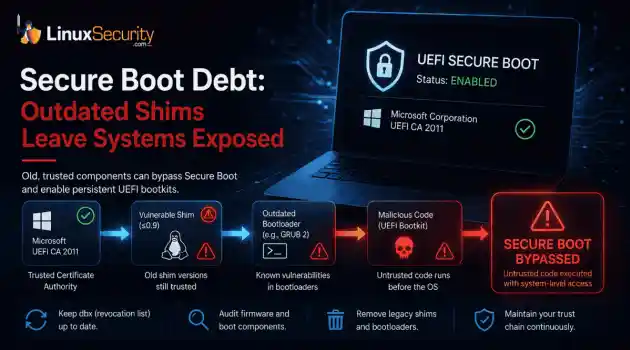
security advisory linux distribution ESET researchers identified 11 old and forgotten Linux UEFI shim bootloaders at versions 0.9 and below that can be used to bypass UEFI Secure Boot on any UEFI-based machine that trusts Microsoft’s Microsoft Corporation UEFI CA 2011 third-party certificate authority, regardless of the installed operating system (OS). Reported shims can be exploited to execute untrusted code during system boot, enabling attackers to deploy malicious UEFI bootkits even on systems with UEFI Secure Boot enabled.....
 Jul 16, 2026

Server Securitysecurity measures sysadmin practices
security measures sysadmin practices Proxies are a standard component of a Linux administrator's toolbox. You can use them to see how services respond in various locations, to run route monitoring checks, and to retrieve public data for internal tooling. However, a proxy is an outbound tunnel with credentials attached, and on a multi-user server, it is a security risk that should be treated with the same caution as SSH or sudo. This post explains the practical measures that prevent a proxy setup from becoming a weak point in an...
Jul 16, 2026

Security Vulnerabilities security advisory Red Hat
security advisory Red Hat Before the week gets away from you, take a look at what's landed across the Linux ecosystem. The volume of security advisories hasn't slowed, and while not every update demands an emergency maintenance window, several deserve to move to the top of your patch queue. This week's updates span the kernel, remote desktop infrastructure, VPNs, containers, browsers, and the utilities Linux systems quietly depend on every day. Individually, these look routine. Together they show how quickly attackers...
Jul 15, 2026
Security Vulnerabilities security research open-source
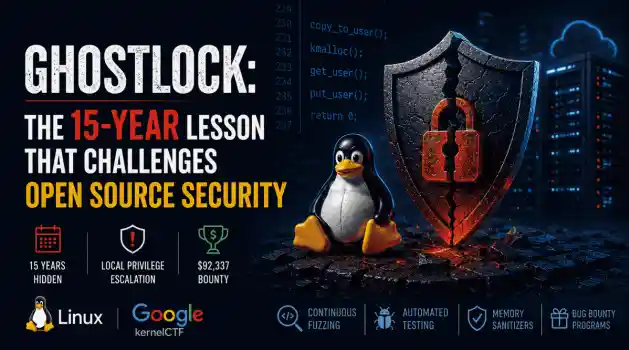
security research open-source When researchers announced GhostLock, many people focused on the exploit. What stood out to me wasn't just what the vulnerability could do, but how long it had remained hidden. The flaw had lived in the Linux kernel for roughly 15 years before it was publicly identified by researchers. That means the flaw survived hundreds of kernel releases and years of upstream development before it was publicly documented. It raises an uncomfortable question about one of open source's oldest assumptions....
Jul 14, 2026

Network Securitynetwork protection system hardening
network protection system hardening Spin up a fresh Linux VPS with default settings and check /var/log/auth.log ninety seconds later. There will already be failed login attempts — not dozens, hundreds, sometimes before the deployment script has even finished running. . Automated bots scan the entire IPv4 address space non-stop, and port 22 with password authentication open is exactly what they're looking for. Most cloud providers have seen enough of this that a new instance gets its first probe within a minute of going live....
Jul 13, 2026
 Refine news
X Clear Filters
Get the latest News and Insights
Get the latest Linux and open source security news straight to your inbox.
Community Poll
Is continuous patching actually viable?
Loading...
Explore Latest Linux Security news
We found 34 articles for you...
81
 data encryptioninternet safetyvpn
Top Free VPNs for Linux: Enhance Privacy and Bypass Restrictions
Linux is famous for its strong security. Yet, adding a Virtual Private Network (VPN) boosts privacy even more. A VPN encrypts connections and protects data. This is essential for accessing restricted content, avoiding censorship, or keeping activities private and secure. With privacy concerns growing, choosing the right VPN for your Linux system is key to staying safe online. Let's review the best free VPNs for Linux by comparing their compatibility, features, and limits. Importance of Using a VPN on Linux Privacy and Security Benefits Encryption: A VPN creates a secure tunnel between your device and its server, keeping data safe from hackers, ISPs, and prying eyes. It’s crucial for Linux users who work with servers or sensitive data. Protection from Threats: Linux faces fewer malware attacks than Windows or macOS but isn't safe. Threats like phishing and data theft are real. Using public Wi-Fi makes you vulnerable. A VPN encrypts your data and hides your online identity, reducing these risks. Stopping Data Collection: Data is valuable. Websites often track users for ads. Linux users might use ad blockers or privacy browsers. A VPN adds extra protection by hiding your IP and location, preventing targeted ads and tracking. Secure Work: For Linux users in development or tech, secure file sharing and remote work are key. A VPN protects files and data, crucial for corporate or personal information. Geographical Restrictions Accessing Region-Locked Content: Streaming services like Netflix and Hulu limit access to content based on location. For example, a show might be available in the U.S. but blocked in Europe or Asia. Here, a VPN acts as a digital key. It lets you appear in another country, unlocking more content. Meanwhile, tech-savvy Linux users often adopt VPNs. They navigate the online world while keeping their connections secure. Bypassing Censorship: In some areas, governments heavily censor the internet. They might block access toYouTube, WhatsApp, or Wikipedia. Countries like China, Russia, and Iran impose strict internet rules. A VPN allows users to bypass this censorship. It routes traffic through servers in less restrictive countries. This ensures access to important information and supports free expression. Accessing Work and Educational Resources Abroad: Many professionals and students need resources tied to specific regions. This includes corporate servers, academic journals, or online courses. A VPN can mask your location, granting access to these vital resources. Criteria for Selecting a VPN for Linux Choosing a VPN for Linux needs careful thought. While there are a ton of options for Windows, Android, and iOS, which you can easily find on websites like vpnHunt.com , there are not a ton of options available for Linux. Furthermore, not all VPNs suit Linux users. They often face unique issues, like limited app support or compatibility problems. Here, we outline key factors to help you decide. Compatibility First, ensure the VPN works with Linux. Many VPNs focus on Windows and macOS, but few fully support Linux. Linux Clients: The best choice is a VPN with a Linux app. It simplifies setup and offers better integration. However, not all free VPNs have this. Others may require manual setup, which can be tough for beginners. Support for Distros: A good VPN should work with many Linux distros , like Ubuntu and Fedora . Some providers offer guides for setting up VPNs on different distros, which helps less experienced users. Advanced users might prefer tweaking configurations. Command-Line vs. GUI: Many Linux users prefer terminal commands. Some VPNs offer command-line clients to this group, but others might find a GUI easier. Security and Privacy Security and privacy are crucial, especially for Linux users. Not all VPNs offer the same protection. Encryption Protocols: Look for VPNs using strong protocols like OpenVPN or WireGuard. These ensure datasafety. Logging Policies: Check the provider's logging policy. Avoid those that track or sell data. A no-logs policy is essential for privacy. Kill Switch and DNS Protection: A kill switch stops internet access if the VPN fails. DNS protection keeps browsing private. Both are vital for security-focused users. Advanced Features: Multi-hop and obfuscation features are extra benefits. They offer more security and privacy. Performance A VPN should not slow down your internet too much. Speed and Reliability: Free VPNs may have speed limits. Proton VPN is an exception, offering good speeds for free. Server Availability: More servers mean better performance. You can connect to closer servers, which speeds up your connection. Bandwidth and Data Limits: Be wary of data limits in free VPNs. Proton VPN offers unlimited data for free. TunnelBear, on the other hand, is much more limited. Usability Usability is key, especially for beginners. Installation and Setup: Some VPNs are easy to install. Others might need a manual setup. Ensure the provider offers support. User Interface: A GUI makes things easier for beginners. Some VPNs offer both command-line and GUI options . Customer Support: Free VPNs often have limited support. However, some provide basic support. Good support is crucial for troubleshooting. Customization Options: Advanced users appreciate customizable settings. Look for VPNs that allow such tweaks. Top Free VPN Options Proton VPN Compatibility: Offers a Linux client and setup guides, ideal for Linux users. Features: No data limits. Strong security with AES-256 and ChaCha20 encryption and a no-logs policy. Limitations: Free users can only access servers in a few countries. Speeds may drop during congestion. Follow this guide to learn how to install Proton VPN on linux and set it up. TunnelBear Compatibility: No Linux app, but manual setup isavailable. Features: Easy to use on Windows and macOS. Good speeds for browsing and streaming. Limitations: 2000 MB monthly cap on the free plan. Setup can be tricky for beginners. For those who aren’t familiar with the setup can follow this guide and start using TunnelBear on linux. Hotspot Shield Compatibility: Works with Fedora OS, Debian, Ubuntu, and CentOS operating systems . It is not available for free but comes with a 45-day money-back guarantee. Features: Strong encryption for secure browsing. Good speeds on the free plan. Limitations: Limited customization for Linux users. You can find all the support and installation guides on the official Hotspot Shield website. Comparison and Recommendations VPN Compatibility Features Limitations Best For Proton VPN Native Linux client No data limits, strong security Limited free servers Unlimited data, advanced users TunnelBear Manual configuration only User-friendly, decent speed 2000 MB monthly data cap Beginners, light browsing Hotspot Shield OpenVPN configuration only Strong encryption, good speed Limited Customization Moderate users, secure streaming Conclusion Enhance your online experience with a VPN on Linux—your ally in privacy and security. These virtual shields grant you access to content from around the globe. Free services like Proton VPN, TunnelBear, and Hotspot Shield lay the groundwork but come with limitations. Though free VPNs are a great starting point,they often tether you with data limits and lackluster features. For those seeking faster speeds, robust security, and dedicated support, a paid plan is worth considering. The best VPN adapts to your needs while safeguarding your privacy, ensuring your online world remains secure and accessible. . . Explore the top free VPN services for Linux users, providing secure browsing and access to restricted content with features tailored for online privacy. Linux VPN, Free VPN for Linux, Enhance Privacy Linux, VPN Options Linux. . MaK Ulac
 Jan 06, 2025
•
Jan 06, 2025
• Privacy
81
 security measuresdata encryptionlinux
Boost Linux Protection: Free VPNs for Improved Privacy and Anonymity
Linux is one of the widely used operating systems and is rapidly growing in popularity. Its robust security is a major benefit to users and organizations. Although experts acknowledge Linux as a safer alternative to Windows, the OS can be further fortified by employing a free VPN. . Using a free VPN for Linux is an excellent option for users who value privacy and online security but are also looking for cost-efficient solutions. A VPN converts an open Internet connection into an encrypted network, shielding users’ IP addresses and preserving their anonymity online. It’s important to note that free VPNs may have limitations compared to paid VPNs, such as not offering the same level of reliability, security, or customer support services. Regardless, using a free VPN for Linux can still be advantageous for several reasons, including: Enhancing online privacy and security. Encrypting your sensitive data. Disguising your actual location. Avoiding firewalls. Selecting a free VPN with strong security features like kill switches and DNS leak prevention is crucial to ensure maximum protection. Have questions about choosing a free VPN that is right for you or your business? Connect with us on X @lnxsec - we're here to help! Stay safe out there, friends! . Employing an accessible VPN on a Linux system boosts online anonymity and safeguards your data, emphasizing budget-friendly options for individuals.. Free VPN for Linux, Linux privacy solutions, Data encryption methods. . LinuxSecurity.com Team
Dec 29, 2023
•
Privacy

74
network securityopen sourceopenvpnUnderstanding WireGuard's Rise in Linux as the Leading VPN
Even the best of ideas can take their own sweet time making it into the Linux kernel. Learn how WireGuard - rather than OpenVPN or IKEv2 - made it into the Linux kernel. . Maybe someday – maybe – Zero Trust will solve many of our network security problems. But for now, if you want to make sure you don't have an eavesdropper on your network, you need a Virtual Private Network (VPN). There's only one little problem with commercial VPNs: many of them are untrustworthy . So, what can you do? Well, run your own of course is the open-source answer. And, today, your VPN of choice is Linux's built-in VPN: WireGuard. . WireGuard has quickly become the favored VPN for Linux users owing to its simplicity, speed, and robust security, making it a top choice over traditional protocols. WireGuard, Linux VPN, Open Source Security, Network Trust, Security Architecture. . Brittany Day
Dec 09, 2021
•
Network Security
67
 securitykernel upgradelinux kernel
WireGuard In Linux 5.6 Improves Performance And Simplifies Upgrades
WireGuard has finally made it into the mainline Linux kernel - meaning Dynamic Kernel Module Support (DKMS) builds will no longer be necessary, making routine kernel upgrades significantly faster! . We've been anticipating WireGuard's inclusion into the mainline Linux kernel for quite some time—but as of Sunday afternoon, it's official. Linus Torvalds released the Linux 5.6 kernel, which includes (among other things) an in-tree WireGuard. Phoronix has a great short list of the most interesting new features in the 5.6 kernel, as well as a longer "everything list" for those who want to make sure they don't miss anything. If this is the first time you're hearing about WireGuard, the TL;DR is that it's a relatively new VPN (Virtual Private Network) application that offers a leaner codebase, easier configuration, faster connect times, and the latest and most thoroughly peer-reviewed and approved encryption algorithms. You can find a more detailed introduction in our initial August 2018 coverage. . The highly anticipated integration of WireGuard into the core Linux kernel boosts efficiency and streamlines updates for those utilizing VPN services.. WireGuard VPN, Linux Kernel Integration, Network Security, VPN Application. . LinuxSecurity.com Team
Apr 06, 2020
•
Cryptography
81
 network securityobfuscationvpn
VPN Obfuscation: What It Is And How It Enhances User Privacy
We all likely heard about VPN obfuscation at this point. Over the past years, a pretty noticeable number of VPN providers started using the term on their web pages. But what exactly is it? And why should you care about it? . Here’s all you need to know about VPN obfuscation – including how it works, how to optimize it, what VPN obfuscation techniques VPN providers use, and a whole list of providers who offer it. VPN obfuscation is a technique that can hide VPN traffic. It won’t make any changes to the traffic, though – it will just use a “mask” to hide its patterns so that ISPs and governments can’t spot it. . Explore VPN obfuscation, unraveling its mechanisms, strategies, and advantages for users seeking improved privacy and protection.. VPN, Obfuscation Techniques, Network Privacy, Security Measures. . LinuxSecurity.com Team
Feb 17, 2020
•
Privacy
79
 networkingopen sourcelinux kernel
WireGuard Revolutionizes Linux VPN Infrastructure for Enhanced Connectivity
This new, long-awaited technology will change how virtual private networks work first in Linux and then the rest of the VPN world. . After years of development WireGuard , a revolutionary approach to Virtual Private Networks (VPN) was finally fast-tracked to the Linux kernel . Now, at long last, WireGuard is in Linus Torvald's code tree . That means WireGuard should appear in the Linux kernel 5.6 release. This may be as early as April 2020. This has the potential to change everything about VPNs -- not just in Linux, but in the entire VPN world. That's because essentially all VPN services run off Linux servers. Some VPN services, such as StrongVPN and Mullvad VPN , have already seen the writing on the wall and are moving their software stacks to WireGuard . The link for this article located at ZDNet is no longer available. . OpenVPN transforms secure tunneling, boosting accessibility for Windows and other platforms following extensive innovation.. WireGuard Revolution, Linux VPN Technology, Open Source Networking. . LinuxSecurity.com Team
Feb 04, 2020
•
Security Projects
67
network securityopen sourceprotocolWireGuard Merged Into Linux Kernel 5.6: Enhanced Network Security
The WireGuard VPN protocol, which is smaller, faster and easier to configure than IPsec, has been merged into Linus Torvalds' git repository for version 5.6 of the Linux kernel, the next release. . There is no set date for Linux kernel releases. Version 5.5 was released on 26 January 2020 and there is typically a couple of months between releases, so 5.6 may come in April. WireGuard in 5.6 is not a surprise. The code was merged into network maintainer Dave Miller's repository in December 2019 but not pulled in by Torvalds until today. "Linus pulled in net-next about a half hour ago. So WireGuard is now officially upstream," said the announcement on the WireGuard mailing list. WireGuard developer Jason Donenfeld shared his excitement at the news, but added: "I look forward to start refining some of [the] rougher areas of WireGuard now." The link for this article located at The Register UK is no longer available. . The WireGuard VPN protocol has been officially integrated into the Linux kernel version 5.6, offering enhanced speeds and simplified setup for its users.. WireGuard, Linux Kernel, Network Security, Open Source VPN. . LinuxSecurity.com Team
Jan 30, 2020
•
Cryptography
78
 open sourcetrustworthinesssoftware transparency
ProtonVPN Open Sources Applications for Better User Privacy and Trust
Are you a ProtonVPN user? Have you heard that ProtonVPN applications are now 100% open source? . In this age of surveillance, VPNs have become a powerful tool in safeguarding your privacy. But can you trust your VPN service provider? On more than one occasion, the VPN providers have been caught logging , snooping orsharing data with third party. What to do in such cases? I have shared a list ofin the past andProtonVPNis one of them. The good news is that ProtonVPN has just open sourced all its apps and underwent an independent security audit. The link for this article located at It'sFOSS is no longer available. . With the rise of digital monitoring, VPNs have emerged as essential resources for protecting personal data. Yet, the question remains: are they truly reliable?. ProtonVPN, Open Source Applications, Privacy Tools, Security Audit. . LinuxSecurity.com Team
Jan 23, 2020
•
Vendors/Products

Get the latest News and Insights
Get the latest Linux and open source security news straight to your inbox.
Community Poll
Is continuous patching actually viable?
Search Topics
Powered By

Linux Security - Your source for Top Linux News, Advisories, HOWTOs and Feature Releases
QUICK LINKS
subscribe to newsletters!
Like staying secure? So do we.
Sign up for updates, tips, and alerts!