Explore top 10 tips to secure your open-source projects now. Read More
×


Critical NGINX Vulnerability CVE-2026-42945: What Linux Admins Should Check Now
 May 18, 2026
•
May 18, 2026
•
 MaK Ulac
5 - 10 min read


New flaw leads to denial-of-service on affected NGINX configurations. If ASLR is disabled, it may become a remote code execution.
Known as NGINX Rift, CVE-2026-42945 affects NGINX’s ngx_http_rewrite_module and can allow unauthenticated attackers to crash worker processes with crafted requests. That matters because NGINX often sits at the edge of Linux infrastructure, handling web traffic, redirects, reverse proxy rules, API routing, load balancing, and application delivery.
The configuration requirement may look narrow at first, but active exploitation changes the urgency. Vulnerable rewrite rules can sit in production for years without anyone reviewing them closely, leaving exposed NGINX servers as more than just another routine patch item.
For Linux administrators, the immediate question is simple.
Are any internet-facing NGINX systems using risky rewrite patterns, and have they been updated through official vendor channels?
What You Need To Know
- CVE-2026-42945 affects NGINX Plus and NGINX Open Source.
- The flaw exists in the
ngx_http_rewrite_module. - The issue is tied to rewrite configurations using unnamed PCRE captures such as
$1or$2, with replacement strings that include a question mark. - An unauthenticated attacker can send crafted HTTP requests to trigger a heap buffer overflow in the NGINX worker process.
- The most likely impact is denial of service through worker crashes and restarts.
- Remote code execution may be possible in weakened environments, especially where ASLR is disabled.
- Administrators should prioritize official NGINX and vendor updates, then audit rewrite rules across internet-facing systems.
Who Should Prioritize This First
Not every NGINX server is automatically vulnerable.
The risk depends on version, configuration, exposure, and whether vulnerable rewrite logic is reachable by an attacker. Still, some environments should move faster than others.
Administrators should prioritize:
- Internet-facing NGINX servers
- Reverse proxies handling untrusted traffic
- API gateways using rewrite rules
- Kubernetes ingress deployments based on NGINX behavior
- Older virtual host configurations inherited from previous applications
- Containers or images that package NGINX directly
- Systems using unnamed capture references such as
$1or$2 - Linux systems where ASLR has been disabled
This is especially important for servers that have accumulated rewrite logic over time. Redirects, backend mappings, language routing, legacy URL support, and API path changes are often copied between systems and forgotten.
That is where risk can sit unnoticed.
Why This NGINX Flaw Matters
NGINX is everywhere in Linux environments.
It sits in front of web apps, Kubernetes ingress controllers, API gateways, cloud services, containers, and internal dashboards. In many environments, it is the first layer that handles untrusted traffic before a request ever reaches the application.
That is what makes this flaw different from a bug buried deep inside one service.
An attacker does not need shell access. They do not need stolen credentials. They do not need to reach the backend directly. If the vulnerable rewrite configuration is exposed, crafted HTTP requests may be enough to crash NGINX worker processes and disrupt availability.
In production, that could look like intermittent 502 errors, failed API calls, broken redirects, unstable ingress behavior, or repeated worker restarts. In shared reverse proxy or Kubernetes environments, one exposed traffic layer may affect several services behind it.
The second concern is how quickly bugs in edge-facing services attract attention. CVE-2026-42945 affects a widely used component and sits in rewrite logic that many teams probably have not reviewed in years. Public proof-of-concept activity has also been reported, which makes patching and configuration review harder to delay.
What Makes CVE-2026-42945 Important
The vulnerability is not triggered simply because NGINX is installed.
According to F5’s advisory, the flaw exists when a rewrite directive is followed by a rewrite, if, or set directive and an unnamed PCRE capture, such as $1 or $2, is used with a replacement string that includes a question mark. Under those conditions, crafted HTTP requests may cause a heap buffer overflow in the NGINX worker process.
That creates a practical problem for Linux teams.
Rewrite rules are often old. They are copied between servers, inherited from previous application versions, reused across reverse-proxy templates, and buried in site configs that no one has touched in years. In large environments, administrators may not immediately know which NGINX deployments use vulnerable rewrite patterns.
That delay matters in response, since the vulnerability reportedly dates back many years, meaning older, long-lived systems may be exposed if they have not been updated through vendor channels. Old configuration logic has a way of surviving infrastructure migrations.
A server might move from bare metal to the cloud. A site might move behind a load balancer. A service might become part of a containerized platform. But the rewrite rules often stay almost exactly the same.
Quick 5-Minute Check
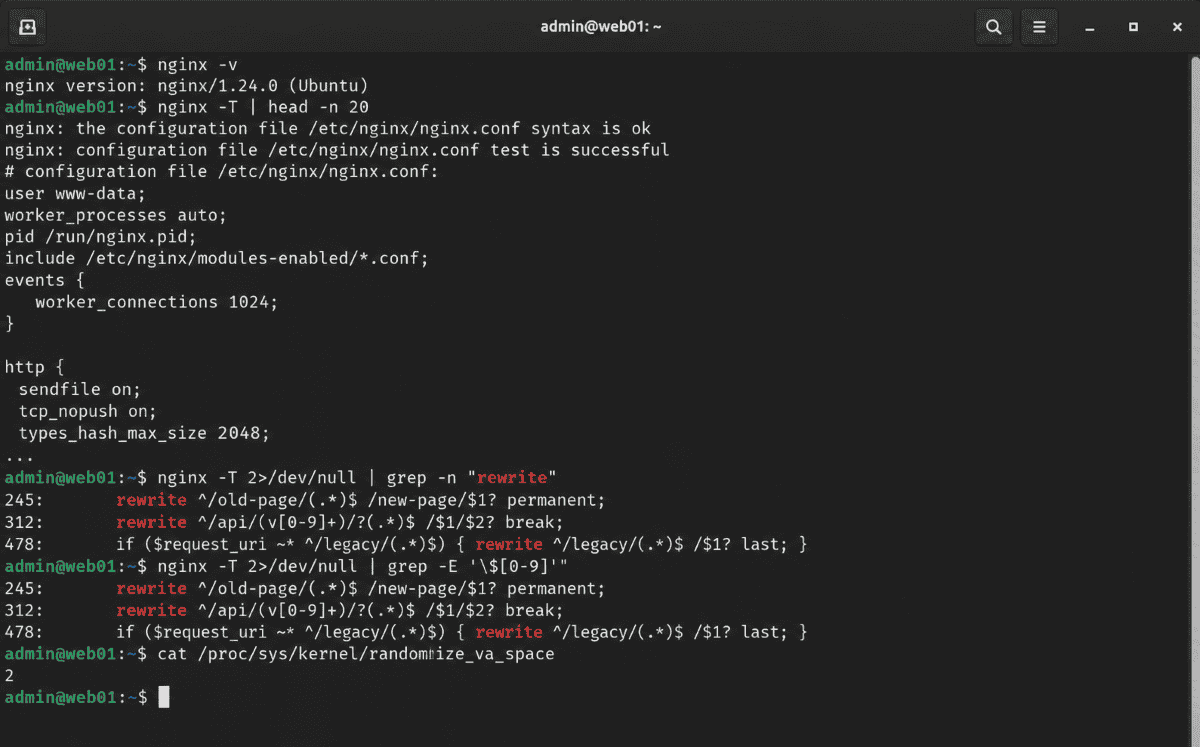
Administrators should begin by identifying where NGINX is running, especially on internet-facing Linux systems.
Check installed NGINX versions:
nginx -v
Review the active configuration:
nginx -T
Search for rewrite directives:
nginx -T 2>/dev/null | grep -n "rewrite"
Search for unnamed capture references:
nginx -T 2>/dev/null | grep -E '\$[0-9]'
Administrators should pay close attention to rewrite logic that uses captures such as $1 or $2, especially when the replacement string includes a question mark.
Additional priorities should include:
- Reviewing NGINX virtual host and site configuration files
- Checking reverse proxy and API gateway rewrite rules
- Auditing Kubernetes ingress configurations that rely on NGINX behavior
- Reviewing container images that package older NGINX versions
- Confirming whether ASLR is enabled on Linux systems
- Prioritizing externally reachable NGINX deployments first
This quick check will not replace patching, but it can help teams find the highest-risk systems faster.
Patching Is the Priority
The safest response is to update NGINX through official channels. Administrators should apply fixes from F5, NGINX, or their Linux distribution rather than manually modifying source code or relying only on partial configuration changes. Organizations should monitor advisories and package updates from:
- Red Hat
- Ubuntu
- Debian
- Fedora
- SUSE
- AlmaLinux
- Rocky Linux
- NGINX upstream sources
Cloud image and container image providers should also be checked closely. NGINX is often embedded in base images, reverse proxy containers, ingress controllers, and application delivery stacks. Updating the host operating system alone may not update every NGINX instance running across the environment.
That is where teams often miss exposure.
A patched server does not help if an older NGINX container is still deployed in production.
Temporary Mitigation Requires Configuration Review
For organizations that cannot patch immediately, configuration review becomes the next priority.
F5’s advisory indicates that the vulnerable condition involves unnamed PCRE captures in certain rewrite patterns. Some reports have recommended replacing unnamed captures, such as $1 and $2, with named captures where appropriate, but this should be tested carefully before production rollout.
Administrators should be careful here.
Rewrite rules can affect routing, redirects, authentication flows, API paths, application compatibility, SEO behavior, and backend request handling. A rushed change can break production traffic even if the security goal is valid.
The better approach is controlled review:
- Identify exposed NGINX systems
- Find rewrite rules using unnamed captures
- Map which applications depend on those rules
- Test named-capture replacements in staging
- Deploy patched NGINX packages as soon as they are available
- Monitor logs for crashes, abnormal requests, and repeated worker restarts
Temporary configuration changes can reduce exposure, but they should not become a substitute for patching.
Why ASLR Still Matters
One of the more important details in the current reporting is the difference between denial of service and code execution.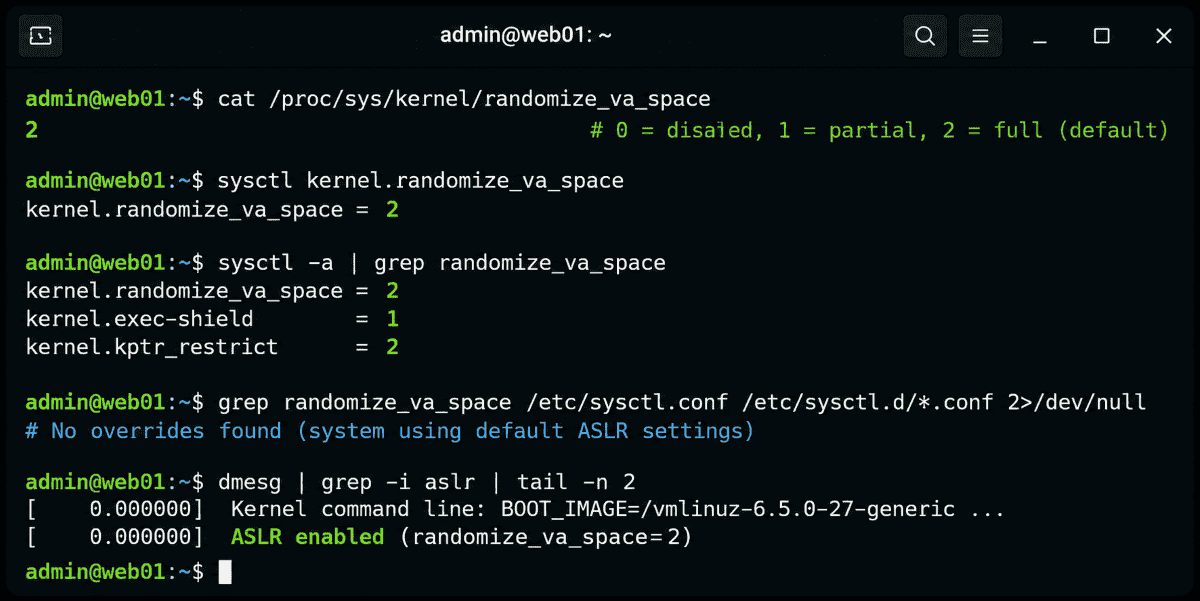
On default hardened Linux systems, the most likely impact appears to be worker process crashes and restarts. That can still be serious, especially against high-traffic services where repeated crashes can degrade availability.
But remote code execution becomes a larger concern when exploit mitigations are weakened. ASLR, or Address Space Layout Randomization, makes memory corruption exploitation harder by randomizing where code and data are loaded in memory. If ASLR is disabled, attackers may have a more reliable path from memory corruption to code execution.
Administrators can check ASLR status with:
cat /proc/sys/kernel/randomize_va_space- A value of
2generally indicates full randomization. - A value of
0means ASLR is disabled.
If ASLR is disabled on exposed Linux systems, that should be treated as a serious hardening gap beyond this one vulnerability. Memory corruption flaws become more dangerous when basic exploit mitigations are turned off.
Cloud and Kubernetes Environments Need Extra Review
This gets more complicated in cloud and Kubernetes environments.
If a vulnerable rewrite rule is exposed through an ingress controller or reverse proxy, the impact may not stop at one application. Crafted requests could repeatedly crash NGINX worker processes, trigger restarts, break routing, or affect several services sitting behind the same ingress layer.
Cloud-hosted reverse proxies and API gateways run into the same problem.
NGINX is used because it is fast, flexible, and familiar. But that flexibility is also where old risk builds up. Teams add redirects, backend mappings, path normalization, language routing, legacy URL support, and API rewrites. Then those rules get copied, reused, migrated, and forgotten.
Years later, they may still be running in production.
That is why teams should check more than just traditional Linux servers. They should also review container images, Helm charts, ingress controller configurations, CI/CD deployment templates, and cloud images that include NGINX.
Default Impact vs. Weakened-System Impact
The impact depends heavily on configuration and hardening.
|
Condition |
Likely Risk |
|
Vulnerable rewrite config exposed |
NGINX worker crash or denial of service |
|
ASLR enabled |
Exploitation is harder |
|
ASLR disabled |
Remote code execution risk may increase |
|
NGINX is used in the ingress or shared proxy layer |
Multiple services may be affected |
|
The older NGINX container is still deployed |
Host patching may not fully remove exposure |
This is why administrators should treat the issue as both a patching task and a configuration review task.
Immediate Actions for Linux Admins
- Patch affected NGINX deployments immediately.
- Audit rewrite rules using unnamed captures such as
$1and$2. - Prioritize internet-facing NGINX servers and reverse proxies.
- Check container images and Kubernetes ingress deployments.
- Confirm ASLR is enabled on exposed Linux systems.
- Monitor logs for worker crashes, abnormal requests, and restart loops.
- Review vendor advisories for updated NGINX packages.
- Test any rewrite-rule mitigation before production rollout.
Why Exposed Infrastructure Bugs Still Matter
Linux servers now sit underneath nearly every modern environment. They power web applications, containers, cloud platforms, CI/CD systems, internal tools, and customer-facing services.
Attackers know that edge services are valuable because they process untrusted traffic all day. A flaw in a public-facing web server, reverse proxy, or ingress layer can create immediate operational risk, even before attackers reach the application behind it.
CVE-2026-42945 is a reminder that mature infrastructure components still need close attention. Old code paths, legacy rewrite behavior, and inherited configuration patterns can carry risk for years.
Because in modern Linux environments, attackers do not always need to compromise the application first. Sometimes, they only need the traffic layer in front of it.
Want more Linux security breakdowns and vulnerability response checklists? Subscribe to our newsletter for weekly infrastructure, hardening, and security updates.
Related Reading
- Enhance Nginx Security With 25 Best Practices for Linux
- Linux Security in 2026 Hardening Monitoring and Defense Strategies
- Container Security Misconfigurations Kubernetes Threats
- Understanding Container Security Best Practices for Linux Admins
- The Linux Kernel in 2025: Security Enhancements, Emerging Threats & Best Practices
 PREVIOUS

 NEXT
NEXT

Powered By

Linux Security - Your source for Top Linux News, Advisories, HOWTOs and Feature Releases
QUICK LINKS
subscribe to newsletters!
Like staying secure? So do we.
Sign up for updates, tips, and alerts!