Explore top 10 tips to secure your open-source projects now. Read More
×


Evolving Linux Malware Threats: A Guide for Admins in Cloud-Native Contexts
 Jan 22, 2026
•
Jan 22, 2026
•
 Brittany Day
6 - 11 min read


For a long time, Linux malware followed a familiar pattern. A compromised host. A binary written to disk. Persistence through cron, systemd, or a quiet modification that survived reboots. If you hardened the system and watched for changes, you felt reasonably in control. That model no longer matches how Linux is actually run. Modern Linux malware increasingly assumes it is landing in environments where hosts are disposable, workloads are short-lived, and the real authority sits somewhere above the operating system.
Most Linux infrastructure today lives inside cloud and container platforms that are ephemeral and API-driven by design. Containers, Kubernetes, managed services. Linux is still there, but it is no longer the primary unit of control. That shift changes what attackers optimize for. Persistence on a single machine matters less when you can influence what gets deployed next. Early 2026 research from Check Point describes a framework called VoidLink that reflects this reality. It is not notable because it is noisy or flashy, but because it fits cloud-native environments almost too well.
VoidLink signals a broader transition in Linux malware away from host-centric techniques toward control planes, identities, and orchestration logic. It assumes images will be rebuilt and nodes will disappear. Control comes from understanding how workloads are created, scheduled, and authenticated, often through mechanisms that look legitimate on the surface. Traditional defenses still have value, but on their own, they are no longer sufficient. Understanding this shift is now part of the job for Linux administrators, because risk, visibility, and policy all move with it.
The Evolution of Linux Malware Frameworks
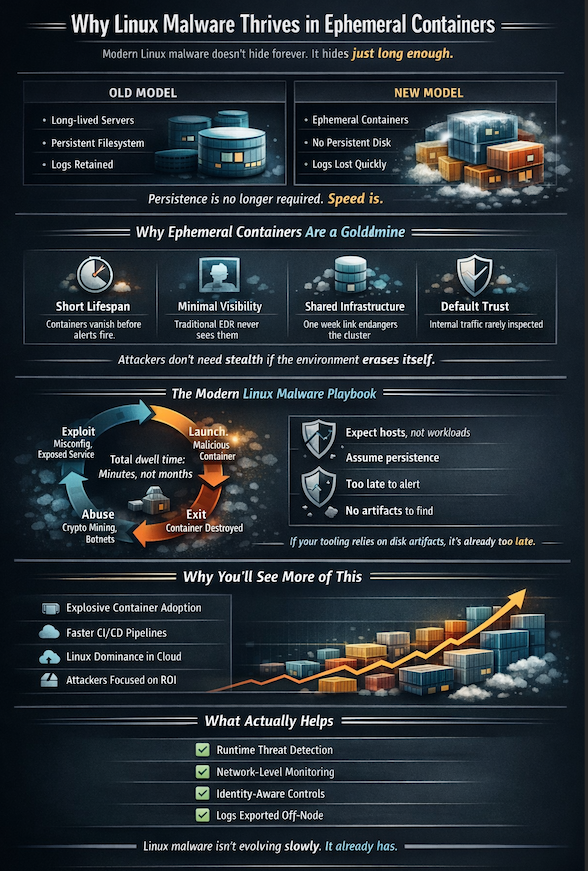 If you look back at older Linux malware, the assumptions are easy to spot. The host mattered. Machines stayed up for months or years. Persistence was the goal, and success meant surviving reboots, package upgrades, and the occasional admin poking around. Root access was the prize, because once you had it, you could stay. Most defensive guidance grew out of that world, and for a long time, it worked well enough.
Cloud and container environments quietly broke those assumptions. Hosts are no longer stable assets. Containers may exist for minutes. Images are rebuilt automatically. In that context, traditional persistence loses much of its value. You start to see Linux malware adapt by shifting its focus away from the filesystem and toward the systems that decide what runs in the first place. Control moves up the stack, toward orchestration platforms, cloud APIs, and identity systems that sit above any single node.
Modern Linux malware frameworks reflect that change in how they are built. They are modular, often split into loaders, plugins, and optional components that can be deployed only when needed. That structure looks familiar to anyone who works with microservices or cloud-native applications, and it is not an accident. Attackers now assume that orchestration layers are the real terrain. Instead of clinging to a host, they aim to influence deployment, scheduling, or identity in ways that let access reappear even as infrastructure churns. As a result, today’s Linux malware is often more flexible and quieter than what came before. For Linux administrators, this means threat modeling can no longer stop at host hardening. Cloud APIs and control planes are now part of the attack surface, whether they were designed that way or not.
Why Cloud and Container Environments Are Attractive to Attackers
Cloud and container platforms change more than how applications are deployed. They change what is visible, what is durable, and what feels normal. Containers deliberately abstract away much of the operating system, and in doing so, they also blur traditional security boundaries. Processes come and go. Filesystems reset. From the outside, it can be difficult to tell whether something unusual happened or whether the platform simply behaved as designed. That ambiguity creates room for abuse.
Centralization plays an equally important role. Kubernetes and cloud APIs concentrate enormous control behind a relatively small number of interfaces. A single service account, role, or token can influence scheduling, networking, storage, and identity across large parts of an environment. When those identities are misconfigured, lateral movement often requires no exploit at all. Access is granted by policy, not by vulnerability, and that access tends to look legitimate in logs. From an attacker’s perspective, this is far more efficient than breaking out of individual containers one by one.
Ephemeral infrastructure further tilts the balance. Workloads disappear before artifacts can be examined. Network policies are frequently permissive during early adoption and rarely revisited. CI/CD systems extend execution well beyond runtime, pulling code, building images, and deploying workloads automatically. Once you start to see how these pieces connect, the appeal becomes obvious. Container security is not just about runtime protection. It is about protecting the orchestration, identity, and control layers that decide what runs at all. For Linux administrators, that is where attention has to shift, even if the hosts themselves look quiet.
VoidLink as a Case Study in Cloud-Native Linux Malware
VoidLink is useful to study because it does not behave like a one-off Linux payload. It is a framework, built as a collection of components that can be deployed selectively depending on the environment. Researchers describe loaders, implants, rootkit-style capabilities, and extensible plugins, all designed to work together rather than as a single artifact. That structure matters. It suggests a system meant to be operated, updated, and reused, not simply dropped onto a compromised machine and forgotten.
The design choices behind VoidLink line up closely with how modern infrastructure actually runs. It is built to function across cloud providers and container platforms, including Kubernetes, Docker, and major public clouds. The codebase spans languages such as Zig, Go, and C, which points to developers comfortable with both low-level systems work and cloud-native tooling. Debug symbols left in some components indicate active development, not a finished campaign frozen in time. That detail alone changes how you think about lifecycle and intent. This is not something thrown together quickly to exploit a single weakness.
Attribution is more complicated. Analysis published so far points toward Chinese-affiliated developers, based on language artifacts and development patterns, but stops short of tying the framework to a specific organization or state actor. Intent is equally unclear. Some analysts have noted that the level of documentation, modularity, and interface design resembles a product more than a bespoke intrusion tool. That does not mean it is commercial malware in the traditional sense, but it does suggest a mindset closer to software engineering than opportunistic compromise.
For Linux administrators, the lesson is not about who wrote VoidLink, but how it was written. Malware at this level is designed, maintained, and evolved by skilled teams who understand cloud platforms as well as operators do. These are not random scripts scraped from forums. They are frameworks that assume churn, abstraction, and centralized control, and they grow more capable over time. That reality should change how risk is assessed, because it raises the baseline for what a modern Linux threat looks like.
What VoidLink Reveals About Modern Linux Attack Chains
When malware is built for cloud and container environments, the attack chain looks different from the start. Initial access often does not come from a memory corruption bug or a kernel exploit. It comes from the configuration. An exposed API, an over-permissive role, a service account that was meant to be temporary and never revisited. In cloud-native environments, access is frequently granted by design, which makes the first step of an intrusion both quieter and harder to classify as malicious.
Execution also shifts away from the idea of a single compromised host. Workloads run inside containers, scheduled jobs, or serverless tasks that are expected to appear and disappear. From the platform’s perspective, something started, did its work, and exited. Malware that operates in this space does not need to linger. What used to be called persistence is often replaced by the ability to trigger redeployment, reuse credentials, or influence orchestration so that access returns naturally as part of normal operations.
Command-and-control follows the same pattern. Instead of unusual outbound connections, communication blends into cloud service traffic and API calls that administrators expect to see. Privilege escalation targets identity rather than the kernel, focusing on IAM roles, service accounts, and tokens that can unlock broader access. When the workload is gone, so are many of the artifacts you would normally investigate. For Linux administrators, this changes what detection looks like. Files and processes still matter, but identity, behavior, and control-plane activity increasingly tell the real story.
Monitoring Gaps Linux Admins Commonly Have Today
 Many Linux environments appear quiet, not because nothing is happening, but because the right things are not being observed. Host-based monitoring still plays an important role, yet it stops at the boundary of the operating system. Control-plane actions do not show up as processes. API calls do not look like system calls. When activity shifts upward into orchestration and cloud services, traditional tools simply have nothing to say about it.
Kubernetes audit logs are a good example. They are often disabled, sampled, or retained briefly due to volume and cost. Even when they are collected, they tend to live apart from runtime telemetry, which makes it difficult to connect an API request to the workload it created. Cloud API logs suffer from the same problem. They describe what was requested, not how that request translated into execution inside a container or a node. Container lifecycle events are frequently treated as background noise because environments are already noisy by design.
Network monitoring adds another layer of false confidence. Many tools still assume relatively static endpoints and predictable traffic patterns, assumptions that do not hold in dynamic clusters. When alerts do not fire, it can feel reassuring. In practice, it often means visibility does not extend into the layers attackers now prefer. For Linux administrators, this gap matters. It is not just about missing alerts. It is about missing entire classes of activity that never touch the host in ways older tools were built to see.
How Linux Admins Should Adapt Their Security Approach
Adapting to cloud-native Linux malware does not start with adding more agents to hosts. It starts with recognizing where control actually lives. In containerized environments, the Kubernetes control plane and cloud APIs are not just management layers. They are security-critical surfaces. Decisions about what runs, under which identity, and with what network access are made there, often long before a process ever starts on a node.
That shift changes what monitoring needs to focus on. Workload creation events, scheduling decisions, and orchestration actions become as important as process execution. Cloud audit logs begin to matter more when they are correlated with what actually ran and under which service account. Least privilege takes on a more concrete meaning because overbroad roles and service accounts effectively become persistence mechanisms. Container security, in this sense, is less about catching something after it runs and more about understanding how it was allowed to run in the first place.
There is also an operational adjustment that is easy to overlook. When compromise happens at the service or identity level, it does not map cleanly to a single host or team. Detection and response require coordination between platform, operations, and security functions that may not have been tightly aligned before. Policies need to reflect that reality. They have to account for how Linux workloads are created, authorized, and redeployed, not just how they behave once they are running. For many administrators, that is the real change this new class of malware forces.
Our Final Thoughts: Decision Points for Linux Admins and Platform Teams
 Once you accept that Linux malware now operates comfortably above the host, a different set of questions starts to matter. Visibility becomes an ownership problem as much as a technical one. Someone has to decide who is responsible for seeing control-plane activity and responding to it. In many organizations, Kubernetes, cloud infrastructure, and Linux operations sit with different teams, each assuming the others are watching closely. That gap is where problems tend to settle.
Logging decisions follow quickly. Not every log can be kept forever, but some logs are no longer optional. Kubernetes audit events, cloud API calls, and identity changes start to carry the same weight that syslogs and authentication logs once did. Where detection lives also becomes less obvious. Host-based tooling still has value, but it cannot see everything. Cluster-level signals and cloud-level context often need to be part of the same picture, even if that complicates tooling and workflows.
There are tradeoffs here that cannot be avoided. More visibility can slow teams down. Tighter controls can frustrate developers and operators who are used to moving quickly. Linux administrators increasingly find themselves at the center of those discussions, translating risk into practical constraints. These are not decisions about installing another tool. They are architectural and organizational choices that shape how much control and how much uncertainty an environment is willing to live with.
 PREVIOUS

 NEXT
NEXT

Powered By

Linux Security - Your source for Top Linux News, Advisories, HOWTOs and Feature Releases
QUICK LINKS
subscribe to newsletters!
Like staying secure? So do we.
Sign up for updates, tips, and alerts!