Explore top 10 tips to secure your open-source projects now. Read More
×


Network Security Monitoring: Common Linux Monitoring Gaps That Hide Threats
 Jun 30, 2026
•
Jun 30, 2026
•
 MaK Ulac
4 - 7 min read


If you’re relying on standard network logs to protect your Linux infrastructure, you’re flying blind. Most organizations believe they have network security monitoring because they’re capturing traffic, but they’re actually just collecting noise. Real security—the kind that stops an attacker—happens in the gaps between the network, the process, and the host.
When an attacker breaches a Linux server, they rarely reach for a custom zero-day. They use what’s already there: curl, bash, python, or netcat. Because these are standard tools, traditional monitoring platforms see the traffic as "authorized" and let it sail right through. To stop this, stop looking at logs in silos. You have to correlate the network flow with the specific host activity that triggered it.
What Is Network Security Monitoring?
Network security monitoring is the continuous collection and analysis of network and host telemetry to identify malicious activity, investigate incidents, and detect attacks before they spread.
There’s a massive difference between keeping a server running and actually monitoring its security. If you’re just watching performance metrics or bandwidth, you’re doing basic network monitoring. Security monitoring is a forensic exercise.
During an investigation, nobody cares that a server connected to an IP address. The first thing you want to know is what made that connection. Was it SSH? Was it curl? Was it a Python process that shouldn't exist? If your monitoring can't answer those questions, you're working backward with half the evidence missing.
Key Takeaway
- Network connection: Answers where traffic went.
- Host telemetry: Answers who generated it.
- Detection engineering: Explains whether it matters.
- Effective NSM: Requires all three.
Outbound Traffic Without Process Attribution
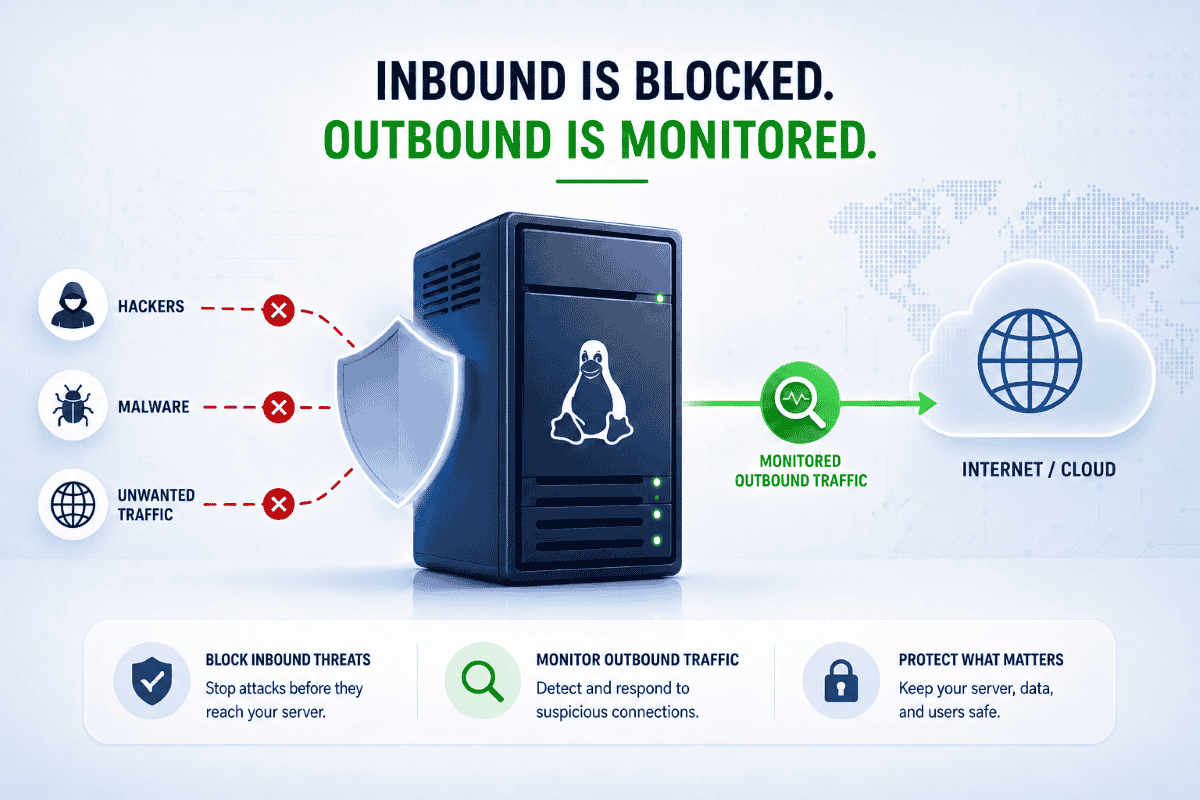
The biggest failure point is looking at an IP address without knowing the "who." If your network logs show a server reaching out to an unknown destination, but you can’t tell me exactly which process opened that socket, you’re investigating with incomplete evidence.
Attackers love this ambiguity. They can run a malicious command that blends perfectly into the background of a busy server. To close this gap, map every socket to its parent process, the command-line arguments used, and the specific user account involved. Without that lineage, you're just staring at a list of numbers.
DNS Activity Without Host Context
DNS is a goldmine for attackers, which is exactly why they abuse it for C2 beaconing, data exfiltration, or DNS tunneling. Most teams treat DNS logs as garbage data—too voluminous to store or analyze.
But if you don't know which host or container initiated that lookup, you’re blind. You need to tie DNS requests back to the source. If a database server is suddenly asking for a high-entropy domain that looks like a crypto-miner's C2, you need to know about it the second the query leaves the box.
East-West Traffic Inside Linux Environments
Traditional perimeter security is no longer sufficient for detecting internal attacker movement. Lateral movement happens via SSH, rsync, or database calls—traffic that never touches your edge firewall.
Because this traffic is internal, it’s often ignored by security teams who assume that "inside" equals "safe." In reality, this is where attackers spend the most time, pivoting from a compromised web server to a back-end database. If you aren't monitoring internal flows, you’re giving them a free pass to traverse your environment.
Encrypted Traffic That Looks Normal
Containers make investigations harder because they don't stick around. A compromised pod can start, execute a command, establish a network connection, and disappear before anyone even notices an alert.
If you're relying on logs collected after the fact, you're already behind. Runtime telemetry from tools like eBPF captures process execution and network activity while the container is still running, preserving the evidence you need before the workload disappears. That context is often the difference between understanding what happened and trying to investigate a workload that no longer exists
Containers That Disappear Before You Investigate
In a Kubernetes-heavy environment, containers are ephemeral—they spin up, do their work, and vanish. If an attacker gains execution, runs a malicious script, and the pod terminates, the evidence is often wiped from the host's standard logging.
This is why traditional agent-based logging fails. You need runtime visibility, often utilizing eBPF, to capture the system calls and network activity in real-time. You need that metadata attached to the event before the container stops existing; otherwise, you're left trying to conduct forensics on a ghost.
What Effective Linux Network Security Monitoring Looks Like
During an investigation, context is everything. A network connection without a process isn't very useful, and a process without network activity doesn't tell the whole story either. You need both. That's why effective Linux network security monitoring relies on multiple sources of telemetry that complement each other instead of trying to make one tool do everything. 
- Auditd: For recording system calls and process execution.
- eBPF: For deep, low-overhead kernel observability.
- Flow Logs: To map internal communication.
- DNS Logs: To catch C2 beaconing.
- Contextual Metadata: The glue that ties every network event to the specific workload.
How Detection Engineering Improves Monitoring
Detection engineering is how you move past the "out-of-the-box" alerts that generate nothing but noise. This is where modern NDR platforms become invaluable. They don't just alert on a connection; they correlate it, showing you the process lineage. They make it possible for an analyst to see that python was spawned by a web-server user, which then opened an outbound connection to a rare domain.
However, effective detection engineering isn't a "set it and forget it" task. It involves continuously tuning detections, eliminating false positives, incorporating new attacker techniques, and validating rules through purple-team exercises. The goal is to create alerts that analysts trust rather than ignore. Network traffic analysis is excellent at identifying communication patterns, but it becomes significantly more valuable when correlated with host telemetry that identifies the responsible process and user.
Frequently Asked Questions
What is Linux network monitoring? It's the practice of observing data flows, connections, and system-level actions within a Linux environment to detect unauthorized access.
What’s the difference between NSM and NDR? NSM is the visibility layer (the "what is happening"), while NDR (Network Detection and Response) adds the correlation and automated response needed to stop threats.
How does eBPF improve visibility? It lets you monitor the kernel and network with almost zero performance penalty—essential for high-density containers.
What is detection engineering? It's the iterative process of building and refining security rules so they are specific to your environment, cutting out the noise.
Is network traffic analysis enough to find attackers? Nope. Traffic analysis tells you where data is going, but host telemetry is required to identify who sent it and why.
Conclusion
At the end of the day, attackers aren't trying to outsmart your logs—they’re trying to hide in the gaps between them. The goal of your Linux network security monitoring shouldn't be to collect everything; it should be to create context. When you can tie a network flow to a specific user, process, and container, you take away the attacker’s ability to hide. That’s how you actually secure an environment.
Want more Linux security news, vulnerability analysis, and software supply chain updates? Subscribe to the LinuxSecurity Newsletter and get the latest threats, advisories, and expert insights delivered directly to your inbox.
 PREVIOUS

 NEXT
NEXT

Powered By

Linux Security - Your source for Top Linux News, Advisories, HOWTOs and Feature Releases
QUICK LINKS
subscribe to newsletters!
Like staying secure? So do we.
Sign up for updates, tips, and alerts!