Audit Linux privileges now to limit compromise, escalation, and system-wide damage. Review Linux Privileges×


Linux Kernel Updates Privilege Escalation Provisioning July 28 2026
 Jul 28, 2026
•
Jul 28, 2026
•
 MaK Ulac
4 - 7 min read

Topics Covered
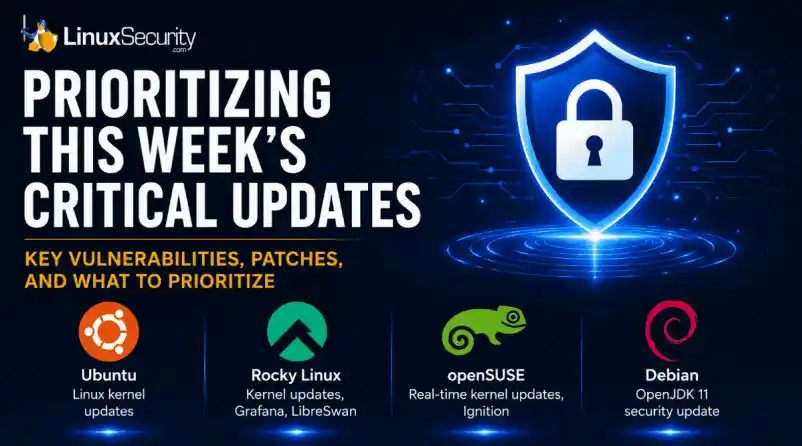
The volume of Linux security advisories remains high across enterprise distributions, but the more difficult task is determining which updates carry the broadest operational risk. Looking across this week's advisory set, one pattern stood out more than any other.
To me, the big story isn't the individual CVEs; it's how many of this week's highest-priority updates affect the systems that enforce privilege boundaries, from the kernel itself to sandboxing, provisioning systems, and externally exposed infrastructure. Viewed together, they highlight where Linux administrators should focus their attention first.
Linux Kernel Updates: Protecting the Host Boundary
The pattern that stood out most during this week's advisory review was the broad rhythm of kernel maintenance across major enterprise distributions. When multiple vendors drop kernel patches in the same cycle, it reminds us that core operating system hygiene remains non-negotiable. Kernel flaws can impact privilege boundaries, process isolation, containers, system availability, and the entire host. Because the kernel underpins every single workload you run, administrators must establish systematic ways to align patch levels across server fleets. Administrators should confirm that affected hosts have installed the applicable packages and rebooted into the updated kernel images.
Alongside core kernel maintenance, tools operating above the kernel layer also require attention. Recent Qualys research on CVE-2026-8933 highlights a high-severity local privilege escalation vulnerability in snap-confine. The flaw stems from a race condition during sandbox initialization that lets an unprivileged local user manipulate temporary directories and achieve root code execution.
CVE-2026-8933 matters because restricted local access can easily become root access, particularly in multi-user environments, developer workstations, and Ubuntu desktops where untrusted code or user-driven interactions are common. If you manage developer workstations, don't overlook this simply because it isn't affecting your production servers. Include developer workstations and shared Ubuntu desktops in the exact same disciplined maintenance process you use for core infrastructure.
- Ubuntu: Linux kernel security update USN-8609-1
- Ubuntu: Linux kernel security update USN-8619-1
- Ubuntu: Linux kernel security update USN-8574-3
- Ubuntu: Linux kernel security update USN-8618-1
- Rocky Linux: Kernel security update RLSA-2026:45192
- openSUSE: Real-time kernel security update openSUSE-2026-3316-1
Monitoring and Remote Access Infrastructure
Software exposed directly to the internet or managing critical network perimeters always demands caution because it carries disproportionate operational risk by handling sensitive control paths. This week's advisories feature key components that occupy privileged positions in enterprise architectures, such as the Rocky Linux: Grafana security update RLSA-2026:46391 and the Rocky Linux: LibreSwan security update RLSA-2026:46396. Monitoring platforms aggregate massive amounts of operational visibility, meaning security flaws here can expose internal hostnames, performance metrics, and authentication details. At the same time, VPN gateways protect remote connectivity and sit directly on the network perimeter as critical gates into internal enterprise networks.
While monitoring platforms and VPN gateways have entirely different functional roles, both act as high-value control systems. Their placement within an architecture often has a greater influence on remediation priority than the CVSS score alone. In my view, teams need to track down every externally reachable dashboard and VPN gateway across their network boundaries, restrict management interfaces, audit authentication mechanisms tightly, and patch these systems long before touching ordinary internal applications.
Provisioning Infrastructure
Provisioning software occupies an operational layer that teams often overlook until automation scales a mistake. Unlike internet-facing gateways or monitoring tools, provisioning systems like the openSUSE: Ignition security update openSUSE-2026-3300-1 are responsible for initial machine setup.
Provisioning tools establish filesystems, system users, network services, storage configurations, and startup states. A weakness or misconfiguration here can affect every single machine created from the same template or automated workflow. The risk is heavily concentrated in automated cloud deployments, container-host provisioning pipelines, and immutable infrastructure. Take a hard look at your golden images, template repositories, and automated bootstrap pipelines to make sure vulnerable versions aren't quietly reproducing risk across your entire fleet.
Enterprise Runtime Maintenance

Enterprise environments also saw updates like the Debian: OpenJDK 11 security update DLA-4702-1, highlighting the ongoing need for diligent runtime maintenance. Because Java runtimes support numerous backend applications, vulnerabilities at this layer can impact multiple services even when administrators do not manage Java as a standalone network service. However, the actual urgency depends entirely on context: which applications use the affected runtime version, whether those applications process untrusted user input, and whether they are reachable from external networks. Map runtime packages to the services that depend on them before assigning remediation priority.
What This Week Says About Linux Security
- Privilege enforcement appeared at multiple layers: The kernel and snap-confine activity show that system security depends heavily on both the operating system core and the sandboxing mechanisms built above it.
- High-value control systems deserve faster attention: Monitoring tools and VPN infrastructure can expose sensitive operational data or provide direct access routes into internal environments.
- Provisioning risk can scale across fleets: A problem in deployment tooling can be silently reproduced across every single system created from the same image or automation pipeline.
- Shared runtimes require dependency awareness: The importance of an OpenJDK update cannot be determined by the package name alone; teams need visibility into which services rely on it and how those services are exposed.
- Cross-distribution kernel activity remains operationally significant: Updates across Ubuntu, Rocky Linux, and openSUSE illustrate how upstream security maintenance flows into downstream enterprise environments.
How to Prioritize This Week’s Linux Security Updates
|
Category |
Default Priority |
Why It Comes First |
|
Externally exposed control and access infrastructure |
Highest |
These systems may be directly reachable and provide direct access to sensitive internal resources. |
|
Applicable local privilege-escalation fixes |
Highest on multi-user and workstation systems |
Restricted local access can escalate to full host compromise if left unpatched. |
|
Linux kernel updates |
Highest |
Kernel flaws can affect privilege boundaries, process isolation, containers, system availability, and the entire host. |
|
Provisioning and deployment tooling |
High |
Vulnerable automation can reproduce insecure configurations across many systems simultaneously. |
|
Monitoring platforms |
High to exposure-dependent |
Operational dashboards may reveal sensitive infrastructure data and privileged backend integrations. |
|
Shared runtimes such as OpenJDK |
Exposure-dependent |
Priority depends on the applications utilizing the runtime and whether they process untrusted input. |
Note on Risk Adjustment: An externally accessible LibreSwan gateway requires faster remediation than a kernel issue isolated to an offline test system. Likewise, snap-confine demands greater urgency on developer workstations and shared Ubuntu desktops than on systems where the affected package is unused.
Building a More Effective Linux Patching Process
This week’s Linux security updates show why effective patching begins with knowing what each system does, where it is exposed, and which other workloads depend on it. Kernel and privilege-escalation updates require fleet-wide validation and reboot verification, while VPN gateways and monitoring platforms deserve faster attention when they are reachable from external networks.
Provisioning tools and shared runtimes require a different kind of visibility because their risk can spread through images, automation pipelines, and dependent applications. Organizations that map those relationships and prioritize according to actual exposure will reduce more risk than teams that simply work down a list ordered by CVSS score.
 PREVIOUS

Powered By

Linux Security - Your source for Top Linux News, Advisories, HOWTOs and Feature Releases
QUICK LINKS
subscribe to newsletters!
Like staying secure? So do we.
Sign up for updates, tips, and alerts!