Overly broad permissions can turn one compromised account into a much larger security problem. Learn how to reduce unnecessary access, review privileges, and apply least privilege across modern Linux systems. Review Linux Privileges


Why Software Supply Chain Security Matters in Linux Systems
 Oct 01, 2025
•
Oct 01, 2025
•
 MaK Ulac
9 - 17 min read


For Linux users, software supply chain security means protecting the entire path from source to install. It covers who authors and reviews the code, how it is built, how artifacts and metadata are signed, where they are mirrored, and which keys the client trusts. In short: provenance, freshness, and scoped trust across the package pipeline.
Signatures and HTTPS are not enough. The distribution layer still introduces risk through build system breaches, website-level distribution swaps, stale or broken mirrors, mismanaged repository keys, and community repositories without strong guarantees. Each of these failures bypasses cryptography without breaking it.
We see the same patterns repeat in open source supply chain security: outdated packages served from mirrors, keys that expire or sprawl, community packages that look legitimate but were never vetted, and infrastructure that turns trusted delivery into an attack path. The problem isn’t the math. It’s the systems around it.
The fix is not “turn on HTTPS and move on.” It requires signed metadata and verifiable provenance, sane mirror freshness policies, and per-repository key isolation on the client. That is the baseline for modern software supply chain security.
Why Software Supply Chain Security Matters for Linux Users
Open source supply chain security isn’t a theoretical problem — it shapes how Linux systems run and how secure they remain for administrators, security teams, and everyday users alike.
- Admins and engineers: Stale mirrors and expired keys don’t just raise warning messages. They break deployments, block updates, and in some cases allow corrupted or even malicious packages to slip through.
- Security teams: Attackers rarely waste effort trying to break cryptography itself. They target the weak spots around it — mirrors, build systems, or community repositories — where they can bypass signatures and HTTPS without ever touching the math.
- Everyday users: A package downloaded over HTTPS and signed with a valid key can still be malicious if the repository serving it is compromised. The surface looks safe, but the content underneath isn’t.
At LinuxSecurity, we’ve seen these risks play out in real-world incidents for years. That history is what makes them so important to understand.
The following case studies show how each of these weak points has been exploited in practice.
Incidents That Shaped Open Source Supply Chain Security
Incidents span more than a decade, and they fall into two groups. From early cases like FreeBSD 2012 and Linux Mint 2016 to recent compromises, the same risks have continued to surface across Linux ecosystems.
FreeBSD 2012 Infrastructure Compromise: Build System Breach
This incident illustrates the failure mode of compromised build infrastructure. As one of the legacy cases, the 2012 FreeBSD breach demonstrated early on how fragile the build environment could be. Several package-building servers were compromised, creating the possibility that malicious code could be introduced during the build process.
According to the project’s official postmortem, the intrusion affected servers used to prepare software distributions. While signed binaries continued to be produced, the compromise showed that signatures mean little if the system generating those binaries has already been tampered with. Provenance becomes critical in open-source supply chain security, as delivery integrity cannot compensate for poisoned origins.
The takeaway is clear: provenance and build isolation are essential to any credible security model.
To us at LinuxSecurity,
The real weakness isn’t the signatures. It’s the build environment itself. Once attackers reach that layer, they can turn out validly signed malware, and every downstream control fails with it.
Some argue that identifying and disclosing such errors proves the system works. In reality, an infrastructure compromise demonstrates how brittle the trust model is when attackers reach inside the build environment itself.
FreeBSD proved that when the build system itself is poisoned, provenance collapses no matter how strong the signatures. Distribution adds a different weakness: the servers users depend on to fetch software can be turned against them. The Linux Mint hack in 2016 was the most evident proof of that.
Linux Mint Hack (2016): Distribution-Layer Compromise
Back in 2016, a major compromise showed how fragile the distribution infrastructure could be. Attackers breached the Linux Mint website and quietly replaced official ISO download links with images containing a backdoor.
The project later confirmed on its site that modified ISOs had been served directly from the distribution page. HTTPS and GPG were technically intact, but once attackers controlled the download portal, those checks offered no real protection. Trojanized ISOs spread quickly to users who believed they were following best practices. This showed how software supply chain security depends on delivery paths as much as code.
It’s tempting to write incidents like this off as rare. The reality is that every breach, no matter how isolated, maps directly to a weakness that will surface again if left unaddressed.
At LinuxSecurity, we’ve long pointed to the Mint hack as evidence that signatures can’t defend a broken delivery path. Infrastructure has to be guarded with the same rigor as the code itself.
Mint showed how delivery can be subverted after the build. XZ exposed an even deeper cut: compromise at the source, where the maintainer workflow itself became the entry point.
XZ Utils Backdoor (2024): Maintainer Workflow Compromise
In 2024, malicious code was discovered in XZ Utils versions 5.6.0 and 5.6.1, compromising the maintainer workflow. What set this attack apart was patience. The attacker spent years inside the project, sending patches and building credibility until they were treated as a trusted maintainer. 
By the time the backdoor landed, it blended in as just another update. That long game is what made the compromise so effective — the usual safeguards never triggered, because the attacker was already on the inside.
CISA confirmed the incident as CVE-2024-3094, rating it CVSS 10.0 and warning of impacts across Debian, Fedora, and Ubuntu development channels. Technical analysis later explained how the backdoor worked and why it was so dangerous: payloads persisted even when downstream container images were rebuilt, allowing the compromise to spread beyond the original packages.
HTTPS and valid signatures never failed, but software supply chain security collapsed when provenance did. With the maintainer account compromised, the backdoor entered as an “official” change, collapsing trust before cryptographic checks or delivery controls could even play a role.
Some argued the damage was limited because stable users were not affected. In reality, timing and vigilance prevented worse fallout. The lesson stands: modern compromises can emerge from trusted maintainers, and when they do, the usual assurances of signatures and HTTPS cannot contain the risk.
The XZ case was caught quickly, but discovery didn’t erase the damage. Once malicious code is released, it clings to downstream images and caches. That persistence was exactly what surfaced in 2025, when Docker Hub continued to distribute backdoored versions long after the upstream fix.
XZ Persistence in Docker Hub (2025): Downstream Amplification
The 2024 XZ backdoor didn’t disappear once patched. It carried into 2025, embedded in Docker Hub base images and derivative containers. This was the failure mode of downstream persistence, where compromised artifacts spread and linger across caches and builds long after the upstream fix.
Binarly’s report found more than 35 public Docker images still shipping the backdoored XZ Utils library, including Debian-based ones. The problem didn’t stop there — “second-order” images built on top of those bases multiplied the exposure. This isn’t mirror staleness. Container ecosystems replicate tainted binaries indefinitely, giving compromised artifacts a half-life of years, not weeks. Because these images inherit directly from upstream distributions, the weakness cascades across the ecosystem.
What persistence reveals
- Once poisoned, artifacts replicate through container bases and derivatives.
- There is no recall mechanism to purge compromised libraries.
- Risk spreads silently, infecting and building long after the upstream issue is fixed.
Persistence is one of the hardest problems in software supply chain security. Once an artifact is embedded in Docker or similar ecosystems, it doesn’t fade out quickly — it lingers. That cascading effect points to another gap in open source supply chain security: not just persistence of bad code, but the trust we extend to code that enters the ecosystem in the first place.
AUR Chaos RAT Malware (2025): Community Trust Failure
This case illustrates the failure mode of community trust. Unlike official repositories, the Arch User Repository (AUR) accepts user-submitted packages without upstream review. In 2025, several of those packages were found to deliver the Chaos RAT malware.
Malicious versions of utilities such as arch-wiki-lite and vim-patchupdate were uploaded and distributed through the AUR. The scope of the compromise was detailed in Chaos RAT in AUR, where users expecting benign tools instead installed a remote access trojan. Community reaction captured by Linuxiac reflected the ongoing debate over whether the AUR should be treated as part of the distribution or as an inherently untrusted space.
Open-source supply chain security has to account for where software originates, not just how it is transported. Some argue that AUR use is a personal choice, but package managers blur those boundaries — once a malicious package circulates, the risk spreads.
What this shows
- Community repos bypass upstream review
- Signatures only confirm delivery, not trustworthiness
- Risk spills over into the broader ecosystem
- Community repos revealed how extending trust too far can poison the ecosystem, proving once again that software supply chain security is about provenance, not just signatures.
Community repos revealed how extending trust too far can poison the ecosystem. But risk isn’t limited to the edges. Research in 2025 showed that even the official infrastructure behind Fedora and openSUSE carried exploitable flaws.
Fedora & openSUSE Build Services (2025): Modern Infra Risks
In 2025, new research exposed critical weaknesses in the infrastructure behind major Linux distributions. Investigations into Fedora’s Pagure forge and the Open Build Service (OBS) used by openSUSE revealed vulnerabilities in the very systems responsible for managing and building packages. This represents modern build and repository infrastructure risks, echoing the lessons first seen in the FreeBSD compromise of 2012.
One of the most severe findings was CVE-2024-47516, a critical argument injection vulnerability in Pagure that enabled remote code execution during repository history retrieval. At the same time, research from Fenrisk showed how the source service in OBS could be manipulated to alter package sources directly. Together, these disclosures confirmed that infrastructure-level compromises are not just historical anomalies. The same class of risk persists today, nearly identical in nature to the problems uncovered more than a decade earlier.
For software supply chain security, the implications are clear. Even if signing keys are properly managed, poisoned binaries can slip through when the systems that assemble and distribute them are insecure. Provenance collapses if attackers can compromise the build process itself.
Building infrastructure remains one of the weakest points in the Linux supply chain. Some dismissed these as proofs-of-concept, but that misses the point — if today’s core build services can be modeled as exploitable, the system is already brittle. The only variable left is timing.
Why the Same Failures Repeat Across Incidents
A decade’s worth of incidents makes the pattern clear.
|
Incident |
Weak Point |
Why Crypto Didn’t Help |
Lesson |
|
FreeBSD 2012 |
Build infra compromise |
Signed binaries were still malicious |
Even valid signatures can’t protect if the build environment itself is poisoned. |
|
Linux Mint 2016 |
Website compromised |
HTTPS and GPG were intact but irrelevant |
A trusted download site turned hostile, showing the distribution layer is as critical as the code it serves. |
|
XZ Utils 2024 |
Maintainer workflow |
Crypto verified poisoned binaries as “legit” |
Provenance collapsed when a maintainer account was abused, proving trust can fail at the source. |
|
DockerHub Persistence 2025 |
Mirrors, caches, derivatives |
Tainted images lived on after removal |
Without recall, poisoned artifacts persist and spread downstream long after the fix. |
|
AUR Chaos RAT 2025 |
Community repo trust |
Signatures delivered malware anyway |
Community repositories bypass review, proving that provenance matters as much as delivery. |
|
Fedora/OBS 2025 |
Build service flaws |
Vulnerable infrastructure could sign bad code |
Even in 2025, core build services can still be modeled as exploitable, showing how brittle the foundation remains. |
These incidents show that software supply chain security is not a problem cryptography can solve on its own. It depends on securing the entire delivery chain, from build systems and distribution sites to mirrors, caches, and community repositories.
Why Mirrors and Metadata Integrity Matter in Open Source Supply Chain Security
The last set of incidents showed how attackers plant malicious code at different points in the chain. Mirrors and metadata integrity represent a different risk. They determine whether those compromises fade quickly or linger long after the initial breach.
Fedora Metalink Freshness Checks: Freshness Enforcement
Fedora treats mirror freshness as a security control, not just an uptime concern. This is the failure mode of stale mirrors, and Fedora’s answer is to enforce “freshness” at the metadata level.
As described in the Fedora infrastructure blog, package delivery depends on repomd.xml checksums and timestamp validation. If a mirror falls out of sync, Fedora clients reject it. To users, the result looks like downtime, but the outages are a defense at work. Mirror staleness is more than an inconvenience. It is a vector for replay and rollback attacks. That’s why freshness enforcement is a core part of software supply chain security. For open-source supply chain security, keeping metadata fresh is as critical as key management.
Outages here are intentional safeguards. At LinuxSecurity, we’ve pointed out that this is exactly the kind of control missing in earlier incidents like FreeBSD’s 2012 compromise. The same risks seen more than a decade ago still shape modern infrastructure.
Some argue that mirrors are simply an availability issue. In reality, without enforced freshness, outdated packages can be replayed as if they were current, and cryptographic checks alone will not stop it.
Fedora demonstrates proactive enforcement. Debian shows the opposite, where brittle checks allow the problem to surface in practice.
Debian SecureApt: Rollback Fragility
In Debian, open-source supply chain security relies on SecureApt and its Valid-Until mechanism. This represents the failure mode of rollback fragility: protections against stale mirrors that can also lock users out when freshness checks break down.
As detailed in the Debian security manual, Release and InRelease files are signed and include a Valid-Until field. When a mirror drifts or a system clock slips, users see the familiar error: “Release file expired.” It protects against rollback but also shows how brittle the system becomes when mirrors lag.
Some argue that these errors simply prove the system is working. That is true, but it also demonstrates how fragile the trust model can be when enforcement collides with real-world infrastructure. Debian’s model shows the price of enforcing freshness when mirrors drift: security holds, but usability breaks. That tension is what pushed projects to rethink key hygiene in the years that followed.
Key Hygiene and Isolation on the Client Side
Attacks on infrastructure and mirrors show where the chain can be poisoned. Key management on the client side decides how far that poison spreads.
apt-key Deprecation: Trust Scope Failure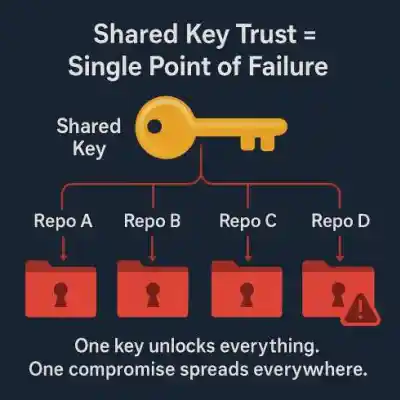

For years, Ubuntu and Debian-based systems used apt-key to manage repository signing keys. It worked, but it was insecure: a single trusted key meant a compromise in one repository could affect them all — the failure mode of trust scope.
Canonical announced the deprecation of apt-key in its Discourse post. The replacement uses deb822 source entries with the Signed-By option, which lets each repository define its own key. The move acknowledged what the community already knew: shared trust anchors undermine software supply chain security, while scoped keys and isolated trust boundaries reduce the blast radius of a compromise.
Shared keys created a global blast radius. Per-repo keys isolate trust, reducing fallout when one key is exposed. Key hygiene failures are dangerous because they fail silently until compromise has already spread.
Per-Repository Key Isolation: Trust Scope Failure
With deb822 and the Signed-By directive, each repository now carries its own signing key. This model directly addresses the failure mode of trust scope, where a single global key once had authority over every source.
Benefits of per-repo key isolation:
- Limits compromise to one repository rather than the entire system
- Reduces systemic risk if a single key is exposed
- Encourages better hygiene and accountability across maintainers
This shift matters because software supply chain security depends on limiting how far a compromise can travel once it begins. Isolating keys ensures that a poisoned source does not cascade across unrelated repos. For open-source supply chain security, it is the difference between a local breach and an ecosystem-wide incident.
Some argue that key isolation is overkill. In practice, one bad key under the old model meant global compromise. Scoped trust prevents that outcome and keeps failure contained. This is why key hygiene sits at the heart of modern software supply chain security.
Client-Side Controls Show Their Own Weak Points
Mirrors, keys, and client-side controls show that failures aren’t only upstream — they play out on end-user systems as well.
|
Incident |
Weak Point |
What Users Saw |
Security Trade-off |
Failure Mode |
|
Fedora Metalink |
Stale or broken mirrors |
Outages when mirrors drifted |
Enforced freshness stopped rollback, but at the cost of availability |
Freshness Enforcement |
|
Debian SecureApt |
Expired Release files |
“Release file expired” errors |
Valid-Until blocked stale repos, but also locked users out |
Rollback Fragility |
|
apt-key Deprecation |
Shared global key |
One key is trusted everywhere |
Convenience created a global blast radius |
Trust Scope Failure |
|
Per-Repo Keys |
Poor key isolation |
Each repo now has its own key |
Scoped trust prevents cascades, improves maintainer accountability |
Trust Scope Failure |
Together, these cases reinforce the main point: software supply chain security cannot be reduced to signatures and HTTPS. Even when cryptography is intact, weaknesses in mirrors, metadata, and key hygiene expose users to rollback, replay, and trust-scope failures. Open source supply chain security has to account for every layer, from upstream build systems to client-side validation.
How to Improve Open Source Supply Chain Security: Practical Fixes
The incidents made one thing clear: distribution is where the chain most often fails. Provenance, freshness, and scoped trust are the controls that matter.
- Signed metadata and provenance keep packages traceable and stop poisoned repositories from masquerading as legitimate.
- Mirror freshness policies block rollback and replay by rejecting outdated files before they spread.
- Per-repository key isolation contains a compromise to a single source instead of exposing an entire system.
Our perspective: These aren’t advanced features. They are the baseline. They don’t close every gap, but they stop the failures that have defined the last decade of attacks.
Enterprise ecosystems like Microsoft and Red Hat enforce provenance and freshness through centralized infrastructure. Open source has the same needs but depends on fragmented adoption, which leaves room for the same failures to resurface.
These aren’t optional add-ons. They are the foundation of modern software supply chain security, and without them, open source software supply chain security will keep repeating the same incidents we’ve already seen.
Conclusion: Rethinking Open Source Supply Chain Security
The failures we’ve traced don’t come from broken cryptography. Signatures and HTTPS hold up. What fails is distribution — the systems, mirrors, workflows, and trust models that deliver code.
From FreeBSD’s compromised build servers to Linux Mint’s website breach, from XZ’s maintainer compromise to Docker and AUR persistence, the same pattern repeats. The fix is not new crypto, but a focus on provenance, freshness, and scoped trust. Without that, software supply chain security will keep failing in predictable ways.
 PREVIOUS

 NEXT
NEXT

Powered By

Linux Security - Your source for Top Linux News, Advisories, HOWTOs and Feature Releases
QUICK LINKS
subscribe to newsletters!
Like staying secure? So do we.
Sign up for updates, tips, and alerts!