Audit Linux privileges now to limit compromise, escalation, and system-wide damage. Review Linux Privileges×


Stay Ahead With Linux Security HOWTOs

How to Learn Tips and Tricks incident response system monitoring
incident response system monitoring Establishing solid Linux logging foundations is essential for effective security defenses, enabling organizations to detect attacks, validate hardening measures, and maintain visibility to prevent unauthorized access.. Hardening defines what a system should allow, but logs reveal what actually happened. When visibility is incomplete, security teams lose the evidence they need to detect attacks, understand their scope, and determine how they unfolded. Why Linux Logging Must Come Before Security...
 Jul 23, 2026
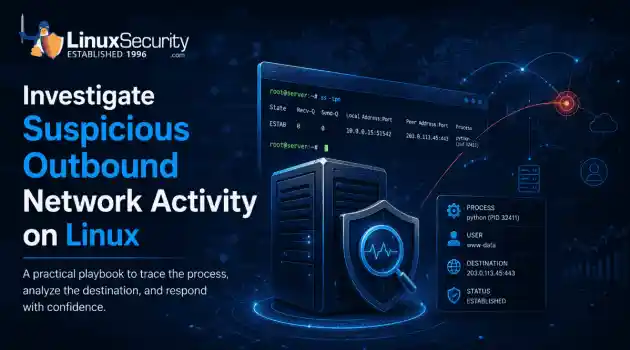
How to Secure My Networkincident response network traffic
incident response network traffic Imagine logging into a production Linux server for routine maintenance and noticing background network activity connecting to an unfamiliar external IP address. Your endpoint protection agent is not popping up with an alert, there is no service failure, and on the surface, the system appears to be running normally. . For Linux administrators and security teams, such a situation is a moment of truth: Is this activity a sign of active intrusion or just a tool that was overlooked in the course of...
Jul 21, 2026
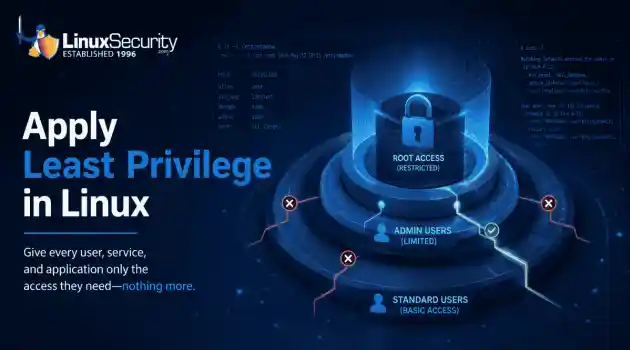
How to Harden My Filesystemsystem hardening open source security
system hardening open source security We all spend a lot of time defending our systems from external threats, but the amount of damage an attacker can cause often depends on what happens after they get in. A single compromised account doesn't always lead to a major incident. The real danger begins when that account has far more access than it actually needs. . That's exactly what the principle of least privilege is designed to prevent. By limiting users, services, and applications to only the permissions required for their jobs,...
Jul 20, 2026

How to Learn Tips and Tricksthreat detection system monitoring
threat detection system monitoring For small security and IT teams, the "enterprise" dream of a fully automated SIEM often feels like a distant luxury. It’s a vision built on massive budgets and dedicated engineering teams—things that, frankly, most of us don't have. But here is the reality: you don’t need a six-figure platform to maintain a secure environment. . Linux systems are, by design, incredibly verbose. Every time a user authenticates, a process executes, or a configuration file changes, your system creates a record of...
Jul 17, 2026
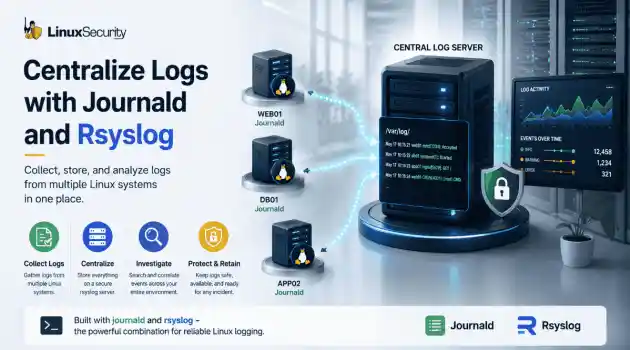
How to Learn Tips and Tricksnetwork security centralized logging
network security centralized logging Linux systems generate a steady stream of authentication, service, kernel, and application logs. On most systems, those logs never leave the machine that created them. If you're responsible for ten or twenty servers, that means checking each one separately. If one disappears before you can investigate it, its logs may disappear with it. Centralized logging solves that by sending log messages to another server as they're created. Instead of searching every machine, you have one place to review...
Jul 15, 2026
 Refine HOWTOs
X Clear Filters
Get the latest News and Insights
Get the latest Linux and open source security news straight to your inbox.
Community Poll
Should Linux servers automatically install security updates?
Loading...

Explore Latest Linux Security HOWTOs
We found -4 articles for you...
166
 incident responsesystem monitoringaudit framework
Linux Logging Strategies for Maximizing Security Visibility
Establishing solid Linux logging foundations is essential for effective security defenses, enabling organizations to detect attacks, validate hardening measures, and maintain visibility to prevent unauthorized access.. Hardening defines what a system should allow, but logs reveal what actually happened. When visibility is incomplete, security teams lose the evidence they need to detect attacks, understand their scope, and determine how they unfolded. Why Linux Logging Must Come Before Security Decisions A common misconception is that the primary defense is securing the configuration of a system. In practice, you need to have a solid Linux logging foundation in place before you can validate or trust hardening. You can't detect attacks you can't see. If a threat actor compromises an environment using a stolen credential, an unmonitored system will not generate any noise. Besides, looking at an incident without evidence forces security teams to guess timelines and vectors, rather than doing a definitive root-cause analysis. You can’t measure the effectiveness of system hardening in a vacuum beyond incident response. If you have no telemetry to see if a security control is working, being bypassed, or slowly degrading over time, then enabling it is a moot point. Operational impact increases quickly when decisions are based on data that cannot be verified. Visibility is the prerequisite that validates all downstream security decisions. How Linux Logging, Auditing, and Monitoring Work Together To create effective visibility, you need to understand how the layers of your visibility architecture work together. Logging, auditing, and monitoring are different things. Administrators should view them as complementary capabilities rather than different names for the same capability. When a service dies unexpectedly, or the system reboots in the middle of the night, admins always turn to journald first, because it keeps the sequence of events that led up to the failure. From the upstream systemddocs : journald can read structured logging data directly from the kernel, services and applications. As an admin, you can check that system logs maintain history across reboots using: journalctl --list-boots Security-critical events need a more sophisticated layer, driven by the Linux Audit framework. The Linux Audit framework is based on a kernel subsystem that logs low-level system activity. The auditd daemon is the user space component that receives and handles audit events. Linux audit logging gives event-level evidence of privilege use, process execution, and changes to sensitive files. Transport layers, such as rsyslog , aggregate these data streams and then send them off the host machine to prevent local tampering. Where Default Linux Logging Creates Visibility Gaps Out of the box, standard Linux distributions rarely ship with configurations optimized for forensics. Left unmanaged, default settings create widespread blind spots that routinely undermine effective Linux log management. The most common failure is the lack of persistent logging. On distributions where journald is configured for volatile storage (saving runtime logs strictly in /run/log/journal), a routine reboot completely wipes out historical evidence. Even worse, default installations don't always have full audit rules, so important system calls aren't always recorded. If auditctl -l shows an empty or minimal ruleset, important kernel-level events may not be logged, rendering organizations blind to unauthorized changes. The local-only storage and weak retention policies further exacerbate these vulnerabilities. If logs are kept strictly on the local machine, an attacker who compromises root privileges can easily overwrite or truncate log files before anyone notices. Without remote centralization and regular validation, organizations often assume their logs provide adequate protection when, in reality, they are fragmented, short-lived, or silently failing. Organizations can then cross-reference these baselines withother frameworks such as CIS Benchmarks or OpenSCAP profiles to see where audit controls are missing. What Meaningful Linux Telemetry Must Reveal Effective Linux telemetry is defined by its utility during an investigation rather than the sheer volume of data it collects. Instead of generating endless streams of unformatted noise, a healthy logging posture should effortlessly answer core forensic questions through real-world context. Returning to our compromised SSH key scenario, a healthy telemetry pipeline tracks the entire lifecycle of the attack: The Entry: The unauthorized connection arrives, and journald logs the initial SSH session establishment. The Escalation: The attacker executes a command that triggers a sudo invocation, recorded by auditd tracking the execve system call and user context transition. The Modification: The adversary edits a system configuration file. Audit rules capture the exact file modification time and inode change. The Telemetry Stream: Concurrently, Linux log monitoring daemons via rsyslog stream these events off-host, while performance tools record the outbound network connection originating from the modified service. The Detection and Response: The monitoring platform raises an immediate alert based on the forwarded stream. The security team correlates the multi-stage events, and the administrator isolates the compromised host from the network before further lateral movement occurs. By focusing on these investigative outcomes, logging transitions from a compliance chore into a powerful operational lens. Why Attackers Try to Blind Linux Defenders Attackers understand visibility better than many administrators, making log disruption one of their earliest operational priorities. Once an adversary compromises a Linux host, evading Linux security monitoring becomes critical to extending their dwell time. If logs are stored locally without protection, an attacker with elevated privileges will systematically target thevisibility architecture. They stop logging services, modify local configuration files to ignore malicious behavior, and delete historical log files. They may also sever connections to forwarding daemons, ensuring that alerts fail to reach a centralized repository. This behavior highlights why off-host collection is essential. When logs are securely streamed elsewhere in real time, local tampering becomes a noisy, detectable event that immediately signals a compromise to security teams. Building a Reliable Linux Logging Strategy Developing a successful logging approach involves considering visibility as a continuous operating model, not a list of discrete functions. Organizations must deliberately configure persistence such that system journals survive reboots and hardware failures. Retention policies balance the cost of storage against compliance and forensic needs such that historical data is available when slow-moving threats are eventually identified. You need to continually verify that centralization via transport layers like rsyslog is up and running using health checks to confirm the forwarding service is running and that events are arriving at the remote log server. The records are sent to a secure repository, which prevents attackers with root access from deleting or modifying local evidence to hide their tracks. At the end of the day, good Linux log management is a blend of automated ingestion with periodic human review to make sure the logging infrastructure is actively maintained and not a set-and-forget scenario. Improving Visibility Across the Organization Visibility benefits every layer of an enterprise, provided each group focuses on its distinct responsibilities: Linux administrators are responsible for configuring persistent storage, verifying active audit rules, and maintaining local daemon health. Security teams focus on tuning Linux log monitoring pipelines, analyzing centralized telemetry for anomalous behavior, and running threat hunts. Leadershipand CIOs use audit trails to measure risk reduction, shorten investigation timelines, and validate the return on security investments. FAQ What is the difference between logging and monitoring? Logging records discrete, historical events for auditing and forensics, whereas monitoring tracks real-time system metrics and performance thresholds to signal immediate operational health. Why is remote logging critical for Linux security? Remote logging ensures that forensic evidence is shipped off the local host instantly, preventing attackers with root access from deleting or modifying local logs to cover their tracks. How can I verify that my system logs are persisting across reboots? You can use commands like journalctl --list-boots to inspect whether historical boot sessions are successfully retained on the disk. How do I check active security audit rules on a Linux server? You can run auditctl -l to review the currently loaded audit rules and determine whether critical system calls are being monitored. Every security decision ultimately depends on trustworthy evidence. Without reliable Linux logging, organizations aren't responding to what happened—they're responding to what they think happened. . Effective security relies on solid Linux logging to ensure visibility, enabling accurate incident response and forensic analysis.. Linux Logging, Security Visibility, Audit Framework, Incident Response. . Dave Wreski
 Jul 23, 2026
•
Jul 23, 2026
• How to Learn Tips and Tricks

Get the latest News and Insights
Get the latest Linux and open source security news straight to your inbox.
Community Poll
Should Linux servers automatically install security updates?
Search Topics
Powered By

Linux Security - Your source for Top Linux News, Advisories, HOWTOs and Feature Releases
QUICK LINKS
subscribe to newsletters!
Like staying secure? So do we.
Sign up for updates, tips, and alerts!