


Stay Ahead With Linux Security HOWTOs
How to Learn Tips and Tricks security framework process monitoring
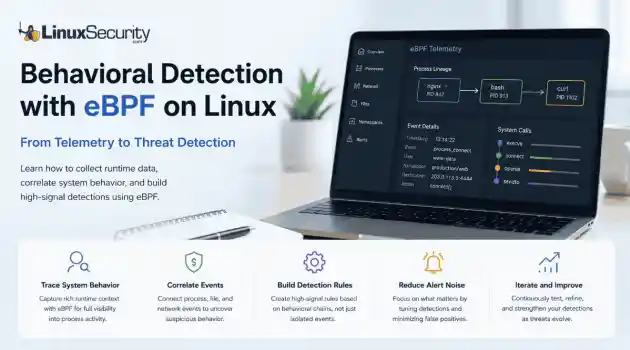
security framework process monitoring Building effective behavioral detections starts with understanding how processes behave at runtime, rather than simply collecting more logs. eBPF gives Linux security teams the visibility needed to correlate those behaviors into meaningful detections, moving away from static signatures and toward real-time analysis. . The first surprise for most people coming from auditd or legacy log collectors is how much context suddenly becomes available. Instead of just seeing that a shell executed, you...
 Jul 01, 2026
How to Learn Tips and Tricksincident response linux
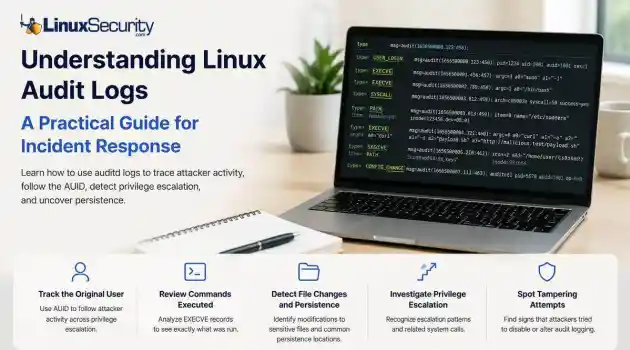
incident response linux When a security alert fires, the panic often sets in before the analysis. Many administrators instinctively reach for /var/log/auth.log or journalctl , but those logs tell only a partial story. They document successful logins and authentication attempts, but they rarely capture the granular "how" of a post-compromise environment. To truly reconstruct an attack, you need to master audit logs . Unlike standard authentication logs, Linux audit logs (managed by auditd ) record system-level...
Jun 29, 2026
How to Harden My Filesystemaccess control SELinux
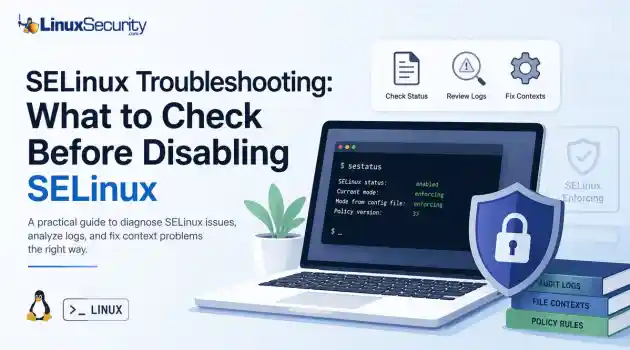
access control SELinux SELinux troubleshooting is a necessary skill for any system administrator. When a service fails despite correct file permissions and ownership, the immediate instinct is often to disable SELinux to confirm if the security policy is the bottleneck. While turning off enforcement frequently "fixes" the immediate symptom, it hides the underlying configuration flaw—such as an incorrect context or a policy violation—that could leave your system exposed. This guide outlines a systematic approach to...
Jun 25, 2026
How to Secure My Networkincident response open-source
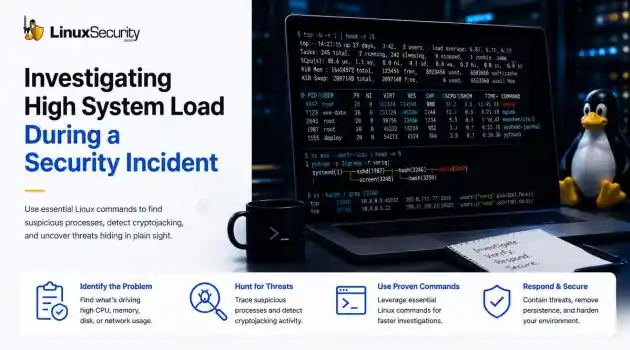
incident response open-source When a production server spikes at 99% CPU or the disk starts grinding, the knee-jerk reaction is usually to blame a bad code push or a runaway backup job. But if you’ve spent enough time in security incident response, you know that "performance issues" are often the first sign that you’re dealing with Linux malware. . If you don't have a systematic way to look past the performance graphs, you’re just guessing. Here is how you use Linux commands to peel back the layers when a system starts...
Jun 23, 2026
How to Secure My Networknetwork security Linux administration
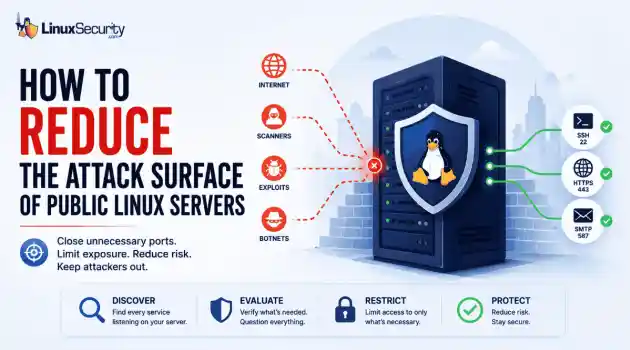
network security Linux administration Open ports have a way of accumulating over time. A test environment gets deployed and never removed. An administrative interface is exposed for troubleshooting and left in place. A database that was supposed to listen internally ends up reachable from the internet. . Attackers look for these mistakes constantly. Redis, Elasticsearch, MongoDB, Jenkins, and similar services still show up on internet-facing systems where they were never meant to be exposed. Sometimes it's a temporary change that...
Jun 10, 2026
 Refine HOWTOs
X Clear Filters
Get the latest News and Insights
Get the latest Linux and open source security news straight to your inbox.
Community Poll
Can sandbox isolation stop malware?
Loading...

Explore Latest Linux Security HOWTOs
We found -4 articles for you...
166
 security frameworkprocess monitoringeBPF
How to Build Behavioral Detections with eBPF on Linux
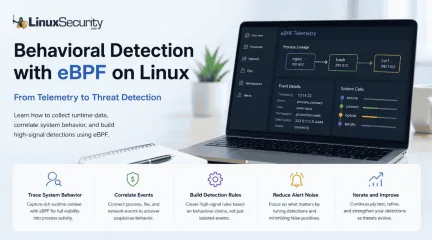
Building effective behavioral detections starts with understanding how processes behave at runtime, rather than simply collecting more logs. eBPF gives Linux security teams the visibility needed to correlate those behaviors into meaningful detections, moving away from static signatures and toward real-time analysis. . The first surprise for most people coming from auditd or legacy log collectors is how much context suddenly becomes available. Instead of just seeing that a shell executed, you also know who launched it, which container namespace it belonged to, and what it did next. That extra context is usually enough to explain why a process started in the first place. eBPF attaches to kernel events through mechanisms such as kprobes , tracepoints , and other hook types, allowing it to observe activity as it happens. You aren't parsing text logs after the fact. You are watching the system execute, which gives you low-latency runtime context. It helps capture short-lived process activity that might never make it into a traditional log file. A Practical Detection Workflow Before we dive into the mechanics, it helps to see the path. You aren't just writing rules; you're building a feedback loop. How eBPF Improves Runtime Security Visibility One thing you'll notice almost immediately is how noisy process execution becomes. A modern Linux server is constantly spawning short-lived processes you probably never realized existed. If you are a detection engineering practitioner, you know the frustration of alert fatigue: logs filled with thousands of events that tell you nothing about intent. eBPF gives you the granularity to cut through that. Much of this visibility comes from observing system calls, the interface processes use to request services from the Linux kernel. Process lineage ends up becoming one of the most valuable pieces of information you'll collect. Seeing /bin/bash execute tells you almost nothing. Seeing /bin/bash launched by nginx instead of an SSH session completely changes how you interpret that event. The command didn't change; the context did. Following that lineage across multiple generations often reveals the entire attack chain without requiring dozens of separate alerts. Choose an eBPF Security Framework You don't need to write raw C or Go code to harness this. Several frameworks sit on top of the eBPF layer. The underlying eBPF programs are doing the heavy lifting. These frameworks package that capability into rule engines, telemetry pipelines, and policy controls so you don't have to write kernel code yourself. Falco : Mature rule-based threat detection . Tetragon : Runtime policy and process-aware enforcement. Tracee : Event tracing and investigation. Cilium : Network visibility and policy for cloud-native environments. Falco is often the easiest place to start because it provides a mature rule engine and a large collection of community-maintained detections. Once you're comfortable with the telemetry, exploring tools like Tracee or Tetragon becomes much easier. Baseline Linux Monitoring Before Writing Detections Don't enable detections yet. Spend a day simply watching the telemetry. The first baseline almost always looks useless. There are hundreds of processes, package updates, scheduled jobs, and Kubernetes components doing things that initially appear suspicious. That's exactly the point. You aren't looking for attacks yet. You're learning what "Tuesday afternoon" looks like on this server. Limit your collection to events tied to process execution, network activity, sensitive file access, and namespace changes. The same approach applies to sensitive file access. Reading /etc/shadow isn't always suspicious, but who opened it, when, and what happened next often tells the real story. If you collect every available syscall , you’ll be staring at millions of records with no idea which ones matter. This is where most first-time eBPF security deployments gosideways. A common pattern is teams spending weeks writing complex detection logic before they've even collected a full day of runtime telemetry. Correlate Runtime Signals for Threat Detection Instead of monitoring isolated events, think about the "chain." An attacker’s goal is to go from entry point to a persistent foothold. Many of these behavioral chains map naturally to MITRE ATT&CK techniques, making them easier to organize and validate over time. When you capture an event, it looks something like this: Timestamp: 10:14:22 Event: process_connect Parent: nginx (PID 842) Child: /bin/bash (PID 913) User: www-data Namespace: production/web Destination: 203.0.113.5:4444 Every field here is a potential pivot point. None of these fields is particularly alarming on its own. Together, they tell a much more complete story. That's the difference between event collection and behavioral detection. Test and Tune Detection Engineering Rules Once you have a rule, verify it. Use Atomic Red Team . These are open-source scripts that mimic attacker behaviors. Run an "Atomic" test, observe the telemetry in your tool, and refine your rule. If you get a false positive, look at the parent process. Was it Ansible pushing a new configuration? Or was it apt or dnf running an unattended upgrade? If you see a legitimate process causing an alert, add an exception. Keep the exception as narrow as possible. If you just tell the system to "ignore bash," you've effectively turned off the security monitoring for that entire branch of your process tree. The Reality of False Positives You’ll see alerts for cloud-init running scripts that look suspiciously like persistence mechanisms. When that happens, your first instinct will be to write a broad ignore rule. Every allowlist entry should be specific enough that an attacker can't easily blend into legitimate activity. Also, remember container context. In a Kubernetes environment, seeing a process execute is nearly useless if youdon't know which pod, which container, and which namespace it belongs to. Always ensure your runtime security telemetry includes these metadata fields, or you’ll spend your entire day running kubectl commands just to find out which workload is generating an alert. Common eBPF Security Monitoring Mistakes Engineers often struggle with the same three mistakes during their first few months of deploying eBPF . First, they ignore the process lineage. They look at bash running a curl command and treat it as a standalone event, rather than looking at the process that spawned bash . Second, they try to treat these tools like a black-box EDR . EDR s often operate on a "install and forget" model, but eBPF provides the raw material, and it’s up to you to define what "bad" looks like. Third, they treat performance as the primary enemy. In reality, modern eBPF runtimes are hyper-efficient. The real enemy is poorly structured telemetry. If you collect everything indiscriminately, you won't have a performance problem, but you will have an "investigation" problem—you’ll be staring at a haystack trying to find a needle that wasn't indexed properly in the first place. Why Detection Engineering Rules Need Regular Tuning None of these detections are especially complex. Their value comes from the fact that they rely on behaviors attackers struggle to avoid, regardless of which malware or framework they're using. You’ll find that you stop trying to catch "everything" and start focusing on the five or six behavioral chains that represent your biggest risks. That focus is exactly what separates a noisy, unmanageable setup from a production-grade detection pipeline. Over time, you'll probably find yourself looking less at individual commands and more at the relationships between processes, users, namespaces, network activity, and file access. That's ultimately what eBPF changes. eBPF doesn't replace good detection engineering. It gives you richer runtime context, making iteasier to distinguish normal system activity from behavior that deserves investigation. Want more Linux security news, vulnerability analysis, and software supply chain updates? Subscribe to the LinuxSecurity Newsletter and get the latest threats, advisories, and expert insights delivered directly to your inbox. . Enhance Linux security with eBPF for real-time behavioral detection to identify threats and improve runtime visibility.. eBPF Linux behavioral detection security frameworks process monitoring. . MaK Ulac
 Jul 01, 2026
•
Jul 01, 2026
• How to Learn Tips and Tricks

Get the latest News and Insights
Get the latest Linux and open source security news straight to your inbox.
Community Poll
Can sandbox isolation stop malware?
Search Topics
Powered By

Linux Security - Your source for Top Linux News, Advisories, HOWTOs and Feature Releases
QUICK LINKS
subscribe to newsletters!
Like staying secure? So do we.
Sign up for updates, tips, and alerts!
Discover faster search, smarter navigation, and deeper Linux security insights. Read More