Overly broad permissions can turn one compromised account into a much larger security problem. Learn how to reduce unnecessary access, review privileges, and apply least privilege across modern Linux systems. Review Linux Privileges×


Stay Ahead With Linux Security HOWTOs
How to Secure My Network incident response network traffic
incident response network traffic Imagine logging into a production Linux server for routine maintenance and noticing background network activity connecting to an unfamiliar external IP address. Your endpoint protection agent is not popping up with an alert, there is no service failure, and on the surface, the system appears to be running normally. . For Linux administrators and security teams, such a situation is a moment of truth: Is this activity a sign of active intrusion or just a tool that was overlooked in the course of...
 Jul 21, 2026
How to Harden My Filesystemsystem hardening open source security
system hardening open source security We all spend a lot of time defending our systems from external threats, but the amount of damage an attacker can cause often depends on what happens after they get in. A single compromised account doesn't always lead to a major incident. The real danger begins when that account has far more access than it actually needs. . That's exactly what the principle of least privilege is designed to prevent. By limiting users, services, and applications to only the permissions required for their jobs,...
Jul 20, 2026
How to Learn Tips and Tricksthreat detection system monitoring
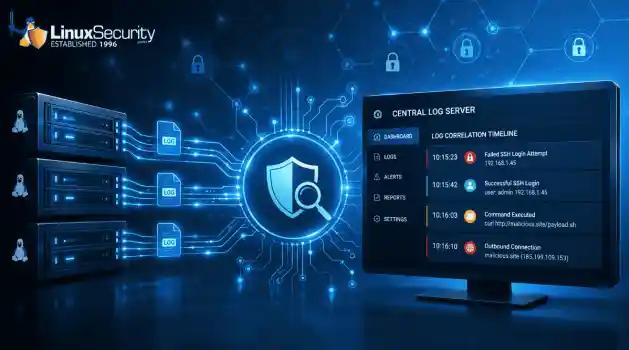
threat detection system monitoring For small security and IT teams, the "enterprise" dream of a fully automated SIEM often feels like a distant luxury. It’s a vision built on massive budgets and dedicated engineering teams—things that, frankly, most of us don't have. But here is the reality: you don’t need a six-figure platform to maintain a secure environment. . Linux systems are, by design, incredibly verbose. Every time a user authenticates, a process executes, or a configuration file changes, your system creates a record of...
Jul 17, 2026
How to Learn Tips and Tricksnetwork security centralized logging
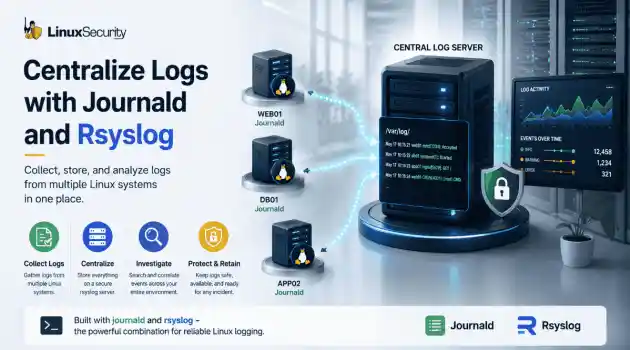
network security centralized logging Linux systems generate a steady stream of authentication, service, kernel, and application logs. On most systems, those logs never leave the machine that created them. If you're responsible for ten or twenty servers, that means checking each one separately. If one disappears before you can investigate it, its logs may disappear with it. Centralized logging solves that by sending log messages to another server as they're created. Instead of searching every machine, you have one place to review...
Jul 15, 2026
How to Secure My Networksecurity advisory audit
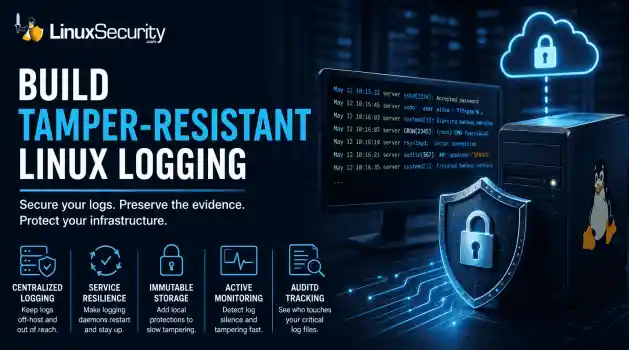
security advisory audit When you’re digging through an incident, your logs are the only thing you can actually trust. The problem is, attackers know that too. If someone gets root on your server, their first move is almost always to delete the evidence and cover their tracks. . If you aren't actively protecting your logs, you're basically flying blind the second a breach happens. It’s a miserable feeling to realize you have no idea what an attacker did because they wiped the logs before you even got there. In this...
Jul 11, 2026
 Refine HOWTOs
X Clear Filters
Get the latest News and Insights
Get the latest Linux and open source security news straight to your inbox.
Community Poll
Should Linux servers automatically install security updates?
Loading...
Explore Latest Linux Security HOWTOs
We found -3 articles for you...
167
 system administrationnetwork toolsnmap
Explore Network Discovery Techniques with Nmap Command-Line Options
Learn about some basic Nmap flags that you can use to generate a quick and useful network map to discover the scope of a network in a new environment, troubleshoot and manage network traffic. . Have you ever shown up to a new job, ready to hit the ground running, only to have your enthusiasm drained by the slow yet stunning realization that nobody has any network diagrams? You might scratch your head and wonder: “How does anything get done around here?” But don’t worry—wherever there’s a problem, there’s an opportunity to be a problem solver. You didn’t hear it from me, but I’ve heard that problem solvers get raises. This article is for discovering the scope of a network as a sysadmin in a new environment. As such, it covers simple Nmap flags to help somebody inside the network discover hosts and facts about them. This is not an article about security auditing, penetration testing, or other advanced Nmap use cases. If you’re new to Nmap and you need to get to know your network, then read on. . Uncover key Nmap parameters to efficiently scan your networks in unfamiliar settings and optimize data flow.. Nmap Tools, Network Mapping, System Administration. . Brittany Day
 Feb 09, 2021
•
Feb 09, 2021
• How to Secure My Network
166
 network securityscanning techniquesnmap
Exploring Nmap: Network Mapping for Enhanced Cybersecurity
In order to keep yourself secure you must understand your enemy.. Prevention is the only protection from becoming the victim of a security exploit. The first step in doing this is to determine what services your servers offer, so you can secure them in the best manner possible. Network scanning can be used to determine potential communication channels. Mapping their existence facilitates the exchange of information with the host, and thus is quite useful for anyone wishing to explore their networked environment, including attackers. Scanning, as a method for discovering exploitable communication channels, has been around for ages. The idea is to probe as many listeners as possible, and keep track of the ones that are receptive or useful. Once these listeners are found, means to exploit the host can be developed. Unnecessarily offering a particular service to a hacker means another avenue to exploit the host. Many different types of scanning are currently available. These range from a simple ping test to see if the host is alive, network broadcasts, and even performing a "stealth" attack by manipulating the ICMP, TCP, or UDP information in a data packet, intentionally violating the protocol definition in an attempt to trick a firewall. Becoming familiar with the tools and techniques an attacker might use to probe a network is the only way to know what information is available if someone attempts to mount an attack against us. Among the things that can be determined from port scanning a machine include: Services a host is offering which can then be used to construct the appropriate attack based on information gathered from this process If there is in fact a host at the IP address that is being scanned A topology map of our network, which can be used to determine where firewalls and other hosts are positioned, trusted relationships between those hosts, and routing and DNS information Operating system identification, vendor release and version, as well as applications and their versions Disclosure of the username and owner of any process connected via TCP, which can then be used to determine, for example, the username of which the web server is running Depending on where the port scan is initiated from will determine what type of information can be gathered. A port scan run from the outside of a firewall will reveal less information than a port scan done right from the local network. Network scanning from the local network can be used to determine the 'worst case' scenerio which will allow us to have the same level of information as an intruder would, had she managed to subvert the firewall before doing the analysis. Scanning from outside the firewall can also be beneficial to determine what ports are available to the public Internet, at which point firewall rules can be adjusted accordingly. Many different types of network scanners exist today, including freely available ones as well as commercial. The one that we will be using and most hackers use is called "nmap", and is a utility used for scanning large networks, although it works fine for single hosts. It supports the following types of attack/anaysis: Vanilla TCP connect() scanning TCP SYN (half open) scanning TCP FIN, Xmas or NULL (stealth) scanning TCP ftp proxy (bounce attack) scanning SYN/FIN scanning using IP fragments (bypasses firewalls) UDP raw ICMP port unreachable scanning TCP Ping scanning ICMP scanning Direct (non portmapper) RPC scanning Remote OS Identification by TCP/IP fingerprinting Reverse-ident scanning Nmap is highly configurable, and offers many services: Flexible target and port specification, so an entire network or only a single host can be scanned at once Decoy scanning, which can be used to confuse intrusion detection systems from finding the real host performing an attack Determination of TCP sequence predictability, which can be used in man-in-the-middle attacks Output to machine parseable or human readable log files for analysis Graphical support, as well as command-line support, is available with nmap. Using the graphical front end, we will be able to determine: Hosts that respond to ICMP Version of Solaris that is reported Services the servers are offering. This will be determined using SYN/FIN scanning. The attacker community is investing an incredible amount of effort to scan the Internet. The single most important service for our site to block is ICMP echo requests. Many attacks originate from this type of service, not only pinging a host to see if it's reachable. Recon probes should be taken seriously; if attackers can learn where your hosts are, they can make fairly short work of determining what services these hosts run. If they can't determine which of the hosts in our network address space are active, they have a very sparse matrix to deal with.. Grasping the adversary is essential for digital defense. Discover proficient methods for network exploration and analysis to ensure safety.. Network Mapping, Nmap Tool, Port Scanning, Attack Strategies, Cybersecurity Techniques. . Anthony Pell
Aug 07, 2000
•
How to Learn Tips and Tricks


Get the latest News and Insights
Get the latest Linux and open source security news straight to your inbox.
Community Poll
Should Linux servers automatically install security updates?
Search Topics
Powered By

Linux Security - Your source for Top Linux News, Advisories, HOWTOs and Feature Releases
QUICK LINKS
subscribe to newsletters!
Like staying secure? So do we.
Sign up for updates, tips, and alerts!