Overly broad permissions can turn one compromised account into a much larger security problem. Learn how to reduce unnecessary access, review privileges, and apply least privilege across modern Linux systems. Review Linux Privileges×


Stay Ahead With Linux Security HOWTOs
How to Secure My Network incident response network traffic
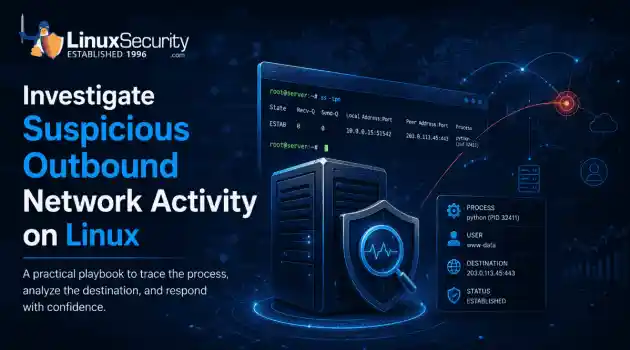
incident response network traffic Imagine logging into a production Linux server for routine maintenance and noticing background network activity connecting to an unfamiliar external IP address. Your endpoint protection agent is not popping up with an alert, there is no service failure, and on the surface, the system appears to be running normally. . For Linux administrators and security teams, such a situation is a moment of truth: Is this activity a sign of active intrusion or just a tool that was overlooked in the course of...
 Jul 21, 2026
How to Harden My Filesystemsystem hardening open source security
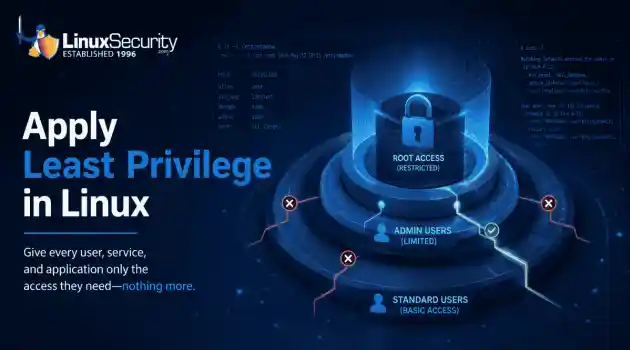
system hardening open source security We all spend a lot of time defending our systems from external threats, but the amount of damage an attacker can cause often depends on what happens after they get in. A single compromised account doesn't always lead to a major incident. The real danger begins when that account has far more access than it actually needs. . That's exactly what the principle of least privilege is designed to prevent. By limiting users, services, and applications to only the permissions required for their jobs,...
Jul 20, 2026
How to Learn Tips and Tricksthreat detection system monitoring
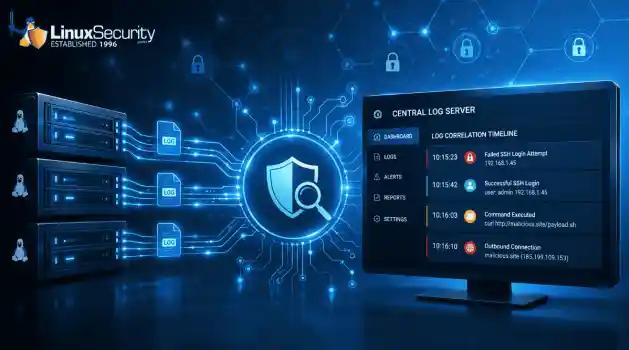
threat detection system monitoring For small security and IT teams, the "enterprise" dream of a fully automated SIEM often feels like a distant luxury. It’s a vision built on massive budgets and dedicated engineering teams—things that, frankly, most of us don't have. But here is the reality: you don’t need a six-figure platform to maintain a secure environment. . Linux systems are, by design, incredibly verbose. Every time a user authenticates, a process executes, or a configuration file changes, your system creates a record of...
Jul 17, 2026
How to Learn Tips and Tricksnetwork security centralized logging
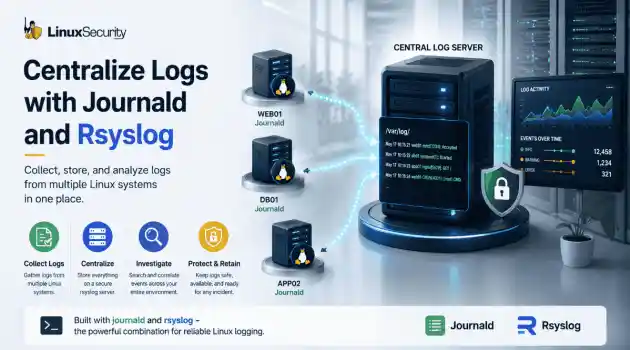
network security centralized logging Linux systems generate a steady stream of authentication, service, kernel, and application logs. On most systems, those logs never leave the machine that created them. If you're responsible for ten or twenty servers, that means checking each one separately. If one disappears before you can investigate it, its logs may disappear with it. Centralized logging solves that by sending log messages to another server as they're created. Instead of searching every machine, you have one place to review...
Jul 15, 2026
How to Secure My Networksecurity advisory audit
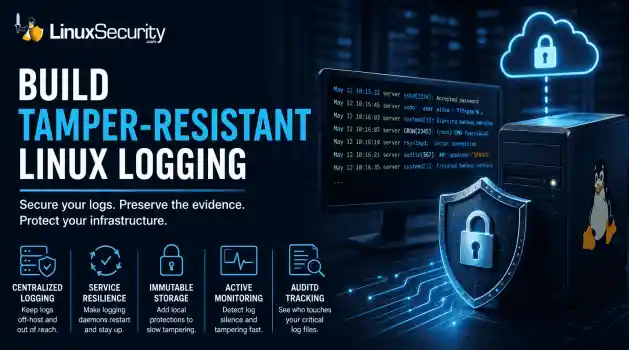
security advisory audit When you’re digging through an incident, your logs are the only thing you can actually trust. The problem is, attackers know that too. If someone gets root on your server, their first move is almost always to delete the evidence and cover their tracks. . If you aren't actively protecting your logs, you're basically flying blind the second a breach happens. It’s a miserable feeling to realize you have no idea what an attacker did because they wiped the logs before you even got there. In this...
Jul 11, 2026
 Refine HOWTOs
X Clear Filters
Get the latest News and Insights
Get the latest Linux and open source security news straight to your inbox.
Community Poll
Should Linux servers automatically install security updates?
Loading...
Explore Latest Linux Security HOWTOs
We found 49 articles for you...
161
 network securityfirewallnetworking
Key Considerations for Selecting a Linux Firewall Solution (Understanding the Types of Firewalls)
Choosing a firewall on Linux looks simple until you try to match a tool to a real environment. Most teams already understand the basic types of firewalls, but the gap between a conceptual model and day-to-day usability can be wider than expected. A tool that feels lightweight on a workstation can become restrictive on a production host. Another that works well in distributed environments might be overkill when all you need is a small ruleset and predictable behavior. . Linux offers several mature options, each shaped by different assumptions about how administrators work. UFW favors clarity. iptables reflects years of legacy deployments. nftables streamlines policy design and replaces older components. firewalld tries to make large or changing systems easier to manage. None is universally the best Linux firewall, but each is the best fit for someone. This guide focuses on how to evaluate those differences without getting buried in packet flow charts or rule syntax. Our goal here is simpler. Identify what matters when selecting a firewall, explain how these tools differ in practice, and give you enough clarity to choose the one that aligns with your environment, your workflow, and your tolerance for complexity. What Do Firewalls Do in Linux? A firewall on Linux has one job. It decides what gets in, what goes out, and what stays on the cutting room floor. The mechanics vary across the different types of firewalls, but the outcome is the same. You are defining the boundaries of a system and the conditions under which traffic is allowed to cross them. Most teams working with Linux already understand this, yet it helps to reset the frame before comparing tools. A firewall is not a cure-all, and it is not a substitute for sound architecture. It is a policy enforcement point that happens to sit very close to the operating system. The value comes from its consistency. If the rules are clear and the structure is predictable, the host behaves the way you expect. Overview of the Main Linux FirewallOptions Most administrators choose between four tools when they evaluate the best Linux firewall for a given environment. The differences are not subtle, but they are also not complicated once you look at how each one expects you to work. The goal here is not to walk through syntax or rule construction. It is to explain how each option approaches policy control so you can match the tool to the way your team operates. UFW: A Simple Firewall Option for Beginners UFW was designed for people who want to express intent without wrestling with low-level primitives. It offers a clean, high-level interface that makes sense in smaller environments, especially when the rule set is short and the workflow is predictable. Many administrators use it on laptops, developer machines, and lightweight servers because it removes friction without hiding too much. Anyone who needs a quick refresher on its behavior can use the UFW basics guide available at linuxsecurity.com. iptables: A Legacy Linux Firewall Framework iptables still appears everywhere. Long-running fleets, older distributions, and embedded systems rely on it because it has been the default for so long. It remains a stable choice when compatibility matters more than modernization. The tradeoff is that it mirrors the structure of the underlying packet filter, so it expects you to understand how traffic moves through those chains. If you want to revisit the fundamentals behind that model, our article on packet filtering basics gives helpful context without diving into deep engineering detail. nftables: The Modern Successor for Linux Firewall Management nftables replaces several older components and introduces a cleaner rule model that better reflects how administrators think about policy. It reduces duplication, organizes logic more efficiently, and ties long-term maintenance to a single, consistent framework. Teams planning future deployments tend to favor it because it avoids the pitfalls that accumulated around legacy tooling. Beforeworking with it, many administrators find it useful to review material on rule structure and ordering. firewalld: A Zone-Based Firewall Manager for Dynamic Environments firewalld takes a service-oriented approach. Instead of writing rules directly, you work with zones and service definitions that can shift with the system. This approach fits hosts that change roles or sit in environments where network conditions vary. It also makes sense in data centers or virtualized platforms where interfaces and services do not stay static. When something behaves unexpectedly, troubleshooting often comes down to verifying which zone is active and how the service definitions map to the rule backend. Those who want to revisit common diagnostic steps can look at the firewall troubleshooting steps overview at linuxsecurity.com for context. Strengths and Weaknesses of Firewalls for Beginners When people compare the types of firewalls on Linux, they often get lost in syntax, even though the real differences show up in how these tools frame policy. Each one sets its own expectations for structure, clarity, and scale. Looking at those factors side by side helps you see why a tool may feel intuitive in one setting and awkward in another. Some firewalls focus on abstraction. UFW falls into that category. It presents intent through a simplified interface, which works well when your rules are short and the system does not change much. The advantage is speed. You can express policy without parsing long tables of chains or translating a decision into multiple rule entries. The tradeoff is that you have limited visibility into the underlying logic, which can matter later if you begin to stack more complex conditions. Others favor granularity. iptables is the clearest example. It exposes the structure of the packet filter directly, so your policy ends up expressed in a sequence of tightly scoped rules. This approach appeals to administrators who want to see every step of the decision path. It also scales in ways simpleinterfaces cannot, but it carries a cost. The more detailed the policy becomes, the harder it is to follow the flow unless you are already comfortable with the underlying model. Tools like nftables and firewalld sit between these extremes. nftables streamlines logic and reduces duplication, which helps when rulesets grow or when multiple teams maintain the same policy. firewalld organizes behavior through zones and services, which works well in changing environments where interfaces and requirements shift. Both tools reward administrators who value organization and long-term maintainability over step-by-step detail. Understanding these differences helps you set realistic expectations. A tool that feels accessible today might become restrictive when your environment changes. Another that seems complex at first might be the only option that handles the scale or clarity you need later. The next section gets into how to evaluate those factors when choosing the best Linux firewall for your situation. How Do I Choose the Right Linux Firewall? Selecting the best Linux firewall is less about feature lists and more about how each tool fits the way you already manage systems. Administrators rarely choose a firewall in isolation. They choose it in the context of their workflow, their operational habits, and the level of complexity they are willing to support long term. One of the simplest ways to narrow the field is to look at your comfort level with networking concepts. If you want high-level control without interpreting detailed rule structures, UFW usually feels natural. It gives you fast results and predictable behavior, which is why many teams use it on smaller servers and individual workstations. Your environment matters just as much. Servers with a static role often do fine with straightforward tools. Systems that shift between networks or services benefit from the zone-based model firewalld uses, since it adapts more easily when interfaces move or when new roles come online. In largerdeployments, especially those that span multiple hosts, nftables tends to stand out because it organizes policy in a cleaner way and avoids the duplication that creeps in with legacy tooling. Some administrators need more than simple allow or deny decisions. They want consistent outbound control or detailed filtering of egress traffic. If that is part of your threat model, you will want to factor it into your choice. If you want a clear explanation of how outbound control works, you can reference the Egress filtering basics guide at linuxsecurity.com. Maintenance is another practical consideration. Policies tend to grow over time. A ruleset that starts small can evolve into something dense after a few service additions or operational changes. If your team expects to revisit the firewall regularly, choose a tool that keeps rules readable as they expand. nftables and firewalld often age better in that respect, although the right choice still depends on how your team writes and reviews policy. No single tool solves every use case. The decision comes down to how much detail you want to manage, how often the system changes, and how you plan to maintain the rules over the life of the host. The goal is not to memorize internal mechanics. It is to choose the firewall that aligns with your environment and reduces the friction your team deals with day to day. Common Beginner Misunderstandings When Choosing Among Types of Firewalls People run into the same predictable issues when they compare the types of firewalls on Linux. Most of these misunderstandings come from expectations shaped by older deployments, half-remembered tutorials, or outdated advice. The most common patterns include: Thinking iptables is obsolete. nftables replaces several legacy components, but iptables is still everywhere. Teams keep it because the behavior is predictable and because migrations take time. Treating it as deprecated creates the wrong assumptions when you’re supporting long-running hosts. Assuming UFW isinsecure because it simplifies the interface. Its security posture comes from the policies you apply, not the level of abstraction. UFW remains popular on workstations and smaller servers because it reduces configuration drift without weakening control. Believing firewalld is only for servers or large deployments. Its zone-based structure helps on any host where interfaces or roles change. Many unexpected decisions come from the rule order rather than the tool itself. If you want a clearer picture of how ordering affects outcomes, see our firewall rule ordering basics guide. All of these misunderstandings share a pattern. They focus on the surface of the tool instead of the policy beneath it. Once the interaction between rules feels familiar, the differences among these firewalls become easier to interpret. Our Final Thoughts on What Matters Most When You Compare Linux Firewalls Most firewall decisions get easier once the core ideas feel familiar. All of the major Linux tools work from the same principles. They inspect traffic, compare it against the rules you define, and enforce a policy that reflects your expectations. The structure changes from tool to tool, but the intent stays constant. A clear understanding of those fundamentals is usually what prevents confusion later, especially when a system behaves in a way that does not match your first impression. If you want a closer look at how Linux evaluates traffic, you can explore our article on Linux firewall basics . This guide keeps the focus on selection rather than mechanics, which is usually the part that stalls teams. Once you know the boundaries you need to enforce, the rest of the work comes down to picking a tool that represents those policies in a way you can maintain. Once you know how your environment handles traffic, the choice between UFW, iptables, nftables, and firewalld turns into a practical evaluation instead of a theoretical one. Each option fits a particular workflow and a particular tolerance forcomplexity. That is why most teams refine their choice as their infrastructure grows. What works for a single host may not scale in a multi-tenant setup, and what feels heavy on a workstation might be exactly what you want on a production system. . Linux offers several mature options, each shaped by different assumptions about how administrators w. choosing, firewall, linux, looks, simple, until, match, environment. . Anthony Pell
 Dec 03, 2025
•
Dec 03, 2025
• How to Secure My Firewall
167
 open sourcethreat detectionsecurity testing
Installing Metasploit Framework On Ubuntu 22.04: A Comprehensive Guide
Network admins must scan for security vulnerabilities and patch them promptly to prevent attacks and security breaches. Metasploit is an open-source framework for detecting threats and vulnerabilities. . It identifies and exploits vulnerabilities in computer systems, networks, and applications. Metasploit enables security professionals to simulate real-world attacks and test their organization's security posture. It comes with many exploits, and you can also create your own! In the tutorial linked below, learn how to install the Metasploit framework and perform basic testing on an Ubuntu 22.04 system. . Discover the process of setting up the Metasploit Framework on Ubuntu 22.04 to enhance your capabilities in threat assessment and security evaluation.. Metasploit Framework, Ubuntu Security, Threat Detection, Installation Guide, Open Source Tools. . Anthony Pell
Apr 06, 2024
•
How to Secure My Network

162
 open sourceprivacysecurity distribution
Tails OS: Improved Privacy And Anonymity For All Users Worldwide
Tails (The Amnesic Incognito Live System) is a free and open-source operating system that prioritizes online privacy and anonymity. Key features and functionalities of Tails include its privacy-focused nature, its ability to leave no trace on the computer's hard drive, and its integration with the Tor network. . A diverse range of users can benefit from Tails, such as journalists, activists, professionals handling confidential data, individuals in censored regions, security researchers, whistleblowers, and privacy-conscious individuals. You can learn more about the advantages of Tails, how it works, and how to use it effectively to protect your online privacy and anonymity in the article linked below. You can also learn about other secure Linux distros we love for enhanced digital security and privacy in this LinuxSecurity Feature article. We also recently covered the release of Tails 6.1 , the latest version of Tails OS. Good luck on your journey to greater online privacy and security, fellow Linux users! . Tails OS enhances privacy for journalists, activists, and users worldwide by ensuring anonymity online. Discover its key features!. tails, amnesic, incognito, system) is a, open-source, operating, system. . Dave Wreski
Apr 01, 2024
•
How to Strengthen My Privacy
160
 open sourcefile encryptionencryption methods
GPG: Securely Transfer Files with Public Key Encryption
Today we'll cover how to encrypt and securely transfer files using GPG. GPG is a free, open-source encryption program that uses public-key cryptography, which means you can send encrypted files without ever having to send your private key over email or any other insecure channel. The only way to decrypt the file is if you have both your public and private keys, which means even if someone were able to intercept and read the message before it reached its intended recipient, it would be useless without the private key. . As an added bonus, the recipient doesn't need any special software or plugins—they just need a copy of PGP Desktop 9 or newer installed on their computer, along with a copy of their own public key so they can decrypt the message. Let's get started! Visit the link below for a step-by-step tutorial on how to encrypt and securely transfer files with GPG. . GPG (GNU Privacy Guard) provides advanced encryption for secure document sharing. Techniques include key management, file encryption, and secure messaging. File Encryption, GPG Security, Secure Data Transfer, Open Source Encryption. . Brittany Day
Dec 09, 2023
•
How to Harden My Filesystem
162
 linux distributionbrowseropen source
Step-By-Step Waterfox Installation Guide for Linux Users
Waterfox is a lightning-fast web browser that is entirely independent and built on Firefox technology, ensuring absolute data privacy by never accessing your personal information. . You might wonder why we need another privacy-focused browser when Firefox already exists. The answer lies in Firefox’s management by the Mozilla Foundation , which has control over user policies and requires manual adjustments for enhanced privacy settings. Whereas, Waterfox provides all the privacy-oriented features enabled by default, which include a private search engine, anti-tracking, container tabs, private tabs, no telemetry collection, pocket disabled by default, and many more. Overall, you can openly say that Waterfox is better than Firefox for all advanced or regular users looking for a private browser that aligns with their privacy objectives. So today in this article, you will learn how to install Waterfox on your favorite Linux distribution with a few tips to ease your journey. . Waterfox stands out for its strong privacy focus, outperforming Firefox with less data collection, legacy support, customization, and built-in blockers for enhanced security. Waterfox Browser, Privacy Protection, Installing Waterfox, Linux Browser, Open Source Privacy. . Brittany Day
Nov 02, 2023
•
How to Strengthen My Privacy
162
open sourceinstallation guidesecure networkingGuide to Installing WireGuard VPN Client on Key Operating Systems
Here's a step-by-step guide to installing the WireGuard VPN on Windows, MacOS, Linux, iOS, and Android. . WireGuard is reshaping the VPN landscape with its lightweight yet secure protocol. With just a server and a configuration file, you're ready to begin. Whether you have a WireGuard configuration from a VPN service, workplace, or personal project, this guide streamlines the process. So what is WireGuard? How can you set it up on Windows, MacOS, Linux, iOS, and Android? WireGuard is an open-source VPN protocol . It prioritizes simplicity and speed over older VPN technologies and implements VPN techniques to create secure point-to-point connections. It's streamlined, easy to use, and has been widely adopted due to its high performance and security. A WireGuard configuration file (.conf) is obtained from VPN service providers or self-generated from personal server setups . It is a concise set of instructions that the WireGuard software uses to establish a VPN connection, and contains details like endpoint addresses, encryption keys, and connection preferences. Armed with your WireGuard configuration file, you'll find setting up a client on popular operating systems to be a breeze. . Tailscale is transforming the way we think about remote access with its efficient yet robust networking system. This tutorial will assist you in setting it up effortlessly.. WireGuard VPN, Installation Steps, Open Source Protocol, Secure Networking, Client Setup. . Brittany Day
Aug 19, 2023
•
How to Strengthen My Privacy
167
network securitysecurity auditingopen sourceMastering Nmap and Netcat for Effective Network Security
Dive into the fascinating universe of network security and system administration, where two tools reign supreme: Nmap and Netcat. These open-source marvels are the linchpins of network exploration and security auditing. . This guide is your ticket to a deep, comprehensive, and beginner-friendly understanding of these powerful tools. Nmap, or Network Mapper, is a free, open-source tool designed for network discovery and security auditing. It's like a Swiss Army knife for network administrators, providing a range of features to explore and secure their networks. Netcat, on the other hand, is a networking utility that reads and writes data across network connections. It's a versatile tool, capable of opening TCP connections, sending UDP packets, listening on arbitrary TCP and UDP ports, and much more. The link for this article located at Hackernoon is no longer available. . Explore beginner-centric knowledge regarding Nmap and Netcat to enhance your network safety and management.. Network Security,System Administration,Nmap,Netcat,Security Auditing. . Brittany Day
Jun 18, 2023
•
How to Secure My Network
162
 security toolopen sourceubuntu
How To Install Hashcat On Ubuntu Versions 22.04 And 20.04 LTS
Hashcat is for those who are in the computer security field and want to test the strength of the password to perform security audits. In short, it is an advanced password recovery tool that supports various hashing algorithms with extensive options for password cracking. . Till 2015 it was a propriety tool but later open-sourced. Here in this article, we learn the steps involved in installing Hashcat on Ubuntu Linux systems. We are guiding how to install Hashcat on Linux, therefore you should be on Ubuntu 20.04, 22.04, or any other latest version. Also, the system must have an internet connection whereas to install packages you either need to have sudo access or root. . Till 2015 it was a propriety tool but later open-sourced. Here in this article, we learn the steps i. hashcat, those, computer, security, field, strength. . Brittany Day
Jun 10, 2023
•
How to Strengthen My Privacy

Get the latest News and Insights
Get the latest Linux and open source security news straight to your inbox.
Community Poll
Should Linux servers automatically install security updates?
Search Topics
Powered By

Linux Security - Your source for Top Linux News, Advisories, HOWTOs and Feature Releases
QUICK LINKS
subscribe to newsletters!
Like staying secure? So do we.
Sign up for updates, tips, and alerts!