Audit Linux privileges now to limit compromise, escalation, and system-wide damage. Review Linux Privileges×


Stay Ahead With Linux Security HOWTOs
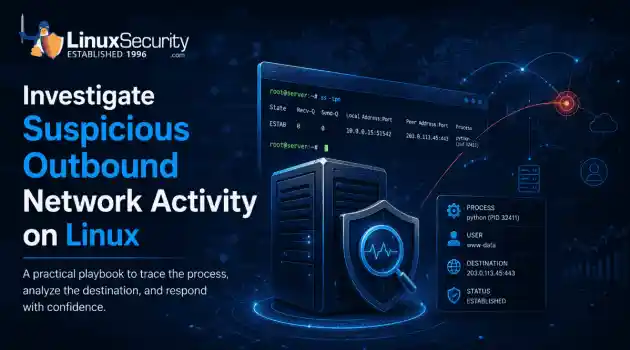
How to Secure My Network incident response network traffic
incident response network traffic Imagine logging into a production Linux server for routine maintenance and noticing background network activity connecting to an unfamiliar external IP address. Your endpoint protection agent is not popping up with an alert, there is no service failure, and on the surface, the system appears to be running normally. . For Linux administrators and security teams, such a situation is a moment of truth: Is this activity a sign of active intrusion or just a tool that was overlooked in the course of...
 Jul 21, 2026
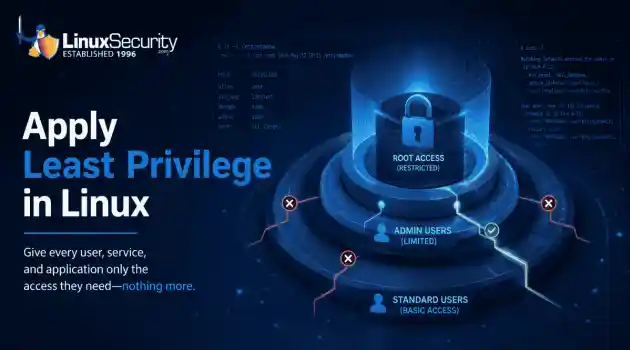
How to Harden My Filesystemsystem hardening open source security
system hardening open source security We all spend a lot of time defending our systems from external threats, but the amount of damage an attacker can cause often depends on what happens after they get in. A single compromised account doesn't always lead to a major incident. The real danger begins when that account has far more access than it actually needs. . That's exactly what the principle of least privilege is designed to prevent. By limiting users, services, and applications to only the permissions required for their jobs,...
Jul 20, 2026
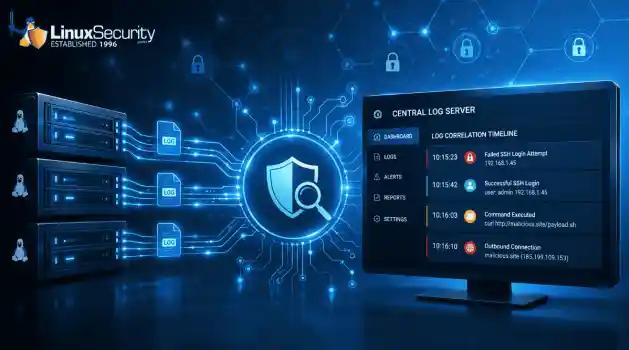
How to Learn Tips and Tricksthreat detection system monitoring
threat detection system monitoring For small security and IT teams, the "enterprise" dream of a fully automated SIEM often feels like a distant luxury. It’s a vision built on massive budgets and dedicated engineering teams—things that, frankly, most of us don't have. But here is the reality: you don’t need a six-figure platform to maintain a secure environment. . Linux systems are, by design, incredibly verbose. Every time a user authenticates, a process executes, or a configuration file changes, your system creates a record of...
Jul 17, 2026
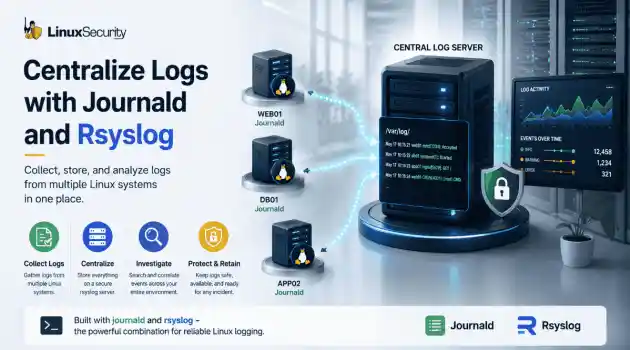
How to Learn Tips and Tricksnetwork security centralized logging
network security centralized logging Linux systems generate a steady stream of authentication, service, kernel, and application logs. On most systems, those logs never leave the machine that created them. If you're responsible for ten or twenty servers, that means checking each one separately. If one disappears before you can investigate it, its logs may disappear with it. Centralized logging solves that by sending log messages to another server as they're created. Instead of searching every machine, you have one place to review...
Jul 15, 2026
How to Secure My Networksecurity advisory audit
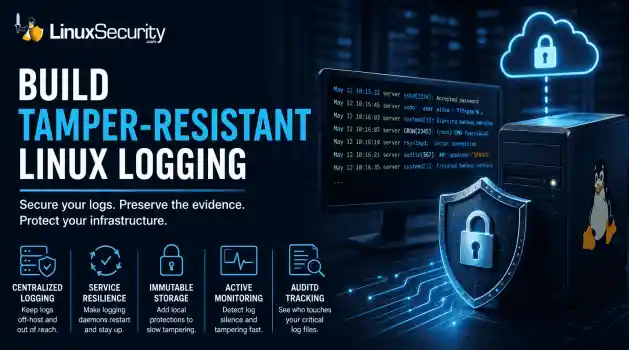
security advisory audit When you’re digging through an incident, your logs are the only thing you can actually trust. The problem is, attackers know that too. If someone gets root on your server, their first move is almost always to delete the evidence and cover their tracks. . If you aren't actively protecting your logs, you're basically flying blind the second a breach happens. It’s a miserable feeling to realize you have no idea what an attacker did because they wiped the logs before you even got there. In this...
Jul 11, 2026
 Refine HOWTOs
X Clear Filters
Get the latest News and Insights
Get the latest Linux and open source security news straight to your inbox.
Community Poll
Should Linux servers automatically install security updates?
Loading...
Explore Latest Linux Security HOWTOs
We found -2 articles for you...
166
 kernel securitysystem integrityroot access
Enhancing Linux Kernel Security: Lockdown Mode and Self-Protection Insights
The Linux kernel serves as the heart and soul of our much-loved OS, orchestrating computer and software functions within kernel space to protect user actions in user space from accidental or malicious file changes occurring outside kernel space. While kernel security may seem straightforward at first glance, protecting essential system files is critical and requires robust security features due to potential local and remote attacks. . As Linux admins, you and I face the enormous task of protecting Linux kernels in diverse environments and architectures across their deployment. Kernel security is fundamental to OS functioning because vulnerabilities at this level can lead to serious security breaches, including unauthorized data access, system control issues, and persistent malware infections . To combat these attacks, the Linux community has developed numerous security mechanisms, including Lockdown Mode and Kernel Self-Protection , that work effectively against exploiting vulnerabilities. I'll walk you through what each of these features does and why you should be using it, and I'll end by directing you to a tutorial that helped me understand how to enable and configure these security features. What Is Lockdown Mode & How Does It Improve Linux Kernel Security? Lockdown Mode is an additional security measure designed to maintain kernel integrity by prohibiting any unauthorized modifications to its code. This mode reduces the kernel's attack surface by restricting userland applications with root privileges and those without them to protect environments handling sensitive data like servers and embedded systems from potential attackers. Lockdown Mode enforces its policy through three increasingly stringent levels: None, Integrity, and Confidentiality. Lockdown Mode offers the maximum level of confidentiality by blocking features that could lead to kernel memory leaks, blocking unsigned kernel modules from loading and altering kernel memory, and protecting from kernel code injection and dataexfiltration threats. Lockdown Mode offers many advantages that cannot be overstated. It ensures that only trusted code is executed within the kernel, improves secure boot practices by maintaining kernel security from startup to shutdown, and significantly reduces risks related to unauthorized code execution and memory tampering, thus offering robust defense against various kernel-level threats. What Is Kernel Self-Protection & What Security Benefits Does It Provide? Kernel Self-Protection aggressively approaches kernel security by employing various features and mechanisms to fortify it against attacks, including Kernel Address Space Layout Randomization (KASLR), stack protection mechanisms such as Canaries, and Control Flow Integrity (CFI). KASLR protects against attackers by randomizing memory addresses used by the kernel and its modules, thus eliminating exploitable patterns of memory addresses. Stack protection mechanisms aim to defend against buffer overflow attacks using "Stack Canaries," secret values that, when altered, trigger program termination. CFI protects against arbitrary code execution by adhering to predefined execution paths, while read-only data structures ensure critical kernel segments are unmodifiable during runtime. Kernel Self-Protection strategies provide admins with an essential tool for shielding their systems against an array of attack vectors, such as memory corruption and arbitrary code execution attacks. By employing these mechanisms, admins can create an unpredictable target for attackers while increasing the complexity and resource requirements associated with successful kernel exploits. Using these strategies, Linux sysadmins can significantly protect their systems against multiple forms of attack, such as memory corruption attacks or code execution attacks that threaten kernel security. Why Should Admins Implement These Features? Lockdown Mode and Kernel Self-Protection measures should be adopted due to their inherent logic: cyber threats have evolvedrapidly over the years, necessitating an equally dynamic defense mechanism at the kernel level. By adopting such security features, administrators will gain an arsenal of defense features to anticipate potential exploit attempts. These features will provide admins with tools that make corrupting kernel files or running unauthorized code far more difficult for attackers to accomplish. Another advantage is that these features can be easily enabled; their integration into the kernel makes this simple for administrators. Lockdown Mode activation may only require changing a few command-line parameters, while for more advanced settings, a custom kernel build may be necessary to implement self-protecting features. Final Thoughts & Next Steps: Learn How To Enable & Configure These Security Features Linux kernel security mechanisms like Lockdown Mode and Kernel Self-Protection represent significant advances in Linux security, providing unprecedented levels of protection from unauthorized access or kernel-targeted attacks. By understanding and effectively implementing these measures alongside monitoring and auditing practices , admins can defend their environments against advanced threats while assuring the integrity of Linux systems and safeguarding sensitive data that run upon them. This will ultimately create a resilient infrastructure to support numerous applications and services. You can learn how to enable and configure these security features in the tutorial linked below. Check it out and implement these features to improve the security of your Linux environment to better defend against current and future threats! . System administrators work on safeguarding operating systems across varied platforms by employing Secure Boot and advancements in System Integrity techniques.. Linux Kernel Security, Lockdown Mode, Kernel Self-Protection, System Integrity, Cyber Threats. . Brittany Day
 Aug 01, 2024
•
Aug 01, 2024
• How to Learn Tips and Tricks
166
 user managementroot accesssystem administration
Learn How To Reset Root Password On AlmaLinux And Rocky Linux 8
Learn how to reset or recover a forgotten root user password on your AlmaLinux or Rocky Linux 8 desktop or server in this tutorial. . AlmaLinux / Rocky are the two latest RedHat-based Linux distros meant to use for Servers as well as on Desktops. However, in case after some time you want to log in root user and you couldn’t remember its password then the only way is to recover the root password is by resetting it. Yes, we cannot get our old password at all, instead, we manually have to change it. . AlmaLinux / Rocky are the two latest RedHat-based Linux distros meant to use for Servers as well as . learn, reset, recover, forgotten, password, almalinux, rocky, linux. . Brittany Day
Jun 01, 2021
•
How to Learn Tips and Tricks

166
 access controlsudoroot access
Controlling User Privileges: Effective Management of Root Access with Sudo
sudo is a mechanism of providing root prileges to an ordinary user. If you absolutely positively need to allow someone (hopefully very trusted) to have superuser access to your machine, there are a few tools that can help. sudo allows users to use their password to access a limited set of commands as root. sudo keeps a log of all successful and unsuccessful sudo attempts, allowing you to track down who used what command to do what. For this reason sudo works well even in places where a number of people have root access, but use sudo so you can keep track of changes made. Although sudo can be used to give specific users specific privileges for specific tasks, it does have several shortcomings. It should be used only for a limited set of tasks, like restarting a server, or adding new users. Any program that offers a shell escape will give the user root access. This includes most editors, for example. Also, a program as innocuous as /bin/cat can be used to overwrite files, which could allow root to be exploited. Consider sudo as a means for accountability, and don't expect it to replace the root user, yet be secure. To do almost any administrative function in Linux one requires root (privileged) access. Unfortunately the built in mechanisms that can be used to grant this type of access are relatively weak. The primary tool is "su" which lets you run a shell as another user, unfortunately you need the other user's password, so everyone you want to grant root access will have the password and unrestricted access. A slightly more fine grained tool is the setuid or setgid bit, if this is set on a file, then the file runs as the user or group that owns it (typically root). Managing file permissions, and ensuring there are no bugs in the program that can be used to gain full root access is difficult at best. More information: There are several tools that let you tightly control root access to various programs, they all act as intermediaries, checking who has called them, possibly asking for apassword, and applying other criteria before executing the program in quesiton as root. Sudo gives a user setuid access to a program, and you can specify which hosts they are allowed to login from (or not) and have sudo access. You can specify what user a command will run as, giving you a relatively fine degree of control. Sudo now ships with some Linux distributions, and binary packages / source are widely available. Super can be used to give certain users (and groups) varied levels of access to system administration. In addition to this you can specify times and allow access to scripts. Debian ships with super, and there are binary packages and source widely available. runas let's you define a configuration file listing the command, who it runs as, and which users/groups/etc. are allowed to run it.. In addition to this you can restrict the use of options (arguments), and you can prompt the user for a reason (which is logged to syslog). Downloads: . If you absolutely positively need to allow someone (hopefully very trusted) to have superuser access. mechanism, prileges, ordinary, absolutely, positively. . Anthony Pell
Aug 07, 2000
•
How to Learn Tips and Tricks

Get the latest News and Insights
Get the latest Linux and open source security news straight to your inbox.
Community Poll
Should Linux servers automatically install security updates?
Search Topics
Powered By

Linux Security - Your source for Top Linux News, Advisories, HOWTOs and Feature Releases
QUICK LINKS
subscribe to newsletters!
Like staying secure? So do we.
Sign up for updates, tips, and alerts!