Overly broad permissions can turn one compromised account into a much larger security problem. Learn how to reduce unnecessary access, review privileges, and apply least privilege across modern Linux systems. Review Linux Privileges×


Stay Ahead With Linux Security HOWTOs
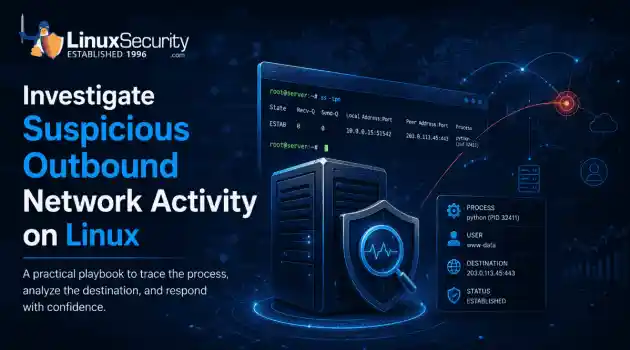
How to Secure My Network incident response network traffic
incident response network traffic Imagine logging into a production Linux server for routine maintenance and noticing background network activity connecting to an unfamiliar external IP address. Your endpoint protection agent is not popping up with an alert, there is no service failure, and on the surface, the system appears to be running normally. . For Linux administrators and security teams, such a situation is a moment of truth: Is this activity a sign of active intrusion or just a tool that was overlooked in the course of...
 Jul 21, 2026
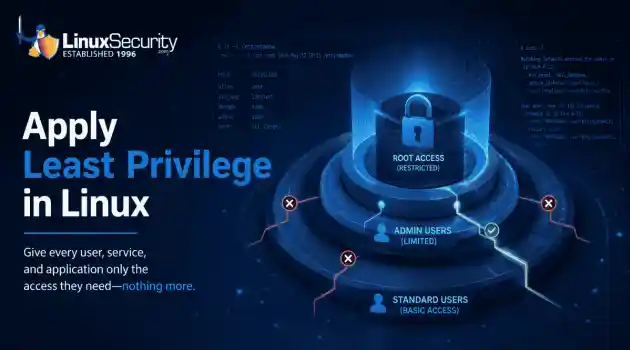
How to Harden My Filesystemsystem hardening open source security
system hardening open source security We all spend a lot of time defending our systems from external threats, but the amount of damage an attacker can cause often depends on what happens after they get in. A single compromised account doesn't always lead to a major incident. The real danger begins when that account has far more access than it actually needs. . That's exactly what the principle of least privilege is designed to prevent. By limiting users, services, and applications to only the permissions required for their jobs,...
Jul 20, 2026
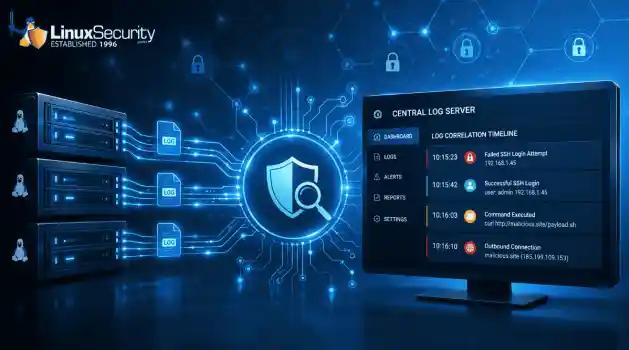
How to Learn Tips and Tricksthreat detection system monitoring
threat detection system monitoring For small security and IT teams, the "enterprise" dream of a fully automated SIEM often feels like a distant luxury. It’s a vision built on massive budgets and dedicated engineering teams—things that, frankly, most of us don't have. But here is the reality: you don’t need a six-figure platform to maintain a secure environment. . Linux systems are, by design, incredibly verbose. Every time a user authenticates, a process executes, or a configuration file changes, your system creates a record of...
Jul 17, 2026
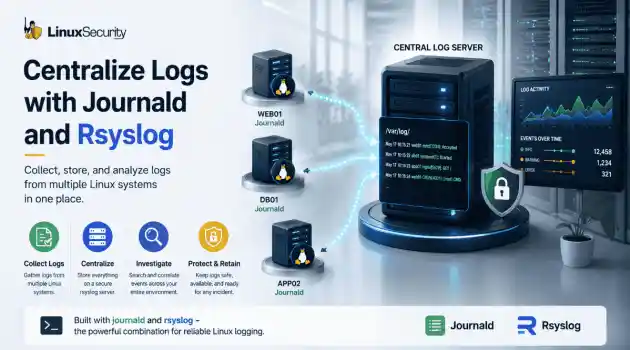
How to Learn Tips and Tricksnetwork security centralized logging
network security centralized logging Linux systems generate a steady stream of authentication, service, kernel, and application logs. On most systems, those logs never leave the machine that created them. If you're responsible for ten or twenty servers, that means checking each one separately. If one disappears before you can investigate it, its logs may disappear with it. Centralized logging solves that by sending log messages to another server as they're created. Instead of searching every machine, you have one place to review...
Jul 15, 2026
How to Secure My Networksecurity advisory audit
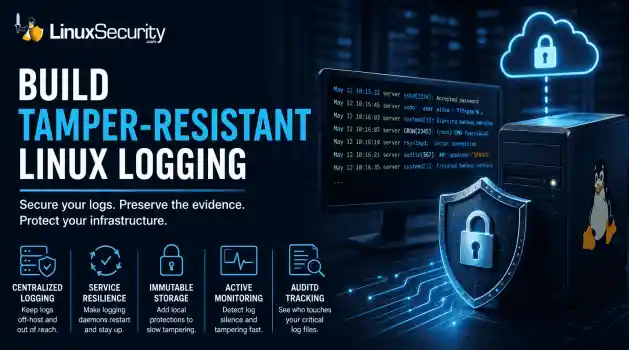
security advisory audit When you’re digging through an incident, your logs are the only thing you can actually trust. The problem is, attackers know that too. If someone gets root on your server, their first move is almost always to delete the evidence and cover their tracks. . If you aren't actively protecting your logs, you're basically flying blind the second a breach happens. It’s a miserable feeling to realize you have no idea what an attacker did because they wiped the logs before you even got there. In this...
Jul 11, 2026
 Refine HOWTOs
X Clear Filters
Get the latest News and Insights
Get the latest Linux and open source security news straight to your inbox.
Community Poll
Should Linux servers automatically install security updates?
Loading...
Explore Latest Linux Security HOWTOs
We found 1 articles for you...
167
 network securitysecurity assessmentsecurity tools
Boost Linux Pentesting with BlackArch Linux's Extensive Tools and Features
Penetration testing (or pentesting) plays an integral part in cybersecurity. Ethical hackers employ this practice to simulate cyberattacks against systems, networks, or applications to locate vulnerabilities before malicious hackers do. The goal of pentesting is identifying and repairing security weaknesses. . Pentesters often rely on operating systems designed for security assessment, such as BlackArch Linux , ParrotOS , and Kali Linux . In this article, we'll focus on BlackArch Linux, outlining its benefits and discussing its prominent use cases alongside its counterparts, ParrotOS and Kali Linux. We aim to highlight how BlackArch Linux could enhance your Linux pentesting and network security efforts while helping you decide which secure Linux distro best fits your needs. Pentesting: What Is Its Importance and Its Purpose? Pentesting serves as a digital military exercise. It prepares organizations to deal with real-world cyber threats by identifying vulnerabilities. By strengthening defenses against potential attacks, this practice helps ensure data integrity and security. Pentesting should not focus on finding and fixing bugs but should explore an organization's overall security posture. Without effective pentesting, organizations remain vulnerable to data breaches, malware infections , and other cyberattacks that could have devastating consequences. What Is BlackArch Linux & What Are Its Main Benefits for Pentesters? BlackArch Linux is an advanced Arch Linux distribution designed specifically to meet the needs of security researchers and ethical hackers. What sets BlackArch apart is its vast repository and minimalist approach, coupled with over 2,700 security tools designed to aid security researchers in their work. These tools cater to every facet of pentesting, from vulnerability assessment and cryptography to reverse engineering and forensic analysis. Pentesters rarely need to search elsewhere for additional software solutions. There are various advantages associatedwith its Arch Linux base, including: Minimalism: Arch Linux is known for its elegance and minimalism. BlackArch adheres to this philosophy by providing an efficient operating system tailored to user needs. Customizability: BlackArch's Arch foundation makes it highly configurable, allowing pentesters to tailor their environment to their specific requirements. Rolling Release Model: Arch Linux and BlackArch Linux adhere to a rolling release model to ensure the up-to-dateness of tools and system components. Efficiency: BlackArch Linux was specifically created to be lightweight and efficient, which makes it essential for pentesters who operate in resource-constrained environments like virtual machines or older hardware. BlackArch's speed and efficiency allow users to complete their tasks quickly. Community and Documentation: At first glance, BlackArch may seem to lag in community support due to its smaller user base than Kali Linux or ParrotOS; however, that is far from true. Its active community remains strong while offering comprehensive documentation even for beginners in Arch. Comparing BlackArch Linux, ParrotOS, and Kali Linux BlackArch Linux, KaliLinux, and ParrotOS are all excellent options for Linux pentesters. That said, each has its own strengths and limitations: Ease of Use: Kali Linux is designed with beginners in mind, boasting an intuitive user interface. Community and Support: BlackArch offers more comprehensive options in terms of toolset capacity than other secure Linux distros. Security Focus: ParrotOS' primary security focus is privacy and sandboxing, featuring tools like Anonsurf for anonymizing network connections and isolating applications. Flexibility: ParrotOS caters to pentesting, forensic analysis, and secure software development projects. User Experience: BlackArch Linux offers a more user-friendly experience that is appealing to newcomers and intermediate users. Though its learning curve may be steeper dueto Arch Linux as its foundation, its benefits outweigh these drawbacks substantially. BlackArch is an efficient, lightweight solution for ideal resource management in environments with limited resources. Here are its primary use cases. Security Assessments: BlackArch Linux provides everything needed for comprehensive security assessments, from surveillance and scanning to exploiting and reporting. Its toolset caters to every stage of pentesting, from the initial survey to full exploitation and reporting. Research and Development: BlackArch is ideal for security researchers and developers working on new exploits or tools. Its vast repository offers abundant resources for security research and tool creation. BlackArch also provides tools for post-incident investigations, making it suitable for post-pentesting investigations. Our Final Thoughts on Improving Linux Pentesting with BlackArch Linux With cybersecurity constantly morphing and shifting, having access to appropriate tools and platforms is critical. BlackArch Linux is an exceptional choice among pentesting platforms thanks to its vast tool repository, Arch Linux core OS base platform, and lightweight nature - an ideal combination for pentesters. Although BlackArch may require more effort when learning than Kali Linux or ParrotOS due to its steep learning curve and a wide array of customizable features compared to those two alternatives, its customizability, efficiency, and breadth of tools make it invaluable for experienced security professionals. Whether conducting comprehensive security assessments, developing exploits, performing forensic analyses, or performing forensic investigations, BlackArch Linux provides a robust and versatile environment suitable for performing these activities and more! You can learn how to install BlackArch Linux and use the pacman package manager in the tutorial linked below. . BlackArch Linux is a potent OS tailored for penetration testing, featuring over 2700 tools for comprehensive securityresearch and vulnerability assessment. BlackArch Linux, Pentesting Tools, Ethical Hacking Techniques, Linux Security Assessment. . Brittany Day
 Jul 24, 2024
•
Jul 24, 2024
• How to Secure My Network
166
security assessmentLinux toolsethical hackingEssential Linux Tools For Subdomain Discovery In Ethical Hacking
If you're an ethical hacker, gathering information about the subdomains of a website is important. Here are some free Linux tools that will help you. . When it comes to web penetration testing, an essential aspect of the reconnaissance stage is the discovery of subdomains. Before diving into the actual pentesting, it's crucial to enumerate subdomains to gain a better understanding of the project's scope. You never know what interesting domains you might stumble upon that could uncover significant vulnerabilities. Here we'll explore some fantastic free Linux tools that can assist you in this subdomain enumeration process. So let's dive in and discover these resources that can enhance your web security assessment capabilities. A subdomain serves as an extension to the main domain of a website, offering a way to organize or differentiate various sections of the site. In a website's domain structure, there are two primary parts: the top-level domain (TLD) and the second-level domain (SLD). In this case, the TLD is " com ," while the SLD is " makeuseof ." Now, if there was a dedicated section for partnerships on the site, the subdomain for this section could be named partnerships, resulting in the full URL partnerships.makeuseof.com . This subdomain allows for easy categorization and navigation within the website.. Uncover vital Linux utilities tailored for ethical hackers to amplify subdomain enumeration and bolster website security evaluations.. Subdomain Discovery, Ethical Hacking Tools, Linux Security Applications. . Brittany Day
Aug 11, 2023
•
How to Learn Tips and Tricks

163
 security toolsecurity assessmentlinux distribution
Scan WordPress Sites For Security Issues With WPScan On Kali
Learn how to use WPScan to scan WordPress for vulnerabilities on Kali Linux in this LinuxConfig.org guide. . Vulnerabilities in WordPress can be uncovered by the WPScan utility, which comes installed by default in Kali Linux . It's also a great tool for gathering general reconnaissance information about a website that's running WordPress. Owners of WordPress sites would be wise to try running WPScan against their site, as it may reveal security issues that need patched. It can also reveal more general web server issues, such as directory listings that haven't been turned off inside Apache or NGINX. . Explore potential weaknesses in WordPress installations employing WPScan on Kali Linux for improved website protection.. WPScan, Kali Linux, WordPress Security, Vulnerability Scan. . Brittany Day
Feb 18, 2021
•
How to Secure My Webserver
163
 John the Rippersecurity assessmentLinux tool
How to Verify Strong Passwords Using John the Ripper on Linux Systems
Are you certain that your end users are utilizing strong passwords on your Linux servers? Let a tool called John the Ripper (JTR) show you who is and who isn't. Learn how this is done in a helpful tutorial. . The security of your Linux servers is only as strong as the passwords used by your end users. If your users have weak passwords, it's only a matter of time before any given ne'er do well breaks into your system to wreak havoc on your network or steal precious data. You don't want that. So what do you do? You can certainly set password policies, but even then, you might have a user that predates the policy or maybe you've set a policy that borders on weak. To make sure your users aren't working with weak passwords, you can employ a tool called John the Ripper (JTR) to make sure those passwords aren't easily crackable. . Secure your Linux servers by effectively auditing user passwords with John the Ripper to enhance overall security and protect sensitive data.. Password Strength, John the Ripper, Linux Passwords, User Security, Authentication Checks. . Brittany Day
May 01, 2020
•
How to Secure My Webserver
167
 security assessmententerprise securitynetwork tool
Examining Nmap: A Key Tool for Network Security in Enterprises
So when many people think of Nmap, it is often related to those who are new or learning in the world of scanning and tracking network ports. It's open source. It's easy to use (with a GUI). It has a full community of friendly users, plays well with friends, is good with children and even makes cupcakes at parties (okay maybe not those last few). The point is, the reality may not always be apparent; that Nmap provides some serious , enterprise, #&$#!-kicking functionality. And while we tend to avoid pushing specific papers or How-tos that cost money, this paper we found brought up a nice point considering that Nmap is, in fact, our Open Source Tool of the Month. So if you were curious as to whether Nmap is serious enough to warrant charging for a how-to, (without shame that is) check this out. Could you find this information elsewhere? Probably. Is it as good? We don't know, we didn't buy it :) Is it easier to understand and follow, especially for someone in a business environment? Just maybe. Either way, when push comes to shove, it's nice to see an open source tool get some attention. And who knows? If there's some company manager that doesn't trust Nmap's functionality, maybe a paid analysis of its utility could go farther in convincing them than some free how-to you found online (even from such a trustworthy, experienced site such as this :) Fair is fair, and heck, its food for thought.. The link for this article located at Elsevier.com is no longer available. . The link for this article located at Elsevier.com is no longer available.. people, think, often, related, those, learning, world. . LinuxSecurity Contributors
Feb 18, 2008
•
How to Secure My Network
166
risk managementsecurity assessmentnetwork analysisEffective Risk Management Using Nmap And SAINT Scanning Techniques
Protect yourself by knowing what services you are offering.. In order to protect your system from crackers, you have to think like one. The first step in determining the level of risk of the services you are offering to the public is to determine what those services are. Chances are you've heard of SATAN, the System Administrator Tool for Analyzing Networks. Designed by Dan Farmer and Wietse Venema, SATAN scans systems for the existence of well known, often exploited vulnerabilities. Todays scanners, such as nmap and SAINT, have become popular tools for determining what ports are open, and potential vulnerabilities for those services. Using nmap, you can port scan large numbers of hosts in a brief period of time using a variety of scanning methods. A typical execution of the program might go like this: dave@mastermind dave$] nmap localhost Starting nmap V. 2.54BETA1 by
Aug 07, 2000
•
How to Learn Tips and Tricks

Get the latest News and Insights
Get the latest Linux and open source security news straight to your inbox.
Community Poll
Should Linux servers automatically install security updates?
Search Topics
Powered By

Linux Security - Your source for Top Linux News, Advisories, HOWTOs and Feature Releases
QUICK LINKS
subscribe to newsletters!
Like staying secure? So do we.
Sign up for updates, tips, and alerts!