Overly broad permissions can turn one compromised account into a much larger security problem. Learn how to reduce unnecessary access, review privileges, and apply least privilege across modern Linux systems. Review Linux Privileges×


Stay Ahead With Linux Security HOWTOs
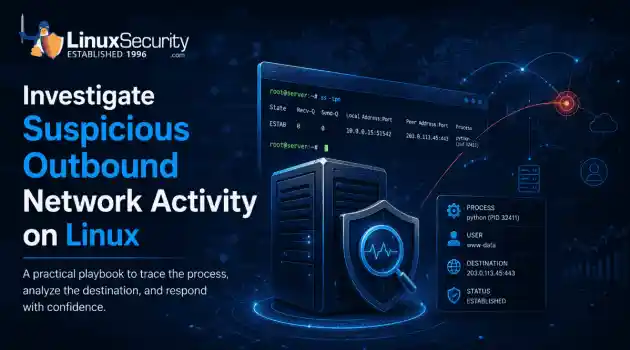
How to Secure My Network incident response network traffic
incident response network traffic Imagine logging into a production Linux server for routine maintenance and noticing background network activity connecting to an unfamiliar external IP address. Your endpoint protection agent is not popping up with an alert, there is no service failure, and on the surface, the system appears to be running normally. . For Linux administrators and security teams, such a situation is a moment of truth: Is this activity a sign of active intrusion or just a tool that was overlooked in the course of...
 Jul 21, 2026
How to Harden My Filesystemsystem hardening open source security
system hardening open source security We all spend a lot of time defending our systems from external threats, but the amount of damage an attacker can cause often depends on what happens after they get in. A single compromised account doesn't always lead to a major incident. The real danger begins when that account has far more access than it actually needs. . That's exactly what the principle of least privilege is designed to prevent. By limiting users, services, and applications to only the permissions required for their jobs,...
Jul 20, 2026
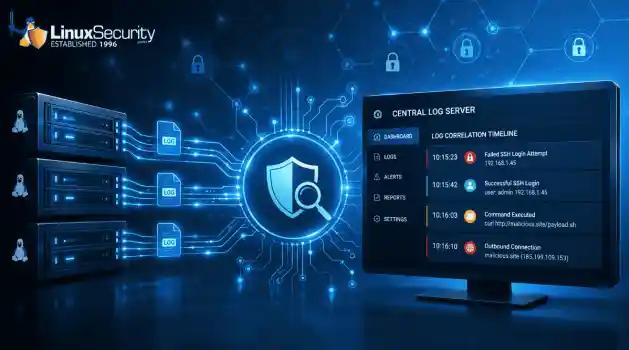
How to Learn Tips and Tricksthreat detection system monitoring
threat detection system monitoring For small security and IT teams, the "enterprise" dream of a fully automated SIEM often feels like a distant luxury. It’s a vision built on massive budgets and dedicated engineering teams—things that, frankly, most of us don't have. But here is the reality: you don’t need a six-figure platform to maintain a secure environment. . Linux systems are, by design, incredibly verbose. Every time a user authenticates, a process executes, or a configuration file changes, your system creates a record of...
Jul 17, 2026
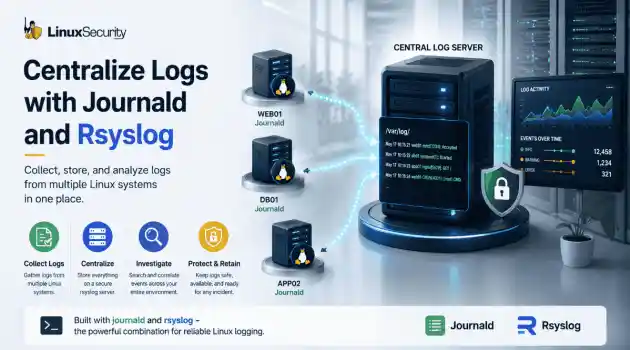
How to Learn Tips and Tricksnetwork security centralized logging
network security centralized logging Linux systems generate a steady stream of authentication, service, kernel, and application logs. On most systems, those logs never leave the machine that created them. If you're responsible for ten or twenty servers, that means checking each one separately. If one disappears before you can investigate it, its logs may disappear with it. Centralized logging solves that by sending log messages to another server as they're created. Instead of searching every machine, you have one place to review...
Jul 15, 2026
How to Secure My Networksecurity advisory audit
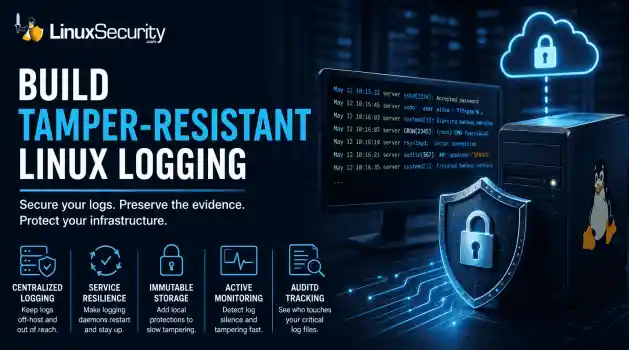
security advisory audit When you’re digging through an incident, your logs are the only thing you can actually trust. The problem is, attackers know that too. If someone gets root on your server, their first move is almost always to delete the evidence and cover their tracks. . If you aren't actively protecting your logs, you're basically flying blind the second a breach happens. It’s a miserable feeling to realize you have no idea what an attacker did because they wiped the logs before you even got there. In this...
Jul 11, 2026
 Refine HOWTOs
X Clear Filters
Get the latest News and Insights
Get the latest Linux and open source security news straight to your inbox.
Community Poll
Should Linux servers automatically install security updates?
Loading...
Explore Latest Linux Security HOWTOs
We found -3 articles for you...
166
 kernel updateLinux administrationautomatic updates
Automatic Kernel Updates: Configure Rebootless Patching on Linux
Learn how to set up automatic rebootless kernel updates using the live patching solutions from Canonical and CloudLinux in this 3-minute tutorial. . Applying security updates to the Linux kernel is a straightforward process that can be done using tools such as apt , yum , or kexec . However, when managing hundreds or thousands of servers running different Linux distribution to patch, this method can be challenging and time-consuming. Manually updating the kernel requires rebooting the system. This results in downtime, which can be problematic, so reboots are usually scheduled to occur at specific time intervals. Because manual patching is done during these cycles, it provides hackers with a “time window” in which they can attack the server infrastructure. . Explore the approach for smooth kernel updates through live patching methods that guarantee continuous system performance while applying important patches without rebooting. Kernel Updates, Linux Administration, Live Patching Solutions. . Brittany Day
 Sep 09, 2020
•
Sep 09, 2020
• How to Learn Tips and Tricks
166
 software managementsystem securityRPM
Update Strategies For RPM And Debian Systems: Enhance Security
Having Outdated software is just asking for trouble.. Once an error, bug or vulnerability is found in a software package, a patch and an updated RPM are released. If the system does not contain the most current version of the software, a cracker can use an exploit to gain root access and cause damage to your precious data. Several programs exist to assist you in ensuring your host contains the most recent forms of software. AutoRPM is a program that compares the database of RPM packages installed on your host to several different FTP sites looking for new packages. Conveniently enough, there is an RPM of AutoRPM located at Rpmfind mirror . Install the RPM and read the man pages for autorpm and autorpm.conf. The default settings for autorpm.conf should work well. To run AutoRPM, enter this into the command line: /usr/sbin/autorpm --interactive Once that is entered, a screen comes up that gives different options about how to proceed. Just go through the screens, taking actions as needed. For more information, go to AutoRPM's home page: While AutoRPM is a very useful tool, it can only be used on systems that use RPMs. For Debian GNU/Linux, there is a tool called apt-get. Apt-get requires a sources.list file that is in the /etc/apt directory and is similar to *-update files that come already filled out with AutoRPM. The syntax for a line of sources.list goes like this: deb URL release-type package-type The URL can be either a local directory, a CD-ROM, a web site, or an ftp site. The release-type field looks for either stable or unstable. It should probably always be set to stable, except for the very adventurous. The package-type field refers to the type of package. The values can be either main, contrib or non-free. Packages that fall under the category of main are packages that can be found on the Debian GNU/Linux CD. Contrib packages are packages that are GNU packages, but didn't make it onto the Debian CD. Non-Free are packages that do mean the FSF definition of"free." Example lines of sources.list are: deb file:/cdrom stable main deb http://ftp.debian.org/ stable main contrib deb stable main contrib After the sources.list is set up, run apt-get update To update information about packages available. Run apt-get install package-name To install a package. Run apt-get upgrade To bring all of your currently used packages to newest version. To find more information about apt-get, read Learning Debian GNU/Linux by Bill McCarty, published by O'Reilly and associates. . Keep your systems secure by regularly checking for and applying software updates with YUM and apt for RPM and Debian environments.. Software Management,RPM Security,Debian Update Tools. . Anthony Pell
Jul 23, 2000
•
How to Learn Tips and Tricks


Get the latest News and Insights
Get the latest Linux and open source security news straight to your inbox.
Community Poll
Should Linux servers automatically install security updates?
Search Topics
Powered By

Linux Security - Your source for Top Linux News, Advisories, HOWTOs and Feature Releases
QUICK LINKS
subscribe to newsletters!
Like staying secure? So do we.
Sign up for updates, tips, and alerts!