Overly broad permissions can turn one compromised account into a much larger security problem. Learn how to reduce unnecessary access, review privileges, and apply least privilege across modern Linux systems. Review Linux Privileges×


Stay Ahead With Linux Security HOWTOs
How to Harden My Filesystem system hardening open source security
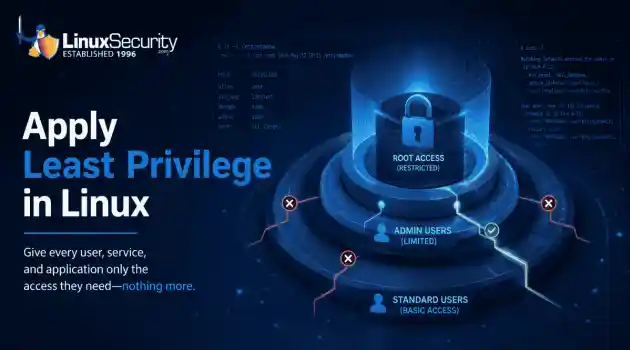
system hardening open source security We all spend a lot of time defending our systems from external threats, but the amount of damage an attacker can cause often depends on what happens after they get in. A single compromised account doesn't always lead to a major incident. The real danger begins when that account has far more access than it actually needs. That's exactly what the principle of least privilege is designed to prevent. By limiting users, services, and applications to only the permissions required for their jobs, you...
 Jul 20, 2026
How to Learn Tips and Tricksthreat detection system monitoring
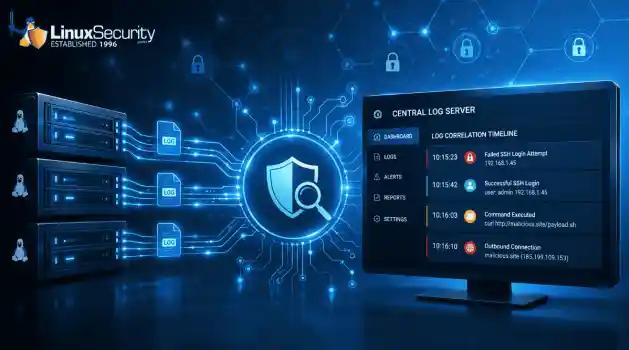
threat detection system monitoring For small security and IT teams, the "enterprise" dream of a fully automated SIEM often feels like a distant luxury. It’s a vision built on massive budgets and dedicated engineering teams—things that, frankly, most of us don't have. But here is the reality: you don’t need a six-figure platform to maintain a secure environment. . Linux systems are, by design, incredibly verbose. Every time a user authenticates, a process executes, or a configuration file changes, your system creates a record of...
Jul 17, 2026
How to Learn Tips and Tricksnetwork security centralized logging
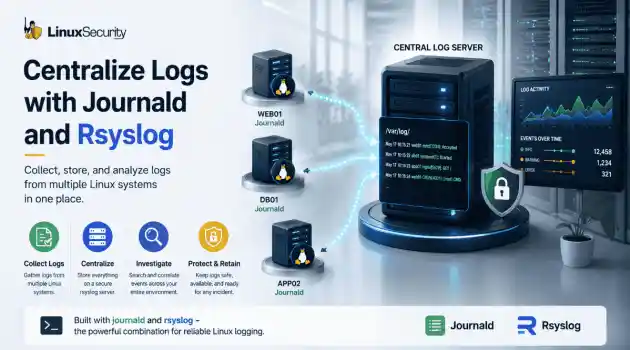
network security centralized logging Linux systems generate a steady stream of authentication, service, kernel, and application logs. On most systems, those logs never leave the machine that created them. If you're responsible for ten or twenty servers, that means checking each one separately. If one disappears before you can investigate it, its logs may disappear with it. Centralized logging solves that by sending log messages to another server as they're created. Instead of searching every machine, you have one place to review...
Jul 15, 2026
How to Secure My Networksecurity advisory audit
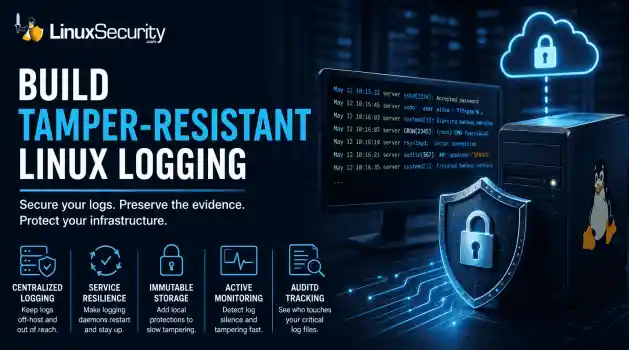
security advisory audit When you’re digging through an incident, your logs are the only thing you can actually trust. The problem is, attackers know that too. If someone gets root on your server, their first move is almost always to delete the evidence and cover their tracks. . If you aren't actively protecting your logs, you're basically flying blind the second a breach happens. It’s a miserable feeling to realize you have no idea what an attacker did because they wiped the logs before you even got there. In this...
Jul 11, 2026
How to Harden My Filesystemlog analysis security incident
log analysis security incident When an attacker breaks into a Linux system, their work is rarely done. Usually, the real work starts after the initial exploit: hiding their tracks. If you’re a Linux admin or security analyst, there is nothing worse than logging in, running a few commands, and realizing the logs aren't telling the whole story. When logs are missing or look "off," your primary source of truth is compromised. This guide covers how to handle that situation. We’ll walk through the workflow you need to determine...
Jul 10, 2026
 Refine HOWTOs
X Clear Filters
Get the latest News and Insights
Get the latest Linux and open source security news straight to your inbox.
Community Poll
Should Linux servers automatically install security updates?
Loading...
Explore Latest Linux Security HOWTOs
We found -2 articles for you...
162
 security practicesdata privacysensitive data
Tutorial: Hide Sensitive Files On Linux Desktop File Managers
Want to hide sensitive files and folders from your Linux desktop file manager? Learn about one method for doing this in a helpful tutorial. . You probably already know the traditional method of hiding files on the Linux command line. If not, any file that begins with a . will not be seen with the ls command, unless you add the -a option. Those same files and directories will be hidden from the file manager unless you explicitly tell the file manager to show those secreted files. This is a handy way to hide sensitive information (such as app configurations and the like) away from prying eyes. Although not truly a means to security, it shouldn't be overlooked as an additional layer. . Discover methods to secure private documents on the Linux desktop by employing straightforward strategies.. File Hiding Techniques,Linux Sensitive Data Management,Desktop File Privacy. . Brittany Day
 Aug 14, 2020
•
Aug 14, 2020
• How to Strengthen My Privacy
160
 data managementsensitive datadata deletion
Comprehensive Guide on Securely Erasing Files Using Wipe Tool
Wipe is a secure file wiping utility.. The link for this article located at Wipe: Secure File Deletion is no longer available. . The link for this article located at Wipe: Secure File Deletion is no longer available.. secure, wiping, utility, article, located, deletio. . Anthony Pell
Jan 10, 2005
•
How to Harden My Filesystem

166
authenticationsensitive dataweb accessSecure Sensitive Data Access Using Apache Password Protection
Sensitive information that only certain people need to have web access to must be secured.. Sensitive information that only certain people need to have web access to must be secured. If sensitive or proprietary information is located on your web site and you do not want public access to this information, you must password it. An obscure file name with no links to it anywhere on the site will not keep the information secure. Security through obscurity does not work. To password a file, a series of files or a directory in Apache, the httpd.conf file must be edited. Then, a database of usernames and passwords must be created. AuthType Basic AuthName "Secret" AuthUserFile /usr/local/apache/users require valid-user In this example, all files that begin with secret. will require authentication. If only one file needed to be password protected, the example could be changed to: Similarly, if a directory needed to be password protected, the example could be changed to this: Now back to the original example, the authentication type is basic, meaning it is just a text file, not a true database. When someone tries to go to one of the pages that is protected, the box that asks for a username and password will be titled Secret. The text file with the usernames and passwords will be called users and be located in the /etc/httpd/conf directory. According to the require field, any user in the users file is allowed access. To set up the text file with usernames and passwords, the program htpasswd must be used. It is located in the bin directory when you install apache. The syntax is very simple for this program. The first time htpasswd is run for the users file, it should be called like this: root# /usr/bin/htpasswd -m -c filename username In our example, it would look something like this: root# /usr/bin/htpasswd -m /etc/httpd/conf/users canisab For more information about this and similar things, goto Welcome to The Apache Software Foundation! . Also, there are great books such as Apache: The Definitive Guide by Ben and Peter Laurie. . Safeguard confidential data on your site by utilizing Nginx security measures. Discover how through professional guidance.. Apache Authentication, Sensitive Data Security, Web Access Control. . Anthony Pell
Jul 23, 2000
•
How to Learn Tips and Tricks

Get the latest News and Insights
Get the latest Linux and open source security news straight to your inbox.
Community Poll
Should Linux servers automatically install security updates?
Search Topics
Powered By

Linux Security - Your source for Top Linux News, Advisories, HOWTOs and Feature Releases
QUICK LINKS
subscribe to newsletters!
Like staying secure? So do we.
Sign up for updates, tips, and alerts!