Overly broad permissions can turn one compromised account into a much larger security problem. Learn how to reduce unnecessary access, review privileges, and apply least privilege across modern Linux systems. Review Linux Privileges×


Stay Ahead With Linux Security HOWTOs
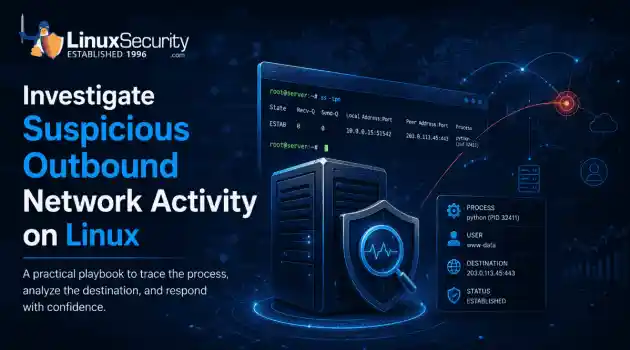
How to Secure My Network incident response network traffic
incident response network traffic Imagine logging into a production Linux server for routine maintenance and noticing background network activity connecting to an unfamiliar external IP address. Your endpoint protection agent is not popping up with an alert, there is no service failure, and on the surface, the system appears to be running normally. . For Linux administrators and security teams, such a situation is a moment of truth: Is this activity a sign of active intrusion or just a tool that was overlooked in the course of...
 Jul 21, 2026
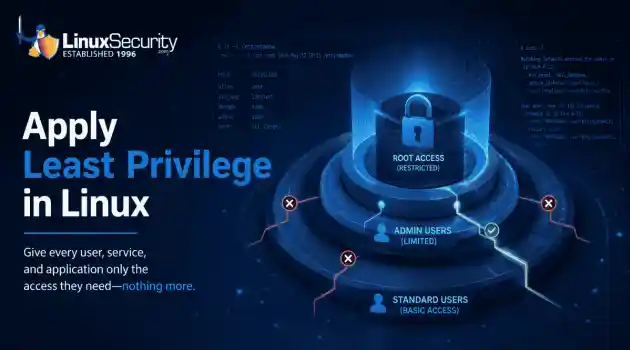
How to Harden My Filesystemsystem hardening open source security
system hardening open source security We all spend a lot of time defending our systems from external threats, but the amount of damage an attacker can cause often depends on what happens after they get in. A single compromised account doesn't always lead to a major incident. The real danger begins when that account has far more access than it actually needs. . That's exactly what the principle of least privilege is designed to prevent. By limiting users, services, and applications to only the permissions required for their jobs,...
Jul 20, 2026
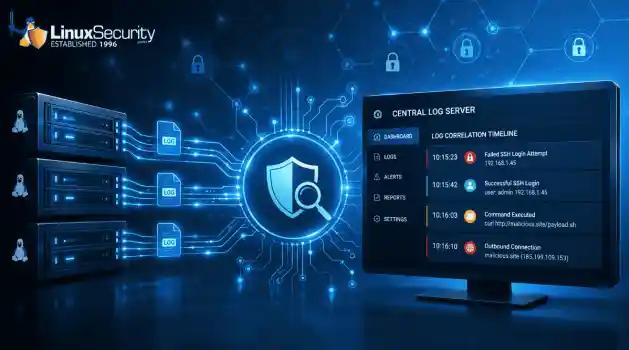
How to Learn Tips and Tricksthreat detection system monitoring
threat detection system monitoring For small security and IT teams, the "enterprise" dream of a fully automated SIEM often feels like a distant luxury. It’s a vision built on massive budgets and dedicated engineering teams—things that, frankly, most of us don't have. But here is the reality: you don’t need a six-figure platform to maintain a secure environment. . Linux systems are, by design, incredibly verbose. Every time a user authenticates, a process executes, or a configuration file changes, your system creates a record of...
Jul 17, 2026
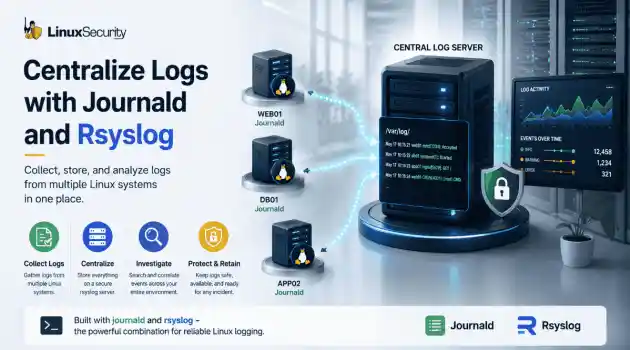
How to Learn Tips and Tricksnetwork security centralized logging
network security centralized logging Linux systems generate a steady stream of authentication, service, kernel, and application logs. On most systems, those logs never leave the machine that created them. If you're responsible for ten or twenty servers, that means checking each one separately. If one disappears before you can investigate it, its logs may disappear with it. Centralized logging solves that by sending log messages to another server as they're created. Instead of searching every machine, you have one place to review...
Jul 15, 2026
How to Secure My Networksecurity advisory audit
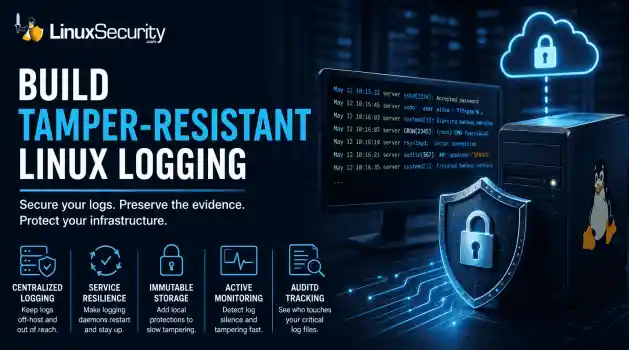
security advisory audit When you’re digging through an incident, your logs are the only thing you can actually trust. The problem is, attackers know that too. If someone gets root on your server, their first move is almost always to delete the evidence and cover their tracks. . If you aren't actively protecting your logs, you're basically flying blind the second a breach happens. It’s a miserable feeling to realize you have no idea what an attacker did because they wiped the logs before you even got there. In this...
Jul 11, 2026
 Refine HOWTOs
X Clear Filters
Get the latest News and Insights
Get the latest Linux and open source security news straight to your inbox.
Community Poll
Should Linux servers automatically install security updates?
Loading...
Explore Latest Linux Security HOWTOs
We found 0 articles for you...
166
 access controlsystem hardeningservice isolation
Manage Linux Services for Better Security and System Hardening
One of the most important responsibilities in Linux system administration is managing services. Services are long-running programs that provide different functionalities for users, local systems, or remote computers. . These services enable the networking capabilities we take for granted daily in our digital interactions and are essential to Linux security and hardening. Email transfer, web servers, and printing services are common services. To help you better manage Linux services to streamline and secure your administration efforts, let's examine common Linux services and their functions, the intersection of services and security, and the type of management these services require. Understanding Linux Services Let's begin by looking at some examples of common services and their functions on Linux: sshd: sshd is the Secure Shell (ssh), a remote administration tool essential for Linux systems. Apache Web server: This is a common service used to host websites and web applications. Firewalld: Firewalld filters network traffic according to predefined rules and enhances system security. Common Unix Printing System service (CUPS): The Common Unix Printing System service (CUPS) streamlines the management of print servers. How Does Service Management Impact Linux Security? Managing these services effectively for operational efficiency, enhancing security, and minimizing vulnerabilities is essential. Here are some of the key aspects of service management that relate to security: Configuration settings: Linux services rely on configuration files to dictate their behavior. Administrators need to ensure these settings are configured correctly to avoid security holes. Restarting services: It is important to restart the service after making any changes to the configuration. This will ensure that all the settings are applied. Failure to do this can result in discrepancies in the service's behavior compared to the intended configuration. StartupConfiguration: Using systemctl commands such as enable and disable , administrators can instruct services to start or stop automatically during system boot. This allows them to control the attack surface. Monitor Service Status: By regularly checking service statuses, administrators can quickly address service disruptions and potential security issues. Maintenance of Service Accessibility: It is important to manage service accessibility to reduce the risk of security breaches and to prevent unauthorized entry. Service Removal: Disabling and removing unnecessary services using the systemctl command directly impacts your system's security. Inactive or unused services can be used as entry points for malicious actors. It should be noted that updating your services with the latest security patches to protect against cyber threats is essential for effective and secure service management, and the importance of this best practice must not be overlooked. Why Is Service Management Essential to System Hardening? Hardening Linux systems involves minimizing its attack surface and removing unnecessary components. Service management is crucial to security hardening as it allows administrators to: Identify Unneeded Services and Disable Them: Sysadmins can reduce the security risk of their system by conducting an audit and disabling unnecessary services. Implement Access Controls: Services should have appropriate access controls configured to limit the users who can interact with them. This will prevent unauthorized users from exploiting vulnerabilities. Regular Auditing & Monitoring: Maintaining a secure environment in which services are continuously monitored for abnormal behavior, unauthorized access attempts, or potential security breaches is essential. Implement Service Isolation: By ensuring that services are isolated from critical components of the system, you can reduce the risk of a service compromise affecting the overall security. Our FinalThoughts on Using Service Management to Improve Security Effective service management is crucial to maintaining the functionality of Linux systems. It also helps improve security and hardening. Administrators can improve the security of their systems by implementing good configuration practices, regular updates, access control, and regular monitoring. Service management is an important part of a broader security plan, as it helps to ensure that Linux systems are resilient against cyber threats. We encourage you to continue your educational journey by learning about Linux service configuration, startup options, and more in the tutorial linked below. . Efficiently handling Linux services boosts security measures while reducing potential risks, contributing to streamlined operations.. Linux System Services, Security Hardening, Service Management, Linux Administration, Access Control. . Anthony Pell
 Aug 21, 2024
•
Aug 21, 2024
• How to Learn Tips and Tricks
166
service managementsystemdsystemctlManaging Systemd Services: Your Guide to Systemctl Command Usage
Your Linux computer relies on a lot of background tasks called services or daemons. On systemd-based distributions you have built-in commands that let you see which services are running, disabled, or failed. . Services and daemons are background tasks that run without a user interface, don’t require human interaction, and are usually started as the computer boots up. At one time, services were launched by init , which was the very first process to be launched. The details of the services were held in a collection of scripts located in the “/etc/init/d” directory. On non-systemd distributions that’s still the case. The link for this article located at How-To Geek is no longer available. . Gain insight into administrating and enumerating services on systemd-powered Linux distributions through the proficient use of systemctl commands.. Service Management,Systemctl Commands,Daemon Administration,Linux Systemd,Background Tasks. . Brittany Day
Oct 24, 2022
•
How to Learn Tips and Tricks

166
 Linux administrationservice managementsystemctl
Enhance Governance of Masked Services within Linux Operating Environments
Here's everything you need to know about masked services in Linux. . Have you ever gone to start or stop a service in Linux using the systemctl command only to see a warning such as: Failed to start postgresql.service: Unit postgresql.service is masked You know you installed the Postgresql database server and it was working properly, yet somehow you no longer have control over the service. You can’t manage it in any way. What happened? First of all, masks are a different way of disabling a service. Here’s the difference: When you disable a service with sudo systemctl disable , all symlinks for the service are removed. When masking a service, the symlinks are moved and then point to /dev/null. When you simply disable a service, it can still be started manually. When you mask a service, it cannot be started manually. In other words, masking a service renders the service permanently unusable until it’s unmasked. . Grasping hidden services in Unix aids in sustaining efficient service oversight utilizing systemctl commands and implementations.. masked Services, service management, Linux administration. . Brittany Day
Jul 22, 2022
•
How to Learn Tips and Tricks
166
 process monitoringLinux servicesservice management
Gaining Proficiency in Linux Service Control via the Systemctl Command
Knowing how to list and check the status of running services is essential when debugging system issues. Learn how to list and manage Linux services using the Systemctl utility in this Linuxize tutorial. . In Linux, a service is a program that runs in the background . Services can be started on-demand or at the boot time. If you are using Linux as your primary operating system or development, platform you will deal with different services such as webserver, ssh or, cron . Knowing how to list running services or check the service status is important when debugging system issues. Most of the recent Linux distributions are using systemd as the default init system and service manager. . Understand the utilization of Systemctl for overseeing and verifying the operational state of services in Linux to enhance troubleshooting capabilities.. Service Management,Systemctl Usage,Linux Services,Process Monitoring. . Brittany Day
Dec 29, 2020
•
How to Learn Tips and Tricks
167
 network monitoringopen source toolsystem configuration
Setting Up Nagios Network Monitoring For Effective Management
Ever wanted to set up a robust, manageable and capable network monitoring system? How about one that is free to download? Look no further than Nagios with this HowTo from Rainer Brunold at Novell. With these basic steps you'll be able to pin down movement on your network in no time: Server Preparation Software Download and Extraction Security Preparation Software Compilation and Installation Installation of Plugins Configuration Apache Security Preparation Apache and Nagios Startup Testing and Next Steps Take Nagios for a spin and look out for more of the same soon! . The link for this article located at Novell is no longer available. . Explore streamlined approaches to configure Nagios for peak network surveillance and practical management techniques.. Nagios Monitoring, Network Management, Service Monitoring. . LinuxSecurity Contributors
Oct 24, 2007
•
How to Secure My Network

Get the latest News and Insights
Get the latest Linux and open source security news straight to your inbox.
Community Poll
Should Linux servers automatically install security updates?
Search Topics
Powered By

Linux Security - Your source for Top Linux News, Advisories, HOWTOs and Feature Releases
QUICK LINKS
subscribe to newsletters!
Like staying secure? So do we.
Sign up for updates, tips, and alerts!