Audit Linux privileges now to limit compromise, escalation, and system-wide damage. Review Linux Privileges×


Stay Ahead With Linux Security HOWTOs
How to Learn Tips and Tricks incident response system monitoring
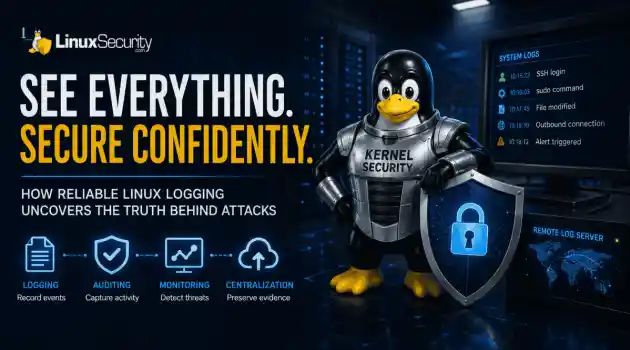
incident response system monitoring A Linux server can be fully patched, hardened, and compliant, yet still leave investigators unable to explain how an attacker got in. Without reliable Linux logging, even a well-secured system can become impossible to investigate. . Hardening defines what a system should allow, but logs reveal what actually happened. When visibility is incomplete, security teams lose the evidence they need to detect attacks, understand their scope, and determine how they unfolded. Why Linux Logging Must Come...
 Jul 23, 2026
How to Secure My Networkincident response network traffic
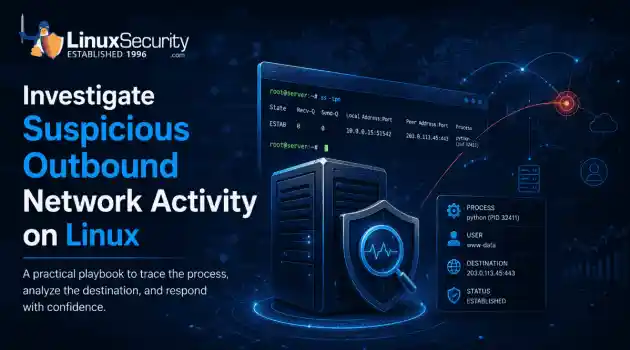
incident response network traffic Imagine logging into a production Linux server for routine maintenance and noticing background network activity connecting to an unfamiliar external IP address. Your endpoint protection agent is not popping up with an alert, there is no service failure, and on the surface, the system appears to be running normally. . For Linux administrators and security teams, such a situation is a moment of truth: Is this activity a sign of active intrusion or just a tool that was overlooked in the course of...
Jul 21, 2026
How to Harden My Filesystemsystem hardening open source security
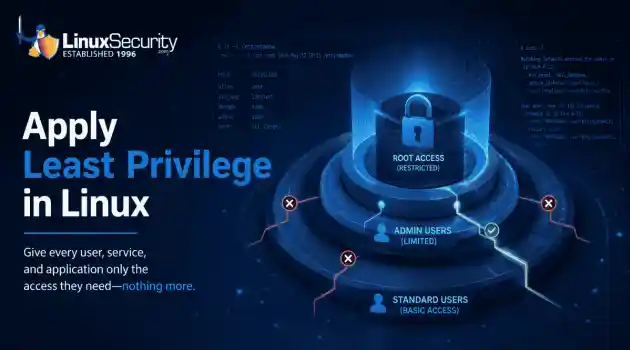
system hardening open source security We all spend a lot of time defending our systems from external threats, but the amount of damage an attacker can cause often depends on what happens after they get in. A single compromised account doesn't always lead to a major incident. The real danger begins when that account has far more access than it actually needs. . That's exactly what the principle of least privilege is designed to prevent. By limiting users, services, and applications to only the permissions required for their jobs,...
Jul 20, 2026
How to Learn Tips and Tricksthreat detection system monitoring
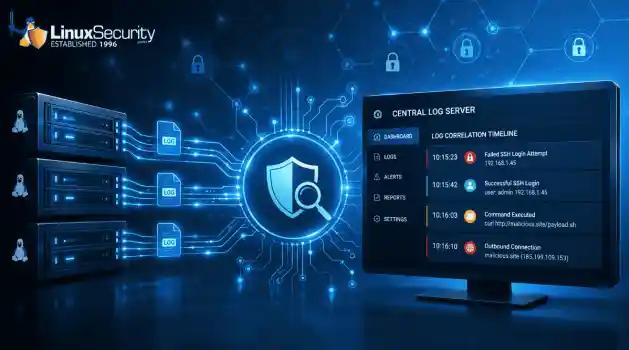
threat detection system monitoring For small security and IT teams, the "enterprise" dream of a fully automated SIEM often feels like a distant luxury. It’s a vision built on massive budgets and dedicated engineering teams—things that, frankly, most of us don't have. But here is the reality: you don’t need a six-figure platform to maintain a secure environment. . Linux systems are, by design, incredibly verbose. Every time a user authenticates, a process executes, or a configuration file changes, your system creates a record of...
Jul 17, 2026
How to Learn Tips and Tricksnetwork security centralized logging
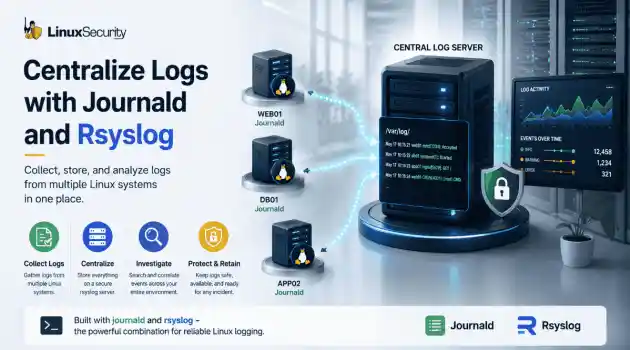
network security centralized logging Linux systems generate a steady stream of authentication, service, kernel, and application logs. On most systems, those logs never leave the machine that created them. If you're responsible for ten or twenty servers, that means checking each one separately. If one disappears before you can investigate it, its logs may disappear with it. Centralized logging solves that by sending log messages to another server as they're created. Instead of searching every machine, you have one place to review...
Jul 15, 2026
 Refine HOWTOs
X Clear Filters
Get the latest News and Insights
Get the latest Linux and open source security news straight to your inbox.
Community Poll
Should Linux servers automatically install security updates?
Loading...
Explore Latest Linux Security HOWTOs
We found -2 articles for you...
160
 data protectionLinux administrationencryption utility
How to Use Cryptmount for Encrypted Filesystems on Linux
Looking for a way to create encrypted filesystems on Linux? Cryptmount is a powerful utility that allows any user to access encrypted filesystems on-demand under GNU/Linux systems without requiring root privileges. . It requires Linux 2.6 or higher. It handles both encrypted partitions as well as encrypted files. It makes it as easy (compared to older approaches such as cryptoloop device driver and dm-cryptdevice-mapper target) for ordinary users to access encrypted filesystems on-demand using the newer devmapper mechanism. Cryptmount helps a system administrator in creating and managing encrypted filesystems based on the kernel’s dm-crypt device-mapper target. . Effortlessly set up and control secure storage areas on Linux with Cryptmount, a robust and intuitive tool.. Encrypted Filesystems, Cryptmount, Linux Encryption Utility, Data Protection, User Access Control. . Brittany Day
 Jun 12, 2020
•
Jun 12, 2020
• How to Harden My Filesystem
166
 user access controlLinux configurationrestricted shell
Using Restricted Shell For Access Control In Linux Systems
Learn how to prevent Linux users from executing certain commands and confining them to their home directory by employing rbash. . You have users logging in to your Linux system. Those users might have not have sudo rights, but they quite possibly could have free rein to poke around most of the system directory tree. You don't want that. Why? Although those users might not be able to edit the vast majority of your configuration files, you certainly don't want those users viewing them. Same holds true for your client data--you want that locked down. But how do you prevent users from being able to access your directory hierarchy without having to tweak the permissions of every file and folder on the system, which could seriously complicate things? The link for this article located at TechRepublic is no longer available. . Learn how to restrict Linux users with rbash: limit their command usage and ensure activities are confined to their home directories with our guide.. Linux User Management, Restricted Shells, RBash Usage, Secure Linux Access. . Brittany Day
Feb 21, 2020
•
How to Learn Tips and Tricks

166
 security practicesaccess controlPAM
Implementing PAM for Authentication: Control Access and Improve Security
Pluggable Authentication Modules is a method for authenticating users.. Pluggable Authentication Modules is a method for authenticating users. Using PAM, programmers can provide a more easy and verstile means of performing authentication functions. The ability to change from basic password authentication to the use of smart cards or even biometrics can be changed without having to recompile programs or require serious modifications. Additionally, PAM can be used to modify the terms of access by users as well as system resources. Just a few of the things you can do with PAM: Use a different encryption method for passwords such as MD5, making them harder to brute force decode; Set resource limits on all your users so they can't perform denial of service attacks (number of processes, amount of memory, etc) Enable shadow passwords on the fly Allow specific users to login only at specific times from specific places Within a few hours of installing and configuring your system, you can prevent many attacks before they even occur. For example, use PAM to disable the system-wide usage of .rhosts files in user's home directories by adding these lines to /etc/pam.d/login : # # Disable rsh/rlogin/rexec for users # login auth required pam_rhosts_auth.so no_rhosts Set filesystem limits instead of allowing unlimited as is the default. You can control the per-user limits using the resource-limits PAM module and /etc/pam.d/limits.conf . For example, limits for group 'users' might look like this: @users hard core 0 @users hard nproc 50 @users hard rss 5000 This says to limit the creation of core files to zero bytes, restrict the number of processes to 50, and restrict memory usage per user to 5 Meg. References The main Linux-PAM has a great deal of (sometimes out-of-date) information on configuring and using PAM. The Linux-PAM System Administrators' Guide is a"draft" document that describes the usage of the default PAM modules. This Red Hat whitepaper on Enhanced Console Access describes how you can configure PAM to authorize ordinary users to access system devices such as the floppy. The Red Hat User Guide contains a section on User Authentication with PAM that explains the basics of PAM as well as some more advanced techniques. Keep in mind that there is the potential to create a situation whereby even root doesn't have access to the system, creating all kinds of configuration headaches. Use caution. . Pluggable Authentication Modules is a method for authenticating users. Using PAM, programmers can pr. pluggable, authentication, modules, method, authenticating, users. . Anthony Pell
Jul 30, 2000
•
How to Learn Tips and Tricks

Get the latest News and Insights
Get the latest Linux and open source security news straight to your inbox.
Community Poll
Should Linux servers automatically install security updates?
Search Topics
Powered By

Linux Security - Your source for Top Linux News, Advisories, HOWTOs and Feature Releases
QUICK LINKS
subscribe to newsletters!
Like staying secure? So do we.
Sign up for updates, tips, and alerts!