Explore top 10 tips to secure your open-source projects now. Read More
×


Attacks Targeting South Korean Web Servers: MeshAgent & SuperShell in Play
 Jun 30, 2025
•
Jun 30, 2025
•
 Brittany Day
3 - 6 min read

Topics Covered
Linux admins and infosec professionals, let’s talk about a sophisticated attack campaign targeting South Korean web servers. Threat actors are leveraging file upload vulnerabilities to deploy web shells and advanced malware, such as MeshAgent and SuperShell, in a coordinated, multi-stage process.
If you’re responsible for keeping servers secure, particularly Linux systems, this is one you’ll want to pay close attention to. It’s not just about patching anymore. These attacks highlight vulnerabilities in web-facing applications that could expose you to lateral movement and deep system compromise if not addressed properly.
We’ll unravel the technical details, step by step, of what makes this campaign so dangerous and, more importantly, how you can protect your infrastructure. Consider this a conversation, not theoretical chatter, but real-world strategies you can use immediately to reduce attack surfaces and tighten your defenses.
The Anatomy of the Attack
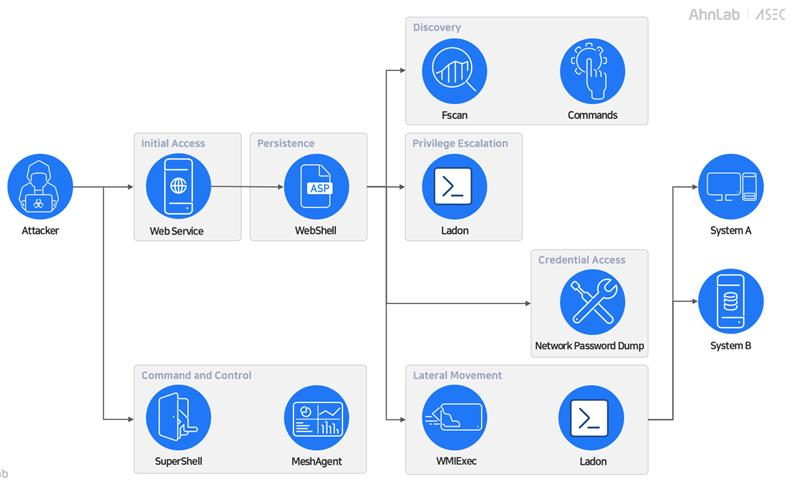 Attack Flow Chart (Source: asec)Let’s start with the basics here. The problem begins with exploited file upload vulnerabilities. Many frameworks, web applications, and CMS platforms allow users—often without sufficient validation—to upload files to a public directory. When security mechanisms fail to check these files properly, attackers use them to sneak in web shells. These aren’t rare tools—names like Chopper, Godzilla, and ReGe-ORG are prevalent and readily accessible online.
Now imagine this: as soon as an attacker installs a web shell, they gain control over your server, from executing arbitrary commands to establishing persistence. They aren’t stopping at basic recon either. Instead, they pivot through multiple attack phases that showcase their agility and sophistication:
- Initial Breach Using Web Shells: This is where it all kicks off—using malware-laced uploads to install web shells. These tools serve as remote consoles, giving attackers continual access.
- Persistence and Command Execution: The attackers install robust tools like SuperShell, a lightweight reverse shell written in Go, or MeshAgent, a remote management tool with cross-platform functionality. If you’re running Linux, don’t think you’re immune—MeshAgent works seamlessly on Linux servers too.
- Recon and Privilege Escalation: With tools like Fscan, threat actors aggressively scan internal networks and systems for vulnerabilities to exploit next. Then comes SweetPotato or PowerLadon—efficient utilities for escalating privileges, enabling attackers to run commands with elevated rights.
- Credential Harvesting and Lateral Movement: Admin credentials, NT hashes—you name it—are being harvested with tools like Network Password Dump. Using these as footholds, attackers pivot across departments, systems, and services in the target network.
- Command & Control Infrastructure: Once they have the lay of the land, attackers plant custom payloads (like ELF-based malware) for Linux-specific exploitation and maintain access via a remote C2 framework. If you don’t catch this early, you risk full-scale compromise.
This strategy is modular, flexible, and downright efficient. The scary part? Many of the tools at play, like SuperShell and Ladon, are publicly available. It doesn’t require nation-state resources to pull off attacks at this scale—any capable group could replicate the same playbook with enough time and access.
Why Does This Campaign Stand Out?
 There’s no shortage of attack campaigns in today’s threat landscape, but this one demands attention for a few specific reasons. First, it’s cross-platform. Both Linux and Windows systems are being targeted, breaking the myth that Linux environments are somehow inherently safer. If you’ve ever subscribed to that belief, now’s the time to shift your perspective—these attackers have modular ELF-based payloads tailored for Linux exploitation, and it’s clear they know what they’re doing.
Second, the operation reveals meticulous planning. Tools like MeshAgent aren’t your run-of-the-mill malware—they’re robust applications typically used for legitimate remote management, repurposed here for illicit purposes. This means detection isn’t always simple. Malware scanners and anomaly detection systems may misclassify these tools, especially if no distinct signature points to a threat.
Finally, there’s the lateral movement. Attackers aren’t content with compromising a single server. Instead, they harvest credentials, infect additional systems, and navigate deeper into your network. The implications can range from data theft to ransomware deployment or even destructive sabotage—what starts as an exploit could escalate rapidly into a full-blown disaster.
Practical Defense Strategies
Here’s where you come in. Whether this campaign touches your environment or not, proactive measures are the key to staying ahead. Let’s break it into manageable steps:
- Harden Your File Upload Mechanisms: Start with tight restrictions: validate incoming files rigorously, not just their extensions but their actual content. MIME type checks, content filtering, and isolating uploaded files in directories with restrictive access controls all go a long way.
- Patch, Patch, Patch: This one’s obvious, but it bears repeating. File upload vulnerabilities in software often stem from neglected patches. CMS platforms, plugins, libraries—whatever you run needs regular auditing and updates to close these gaps.
- Detect Web Shells Actively: Tools like Linux Malware Detect (LMD) and ClamAV can help you scan for malicious files regularly, while services that monitor file integrity changes—like Tripwire—can flag unauthorized modifications.
- Block Privilege Escalation Opportunities: Disable unused services, especially if they run under administrative roles. Use SELinux or AppArmor profiles to enforce tight process-level restrictions.
- Segment Your Network: Lateral movement is where attackers thrive. By implementing strict network segmentation, you immediately limit their ability to pivot between systems. Think VLANs, restricted SMB access, and locked-down WMI.
- Catch Suspicious Outbound Traffic: Command and Control (C2) traffic is a red flag you can’t afford to miss. Use intrusion detection systems like Snort to sniff out unusual patterns. For Linux, tools like Falco can monitor for runtime security events at the kernel level.
Our Final Thoughts: Vigilance Is Non-Negotiable
 The attacks hitting South Korean web servers are a wake-up call to stop treating file upload vulnerabilities as a minor issue. These exploits are gateways to much larger problems, including lateral network intrusions and targeted Linux malware incidents. If you manage Linux servers, you should assume attackers are already testing your defenses.
The good news? With layered defenses, active monitoring, and a solid patching routine, you can significantly reduce risk. The next time you audit your systems, take a deeper look at file upload workflows, credential management, and network segmentation. The attackers are persistent. You’ll need to be doubly so.
 PREVIOUS

 NEXT
NEXT



Powered By

Linux Security - Your source for Top Linux News, Advisories, HOWTOs and Feature Releases
QUICK LINKS
subscribe to newsletters!
Like staying secure? So do we.
Sign up for updates, tips, and alerts!