Explore top 10 tips to secure your open-source projects now. Read More
×


UNC5174: SNOWLIGHT & VShell Malware Threat Overview for Linux
 Apr 16, 2025
•
Apr 16, 2025
•
 Brittany Day
3 - 5 min read


Recently, the infamous China-linked threat actor UNC5174 has launched a sophisticated campaign targeting Linux systems, employing an evolved variant of the SNOWLIGHT malware and a new tool called VShell. This campaign's sophistication lies in its use of advanced techniques and an open-source Remote Access Trojan (RAT) notorious for its stealth and efficiency.
As Linux security admins, it's crucial to understand the workings of this threat, which leverages domain mimicry and fileless payloads to establish covert communications and persistent access to critical systems. Recognizing the dangers of such state-sponsored attacks is the first step in fortifying defenses. By adopting proactive measures like stringent monitoring, system hardening, and robust access controls, we admins can significantly mitigate this risk and safeguard our environments from similar emerging cyber threats.
Let's examine what makes SNOWLIGHT malware unique and dangerous, how it operates, and practical countermeasures you can implement to fortify your Linux environments.
An Overview of the New SNOWLIGHT Malware Campaign
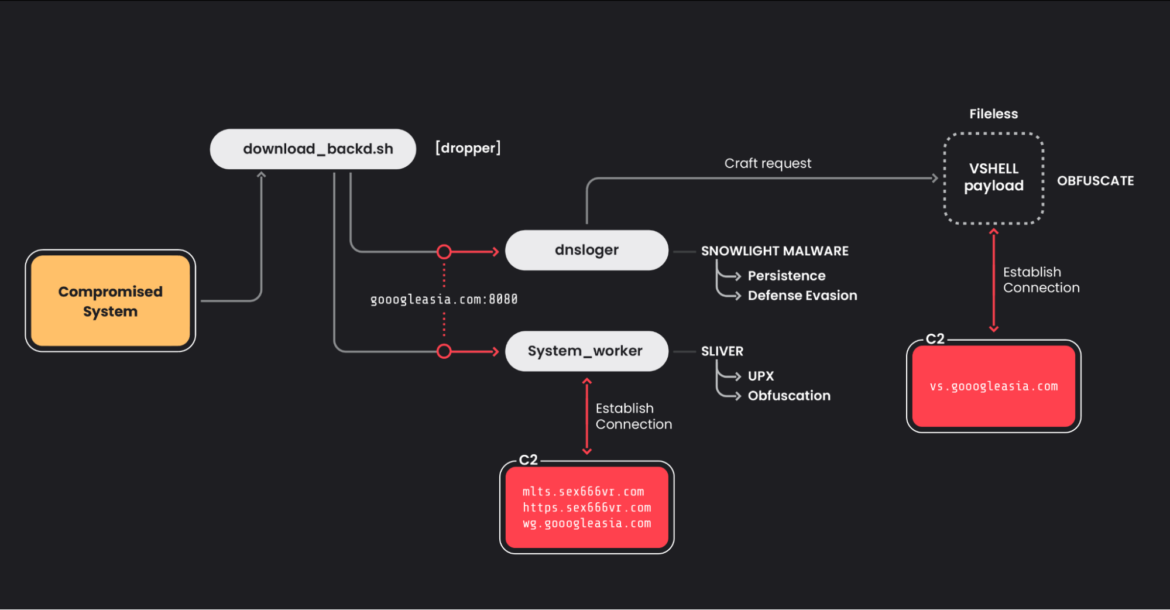 Source: sysdigUNC5174 has long been considered one of the premier cyber threat actors, yet why are they now back in the spotlight after previous campaigns? Their latest attack presents new obstacles and risks. Focused on targeting Western entities and various non-governmental organizations (NGOs), UNC5174 recently enhanced its toolset by adopting the SNOWLIGHT malware variant as a dropper. At the same time, VShell acts as a Remote Access Trojan (RAT), providing UNC5174 with an efficient yet stealthy means to infiltrate Linux systems with impunity.
This threat's C2 infrastructure is notable. Threat actors use sophisticated techniques, such as domain squatting—where domains similar to legitimate ones are created for no obvious purpose other than mimicking Google or Telegram domains—to evade detection and carry out phishing attacks. Such advanced obfuscation increases this attack's effectiveness while simultaneously complicating detection and mitigation efforts.
How the SNOWLIGHT Malware Operates
The operational mechanics of the SNOWLIGHT and VShell malware are particularly intricate. SNOWLIGHT acts primarily as a dropper, facilitating deployment of additional fileless payloads that remain resident in system memory rather than leaving physical footprints that traditional detection methods might pick up on.
VShell enhances this evasiveness as an inconspicuous covert tool, enabling remote access and control over an infected system. Its popularity among Chinese cybercriminals demonstrates its reliability and effectiveness. Using WebSockets C2 communications, VShell ensures data exchange without risk of interception.
Understanding the Dangers of Fileless Techniques
 SNOWLIGHT and VShell payloads employ fileless techniques, making this an especially dangerous threat. Traditional antivirus and antimalware solutions using signature-based detection have difficulty recognizing these payloads because they do not persist as files. Rather, they execute directly in memory, bypassing many standard security checks.
WebSockets allow malware to blend seamlessly with normal web traffic and complicate network defenders' tasks by making distinguishing between legitimate traffic and malicious communications more challenging than ever.
Distinguishing Features of the New Campaign
Although UNC5174 is notorious for its previous attacks, its latest attack campaign stands out due to a few distinct features. VShell significantly enhances stealth and operational efficiency, further signaling an evolution towards improved tactics, techniques, and procedures.
UNC5174 has also taken an aggressive domain mimicry strategy. Registering new domains and expanding their catalog with subdomains mimicking popular brands increases the odds that phishing emails successfully deceive target recipients. This advanced domain squatting tactic ensures their attack infrastructure remains robust yet deceptive and provides reliable means for data exfiltration or theft.
Implementing Effective Countermeasures
 Given the complex and sophisticated operations of UNC5174, we, Linux security administrators, should implement multifaceted defensive strategies against its campaigns. Real-time monitoring and anomaly detection are key.
System hardening is also essential in mitigating such threats. It restricts script and binary execution in sensitive directories to reduce the attack surface area and sets file permissions so that only trusted processes can modify critical system files or configurations.
Robust access controls and policy enforcement can successfully block SNOWLIGHT persistence mechanisms by restricting the use of cron jobs, which are often utilized to maintain malware persistence. Regularly auditing crontab files will validate changes to stop unauthorized persistence.
Enhancing Network Security and User Awareness
Phishing remains one of the primary attack vectors used by UNC5174 threat actors, so raising user awareness regarding its dangers, particularly domain squatting and impersonation attempts, is essential. Advanced email filters may prevent many such attempts, while intrusion prevention systems (IPSs) can detect harmful email attachments or links and block them before they reach victims.
DNS security is also crucial. Regular audits of DNS servers can identify potential weaknesses that could allow domain spoofing or squatting attacks, while endpoint detection and response (EDR) solutions can identify fileless malware behaviors to further fortify system defenses.
Our Final Thoughts on Mitigating the SNOWLIGHT Threat
UNC5174 poses an unprecedented challenge to us, Linux security admins. Combining advanced fileless malware like SNOWLIGHT with a versatile VShell tool makes these threats evasive and dangerous. However, with an understanding of the threat landscape and dedicated implementation of stringent security practices, administrators can defend effectively against advanced persistent threats. Proactive monitoring, ongoing user education, and adopting cutting-edge detection technologies are crucial in maintaining secure and resilient systems. By remaining informed and prepared for threats like UNC5174's SNOWLIGHT, we can protect our networks against even the most advanced cyberattacks.
 PREVIOUS

 NEXT
NEXT


Powered By

Linux Security - Your source for Top Linux News, Advisories, HOWTOs and Feature Releases
QUICK LINKS
subscribe to newsletters!
Like staying secure? So do we.
Sign up for updates, tips, and alerts!