Overly broad permissions can turn one compromised account into a much larger security problem. Learn how to reduce unnecessary access, review privileges, and apply least privilege across modern Linux systems. Review Linux Privileges×


How Edge Computing Secures Business Data from Cyber Threats
 Jul 12, 2025
•
Jul 12, 2025
•
 MaK Ulac
5 - 9 min read

With the average number of weekly cyberattacks per company rising by 75% in Q3 of last year, the pursuit of effective cybersecurity is relentless in the ever-evolving threat landscape. And while the Internet of Things (IoT) may have introduced us to smart, hyperconnected devices, it’s also introduced a unique set of cybersecurity risks.
Luckily, there are ways to counteract these risks, such as using edge computing over cloud computing.
But what is edge computing?
In this article, we’ll look at what it is and discuss how implementing edge computing and edge security best practices can protect your business against data leaks, attacks, and unauthorized access.
What is Edge Computing?
Computing at the edge is the practice of processing, analyzing, and storing data near the source of generation—i.e., the “edge” of the network—rather than centralized cloud data centers.
By bringing data closer to the location it’s being used, you reduce the distance it has to travel. This has numerous benefits, such as reducing latency, bandwidth use, and network congestion.
For example, a smart warehouse might use edge devices like RFID tags and sensors to track the movement of inventory. Rather than have this data travel to and from a cloud data center, edge computing will process the data locally, either at or near the warehouse network. This allows for real-time analysis of inventory levels and, in turn, faster decision-making.
IoT, Edge Computing, and Cybersecurity
The IoT describes a network of physical “smart” devices and appliances that are enriched with sensors, software, and other technologies to communicate and exchange data with other devices.
Smart cities, industrial IoT sensors, watches, health monitors, point-of-sale (POS) terminals—the list goes on and on, spanning vast consumer and business areas. This has caused the volume of interconnected devices across networks—and, in turn, the volume of data—to explode. 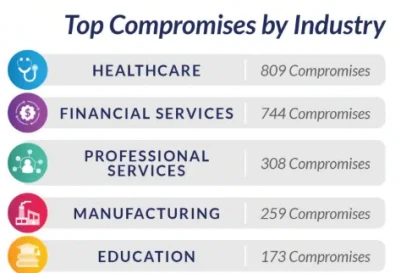
Industries like healthcare and finance handle particularly sensitive data, making them especially alluring to cybercriminals. In a single year, both industries reported a total of 1553 data compromises—and that’s just the attacks that were successful.
All this sensitive information puts businesses at risk of data privacy breaches and cyberattacks. IoT devices are a prime target for threat actors, with IoT malware attacks increasing by 400% between 2022 and 2023. And, the more data you have, the harder it is to secure.
So, rather than a cloud-only approach, businesses are integrating edge computing into their architecture. Luckily, the potential use cases of edge computing in IoT are abundant.
How Edge Computing Enhances Data Security
Let’s take a closer look at how edge computing hardens data security and reduces risk.
Reduces Risks During Data Transmission
The further your data has to travel, the more vulnerable it is to threats.
Cybercriminals can secretly intercept and eavesdrop on in-transit data streams, allowing them to steal, redirect, or manipulate the data.
In cloud models, data must travel long distances to and from the centralized data center, sometimes traversing entire continents. This leaves many opportunities for attackers to strike.
Plus, when data is transmitted over long distances, it may pass any number of intermediary devices. This includes routers, switches, gateways, and hubs. Every touchpoint poses its own risk of potential exploitation, enlarging your attack surface and putting your data at risk of unauthorized access numerous times over.
But in edge computing, the data is processed locally. This means that travel time and distance — and, in turn, any opportunities for interception — are significantly reduced. And, since data doesn’t need to encounter nearly as many intermediary devices en route, your attack surface is reduced.
Enables Rapid Threat Detection and Response
Edge computing enables near-real-time data processing and analysis, speeding up threat detection efforts.
With AI-integrated edge computing models, platforms can execute threat detection monitoring locally instead of waiting for data to travel to the central cloud server and back to the source. This means it can rapidly detect anomalies and instantly alert you to unusual activity, empowering rapid responses.
This is particularly essential for fraud detection. For example, a bank or financial service can leverage edge computing to instantly analyze transaction data from POS systems, mobile banking apps, and ATMs. It can monitor patterns, identify anomalies, and pinpoint suspicious transactional behavior without the delays caused by long-distance data transmission. This isn’t just something enterprises can do — the best payment processor for small businesses should have similar capabilities.
As a result, you can detect fraudulent activities like account takeovers and credit card fraud, and respond before they do any damage by immediately halting transactions and/or notifying the cardholder.
Secures Data Through Decentralization
Centralizing data has its benefits, including improved accessibility, consistency, and collaboration. However, widespread centralization can put sensitive data at risk of large-scale attacks.
Placing sensitive data in centralized cloud servers increases its accessibility, providing more opportunities for internal and external attacks. Plus, threat actors are more likely to target centralized servers because they hold data in abundance—they’re essentially treasure troves for cybercriminals.
By adopting edge computing, you decentralize sensitive data so that it's not all held in one location. If a threat actor does infiltrate your edge device, they’ll have access to a much smaller and incomplete pool of data.
Edge Security Best Practices
Of course, you can’t just implement edge computing and assume security is covered. There are still risks, and you need to follow key best practices to ensure multi-level data protection. Remember, as well as the below practices, to check the security policies of any services you use, such as your ESP (email service provider) or phone system.
Data Encryption
Encrypting data at rest (where it’s stored) and in transit (while traveling over networks) is critical.
- Encrypting data in transit: Data should be encrypted any time it moves between servers and devices, even if it's only travelling a short distance. Transport Layer Security (TLS) is an encryption protocol that secures communications in transit.
- Encrypting data at rest: IoT devices are at risk of theft and compromise, so they must be encrypted at rest to prevent hackers from reading and stealing information if a device is lost, stolen, or compromised. Strong encryption algorithms like Advanced Encryption Standard (AES) offer reliable security.
Multi-Factor Authentication
Multi-factor authentication (MFA) uses two or more verification factors to confirm a user’s identity. So, along with a password, it might also use biometrics, email codes, or push notifications. 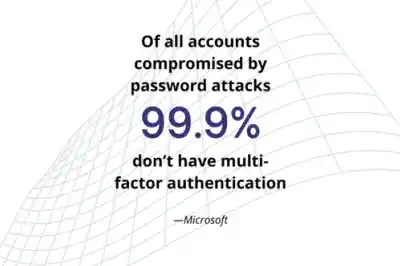
MFA is often used alongside risk-based authentication, which involves analyzing contextual and behavioral data to verify a user’s identity and/or identify suspicious activity. For example, it looks at the geo-location of where the device is being used, what time of the day/week it’s being used, and whether the connection is via a public or private network.
So, if a user is trying to access information in a country they don’t usually reside in, or outside of their usual office hours, it could be flagged as suspicious.
Microsoft fends off over 1,000 password attacks per second, and 99.9% of those that become compromised don’t have multifactor authentication. This highlights the importance of MFA in an age where simple passwords are easy to crack.
Data sourced from Microsoft, image created by writer
Maintaining software integrity and security
One of the biggest risks posed by edge computing is that it’s designed to support a wide and abundant range of devices. The nuances of the different platforms or operating systems they run on can complicate the task of maintaining software integrity and security. To manage this, make sure to:
- Perform regular vulnerability testing across all edge devices to identify and remedy weak points.
- Check for device certificates and manage them appropriately
- Regularly update software to patch vulnerabilities, making sure to secure the process using over-the-air (OTA) updates, digital signatures, and TLS encryption.
Network Segmentation
Network segmentation splits your network into smaller segments. In edge computing, this typically means isolating your IoT devices from the rest of your network.
Segmentation boosts network security by limiting how far attacks can spread. If one of your systems is affected by a malware attack, network segmentation means that it wouldn’t be able to spread to the other systems, minimizing damage and protecting sensitive data.
Zero Trust Architecture
Zero trust security operates on a clear principle: “never trust, always verify”. Every edge device must be authorized and authenticated every time it makes a request, regardless of its location in the network or its previous authentication status.
Least-privilege access is a core part of zero-trust tools. With this, strict user permissions are used to make sure users only get the minimum access required to complete their tasks. That way, if a threat actor were to infiltrate the network, their exposure to sensitive data would be limited by the user's permission. Let’s say you’re looking into how to sell on Amazon without inventory. Not every member of your team will need access to customer data, so by minimizing access to your CRM, you can reduce your threat surface.
Other core principles include continuous verification throughout sessions and risk-based authentication.
Zero trust should also be encouraged at the user level. For example, zero-trust email security aims to verify every email to prevent phishing attacks and other nefarious activities. Integrate AI detection tools with employee training to help them spot email spoofing, spear phishing, and other attacks.
Edge Computing and the Future of Data Security
Like cloud computing, edge computing does come with security risks. But when used as a strategic asset to manage the data abundance produced by IoT devices, its decentralization helps to harden your architecture against threats.
By bringing data processing closer to the source, you minimize how far data has to travel to protect it from interception. You can reduce your attack surface, enable faster threat detection and response, and ultimately limit hackers’ exposure to sensitive data.
To really benefit from edge computing security, implement best practices like data encryption, multi-factor authentication, and network segmentation. And finally, make sure to train your staff on their role—even the best security systems can suffer from human error.
 PREVIOUS

 NEXT
NEXT



Powered By

Linux Security - Your source for Top Linux News, Advisories, HOWTOs and Feature Releases
QUICK LINKS
subscribe to newsletters!
Like staying secure? So do we.
Sign up for updates, tips, and alerts!