Explore top 10 tips to secure your open-source projects now. Read More
×


IPv4 vs. IPv6 Proxies in 2026: Which One Should You Run on Your Linux Stack?
 Jun 09, 2026
•
Jun 09, 2026
•
 Anthony Pell
4 - 7 min read


Topics Covered
For years, IPv4 was the only proxy type that really mattered for anyone running automation off a Linux box. IPv6 was the protocol everyone said they’d migrate to, but almost nobody actually did. In 2026, that’s finally starting to shift.
The problem is that most admins stick with IPv4 out of habit. They know it; it’s what their tooling defaults to, and they don’t see a reason to change. Some are overpaying for addresses they don’t need. Others would quietly break their scrapers, scripts, or account setups the moment they switched. On a server juggling dozens of outbound connections, picking the wrong protocol isn’t just a billing question; it changes how reliable your jobs are and how your traffic looks to the other end.
This guide breaks down which one actually fits your setup.
The Current State of IPv4 and IPv6 Adoption
For most of the internet, IPv4 is still the default. It’s the foundation almost every website, API, and tool was built on. We officially ran out of new IPv4 addresses years ago, but that scarcity never pushed everyone onto IPv6 the way people expected.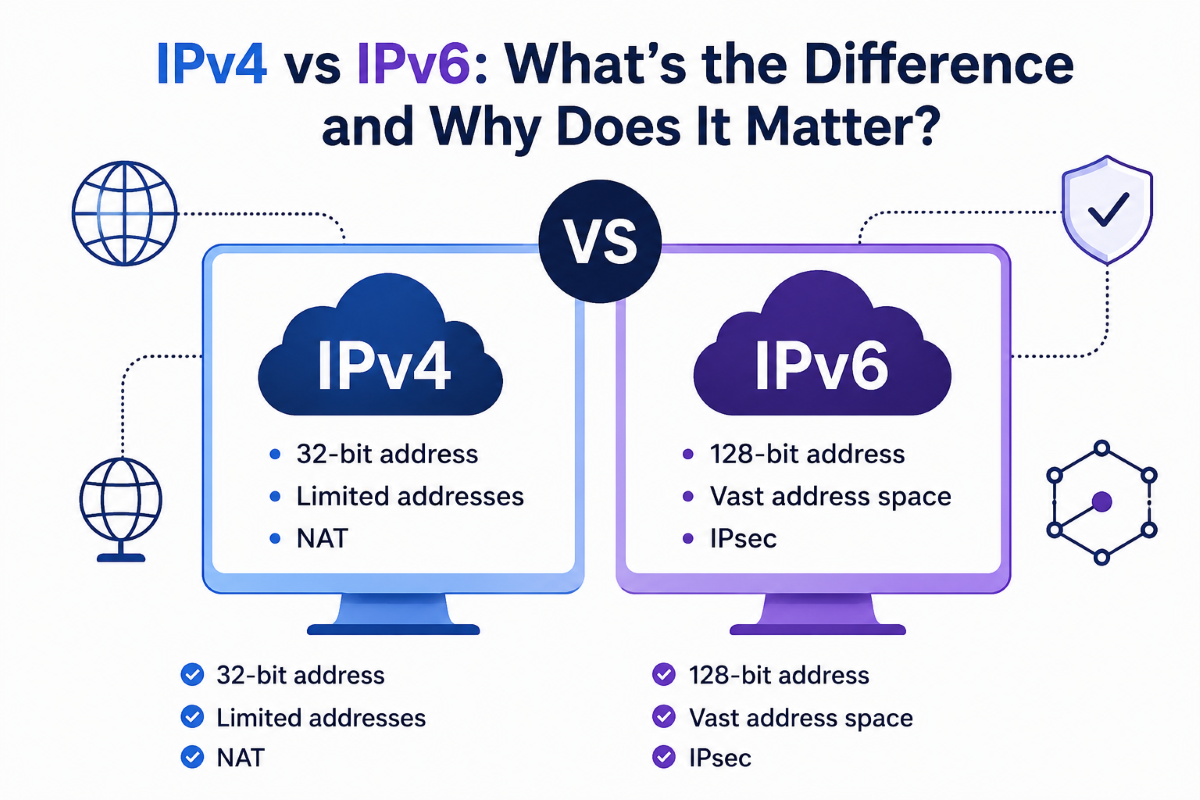
IPv6 was supposed to be the fix — a practically limitless address space that solves the supply problem for good. Google, Facebook, and Cloudflare all fully support it today, and pretty much every modern Linux distribution ships with dual-stack out of the box. But plenty of smaller sites, older tooling, and corporate networks still haven’t caught up.
The result is a split internet. Right now, around 40-45% of traffic runs over IPv6, driven mainly by major mobile carriers and large tech platforms. The rest is still IPv4-only — so if you point an IPv6 proxy at a target that doesn’t support it, the connection simply won’t complete.
Compatibility With Common Tools and Target Sites
Most failed IPv6 rollouts come down to compatibility. The major sites — Google, YouTube, Facebook, and anything behind Cloudflare — are already IPv6-enabled. But a long tail of smaller sites, niche marketplaces, aging e-commerce platforms, and corporate domains is still IPv4-only. For those, an IPv4 proxy is the only thing that will actually connect.
On the tooling side, support is uneven. Modern HTTP clients and scrapers handle IPv6 fine — a recent curl, Python’s requests, and most current browsers will use it without complaint. Older scrapers, hand-rolled scripts, and some SEO software won’t, and a few will hang or fall back unpredictably on a dual-stack lookup if you haven’t tuned how the resolver picks an address family.
Anti-detect browsers and multi-accounting tools usually stay on IPv4 because account trust scores are still built on IPv4 history. APIs and third-party services are all over the map on IPv6 support, so the safe default when your work depends on an API is IPv4.
The rule is simple: if every target and every tool in your stack fully supports IPv6, switching can save real money. If even one link in the chain doesn’t, stay on IPv4.
Pricing Differences and Why They Exist
IPv4 addresses are scarce. There are roughly 4.3 billion of them, and nearly all are already in use. New blocks change hands on a secondary market, and prices keep climbing because demand is high and supply is fixed. Proxy providers pay real money for those addresses, and that cost lands on your bill.
IPv6 is the opposite. The address space is so large that supply is effectively unlimited, so providers can obtain ranges at almost no cost. That’s why IPv6 plans can run far cheaper — some providers price IPv6 proxies at as little as 10 to 20% of the equivalent IPv4 plan.
Where IPv6 Makes Sense
If the target already supports IPv6, the math is hard to ignore.
-
Google, YouTube, and other major tech platforms
These networks have supported IPv6 for years. If most of your traffic goes to Google properties, paying IPv4 prices often doesn't buy you anything. -
Large-scale scraping jobs
When a target is fully IPv6-enabled, address availability stops being the limiting factor. The bigger the crawl, the bigger the savings. -
Social media monitoring and automation
X, Instagram, TikTok, and similar platforms generally handle IPv6 traffic without issue. Some operators still prefer a private residential proxy setup for reputation reasons, but that's a separate decision from the protocol itself. -
Ad verification
Google Ads, Meta Ads, and other large advertising networks are already operating in IPv6 environments. Verification traffic can usually move over without changing the workflow. -
Mobile-focused projects
Many carriers adopted IPv6 long before fixed-line providers. If you're collecting mobile data or testing mobile applications, you'll often find yourself working in IPv6-heavy environments anyway. -
Internal testing and staging
Easy savings. If you're controlling both ends of the connection, compatibility concerns largely disappear.
Where IPv4 Still Has the Edge
IPv6 availability isn't the issue anymore. Compatibility is.
-
Older websites and smaller platforms
Plenty of e-commerce stores, local businesses, forums, and government systems still run IPv4-only infrastructure. -
API-heavy workflows
One endpoint supports IPv6. The next one doesn't. Documentation is often inconsistent, which makes IPv4 the safer option when reliability matters. -
SEO tooling and rank tracking
Much of the SEO ecosystem was built around IPv4 assumptions. IPv6 support exists in some places, but not always consistently. -
Multi-account operations
Reputation systems, trust scoring, and verification workflows still lean heavily on IPv4 history. The connection works. The account may not. -
Anti-detect browser environments
Most anti-detect setups were designed around IPv4. Changing protocols can create inconsistencies that operators would rather avoid. -
Sneaker, ticketing, and limited-drop sites
These are often the last places you'd want protocol-related surprises. Most operators stick with IPv4 and remove the variable entirely.
Security and Privacy Considerations on Linux
For anyone running this on a Linux host, the protocol choice has a couple of security angles worth keeping in mind — not just cost and compatibility.
The first is leakage. On a dual-stack box, a misconfigured client can quietly fall back to your machine’s native IPv6 address and bypass the proxy entirely, exposing the real egress IP you were trying to hide. Before trusting any IPv6 deployment, verify what traffic is actually leaving the box. Start with ip -6 addr and confirm the interface has the addresses you expect. Then check an external service to see which address is being presented upstream. Misconfigurations are common, especially in environments where IPv4 and IPv6 are running side by side.
If IPv4-only egress is the goal, disabling IPv6 at the operating-system level is usually more reliable than hoping individual applications behave correctly. On Linux, that typically means setting the net.ipv6.conf.all.Disable IPv6 sysctl and confirm the change took effect before testing again.
The second is reputation. IPv6 ranges are usually handed out in large contiguous blocks, so a target that sees abuse from one address can flag an entire /64 in one move, which makes a cheap IPv6 pool easier to burn through if you’re not careful. IPv4 reputation is tracked per address and tends to be more established, which is part of why account-trust systems still favor it. Match the protocol to the sensitivity of the work, not just to the lowest price.
Conclusion
At the end of the day, most workflows still run on IPv4, simply because it’s the version of the internet around which most targets and tools were built. IPv6 is the cheaper option with far more room to scale — but only when the specific targets in your stack can actually handle it.
The deciding factor is knowing your targets and your tooling before you commit. If you’re working against the big tech platforms with full IPv6 support, the savings are worth chasing. If you’re dealing with older, smaller, or mixed systems — or you need tight control over what leaves your host — IPv4 is still the safer call.
 PREVIOUS

 NEXT
NEXT



Powered By

Linux Security - Your source for Top Linux News, Advisories, HOWTOs and Feature Releases
QUICK LINKS
subscribe to newsletters!
Like staying secure? So do we.
Sign up for updates, tips, and alerts!