Audit Linux privileges now to limit compromise, escalation, and system-wide damage. Review Linux Privileges×


Cisco SD-WAN Vulnerability: Why Security Starts With the Management Plane
 Jun 16, 2026
•
Jun 16, 2026
•
 MaK Ulac
3 - 6 min read

Topics Covered
For those of us who live and breathe Linux and open-source infrastructure, the "management plane" is usually just a collection of familiar tools—SSH, APIs, and centralized orchestration. But in the world of proprietary enterprise networking, the management plane is often a black box. Cisco’s latest SD-WAN issue serves as a stark reminder that even when these proprietary systems rely on Linux components under the hood, their centralized nature makes them the ultimate high-value target.
Attackers don't need to break into every branch router when they can reach the "brain" that manages them. Cisco’s latest issue shows why SD-WAN security must start with the management plane, not just the edge device.
Cisco SD-WAN Security at a Glance
|
Metric |
Details |
|
Affected Product |
Cisco Catalyst SD-WAN Manager |
|
Vulnerability |
CVE-2026-20262 |
|
Type |
Arbitrary File Write (API Path Traversal) |
|
Risk |
Privilege escalation to root |
|
Status |
Active exploitation confirmed |
|
Recommended Action |
Audit exposure and patch immediately |
What Cisco Warned About in CVE-2026-20262
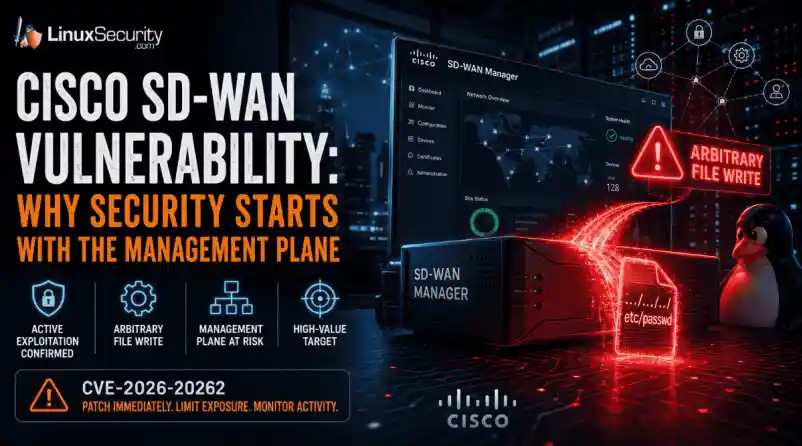
Cisco recently disclosed CVE-2026-20262 in a Cisco security advisory affecting Catalyst SD-WAN Manager. The vulnerability allows an authenticated user with write privileges to create or overwrite files through a vulnerable API. Cisco confirmed that successful exploitation can result in privilege escalation to root.
This is a familiar scenario for Linux administrators: a file-handling flaw that allows an attacker to escape intended boundaries. In a standard Linux environment, we’d secure this with file system permissions, SELinux policies, or containerization. However, because SD-WAN Manager is a proprietary controller that sits at the center of your network fabric, the impact is magnified. It pushes policies, manages certificates, and provisions devices—it effectively acts as the root of trust for your entire WAN.
Why Active Exploitation Matters
Cisco confirmed active exploitation of this issue. This immediately moves the Cisco vulnerability out of the routine patch category. For those of us used to the rapid, transparent patching cycles of open-source projects, this is a call to action.
Why Cisco SD-WAN Controllers Matter
We build SD-WAN environments because manually managing individual Linux boxes at every branch is unsustainable. The controller centralizes that work. But centralization is a double-edged sword: Cisco SD-WAN security depends entirely on the integrity of this controller.
- The Linux Connection: These controllers often use vendor-hardened software stacks, and privileged access is restricted by the vendor rather than by the community.
- Centralized Authority: Catalyst SD-WAN Manager controls configuration, policy distribution, and device onboarding.
- The Operational Risk: Because the controller already knows your entire network topology, a compromise here is significantly more dangerous than a compromise of a standalone branch router. It is a fundamental part of your sd wan security checklist.
Technical Breakdown: The File Write Vulnerability
Cisco describes this as an arbitrary file write condition involving a vulnerable API and improper file handling logic. For anyone who has debugged an insecure Python or Go API, this is a classic path traversal vulnerability.
How Path Traversal Changes the Risk
While upload validation should keep user-controlled content inside expected directories, a path traversal vulnerability breaks that boundary.
- The Primitive: An attacker with write access can influence where the system places a file.
- Breaking Boundaries: Instead of staying in a controlled upload area, files can reach sensitive system paths—like /etc/ or service configuration directories.
- Management Implications: Because the platform runs critical services, a file written to the wrong location can change system behavior after a restart, upgrade, or maintenance task.
When these proprietary controls fail, sd wan security issues shift from simple application bugs into total control plane failures.
FAQ: SD-WAN Security Concerns
Is this a Cisco zero-day vulnerability?
It is a critical flaw with active exploitation reported. Regardless of the label, the operational impact on management plane security remains the same.
What are the primary sd wan security requirements?
Beyond patching, you must restrict administrative access, remove unnecessary internet exposure, and monitor API activity. These are not just sd wan security best practices—they are the standard hardening steps we use in any Linux-based environment.
Does this affect all Cisco products?
No. This specifically affects the Catalyst SD-WAN Manager. Always verify your specific version against the official Cisco security advisory before starting your maintenance window.
Mitigation: Protecting the Management Plane
The first priority is to patch. However, because this is an identity-dependent flaw, you must also address your sd wan security features and exposure.
1. Reduce Internet Exposure
Management interfaces should never be broadly reachable.
- Restrict Access: Use VPNs, jump hosts, or dedicated management segments (like a hardened Linux gateway) to access the SD-WAN Manager.
- Firewalling: Ensure that general user networks cannot reach the administrative interface.
2. Audit Administrative Access
SD-WAN security concerns often stem from overprivileged accounts.
- Review Privileges: Ensure only necessary users have write or netadmin-level privileges.
- Monitor Activity: Check logs for unexpected API activity, unauthorized file operations, or logins from unusual locations.
3. Maintain Vigilance
For those tracking Cisco vulnerability news or Cisco security advisory news, the lesson is clear: management interfaces concentrate trust. If the management plane is exposed, the distinction between an authenticated user and a remote attacker becomes negligible.
Final Takeaway
This Cisco vulnerability matters because of where it lands. An arbitrary file write on a standalone system is a problem; an arbitrary file write on the platform managing your entire SD-WAN policy, certificates, and devices is a crisis.
SD-WAN security and sd wan security both come back to management plane integrity. Patch the flaw, but do not stop there. Treat your controller like the critical, privileged infrastructure it is.
Understanding Cisco SD-WAN Architecture
This video provides a solid overview of the vManage management plane and how it sits at the heart of the SD-WAN architecture, which is critical for understanding the scope of this vulnerability.
Want more Linux security analysis, vulnerability coverage, and threat intelligence? Subscribe to the LinuxSecurity Newsletter for the latest advisories, exploitation trends, and practical security guidance delivered straight to your inbox.
Related Reading
- Securing Remote Access to Linux Servers: Best Practices for 2026
- Mastering SSH for Secure Linux Remote Server Management
- How Secure Is Linux? Open Source, User Privilege, and Defense Tactics Explained
- Port Scanning Explained: Tools, Techniques, and Best Open-Source Port Scanners for Linux
- Exploring Linux Security Modules: SELinux vs AppArmor vs TOMOYO
 PREVIOUS

 NEXT
NEXT



Powered By

Linux Security - Your source for Top Linux News, Advisories, HOWTOs and Feature Releases
QUICK LINKS
subscribe to newsletters!
Like staying secure? So do we.
Sign up for updates, tips, and alerts!