Explore top 10 tips to secure your open-source projects now. Read More
×


The New Rules for AI-Assisted Contributions: Ownership is Not Optional
 Jun 25, 2026
•
Jun 25, 2026
•
 MaK Ulac
3 - 5 min read
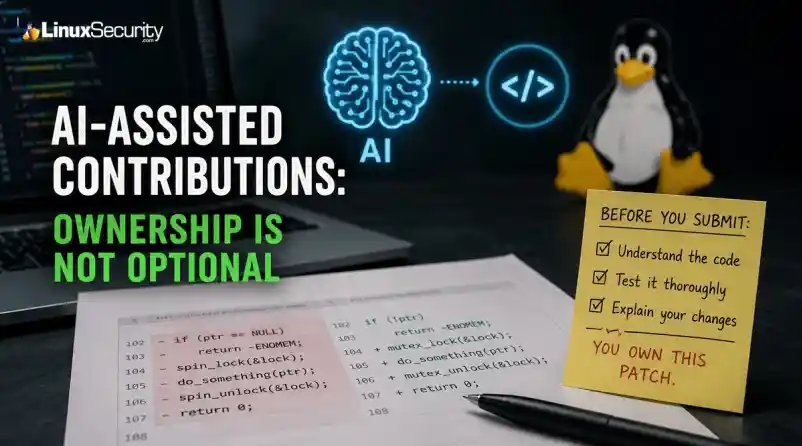

AI-assisted patches are already showing up across open source. Small GitHub projects, package updates, kernel-adjacent tools, system libraries. It’s not a future problem anymore.
Maintainers are going to see more of this code, and most of them aren’t trying to ban it outright. They’re trying to figure out what happens when a contributor submits a patch they didn’t fully write and may not fully understand. That’s where the review process gets messy. Linux development depends on trust, but that trust only works when the person submitting the code can answer for it.
The Software Freedom Conservancy (SFC) just released a set of recommendations for how to handle this. They aren't trying to ban AI. They’re trying to solve a much more basic problem: who owns the mess when AI-generated code breaks in production?
Why Maintainers Are Pushing Back
Nobody really cares whether you used AI. They care whether you understand the patch you're asking them to merge.
Linux development has always worked on the assumption that the person submitting the code knows why every change is there. If the review turns into the maintainer trying to reverse-engineer an AI-generated implementation because the contributor can't answer basic questions, the process starts breaking down pretty quickly.
The Real-World Stakes for Linux
Consider how kernel maintainers handle submissions. They have zero patience for "drive-by" patches that lack documentation.
Imagine you submit a scheduler tweak that passes local tests but triggers a race condition under NUMA workloads six months later. If you didn't understand the original generation, you’re stuck—and so is the maintainer. You’ve moved from being a peer contributor to a black-box operator, and that makes the maintainer's job impossible.
This is even more dangerous in the supply chain. If an upstream project silently accepts an unvetted AI patch that introduces an insecure fallback path in a crypto library or a PAM module, every downstream user of Fedora, Debian, or enterprise Linux inherits that vulnerability. We haven't even begun to grapple with how to track the provenance of AI-influenced commits in our SBOMs. A helper function generated by an AI might be fine for a small utility, but that same mistake inside the networking stack or a filesystem driver can create years of maintenance work.
How Code Review Is Changing
Blind approvals are becoming harder to justify. Reviewers are increasingly emphasizing verification over assumptions. Don't be surprised if your next PR gets hit with questions like:
- "Why did you choose this specific algorithm over a simpler approach?"
- "Can you walk me through the logic of this loop and why it’s safe?"
- "What specific edge cases did you manually test, and why?"
This isn't to be difficult. It’s because the reviewer needs to know if they can trust you to maintain that code long-term. If you used an AI, you’d better be prepared to defend the output as if you had typed every character yourself.
Enterprise Compliance
If you work in a regulated environment—banking, government, or medical—this is a legal minefield. Enterprise Linux vendors already maintain extensive records around package provenance, vulnerability management, and software bills of materials. AI-assisted contributions introduce another layer of documentation that security and compliance teams will eventually need to account for. If your team starts pumping AI-generated code into your infrastructure without a clear audit trail, you’re inviting a massive licensing and liability headache.
What Happens Next?
Don't expect every project to handle this the same way. Some maintainers will update their contribution guidelines. Others won't bother writing anything down and will deal with AI-assisted patches the same way they deal with every other submission: by asking questions until they're satisfied.
You'll probably see more projects asking contributors to disclose AI use when it makes sense. Whether that's an Assisted-By tag, a note in the commit message, or something else depends on the project. There isn't a standard yet, and there may never be one.
The bigger change is in review. Boilerplate isn't where maintainers lose sleep. Kernel code, authentication paths, memory management, networking, package managers. That's where the questions start. If a patch touches code that could introduce a regression or create a new attack surface, reviewers are going to want more than "the AI suggested it."
None of this means maintainers are declaring war on AI. Most of them already use it for something, whether that's documentation, small scripts, or chasing down an unfamiliar API. The line gets crossed when generated code lands in a pull request, and nobody can explain why it works. That's the part the SFC is trying to address.
The Bottom Line
The guidance doesn't really change what Linux projects have expected for years. You own the patch you submit. AI doesn't change that. If anything, it makes that expectation more obvious because reviewers can no longer assume the person who wrote the commit also wrote every line of code.
The tools will keep getting better. Review probably gets harder.
The Software Freedom Conservancy is hosting ongoing public Q&A sessions to help navigate these practices. If you’re a maintainer or a frequent contributor, it’s worth the time to see how the landscape is shifting.
Want more Linux security news, vulnerability analysis, and software supply chain updates? Subscribe to the LinuxSecurity Newsletter and get the latest threats, advisories, and expert insights delivered directly to your inbox.
Related Reading
 PREVIOUS

 NEXT
NEXT


Powered By

Linux Security - Your source for Top Linux News, Advisories, HOWTOs and Feature Releases
QUICK LINKS
subscribe to newsletters!
Like staying secure? So do we.
Sign up for updates, tips, and alerts!