Explore top 10 tips to secure your open-source projects now. Read More
×



Server Security data privacy automation
data privacy automation Every system admin has lived through the same Monday morning ritual. A queue of forty tickets, half of them password resets, permission errors, or disk space warnings that any experienced technician could resolve in under two minutes. The other half require actual judgment. For years, automation promised that software would eventually sort the two apart on its own. That promise is now being tested in production Linux environments. . Early results are reshaping how IT teams think about tier-1...
 Jul 17, 2026

Privacydata collection automation
data collection automation You're running a web scraping project to collect pricing data from e-commerce sites. You set up a pool of datacenter proxies, launch your scripts, and within minutes — banned . CAPTCHAs everywhere. Your data pipeline stops before it really begins. . It's a frustrating scenario that plays out daily in ad verification, market research, and multi-account management. The website doesn't know you're doing legitimate research or monitoring. It just sees traffic coming from IP ranges it recognizes as...
Jul 17, 2026

Security Trends security advisory social engineering
security advisory social engineering Business Email Compromise used to be a numbers game — mass-blasted emails, broken English, an obvious "URGENT WIRE TRANSFER" subject line. That era is over. Generative AI has turned BEC into a tailored, low-noise operation that mimics writing style, voice, and even video presence. This piece looks at what's actually changed under the hood, what defenders are testing in response, and why so many organizations are still structurally unprepared for it. . The Infrastructure Problem Nobody Wants to...
Jul 17, 2026

Security Trends cybersecurity Linux documentation
cybersecurity Linux documentation Linux operating systems have gained prominence due to their stability, adaptability, and excellent security options. In the case of developing documentation, designing cybersecurity dashboards, or educational material, visuals are of vital importance when it comes to making things clear. The use of icons allows one to understand the message regarding alerts, authorization, encryption, authentication, or the state of the system just by looking at the visual cue without having to read long...
Jul 17, 2026
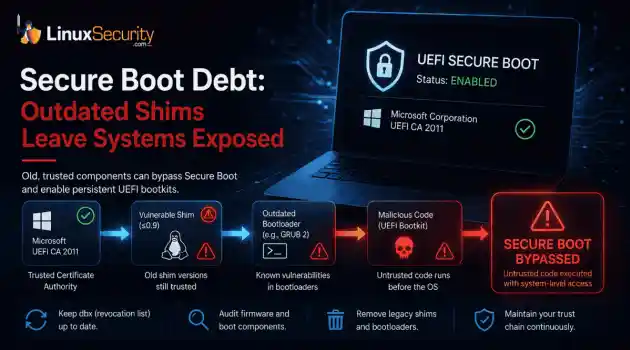
Security Vulnerabilities security advisory linux distribution
security advisory linux distribution ESET researchers identified 11 old and forgotten Linux UEFI shim bootloaders at versions 0.9 and below that can be used to bypass UEFI Secure Boot on any UEFI-based machine that trusts Microsoft’s Microsoft Corporation UEFI CA 2011 third-party certificate authority, regardless of the installed operating system (OS). Reported shims can be exploited to execute untrusted code during system boot, enabling attackers to deploy malicious UEFI bootkits even on systems with UEFI Secure Boot enabled.....
Jul 16, 2026
 Refine news
X Clear Filters
Get the latest News and Insights
Get the latest Linux and open source security news straight to your inbox.
Community Poll
Is continuous patching actually viable?
Trending News
Loading...
Explore Latest Linux Security news
We found 322 articles for you...
72
 security advisorylinuxUFW
UFW in Linux: Why Firewall Issues Repeat and How to Recognize Them
We’ve all run into UFW on Linux systems that were already in use. When firewall problems show up, they almost never show up in new or surprising ways. We at Linux Security want to help other admins recognize the kind of UFW problem they’re dealing with before they start changing rules or chasing symptoms. This page isn’t about fixes yet. The goal is to help you recognize the category of issue so you know where to look next. . Once UFW is in place, most firewall issues fall into a small number of predictable buckets. If traffic isn’t behaving the way you expect, one of those buckets usually explains why. What Does UFW Do in Linux? UFW functions as a user-friendly front-end for iptables (or nftables), acting as the interface to express firewall policy. It defines what should be allowed or denied when traffic reaches the firewall rules it manages. What it does not do is describe how traffic arrived, what path it took through the system, or how an application handled it. That distinction matters because it’s where a lot of confusion starts. On a live system, other components can affect traffic before or after UFW evaluates it. Routing, interfaces, application listeners, and kernel behavior all play a role. That’s why a ruleset can look correct and still not line up with what you’re seeing in practice. If UFW appears to be configured properly but traffic behaves differently than expected, the issue usually isn’t that UFW is lying. It’s that UFW is only one part of the path. The Common Categories of UFW Problems After enough time working with UFW, the problems start to look familiar. Most UFW-related issues fit into one of a small number of categories, even if the symptoms look different at first. Here’s what we see most often. If you’re troubleshooting, start by figuring out which of these applies before changing anything. Rules no longer reflect how traffic actually reaches the host The system changed over time, but the rules didn’t. Thefirewall still exists, but it no longer matches real exposure. Firewall status output disagrees with real-world behavior UFW reports that something should be blocked or allowed, but live traffic doesn’t line up with that view. Logs are confusing, noisy, or unhelpful Logging is either silent when you expect data, or so loud that it’s hard to tell what matters. Server environments amplify small configuration mistakes Long-lived systems and exposed services make minor issues more visible and more costly. IPv6 behaves differently from IPv4 Traffic takes a different path than expected, and firewall behavior doesn’t match what you’re seeing with IPv4. Rulesets become difficult to understand and maintain over time As rules accumulate, intent gets harder to read, and safe changes become riskier. Each section below focuses on one of these categories and points you to a deeper explanation. Why UFW Rules Stop Matching Real Exposure Over time, Linux systems change. Interfaces evolve, networks get reworked, and services move around. Firewall rules often don’t. They stay exactly as they were when the system was first set up. We see this lead to a common situation where UFW rules appear not to be working. The ruleset still exists, but it no longer accurately represents how the host is exposed, which makes the rules feel outdated even though nothing is technically broken. When this happens, the next step is to audit UFW rules and compare them to how traffic actually reaches the system today. When UFW Says a Port Is Blocked, but It’s Still Reachable This happens because UFW is showing you policy, not guaranteed enforcement. A port can appear blocked in UFW while traffic still reaches the service. That gap is where most confusion comes from. UFW reports its own view of the rules it manages, but it doesn’t always reflect the full traffic path through the system. When enforcement happens somewhere else, or traffic bypasses the point you expect, thestatus output and real behavior stop lining up. In this situation, the mistake is assuming the rules are wrong and changing them immediately. The real issue is understanding where visibility and enforcement diverge. That’s a firewall troubleshooting problem, not a rule-writing problem. Why UFW Logs Are Often Misleading UFW logs are often misleading because they don’t provide a complete view of firewall behavior. They show what UFW chooses to log, not a full record of how traffic is handled by the system. We see admins expect UFW logs to answer definitive questions about what was allowed or blocked. In reality, the logging output reflects only a portion of what’s happening and lacks the context needed to interpret behavior on its own. Treating UFW logs as a definitive audit trail is a common pitfall. They are a window into policy hits, not a full network packet capture. Understanding the limits of ufw logging helps prevent misreading the situation and chasing the wrong issue. Why UFW Behaves Differently on Linux Servers UFW doesn’t actually behave differently on servers. What changes is the environment it’s operating in. On Linux servers, services are intentionally exposed, and systems tend to run for long periods without being rebuilt. Because of that, firewall behavior matters more, and small mistakes stay around longer. A rule that’s slightly off or no longer relevant has more opportunity to cause real impact. We see the same UFW configurations behave very differently once they’re in a production server context. The firewall may be doing exactly what it’s configured to do, but the consequences of that behavior are higher. What feels harmless on a short-lived system becomes a recurring problem on a server. This is why server-specific patterns around UFW Ubuntu server setups show up so often. The firewall isn’t special here. The environment is. Why UFW IPv6 Behavior Doesn’t Match IPv4 UFW behaves differently with IPv6 because Linux handles IPv4 andIPv6 traffic as separate paths. When both are enabled, they are evaluated independently, even if that isn’t obvious from the rules or status output. This is where confusion usually starts. An admin checks IPv4 rules, sees what looks like the right policy, and assumes it applies universally. In reality, IPv6 traffic may be following a different set of rules entirely, which makes firewall behavior feel inconsistent or unpredictable. When IPv6 isn’t recognized as a separate concern, it’s easy to misdiagnose unrelated issues elsewhere in the firewall. Treating it as its own part of the firewall configuration helps keep those problems from bleeding into everything else. When UFW Rules Become Hard to Read and Maintain This usually happens slowly. Rules get added one at a time to solve specific problems, and nothing ever gets cleaned up. Months later, the ruleset is still working, but it’s hard to tell what it’s actually doing. At that point, the real problem isn’t the rules themselves. It’s that the original intent is gone. You can’t easily tell which rules belong to which service, what’s still in use, or what’s safe to change without breaking something. That loss of structure is why approaches like UFW application profiles start to matter. They don’t fix a broken firewall. They make it easier to understand what the rules are meant to protect, which is what’s missing once a ruleset becomes hard to reason about. Why the Same UFW Problems Keep Coming Back These problems keep coming back because they’re built into how Linux firewalls work and how systems change over time. Hosts evolve. Traffic patterns shift. Services get added, removed, and replaced. The firewall has to keep up with all of that. Because of that, the same UFW issues show up again and again across different systems. They aren’t rare edge cases, and they aren’t signs that something is fundamentally wrong. Most of the time, they’re also not evidence that UFW is broken. They’re predictableresults of running a firewall on a system that doesn’t stay still. Takeaway: What to Expect Once UFW Is in Place UFW makes it easier to express firewall policy, but it doesn’t remove complexity from the rest of the system. Traffic still changes, services still move, and hosts don’t stay frozen in time. Because of that, you should expect the same categories of firewall issues to surface again after UFW is deployed. Not because something went wrong, but because the environment changed. That’s just how Linux systems behave over time. This page is meant to help you recognize those patterns when they show up and point you in the right direction to dig deeper, instead of treating every issue like a one-off. If you need to step back and reset context before going further, a quick review of Linux firewall basics or a refresher on UFW basics can help frame everything else on this page. . Once UFW is in place, most firewall issues fall into a small number of predictable buckets. If traff. we’ve, linux, systems, already, firewall, problems. . MaK Ulac
 Jan 23, 2026
•
Jan 23, 2026
• Firewalls
72
 security advisorynetwork securitylinux
Managing Unintended Exposure from UFW Application Profiles in Linux
On most long-running Linux servers, UFW rules don’t get removed; they get forgotten. Services change, ports shift, packages come and go, and the firewall stops matching what the box is actually doing. You only notice when you audit it, or when something breaks and nobody remembers why a port was ever opened. . UFW Application Profiles sit in that gap. They don’t secure anything on their own, and they don’t track running services, but they do give structure to how ports get opened and why. Used carefully, they make firewall rules easier to reason about months later. Used casually, they hide assumptions and create blind spots. This isn’t about learning UFW or opening your first port. It’s about how application profiles behave on real servers that stay up for years, how to read what they actually allow, and how to create your own without surprises. What “ufw allow OpenSSH” Actually Does Most systems ship with an OpenSSH application profile, which makes it a useful reference point. When you run: ufw allow OpenSSH UFW is not doing anything SSH-specific. It looks up the OpenSSH profile definition, usually stored under /etc/ufw/applications.d/, reads the ports and protocols listed there, and expands them into standard firewall rules. On most systems, that means allowing TCP port 22. The profile name itself never appears in the packet path. It is resolved once, at rule creation time, and then disappears. You can see exactly what UFW will expand by inspecting the profile directly: ufw app info OpenSSH This shows the ports and protocols the profile maps to. If SSH has been moved to a non-standard port, this output will not change unless the profile itself is updated. After allowing the profile, UFW writes normal port-based rules. You can confirm that with: ufw status verbose Notice that the output lists ports and protocols, not the application profile name. At this point, the firewall no longer knows or cares that the rule originated from OpenSSH. This iswhy application profiles behave more like macros than active policy objects. The human-readable name exists for operators. The firewall only ever enforces ports and protocols. It also explains several behaviors that confuse people later. If SSH moves to a different port, the profile does not follow it. If the profile file is deleted, the allow rule still exists. If IPv6 is enabled, the same ports are opened on both stacks. And if Docker rewrites iptables rules underneath UFW, the profile’s intent may never be enforced at all. Understanding this single example makes the rest of UFW application profiles easier to reason about. Profiles document intent. UFW enforces ports. Once the rule is written, the profile name is no longer part of the system’s behavior, only its history. How UFW Application Profiles Work in Linux At a high level, UFW Application Profiles are just a naming and grouping layer that UFW knows how to translate into firewall rules. What a UFW Application Profile Is (and Is Not) A UFW (Uncomplicated Firewall) Application Profile is a metadata abstraction that maps a human-readable name to one or more ports and protocols. It exists to make rules easier to read and reason about later, not to reflect what is actually running on the system. The profile only becomes meaningful when UFW expands it into rules, which is where its relationship to ufw in Linux really lives. Profiles are not service-aware. They don’t watch processes, they don’t follow sockets, and they don’t change when a daemon moves or dies. They also don’t enforce policy on their own. Until a profile is referenced by an allow or deny rule, it’s just a definition sitting on disk. What profiles control Port and protocol groupings Rule readability and intent Consistency when applied correctly What profiles do not control Whether a service is running Whether traffic is actually accepted Ongoing enforcement or state Where UFW Application Profiles Are Stored On disk,profiles live under /etc/ufw/applications.d/. UFW reads these files at runtime , parses the definitions, and makes them available by name when you reference them in a rule. Simply having a file there does nothing by itself. Presence is not activation. Until a profile is explicitly used in a UFW rule, no firewall behavior changes. This is where people get tripped up on long-lived systems. Files accumulate. Profiles stick around after services are removed. UFW doesn’t care. It will happily list profiles that no longer match reality unless you look closer. When UFW Application Profiles Help or Hurt When Profiles Help When Profiles Hurt Standard services across hosts Blind trust in defaults Multi-port services Ports change, profiles don’t Readability and audits Containers bypassing policy Shared naming across teams Assuming profiles track services Docker deserves a specific callout here. Docker manipulates iptables directly, outside of UFW’s model. Application profiles document intent. They do not enforce it. If packets never hit UFW’s rules, the profile name won’t save you. How to Read and Audit UFW Application Profiles Reading a profile is about confirming what will open, not what the name suggests. How to List UFW Application Profiles ufw app list The list depends on the distribution and installed packages, so identical services across hosts can produce different results. How to View Ports and Protocols in a UFW Application Profile ufw app info This shows the ports and protocols the profile will translate into rules. Before applying it, confirm those ports match the service’s current configuration, not a default that changed during an upgrade. Warning : UFW logs ports and protocols, not profile names. During an audit UFW rules review, you have to trace traffic back to the profile definition manually. Where to Findthe Profile Definition File Profile definitions live in /etc/ufw/applications.d/. On long-lived systems, this directory often contains profiles for services that no longer exist or no longer use the same ports. UFW does not validate these files against running services, so file-level inspection is required to understand what a profile actually represents before trusting or reusing it. How to Apply UFW Application Profiles Safely Applying a profile is simple, but understanding what UFW actually does with it is where mistakes start. How UFW Applies Application Profile Rules When you allow a profile, UFW resolves the profile name into ports and protocols, then writes normal firewall rules for those values. The flow is named to port to rule, and once the rule is written, the profile name no longer exists anywhere in the packet path or logs. Manual rules are not special-cased. A deny rule you added earlier will still block traffic even if a profile later allows the same port. Likewise, allowing a profile does not override an explicit deny. Profiles don’t change precedence. They just expand into rules like anything else. Allow vs Limit for UFW Application Profiles When allow is appropriate Services that must be reachable without interruption Internal services with upstream access controls Ports where the connection rate is not at risk When limit makes sense Exposed services that attract brute-force attempts SSH and similar authentication-heavy endpoints Situations where noise reduction matters Rate limiting reduces connection abuse. It does not reduce exposure. Using limit does not change who can reach the service, which is often misunderstood when people treat it like a safety net for UFW allowlist services . Restricting UFW Application Profiles by Source or Interface Profiles can be scoped the same way as any other rule. The restriction applies to the expanded rules, not the profile itself. Allow from an admin subnet only Bind rules toa management interface A common pattern is allowing a profile only from a trusted network while denying the same ports everywhere else. How UFW Application Profiles Behave with IPv6 Profiles apply to IPv6 the same way they do to IPv4. The same ports are opened, just on a different stack, and that surprises people during reviews. Common pitfalls IPv6 was enabled, while IPv4 rules were the only thing considered Different exposure expectations between stacks Assuming IPv4-only services are unreachable over IPv6 If IPv6 is enabled in UFW , profiles expand into both stacks unless you’ve explicitly constrained them, which is where most unintended exposure comes from. How to Create Custom UFW Application Profiles You usually end up writing custom profiles when the defaults stop lining up with how the service actually behaves. When You Should Create a Custom UFW Application Profile When a service listens on ports that don’t match any shipped profile, you’re already outside the safe path. If the service is internal-only, reusing a public-facing default tends to blur intent and makes audits harder than they need to be. The same applies when a single application exposes multiple ports that belong together. Splitting those across ad-hoc rules works at first, but it gets fragile fast. And once you need that same definition applied across a fleet, copying raw port rules stops scaling. That’s usually the point where a custom profile earns its keep. UFW Application Profile File Format and Syntax [MyApp] title=My internal service description=Internal API listener ports=8080/tcp|8443/tcp|9000:9010/udp Field Purpose Example title Human-readable name My internal service description Context for audits and ownership Internal API listener ports Allowed ports and protocols 8080/tcp|9000:9010/udp UFW treats this file asa flat definition. The pipe operator | separates ports and ranges, and ranges use start:end syntax. You can list many ports, but in practice, once a profile grows past roughly 15 to 20 entries, it stops being readable and starts hiding mistakes. Creating and Applying a Custom Profile Step by Step The workflow is simple and intentionally boring. Create the profile file under /etc/ufw/applications.d/. Confirm UFW can see it. Apply it like any other rule. Then verify the resulting rules actually match the ports you expected to open. Skipping the last step is how profiles drift away from reality. Automating UFW Application Profiles Safely Automation changes the failure mode. UFW does not reload profile definitions automatically. After a profile file changes, you must explicitly refresh the rules, or nothing happens. For existing profiles, ufw app update re-expands the definition without removing and re-adding rules. A full ufw reload also works, but it rebuilds the entire rule set and is heavier than most automation needs. Warning : automation also has to be idempotent. Reapplying profiles without checking existing rules can create duplicates or reorder rules, and that’s how a clean profile definition turns into a firewall state nobody trusts anymore. Maintaining and Troubleshooting UFW Application Profiles Problems with application profiles usually surface during audits or outages, when rules no longer align with the system’s current state. What Causes UFW Application Profiles to Go Out of Sync A few patterns recur in long-lived systems. Service changes: The service starts listening on different ports, but the profile still opens the old ones. Package updates: Updates change or replace profile definitions, while existing firewall rules continue using earlier assumptions. Duplicate profiles: Multiple profiles describe the same service slightly differently, and it’s unclear which one the rules were built from. How to Detect Profile Mismatch inProduction There’s no single command that tells you a profile is wrong. You have to line up a few signals. Listener versus profile comparison: What the service is actually listening to needs to match what the profile opens. Logs show ports, not names: Firewall logs only record ports and protocols, which means you map activity back to profiles manually using UFW logging . If the profile, the rules, and the listeners don’t all agree, trust the listeners. How to Update Profiles Without Breaking Access Changes need to be staged, not swapped. Add the new or updated profile and allow rules first. Confirm traffic still flows as expected. Remove the old rules or profile references only after verification. This add-before-remove sequence avoids lockouts and leaves room to recover. Common UFW Application Profile Problems A few failure modes come up often enough that they’re worth calling out directly. The Problem What Actually Happens Why It Matters Ghost rules Profile file is removed, but the allow rules remain Ports stay open with no visible source or intent Rules removed first Rules are deleted before the profile file You lose context about what was allowed and why Incorrect decommissioning order Service or profile is removed before rules are cleaned up Leftover rules accumulate and confuse audits Profiles and containers Container runtimes bypass UFW via iptables Profiles appear correct, but traffic ignores them Profiles not found Rules reference ports from a profile that no longer exists The rules still work, so the missing profile is easy to miss Unexpected exposure Profiles open more ports than intended Extra listeners or IPv6 widen access without notice Overlapping profiles Multiple profiles expandto the same port Removing one profile’s rule does not close the port These issues usually surface during debugging ufw firewall work, when intent, rules, and observed traffic finally get compared side by side. Using UFW Application Profiles on Production Servers In production, profiles work best when they reflect intent. SSH: Use a narrow profile or custom definition, restrict by source, and treat limit as noise control, not protection. Web services: Profiles help group HTTP and HTTPS cleanly, but only if the ports match the actual listeners and load balancer paths. Databases: Default profiles are rarely appropriate. Custom profiles scoped to specific subnets avoid accidental exposure. Internal services: Profiles are useful for documenting intent, but they should always be paired with source or interface restrictions. UFW Application Profiles on Debian and Ubuntu UFW Application Profiles behave the same at the firewall level on Debian and Ubuntu, but what each distribution ships by default can affect how profiles appear in practice. Default profile availability differs Ubuntu usually ships with more pre-defined application profiles, such as OpenSSH and common web servers. Debian tends to be more conservative and often includes fewer profiles. As a result, the same ufw app list output will not match across hosts, even when identical services are installed. Package-installed profiles are not consistent Some packages install profile files automatically, others do not, and profile definitions can change between package versions without obvious notice. On long-lived systems, relying on distribution-provided profiles increases the risk that firewall behavior silently diverges from expectations. Custom profiles behave identically on both Custom profiles placed in /etc/ufw/applications.d/ are handled the same way on Debian and Ubuntu. File format, parsing rules, and application behavior are consistent, which makes customprofiles safer in mixed environments. Upgrades can overwrite expectations Distribution upgrades may add new profiles, modify existing ones, or leave custom profiles untouched. If teams assume defaults remain stable, these changes introduce subtle inconsistencies over time. The practical takeaway is to treat distro-shipped profiles as convenience defaults, not canonical definitions. For production or long-lived hosts, explicitly managed custom profiles are easier to audit and far more predictable. UFW Application Profiles FAQ These questions usually come up when reviewing firewall behavior on real systems. What are UFW application profiles? UFW application profiles are named definitions that map to one or more ports and protocols. When applied, UFW expands the profile into standard firewall rules. Application profiles do not track running services or enforce policy by themselves. Where are UFW application profiles stored? UFW application profiles are stored in /etc/ufw/applications.d/. UFW reads these files when rules reference them, but profile files alone do not change firewall behavior. Why do UFW logs show ports instead of application profile names? UFW resolves application profile names into ports at rule creation time. After that point, logging reflects only ports and protocols, not profile names. Why is a port still open after deleting a UFW application profile? Deleting a UFW application profile file does not remove the firewall rules created from it. The port remains open until the corresponding UFW rules are explicitly removed. Do UFW application profiles work with Docker? UFW application profiles do not reliably control Docker traffic. Docker modifies iptables directly, which can bypass UFW rules and profile-based intent. How do UFW application profiles affect IPv6? When IPv6 is enabled in UFW, application profiles open the same ports on IPv6 as on IPv4. This can expose services over IPv6 even when only IPv4 behavior was reviewed. UFWApplication Profile Command Reference Task Command List profiles ufw app list View profile ufw app info Apply profile ufw allow Remove rule ufw delete allow . Discover how forgotten UFW application profiles can lead to unintended exposure in long-running Linux servers and how to manage them.. UFW Application Profiles, Linux Firewall, Network Exposure. . MaK Ulac
Jan 20, 2026
•
Firewalls

72
 security advisoryfirewalllinux
Comprehensive Guide to Troubleshooting Linux UFW Firewall Issues
UFW looks simple until you put it on a long-lived server and real traffic hits it. This focuses on the gap between what ufw status shows and what packets are actually doing on production hosts, after rules have already been set up and systems have been up for a while. . Why Does UFW Say a Port Is Blocked, But It Is Still Reachable? One possibility is that the connection was already established before the rule changed. UFW is stateful, and existing TCP sessions are allowed to continue even after a deny is applied. You usually run into this during a scan or a quick external test. ufw status shows the port as blocked, but traffic still flows because the kernel is tracking an active session and honoring it. This is normal behavior, not a bypass. You can confirm this by looking at current connections. ss -atp If you see the port in ESTAB state, that session will persist until it closes. To prove the rule itself is working, terminate the connection and test again. ss -K dst dport = Once the session is gone, new connection attempts should fail. When they do, it confirms the firewall rule is being enforced, and the earlier reachability was explained by state tracking, which is often the root cause when debugging the UFW firewall. How Can I Confirm Which Ports are Actually Exposed on a Server? By testing what the kernel sees and what the network can reach, not what UFW intends to allow or deny. ufw status reflects the configured policy, but it does not tell you whether packets arrive or whether anything is actually listening. Confirming exposure means stepping outside the abstraction. You need to observe traffic at the socket and packet level, and you need at least one test from outside the host to remove local assumptions. Tool What the tool tells you nmap Whether the port is reachable from the network curl Whether the application responds on that port ss-tulpen Whether a process is actually listening tcpdump Whether packets arrive at the interface A port is exposed only when packets arrive, and a listener exists to receive them. Anything else is intent, configuration, or guesswork. Why Do My UFW Rules Look Correct, But Do Not Match Real Network Behavior? Because the rule you are reading is not the rule being applied to the packet. This usually comes down to attribution errors rather than syntax mistakes. Check whether the service is even listening on the protocol you think it is. ss -tulpen Verify that the rule exists in the active chains and is evaluated where you expect. ufw show raw Confirm which interface and route the packet actually uses to reach the host. ip route get If the protocol does not match, the ingress interface is different, or another rule matches first, the UFW rule you are focused on will never fire. When a rule is shadowed or evaluated after an earlier accept, it becomes invisible to the traffic you are trying to explain, which is where most firewall troubleshooting efforts stall. How Does Docker Bypass UFW Firewall Rules? Docker programs its own iptables chains and routes container traffic through them before UFW rules are evaluated. In many cases, UFW never sees the packets at all. This shows up when a host-level deny looks correct but a containerized service remains reachable. Docker inserts NAT and filter rules that short-circuit the normal UFW path, so traffic can be accepted long before it would hit a UFW -managed chain. You can see where this happens by inspecting the Docker user chain. iptables -L DOCKER-USER -n If traffic is accepted here, it bypasses UFW -managed chains entirely. At that point, the firewall behavior is being defined by Docker’s rule set, not by anything you configured through the UFW CLI. Why Do UFW Logs Show Ports Instead of Application Profile Names? Because UFW application profilesonly exist at the UFW layer. Once packets reach the kernel, they are evaluated and logged by port, protocol, and address, not by profile labels. Profiles are a convenience for rule management, not a runtime attribute. Netfilter has no concept of Apache or OpenSSH, only TCP and UDP flows tied to numbers. That distinction disappears as soon as the packet hits the logging path. Operationally, this matters when reading UFW logging output. The logs confirm that packets moved through the firewall and how they were handled, but they do not reflect which profile you thought you were enforcing. They validate packet flow, not profile intent, which is the correct way to interpret UFW logging . Why Is a Port Still Open After I Deleted a UFW Rule or Profile? Because either the traffic is already established, or the traffic is never governed by the rule you removed. There are only two causes that consistently appear in real environments. The first is existing connections. UFW does not tear down active TCP sessions when a rule or profile is deleted. Those sessions stay alive until they close, by design. ss -atp If you see the port tied to ESTAB connections, that traffic will continue regardless of rule changes. Nothing is misconfigured. The kernel is doing exactly what state tracking requires. The second cause is rule precedence outside the UFW CLI. Rules defined in UFW ’s early chains are evaluated before any deny rules you added or removed later. grep ACCEPT /etc/ufw/before.rules Any accept here overrides CLI-level denies. If traffic matches these rules, deleting a UFW rule will not change behavior, because that rule was never in the decision path to begin with. Why Does Blocking a Client IP Not Stop Access in UFW? Because the IP you are blocking is not the IP reaching the firewall. NAT , reverse proxies, and load balancers all rewrite source addresses before packets hit UFW . What UFW evaluates is the post- NAT source. If traffic is coming through aproxy or a managed frontend, the original client address is already gone by the time filtering happens. You can see this directly by watching traffic arrive. tcpdump -i any port -n The source IP in the capture is the only one UFW can act on. If that address is allowed, blocking the original client IP will have no effect. Why Do UFW Rules Work After Reload but Fail After Reboot? Because rule evaluation depends on timing and ownership during startup. After a reload, UFW applies rules to a live, initialized network stack. After a reboot, that order is not guaranteed. Interfaces may not be up when rules load, or routes may not exist yet. Other tools can insert or rewrite iptables rules later in the boot process, changing evaluation order without touching UFW configuration. From a diagnostic standpoint, the key is recognizing that this is a sequencing problem, not a syntax one. When behavior changes across reboots without rule changes, something else is influencing when and how the firewall rules are applied. How Do I Troubleshoot UFW on Production Servers? By starting with what the server actually sees on the wire, not what the rules claim should happen. On production hosts, traffic almost never enters the way the mental model assumes. Multiple interfaces shift where rules apply. Reverse proxies collapse many clients into a single private source. Bastion hosts turn inbound access into internal traffic. Internal-only services often get tested on paths they were never exposed to. The rules look right because they are right, just not for the packets you are thinking about. A typical case is a database port that looks blocked but stays reachable from an application tier. The deny is written for eth0 , but the traffic arrives on eth1 from a private address after passing through a proxy. UFW evaluates the packet correctly. It just evaluates a different packet than the admin had in mind. Once you get used to tracing traffic from the client to the interface and into thekernel, these mismatches stop looking mysterious. That perspective tends to matter more than any individual rule when running UFW for Servers. What Is the Correct Order to Troubleshoot UFW Issues? The order matters because each step answers a different question about where traffic is being handled or dropped. Skipping ahead usually creates false conclusions. Check Intent: ufw status verbose (Is the rule actually there, and is the default policy what you think it is?) Check the Socket: ss -tulpen (Is the application actually bound to the port and interface?) Check the Raw Rules: ufw show raw (Is an earlier ACCEPT chain in iptables shadowing your new rule?) Check the Wire: tcpdump -i any port -n (Are packets even reaching the network card?) If the behavior still persists after disabling UFW entirely, then UFW is not the cause. The Isolation Test: ufw disable (If the problem persists, the issue is upstream—check Cloud Security Groups or your ISP.) That isolation test is blunt, but it is definitive. When traffic behaves the same way with UFW off, the problem is somewhere else in the path. Why Does UFW Allow Traffic but Nothing Reaches the Server? Because the packets never arrive at the host. An allow rule cannot act on traffic that is dropped upstream. You can confirm this by watching for packets directly. tcpdump -i any port If nothing shows up, the block is happening before the server ever sees the traffic. That usually means a cloud security group, provider firewall, or upstream network control, not UFW . How Does UFW Fit Into the Linux Firewall Stack? UFW is a frontend that writes rules. Netfilter is what actually enforces them. All diagnostics that matter happen at the kernel level because that is where packets are accepted, dropped, or forwarded. UFW only shapes intent and ordering before that point. When behavior and configuration diverge, the kernel view is the authoritative one, which is whyeffective troubleshooting always anchors on UFW in Linux. . Explore troubleshooting techniques for UFW on Linux servers to ensure effective firewall rule application and diagnose issues.. UFW troubleshooting,Linux firewall,network security,firewall rules,packet inspection. . MaK Ulac
Jan 16, 2026
•
Firewalls
72
security advisoryUbuntuimportantUbuntu: UFW Important Firewall Rules for Secure SSH and Database Access
UFW is a front-end for iptables that applies firewall policy directly on an Ubuntu server, close to the services that accept traffic. . On real systems, exposure is shaped by more than open ports. A service binds to an address, that address maps to an interface, and that interface may sit behind cloud security groups, VPNs, or container networks. UFW enforces policy inside that path, which is why rules that look correct can still fail once traffic hits the server. The aim is to align those layers. You start by identifying what is listening and where, then apply UFW rules that match the server’s role and expected access. SSH, web services, and databases each behave differently, and the firewall only holds when those differences are made explicit. Before You Change UFW Rules: Check What Ports Are Listening on Your Ubuntu Server Before touching UFW , you need to know what the server is actually listening on. What matters is the current state, as the kernel sees it, because firewall rules only act on traffic headed toward existing listeners. Start with ss -tulpn . On older systems, netstat -tulpn shows the same view. This output tells you which services are bound, on which ports, and, more importantly, on which addresses. UFW evaluates traffic after this binding decision, not before it. When reviewing the output, the binding address is the key signal. It determines whether a service is reachable only from the host, from a private network, or from any interface that can route traffic to the server. Many exposure issues come from assuming a port is “internal” when it is bound far more broadly. Before making changes, take a snapshot. Capture the active listeners, the current ufw status , and the cloud security group rules attached to the instance. These three views together describe how traffic can reach the server, and they give you a stable reference if access changes. The table below is a quick way to interpret common bindings and the risk they imply. Binding Meaning Risk 127.0.0.1 Localhost only Low 10.x.x.x / 192.168.x.x Private network or VPC Medium 0.0.0.0 All IPv4 interfaces High :: All IPv6 interfaces High A service bound to localhost does not need a firewall rule. A private binding depends on who can reach that network. A bind to 0.0.0.0 or :: means the service is exposed on every reachable interface, whether that was intentional or not. This distinction feeds directly into SSH hardening. Before you enable UFW or tighten rules, you need to know exactly how SSH is bound and which paths can reach it, otherwise the firewall becomes the source of the outage instead of the control. How to Prevent SSH Lockouts When Enabling UFW on an Ubuntu Server You prevent SSH lockouts by allowing SSH before UFW is enabled, then turning the firewall on only after you have a confirmed path back in. UFW enforces rules immediately . If incoming traffic is denied by default and SSH is not already allowed, the server does exactly what it is told and drops management access without hesitation. This is not a corner case. It is the most common failure mode. The order is what keeps this from happening: Set defaults to deny incoming and allow outgoing traffic Add an SSH allow rule Enable UFW At the SSH rule step, you have a choice to make. Using the OpenSSH application profile keeps the rule tied to the service itself. A direct port rule works as well, but it is easier to lose the intent later, especially on servers that change ports or get hardened over time. Once you can reconnect reliably, start narrowing exposure. Restrict SSH to a known IP range, a subnet, or a bastion host, and add rate limiting to reduce credential spraying without changing normal admin behavior. Keep a second SSH session open while making changes so you can verify a newconnection before closing the one keeping you in. This sequence underpins most UFW hardening work. If SSH access is fragile, every other firewall change becomes a gamble instead of a control. How to Allow SSH Only Over a VPN or Tunnel Interface (WireGuard, Tailscale, ZeroTier) You do this by allowing SSH on the tunnel interface and explicitly denying it on the public interface. First, identify the interfaces in use: ip addr Look for the tunnel interface. Common names are wg0 for WireGuard, or a virtual interface created by Tailscale or ZeroTier. Also note the public interface, often eth0 or ens* . Then add the UFW rules: sudo ufw allow in on wg0 to any port 22 sudo ufw deny in on eth0 to any port 22 This allows SSH only where traffic enters through the tunnel and blocks it everywhere else. Before enabling or reloading UFW : Keep an active SSH session open Confirm the tunnel is up and routing traffic correctly After applying the rules, test a new SSH connection over the VPN before closing your existing session. Two common mistakes to check if this fails: The rule references the wrong interface name, so traffic never matches IPv6 is still enabled, and SSH is reachable over :: on the public interface If SSH is reachable but nothing appears in UFW logs, the traffic is likely bypassing UFW entirely, usually due to Docker or cloud security group behavior. IPv6 UFW Safety Check: Make Sure IPv6 Firewalling Is Enabled on Ubuntu Before assuming a rule is effective, confirm that UFW is enforcing IPv6 at all. On many Ubuntu servers, IPv6 is enabled at the kernel and interface level, even when no one remembers turning it on. Check /etc/default/ufw and look for IPV6=yes . If it is set to no , UFW will happily enforce IPv4 rules while IPv6 traffic bypasses them entirely. From the outside, the server looks locked down. In reality, the same services may still be reachable over IPv6. This matters because binding behaviordoes not change just because you ignore IPv6. A service bound to :: or dual stack will accept traffic over IPv6 unless it is explicitly filtered. That includes SSH, admin interfaces, and database ports you thought were private. This is where people usually screw up IPv6 behavior in Linux firewalls . IPv4 looks correct. UFW status looks correct. The exposure is still there, just on a parallel path that was never inspected. How to Configure UFW for a Web Server (Allow Only HTTP and HTTPS on Ubuntu) On a web server, UFW should allow traffic only to the layer that actually serves the web. Everything else stays closed by default. Start by deciding what is public on this host. If Nginx or Apache is the public entry point, the firewall rules only need to reflect that fact. A minimal, explicit setup looks like this: sudo ufw default deny incoming sudo ufw default allow outgoing sudo ufw allow 80 sudo ufw allow 443 This is enough for a single-interface server where the web service is meant to be public everywhere. If the server has more than one interface, opening ports globally is usually wrong. In that case, allow web traffic only on the public interface: sudo ufw allow in on eth0 to any port 80 sudo ufw allow in on eth0 to any port 443 The interface name matters. Use the one traffic actually arrives on. Where people get into trouble is with reverse proxy setups. The proxy is public. The backend is not. UFW should only allow access to the proxy layer. Backend services should bind to 127.0.0.1 or a private interface and should not have firewall rules at all. If you expect a site to be reachable and it is not, check three things in order: The service is listening on the expected address The cloud security group allows 80 and 443 to reach the instance UFW rules are scoped to the correct interface If a service is reachable when it should not be, the usual cause is a broad bind to 0.0.0.0 or :: , not a missing firewall rule. The point ofthese rules is not just to open ports. It is to make sure the firewall matches the web server’s role in the architecture. When those lines up, the configuration stays stable instead of growing exceptions over time. How to Restrict PostgreSQL and MySQL Ports With UFW (App Servers Only) PostgreSQL and MySQL ports should not be public. If a database is reachable from the internet, something upstream already failed. On app servers, the question is not which port to open. It is who is allowed to talk to the database at all. That answer is usually short. Valid sources for database access tend to fall into three buckets: An application subnet, where multiple app instances need consistent access A single host, when the dependency is narrow and tightly scoped A VPN CIDR or bastion, used only for administration or break-glass access Anything outside those paths is noise. Scanners, misrouted traffic, or a service binding wider than intended. The firewall rule follows naturally from that model. You allow the database port, but only from the specific source that maps to the dependency. There is no “temporary” public access phase. If connectivity testing requires opening the port broadly, the architecture is already off. The common failure here is not forgetting to add a rule. It is forgetting that databases often bind to all addresses by default. A service listening on :: can be reachable over IPv6 even when IPv4 rules look correct, which is how “internal only” databases end up exposed without anyone noticing. Once these rules are in place, they tend to stay stable. App servers do not accumulate random database consumers, and any new source asking for access is usually a design change worth reviewing, not a firewall tweak. How to Lock Down Admin Ports and Internal Services With UFW on Ubuntu Servers You lock down admin ports by making them unreachable from the public internet, full stop. Unlike web or SSH, these services are not entry points. They are controlsurfaces. If they answer on a public interface, they get probed quickly and often automatically, because attackers already know which ports and APIs to look for. Think about these services as a class, not individually: Service type Typical exposure mistake Real risk Cockpit, Grafana Left open after install Auth bypass, data leakage Redis, Elasticsearch Bound to all interfaces Remote command or data abuse CI/CD agents Open for convenience Lateral movement into builds The rule pattern is intentionally boring. Allow access only from a VPN, a bastion host, or an internal interface that never routes to the internet. If a service does not need to be reachable outside that path, there is no exception phase and no temporary rule. These ports get targeted because they offer leverage. They expose state, credentials, or execution paths that let an attacker move laterally instead of breaking in from scratch. Scanners do not care what your environment looks like. They just wait for something to answer. This is where UFW logging earns its keep. Once admin services are restricted correctly, any blocked traffic to those ports is usually meaningful. It tells you something is misrouted, misconfigured, or actively probing, and that signal is rare enough to pay attention to. After this step, these rules tend to stay quiet. If they do not, the problem is usually elsewhere in the network, not in the firewall itself. Why Your Container Ports May Be Open Even When UFW Blocks Them If a container port is reachable even though UFW says it is blocked, Docker is usually the reason. Not because it is broken, but because it gets there first. Docker inserts its own rules into netfilter when containers start. Those rules can sit ahead of UFW ’s chains. Traffic hits Docker’s logic, gets forwarded to the container, and never trips the deny you thought wouldstop it. From UFW ’s point of view, nothing unusual happened. The easiest way to reason about it is packet order, not tooling: Internet ↓ netfilter (Docker chains) ↓ netfilter ( UFW chains) ↓ service or container Once you internalize that order, the behavior stops feeling mysterious. ufw status can look clean. The deny rules are real. The container is still reachable because the decision already happened upstream. In practice, this leads to a few consistent surprises: UFW rules appear correct, but container ports answer anyway Publishing a port with Docker widens exposure more than expected The firewall becomes observational instead of authoritative The fix is not adding more UFW rules. It is controlling Docker’s exposure explicitly: Use the DOCKER-USER chain to apply allow and deny logic before traffic reaches containers Use ufw-docker only if you understand how it rewires rule order and are willing to own that complexity Bind published ports to 127.0.0.1 when containers are meant to sit behind a reverse proxy or local service Once you treat Docker as its own ingress layer, things line up again. UFW still matters, but it is no longer the first line of defense, and pretending otherwise is where people get burned. UFW Rule Order and Precedence: How to Use status numbered , insert , and Delete by Rule ID UFW matches the first rule that applies. Anything below that never runs. Start by looking at the actual evaluation order : sudo ufw status numbered This shows rules in the order they are processed. If an allow sits below a broader deny, it will never be hit, even if the rule itself is correct. When changing rules, operate by number, not by rewriting text: sudo ufw delete 3 Deleting by rule ID avoids typos and accidental mismatches, which matter more as rulesets grow. If a rule must take priority, insert it at the top: sudo ufw insert 1 allow from to any port This is how you handle exceptions without reshuffling the entire policy. Sometimes the ruleset is past saving. This is common on inherited servers with dozens of overlapping rules and no clear intent. sudo ufw reset This removes all rules and disables UFW . Only do this if you can immediately reallow SSH and re-enable UFW . Keep an active SSH session open, and out-of-band access if possible. Reset is a recovery move, not a cleanup shortcut. Why Your Ubuntu Firewall Rules Aren’t Working When traffic does not behave as expected, it is often blocked outside the host. Cloud security groups control what reaches the instance. UFW controls what the host accepts. Either can block traffic, and neither reflects the other. Debug in layers. Check the security group first. Then UFW . Then service bindings. This order aligns with how packets actually move and matches most firewall troubleshooting steps in practice. How to Restrict Outbound Traffic With UFW on Ubuntu Servers (SMTP, Updates, and Data Exfil) Outbound restrictions matter when a server should not initiate arbitrary connections. Database hosts, internal services, and anything handling sensitive data fall into this category. Start by flipping the outbound model. By default, UFW allows all outgoing traffic. To restrict it, you have to say that explicitly. Set the default outbound policy to deny: sudo ufw default deny outgoing From there, you selectively add back what the server actually needs. Block outbound SMTP to prevent abuse This is the most common first control. It stops compromised hosts from sending spam. sudo ufw deny out 25 sudo ufw deny out 465 sudo ufw deny out 587 If the server should never send mail, this can stand alone. If it uses a relay, allow only that destination IP instead of reopening the ports globally. Allow required outbound dependencies Most servers need a small, predictable set of outbound access: DNS: sudo ufw allow out 53 Packagerepositories: sudo ufw allow out 80 sudo ufw allow out 443 Backups or monitoring: Allow only the specific destination IP or subnet, not the whole internet. Restrict outbound traffic from database servers On database hosts, outbound access is often unnecessary beyond updates and backups. Denying everything else limits data exfiltration if the service is compromised. This is where testing matters. DNS resolution, package updates, and backup jobs are usually the first things to fail when outbound rules are too tight. Watch those explicitly instead of waiting for alerts. Outbound UFW rules work best when the server role is stable. If outbound needs change frequently, the firewall becomes friction instead of control, which is usually a signal that the role itself is too broad. How to Audit UFW Rules on a Production Ubuntu Server (Find Stale or Dangerous Rules) Start with a list you can reason about: sudo ufw status numbered Then compare it directly to what is actually listening: ss -tulpn Any rule that does not map to a running service is a candidate for removal. Any rule broader than the service binding deserves scrutiny. Group the remaining rules by service class and add a short comment for ownership or purpose. This is the difference between auditing and guessing, and it’s the core of audit UFW Rules done well. Managing UFW Across Multiple Ubuntu Servers: Prevent Drift With Ansible or IaC If two servers in the same role have different UFW output, drift already exists. Once that happens, manual CLI changes stop scaling. This is where configuration management earns its keep. Ansible’s community.general.ufw module maps cleanly to UFW semantics. Terraform or baked images work as long as the rules are defined once and applied everywhere. Standardize a small set of patterns. SSH access. Web exposure. Database access. Logging defaults. Audit cadence. When those are fixed, individual rule changes stop being surprises. UFW Troubleshooting on Ubuntu Servers: When Rules Look Right, but Traffic Still Flows When rules look correct, but traffic still flows, trace the packet rather than rewrite the rules. Check bindings first. IPv4 denies do nothing if the service is reachable over IPv6. Confirm which interface the traffic actually arrives on. If Docker is involved, assume UFW may never see the packet. Then step outward. Cloud security groups can override host behavior in either direction. Logs help, but only if you know which layer should have logged the packet. Most UFW troubleshooting comes down to identifying which component made the decision. Once you know that, the fix is mechanical. How to Read a UFW Log Entry on Ubuntu ( SRC , DST , DPT Explained) A UFW log entry is just one dropped or allowed packet written out in text. You do not need to understand all of it to get value out of it. A typical line looks roughly like this: SRC=203.0.113.5 DST=10.0.0.12 DPT=22 PROTO=TCP Read it left to right. SRC is the source address. This is who sent the traffic. DST is the destination address. This is the IP address of your server that was hit. DPT is the destination port. This tells you which service was targeted. PROTO shows whether the traffic was TCP or UDP . If you see a log entry showing a dropped SSH connection from a public IP, that means UFW saw the packet and blocked it. If SSH is supposed to be private, this is expected behavior, and the log is confirming that the rule works. If SSH is supposed to be reachable and you see dropped log entries for it, then UFW is blocking traffic you intended to allow. In that case, the rule set is wrong or ordered incorrectly. If traffic reaches a service but you never see any related entries in the UFW log, it usually means the packet never passed through UFW at all. The most common reasons are Docker handling the traffic first, IPv6 traffic bypassing IPv4 rules, or a cloud security group allowing or blocking traffic before itreaches the host. Each outcome tells you something different. The key is to match what you see in the log with what you expected the firewall to do. UFW Best Practices for Ubuntu Servers Firewall rules last longer when they explain why access is allowed, not just which port is open. Write rules by service intent SSH from a bastion. Web traffic from anywhere. Databases only from app servers. These models survive port changes, IP churn, and tooling swaps. Reuse the same patterns everywhere When every server has custom rules, drift is guaranteed. Shared roles with shared firewall models make exceptions obvious. Review rules after role changes Web nodes become workers. Databases get split. Old access rarely removes itself, and stale rules are how exposure accumulates. Use logging for investigation, not surveillance Enable logging so you can answer questions when something looks wrong. Constant noise just trains people to ignore it. Always use rule comments Keep them short, specific, and tied to ownership or purpose. sudo ufw allow from 10.0.0.0/24 to any port 5432 comment "App servers to Postgres" Comments prevent firewall archaeology. If you have to guess why a rule exists, the system has already failed. UFW on Ubuntu Servers: Key Takeaways for Secure SSH, Web, and Database Access On an Ubuntu server, UFW works when it reflects how the server is actually used, not when it just lists open ports. The failures are consistent. SSH gets locked out because the rule came after enablement. Containers stay reachable because Docker handles the packet first. IPv6 stays open while IPv4 looks clean. Cloud security groups and UFW disagree, and nobody checks both. Over time, rules pile up and no longer match the services running. The way through this is practical. Check what is listening before you write rules. Decide where SSH, web traffic, and databases should be reachable from. Apply UFW rules that match that access path, then remove anything thatdoes not map to a running service or a clear owner. When you treat UFW as a service access control instead of a port list, it holds up as servers change. That is the pattern behind UFW on Linux systems, and it is what keeps firewall rules from quietly becoming irrelevant. Still Have Questions? These are the questions that come up most often when UFW rules look correct, but access still isn’t behaving the way you expect. How do I allow SSH in UFW without getting locked out? Covers rule order, defaults, and why enabling UFW before allowing SSH is still the fastest way to lose access. How do I allow SSH only from one IP address with UFW ? Useful when moving from wide access to a bastion or office IP, and where people often forget IPv6. How do I open ports 80 and 443 with UFW for Nginx or Apache? Walks through profiles vs ports, interface scoping, and why “allowed” does not always mean reachable. Should I open PostgreSQL ( 5432 ) or MySQL ( 3306 ) to the internet? Short answer is no. The longer answer explains when people think they need to, and what to do instead. Why are Docker container ports open even when UFW blocks them? Explains Docker’s place in the packet path and why UFW can look correct while containers stay exposed. . On real systems, exposure is shaped by more than open ports. A service binds to an address, that add. front-end, iptables, applies, firewall, policy, directly, ubuntu, server, close. . MaK Ulac
Jan 09, 2026
•
Firewalls
72
 security advisorynetwork securitylog analysis
UFW: Efficient Logging Strategies for Enhanced Network Security Monitoring
UFW logging is useful, but the output is easy to misread if you’re not used to kernel log lines. Where those logs show up depends on the distro and logging stack. On one system, they’re in journald . On another, they’re in syslog or /var/log/ufw.log . The same rules can surface very differently across hosts. . This guide stays focused on reading and monitoring UFW logs. It covers how to spot blocked traffic, recognize rate limiting, notice IPv6 activity, and tell when logs stop being reliable. It does not get into hardening or rule design. What Does UFW Logging Do? UFW logging records firewall events when traffic matches a rule. If a packet does not hit a rule that is logged, nothing is written. When troubleshooting, UFW logs only show traffic interacting with rules, not whether the overall firewall policy is correct. A quiet log does not mean the firewall is right. A noisy log does not mean it’s wrong. It just means packets are hitting rules. Logging levels only control how much detail gets recorded. They do not change enforcement. Moving from low to high logging doesn’t change firewall behavior. It just starts talking more. If something looks “new” after changing the logging level, it was already happening. Here’s a concrete example I see all the time. You enable logging, wait a few minutes, and spot repeated entries with DROP , DPT=22 , and a rotating set of source IPs in SRC= . That’s not a misconfigured rule, and it’s not a failed service. It’s just background SSH scan noise hitting a blocked port. The log line tells you what was targeted and denied. It does not tell you whether SSH should be open, whether another rule allows it on a different interface, or whether IPv6 traffic is bypassing the rule. How Do I Enable UFW Logging? You can’t read ufw logs if logging isn’t enabled, so this is always the first thing I check. On most systems, turning it on is simple: sudo ufw logging on For ongoing monitoring, I usually leaveit at a baseline level: sudo ufw logging low or, if I’m actively watching traffic: sudo ufw logging medium High logging is something I only use briefly. On a public host, it will generate noise fast and make the logs harder to use, not easier. After changing anything, I always verify what UFW thinks its state is: sudo ufw status verbose That output shows whether logging is enabled and at what level, which is a quick reality check if you’re working from the UFW basics instead of guessing based on log behavior. Why Is UFW Logging Flooding My Console? This usually happens right after raising the logging level to medium or high, and it catches a lot of people off guard. What’s going on is not that UFW suddenly changed behavior. The firewall is just emitting more kernel-level messages, and your system is configured to display some of those directly to the console or via dmesg . The logs are being generated either way. What changed is how visible they are. I see this most often on internet-facing hosts. You enable ufw logging high , look away for a minute, and come back to a terminal scrolling nonstop with [UFW BLOCK] entries. That’s just background scan traffic hitting denied ports and getting logged aggressively. Here’s what you need to do. Stop watching the console and look at the logs where they’re meant to live. Use journalctl or the UFW log files instead, and drop the logging level back to a sustainable level for daily use. If you crank logging on a public host, this behavior is expected and not a failure. Where Are UFW Logs Stored? UFW logs are usually stored in journald , but depending on the system, they may also appear in /var/log/ufw.log , syslog , or kern.log . On most modern distros, journald is the primary place I look: sudo journalctl -f | grep -i ufw If the system is using rsyslog , the same entries may be written to files under /var/log instead: sudo tail -f /var/log/ufw.log The key thing tounderstand is that UFW just hands the data to the kernel/ rsyslog . It doesn't manage the log files itself. It emits kernel messages, and the system’s Linux firewall configuration and logging stack decides where those messages end up. That’s why identical UFW rules can produce logs in different places on different hosts. Can UFW Logs Fill Up Disk Space? Yes. UFW logs can fill disk space quickly, especially on public or internet-facing servers. If logging is set to high, every denied packet gets written somewhere. On a busy host, that usually means constant scan noise turning into large log files. I’ve seen /var/log grow by gigabytes in a few hours after someone enabled ufw logging high and forgot about it. Which file grows depends on how logging is routed. Sometimes it’s ufw.log . Other times it’s syslog or kern.log . The cause is the same either way: too much detail for too long. I keep logging at low or medium for normal operation, use high only for short validation windows, and make sure log rotation is actually working. This matters even more on systems with outbound traffic filtering , where denied egress attempts can quietly add to log volume over time. How Do I Read a UFW Log Entry? You read a UFW log entry by identifying the action first, then the port and direction, and only after that the source and destination details. Here’s a realistic example you’ll actually see on a live system: [UFW BLOCK] IN=eth0 OUT= MAC=aa:bb:cc SRC=203.0.113.45 DST=198.51.100.10 PROTO=TCP SPT=49822 DPT=22 This is how I break it down, every time. The action comes first. BLOCK tells me the packet was denied. Next, I look at DPT=22 , which tells me SSH was targeted. IN=eth0 shows the traffic came in on that interface. Only after that do I care about SRC= and DST= to see where it came from and where it was headed. Here’s another common pattern: [UFW ALLOW] IN=eth0 OUT= MAC=aa:bb:cc SRC=192.0.2.15 DST=198.51.100.10 PROTO=TCP SPT=44321 DPT=443 Same approach. Allowed traffic, inbound on eth0 , destined for port 443 . You’re watching packets hit rules . That’s all UFW logging is showing you. Read what happened, then why, not the other way around. Action markers are the anchor. DROP , REJECT , and LIMIT tell you the outcome. Everything else adds context. What Do UFW Log Prefixes Mean? ( UFW BLOCK , UFW ALLOW , UFW LIMIT ) UFW log prefixes tell you what happened before you read anything else in the line. If I’m skimming logs, I often don’t even parse the fields at first. The prefix alone gives me intent: [UFW BLOCK] means the packet was denied. [UFW ALLOW] means it was permitted by a rule. [UFW LIMIT] means the connection was rate-limited, not fully blocked. Here’s a pattern that shows up a lot: [UFW LIMIT] IN=eth0 SRC=203.0.113.77 DPT=22 [UFW LIMIT] IN=eth0 SRC=203.0.113.77 DPT=22 Repeated LIMIT entries from the same SRC= usually mean someone is hitting a service too aggressively and getting throttled. This is not a failure. It’s the firewall doing exactly what it was told to do. Once you know the prefix, DPT= tells you which service was targeted, and the rest of the fields just confirm direction and source. Reading prefixes first saves time and helps you avoid overthinking logs that are behaving normally, especially when you’re dealing with rule interactions and firewall rule ordering . What Does Blocked Traffic Look Like in UFW Logs? Most blocked traffic in UFW logs is boring. It’s scan noise, not broken clients. You’ll usually see it as DROP or REJECT entries hitting the same port over and over. SSH is the usual target. The source IP changes constantly, the destination port doesn’t. A single blocked attempt looks like this: [UFW BLOCK] IN=eth0 SRC=203.0.113.45 DPT=22 One line like that doesn’t tell you much. It’s just a packet getting denied. What matters is repetition. When the log fills up with this: [UFW DROP] IN=eth0SRC=198.51.100.77 DPT=22 [UFW DROP] IN=eth0 SRC=192.0.2.91 DPT=22 [UFW DROP] IN=eth0 SRC=203.0.113.12 DPT=22 That’s not a service problem. That’s the internet doing what it always does. DROP silently discards the packet. REJECT sends a response back. Either way, the traffic didn’t get through. If the same source keeps showing up, I start wondering about a misconfigured client. If the source changes every line, I stop worrying. That distinction saves a lot of wasted time. Why Don’t I See Allowed Traffic in UFW Logs? Because allowed traffic usually isn’t logged at all. By default, UFW logs denials, not successful connections. That means a service can be working perfectly and leave no trace in the logs. What that looks like in practice: You enable logging You connect to a service Nothing shows up in the logs That silence is expected. For example, a web service on port 443 can handle traffic all day without generating a single UFW entry. Here’s how I interpret it when I’m checking behavior: Users can connect, and logs are quiet = normal Users can’t connect, and I see denies = start reading closely Users can’t connect, and logs are empty = the traffic probably isn’t hitting a logged rule This is common with UFW application profiles. Whole services can be allowed cleanly, without per-connection noise, which is exactly what you want on a healthy system. No log entry usually means the traffic was allowed and moved on. That’s normal. How Can I Filter UFW Logs to Find Relevant Traffic? You filter UFW logs by narrowing the view until only the traffic you care about is left. Start with a time window. If you don’t know when something happened, everything else is noise. To see recent firewall activity, I’ll start here: sudo journalctl --since "30 min ago" | grep -i ufw Once I have the right window, I narrow by what was targeted. Filtering by destination port is usually the fastest way to cut throughscan noise: sudo journalctl -f | grep "DPT=22" If I already know where traffic is coming from, I filter by source next: sudo journalctl -f | grep "SRC=203.0.113." And when direction matters, especially on multi-interface hosts, I pay attention to the interface field. IN= tells you where the traffic entered, which is often the missing piece when behavior doesn’t line up with expectations. That’s the difference between noise and monitoring UFW firewall data. Start wide, then narrow by port, source, and interface until the pattern is obvious. Filtering too narrowly, too early, usually hides the pattern. What Tools Can Help You Read and Analyze UFW Logs? When ufw logs get noisy, tools help you see patterns faster. They don’t change firewall behavior. They just cut down the noise. I always start local. journalctl with a tight time window and simple filters usually gets me far enough. Piping output through less , grep , or a quick awk is still the fastest way to answer one-off questions on a busy host. When scrolling raw output stops working, I switch to lnav . It lets me group and filter interactively without setting anything up. On systems with constant scan noise, being able to group blocks by source IP and destination port makes patterns obvious almost immediately. If logs don’t belong on the host anymore, forwarding them can help. Shipping UFW logs to a central syslog server or normalizing them with rsyslog makes them easier to search and keep around. This doesn’t change policy. It just makes logs usable. At a larger scale, platforms like Graylog , Splunk , or Elastic work as log consumption layers. They’re useful for correlation, retention, and searching across systems, but they’re not required to understand individual entries. What Do Rate Limited Connections Look Like in UFW Logs? Rate-limited connections show up as repeated [UFW LIMIT] entries from the same source hitting the same port. A typical pattern looks like this: [UFW LIMIT] IN=eth0 SRC=203.0.113.77 DPT=22 [UFW LIMIT] IN=eth0 SRC=203.0.113.77 DPT=22 From the client side, this feels like slow or intermittent connections. SSH sessions may hang or drop instead of being cleanly refused. To confirm it’s rate limiting and not a hard block, I look for three things together: the LIMIT prefix, repeated entries from the same SRC= , and a service that sometimes works and sometimes doesn’t. That combination usually points straight at UFW rate limit SSH , not a broken service or network issue. How Do IPv6 Connections Appear in UFW Logs? IPv6 connections appear as log entries with IPv6-style addresses in SRC= and DST= . They stand out immediately if you’re used to IPv4. Long hex addresses, often starting with 2a00 , 2600 , or similar, instead of standard IPv4 addresses. Where people get tripped up is parity. IPv4 traffic is blocked and logged, but IPv6 is still reachable. When that happens, filtering for IPv6 sources usually makes it obvious: journalctl -f | grep -i ufw | grep : If you see IPv6 traffic flowing while IPv4 is quiet, you’re looking at a rule gap, not a logging issue. That’s a common gotcha with IPv6 behavior in UFW , especially on dual-stack hosts. Why Do UFW Log Timestamps Look Wrong? Because you’re not always looking at system time. Some UFW logs come from kernel output, which can show timestamps as uptime-style counters instead of human-readable dates. That’s normal, and it’s why dmesg output often looks “off.” When I want timestamps that make sense, I stick with journalctl . It handles time conversion cleanly and shows logs in actual wall-clock time. If the timestamps look like seconds since boot, you’re almost certainly looking at kernel output, not a misconfigured clock. This difference comes up regardless of how you end up choosing a Linux firewall . Why Do UFW Logs Sometimes Look Incorrect? Because logs show what hit a rule, not what ultimately reached a service. NAT,Docker, and other non- UFW rules can all change how traffic flows. You might see [UFW BLOCK] entries and still be able to connect, or see nothing logged while traffic clearly reaches the application. When that happens, I assume iptables interference first. Docker is usually the culprit, sometimes NAT. Extra chains show up, packets get redirected , and the firewall starts telling only part of the story. When that happens, stop looking at UFW logs and start looking at the raw tables with iptables -L . What Should I Do If UFW Logs Don’t Match UFW Status? When logs and ufw status disagree, I stop staring at logs and check the basics. Quick things I verify: Rule order and defaults IPv4 vs IPv6 parity NAT or Docker rules Non- UFW iptables rules If none of that explains it, logs aren’t enough anymore. At that point, ufw show raw and packet tracing matter more than log interpretation. Knowing when to switch from reading logs to validating raw rules is the whole point of comparing ufw show raw against the standard status output. How Do I Send UFW Logs to syslog or journald? UFW logs already go through the system logging stack. Sending them elsewhere is about routing, not enabling anything new. On busy systems, I separate firewall logs from general system logs so they’re easier to follow. From there, forwarding to a central collector is just a matter of syslog configuration and keeping logging levels reasonable so noise doesn’t drown everything. This is the kind of setup that matters on UFW on production servers , where logs need to be usable, not just present. Simple Checklist for Monitoring UFW Logs When I audit UFW logging, this is what I verify, in order: Logging is enabled at a sane level Log location is known and consistent on this system BLOCK , ALLOW , and LIMIT prefixes are immediately recognizable Logs can be filtered by port, source IP, interface, and time window Scan noise is distinguishable from realclient failures IPv6 traffic is visible and accounted for on dual-stack hosts It’s clear when logs are no longer enough and deeper rule or packet analysis is required If I can check all of those boxes, UFW logs are usable and doing what I need. If not, I fix that before trusting anything the logs say. . This guide stays focused on reading and monitoring UFW logs. It covers how to spot blocked traffic, . logging, useful, output, misread, you’re, kernel, lines. . MaK Ulac
Jan 02, 2026
•
Firewalls
72
 security advisoryhardeningimportant
UFW: Important Hardening Patterns for Long-Lived Linux Servers
UFW rules on long-lived hosts don’t fail because the policy is wrong. They fail because changes get applied out of sequence, old rules survive longer than expected, and the first test looks fine until you disconnect. . This guide is about changing policy safely. Every scenario follows the same pattern: add the scoped allow, test the approved access path, confirm the enforcement order, then remove the broad rule. Rollback is always available. If you haven’t audited the ruleset yet, start with Part 1: Guide to Auditing UFW Rules on Long-Lived Linux Hosts . It will make the scenarios below easier to apply safely. Back Up and Roll Back UFW Rules Before You Change Anything Changing UFW rules on a remote host without a rollback path is how people lose access. Deleting or tightening rules should always start with a way to restore the previous state if something goes wrong. Back Up the Entire UFW Configuration (Recommended) This captures everything UFW uses , including user rules, defaults, profiles, and any logic in before.rules . On long-lived hosts, this is the safest option. sudo cp -a /etc/ufw /etc/ufw.bak.$(date +%F-%H%M%S) Note: This copies the /etc/ufw directory into the backup directory, so your backup will look like /etc/ufw.bak.TIMESTAMP/ufw/ . Back Up Only the Active User Rules (Optional) This is faster and sometimes sufficient if you’re making small changes, but it does not include defaults or before.rules . Use it only if you understand that boundary. sudo cp -a /etc/ufw/user.rules /etc/ufw/user.rules.bak.$(date +%F-%H%M%S) sudo cp -a /etc/ufw/user6.rules /etc/ufw/user6.rules.bak.$(date +%F-%H%M%S) Schedule a Rollback Job Before You Tighten or Delete Rules When you’re working remotely, assume you can lock yourself out. This schedules an automatic rollback that restores the backup and reloads UFW if you lose access. You cancel it after confirming everything still works. If at isn’t available on this host, use consoleaccess or a persistent session ( screen / tmux ) with a delayed rollback command instead. Schedule a rollback in five minutes. Replace TIMESTAMP with the backup directory you just created (for example: /etc/ufw.bak.2025-12-31-143200 ). echo "cp -a /etc/ufw.bak.TIMESTAMP/* /etc/ufw/ && ufw reload" | sudo at now + 5 minutes Confirm the rollback job is queued: sudo atq Cancel the job after you confirm SSH still works: sudo atrm Manual Rollback If You Need It If you still have console access or need to revert after a failed change, restore the backup and reload UFW directly. Replace TIMESTAMP with the backup directory you created earlier. sudo cp -a /etc/ufw.bak.TIMESTAMP/* /etc/ufw/ sudo ufw reload With a rollback path in place, the focus shifts to observation. Before touching enforcement or tightening access, you need to understand what the ruleset says about exposure. That means reading what’s there carefully, without trying to fix it yet. Safe Change Rules for UFW on Production Hosts At this point, you already know what the host is exposed to and which rules actually win. Hardening is where people still get burned, not because the policy is wrong, but because they remove access before proving the replacement rule is dominant. Use the same pattern for every change: Back up the UFW state: sudo cp -a /etc/ufw /etc/ufw.bak.$(date +%F-%H%M%S) If you are remote, schedule rollback before you delete anything. Replace TIMESTAMP with the backup directory you created. echo "cp -a /etc/ufw.bak.TIMESTAMP/* /etc/ufw/ && ufw reload" | sudo at now + 5 minutes sudo atq Then harden using the same sequence every time: Add the scoped allow first Test the approved access path Confirm the enforcement order with: sudo ufw show raw Delete the broad rule by number: sudo ufw status numbered Example output will look like this: [ 1] 22/tcp ALLOW IN Anywhere [ 2] 22/tcp ALLOW IN 203.0.113.10 [ 3] 443/tcp ALLOW IN Anywhere [ 4] 22/tcp (v6) ALLOW IN Anywhere (v6) Then delete the broad rule by number: sudo ufw delete Advice: If you are deleting multiple rules, always delete from the highest number to the lowest number to avoid rule-index shifting. Validate again, then cancel rollback: sudo atrm This is how hardened intent becomes real exposure, without relying on memory or hope. Once this pattern is in place, the scenarios below are just variations of the same workflow. Scenario 1: Harden SSH in UFW Without Breaking Access This is the reference scenario. The same sequence applies to everything else. Starting state SSH works. Multiple rules may exist. The trusted access path isn’t clearly defined. End state SSH is restricted to a known subnet or interface. No Anywhere SSH remains. Sequence Add the scoped allow first. sudo ufw allow from 203.0.113.10 to any port 22 proto tcp If SSH should only arrive over a VPN: sudo ufw allow in on wg0 to any port 22 proto tcp Test SSH from the approved source. Test from a new session, not the one you’re already connected with. Remove the broad rule using its number from ufw status numbered : sudo ufw delete Optionally apply rate limiting : sudo ufw limit ssh Validation Confirm enforcement matches intent: sudo ufw show raw Remote safety Before deleting SSH rules remotely, schedule a rollback. Replace TIMESTAMP with the backup directory you created. echo "cp -a /etc/ufw.bak.TIMESTAMP/* /etc/ufw/ && ufw reload" | sudo at now + 5 minutes Cancel after confirming access: sudo atq sudo atrm Scenario 2: Maintainable Service Allowlisting in UFW Use this when multiple services are exposed, and the ruleset has grown noisy. List active listeners: sudo ufw show listening Remove rules for services that are no longer running: sudo ufw delete Replace duplicates with a single explicit allow: sudo ufw allow from 10.0.0.0/8 to any port 9100 Use application profiles when they reduce duplication: sudo ufw allow 'Nginx Full' Bind UFW Rules to the Interface That Should Carry the Traffic On long-lived hosts, many rules apply to Anywhere , even though the traffic was always intended to come from an internal network or a VPN. Those rules tend to survive long after the context that justified them is gone. If a rule applies to Anywhere , assume it is wrong until proven necessary. Binding rules to interfaces is one of the most reliable ways to make a ruleset predictable. Restrict database access to an internal VLAN only: sudo ufw allow in on eth1 from 10.0.5.0/24 to any port 3306 Restrict administrative access to a VPN interface: sudo ufw allow in on wg0 to any port 22 proto tcp Interface binding turns intent into something the firewall can enforce consistently. On long-lived systems, it’s often the difference between a ruleset that looks tight and one that actually behaves that way. Validation Only expected services should be reachable. One rule per access path. Scenario 3: Apply UFW Rate Limiting and Confirm It Triggered Apply rate limiting where abuse is likely. sudo ufw limit ssh Or by port: sudo ufw limit 443/tcp Validation Confirm drops in logs during testing or abuse conditions: sudo journalctl -f | grep -i ufw Expect temporary connection failures from repeated sources. Scenario 4: Tight Defaults With Explicit Exceptions Use this for hosts where exposure should be minimal. Set deny-first defaults: sudo ufw default deny incoming Add only required exceptions. Management access: sudo ufw allow from 203.0.113.10 to any port 22 Public services: sudo ufw allow 443/tcp Internal services: sudo ufw allow in on eth1 from 10.0.5.0/24 to any port 3306 Validation Confirm order and enforcement: sudo ufw show raw After working through service-level hardening, there are two checks that tend to get skipped. One is IPv6 parity . The other is outbound control. Neither changes how UFW works, but both change whether your rules actually reflect intent on long-lived hosts. IPv6 Parity Check After Every Hardening Change Most unintended exposure after hardening isn’t caused by the rule you tightened. It’s caused by the stack you forgot. IPv4 gets narrowed, IPv6 stays permissive, and the ruleset still looks clean unless you check for v6 entries explicitly. Confirm whether UFW is enforcing IPv6: sudo grep -i '^IPV6=' /etc/default/ufw Then check the active ruleset and look for (v6) entries for every externally reachable service: sudo ufw status numbered If SSH is scoped on IPv4 but still shows Anywhere (v6) , the host is still reachable by SSH over IPv6. The fix is not disabling IPv6. It’s applying the same intent across both stacks. Finally, confirm the enforcement order after changes: sudo ufw show raw Parity is part of hardening. If one stack tells a different story from the other, intent and exposure have already drifted apart again. Optional: Outbound Lockdown for High-Control Hosts Everything so far has focused on inbound exposure. Outbound control is a different class of hardening and should only be considered on hosts with well-understood dependencies. In high-control environments, outbound traffic is denied by default, and only required destinations are allowed explicitly. This reduces the impact of compromised services and unexpected processes calling out. To illustrate the boundary: sudo ufw default deny outgoing This change is intentionally disruptive. It will break DNS, NTP, package updates, monitoring, and most external integrations until they are allowed explicitly. Only consider this if you can enumerate outbound requirements and test them carefully. If you go down this path,allow outbound services deliberately. DNS resolvers, time synchronization, package repositories, and monitoring endpoints should be documented and reviewed in the same way inbound exceptions are. Outbound lockdown is optional by design. It belongs in environments where predictability matters more than convenience, and where changes can be validated without guesswork. Hardening isn’t finished until you can explain how the firewall behaves. So, let’s focus on isolating unexpected behavior. The final section turns the whole process into something you can reuse. Troubleshooting: What to Check When UFW Rules Look Correct but Traffic Still Fails When UFW rules look correct, but traffic still fails, the problem is usually not syntax. It’s an overlap, order, or behavior you didn’t account for during hardening. UFW across Linux environments behaves consistently, but overlapping rules, ordering, and rate limiting still produce failures that look random unless you trace which rule matches first. Common symptoms look familiar. A service works from one source but not another. A port looks open in the ruleset, but connections time out. Rate limiting triggers intermittently and looks like a random failure. IPv4 behaves as expected while IPv6 does not. Most of the time, the cause falls into one of a few buckets. Overlapping rules where a broader match wins. The rule order that allows or drops traffic earlier than expected. Rate limiting that temporarily blocks repeated connections. IPv4 and IPv6 rules don’t reflect the same intent. The workflow to isolate the issue stays consistent. Start by confirming the enforcement order, which is the foundation of debugging UFW firewall behavior: sudo ufw show raw Identify which rule would match the failing traffic first. Don’t assume the narrowest rule applies. Look for the earliest permissive or limiting match. Next, validate behavior with logs when needed: sudo journalctl -f | grep -i ufw Logging helps confirm whether trafficis hitting a rule you didn’t expect, or whether rate limiting is triggering under load. Finally, trace the flow back to the dominant rule for that service. The goal is not to add another exception. It’s to understand which existing rule is responsible for what you’re seeing and adjust that rule deliberately. Troubleshooting here is part of the audit mindset. If you can’t explain why traffic is allowed or blocked, the ruleset still isn’t in a stable state. Final Checklist: UFW Audit and Hardening Steps for Long-Lived Linux Hosts This checklist closes the loop. It’s meant to be reused the next time you inherit a host, revisit an old ruleset, or validate changes after an incident. Exposure summarized in one clear paragraph One dominant allow identified for each exposed service Enforcement order confirmed with ufw show raw SSH was narrowed to known sources and validated Each exposed service is allowed by a single, clearly scoped rule Rate limiting confirmed through logs where applied IPv4 and IPv6 parity checked for exposed services Exceptions documented with purpose, owner, and date If you can walk through this list without guessing, the ruleset is doing its job. You know what the host allows, why it will enable it, and how to change it safely when requirements shift. That’s the difference between a firewall that exists and one you can rely on. . Audit and harden UFW rules on long-lived hosts to ensure security while maintaining access. Essential guide for admins.. UFW Hardening, Linux Firewall, Security Best Practices, Firewall Configuration. . MaK Ulac
Dec 31, 2025
•
Firewalls
72
security advisoryexposureauditGuide to Auditing UFW Firewall Rules on Long-Term Linux Environments
Over time, it’s common for the same service to be allowed by more than one rule. An older broad rule may still match traffic first, while newer, more restrictive rules below it are never evaluated. . If you already know UFW , the challenge is not writing rules. It’s auditing existing UFW rules to identify which still define exposure, which no longer serve a purpose, and which don’t affect traffic due to rule order, IPv6 parity, or underlying iptables behavior. This guide focuses on auditing. You’ll use ufw status numbered to inventory active rules, ufw show raw to confirm enforcement order, and validation steps to reconcile what UFW reports with what the host is actually listening on. Why UFW Rules Stop Matching Real Exposure on Long-Lived Servers Most searches that lead here start with a mismatch. ufw status says a port is blocked, but it’s still reachable. The rules look strict, yet the host is exposed in ways that aren’t obvious from the summary output. That’s the condition you’re auditing. On long-lived servers, it’s often unclear which rules are actually controlling access. The same service often ends up allowed in more than one way. Rules remain after a service changes ports or is no longer running. Temporary access added for debugging or migrations never gets cleaned up. A policy can look locked down in ufw status , while an early Anywhere rule still defines access. IPv4 gets reviewed and tightened while IPv6 remains permissive. Another common issue is incomplete visibility. Not all logic comes from the UFW CLI. Older hosts often include custom rules in /etc/ufw/before.rules , such as NAT handling or ICMP filtering, that run before user-defined UFW rules. If you don’t check that file, you’re not seeing the full enforcement path. A UFW ruleset is ready for restrictive changes only when you can answer two questions without digging or guessing. What the host is currently exposed to, and which specific rule allows a given connection. If youcan’t point to a line number and explain why it matches, tightening rules is premature. For long-lived hosts, auditing needs to happen before any restrictive changes. Until you identify which rules actually allow inbound traffic, changing the policy usually adds complexity instead of reducing it. How to Audit UFW Rules Before You Harden Anything Starting with restrictive changes before understanding exposure usually creates more rules, not less clarity. Without knowing which rules actually define access, tightening tends to pile exceptions on top of exceptions, making the ruleset harder to reason about, not safer. The audit in this guide follows the same order UFW uses to evaluate traffic . Each step answers a specific question about how your UFW rules behave on the host, and each one depends on the previous step. Pull the active policy view. Start with what is enforced right now. This is the complete set of UFW rules that apply to incoming traffic, not what you remember adding, nor what the documentation says should exist. Identify the rules that actually allow traffic. Broad allow rules usually define real exposure, even when more restrictive rules exist for the same service. Note: at the end of this step, you should be able to name the rule that actually allows traffic for each exposed service and explain why it wins. Verify rule order and enforcement. UFW applies first-match logic under the hood. If a broad rule matches early, narrower rules below it may never apply. This step confirms which rule actually decides a connection. Confirm IPv4 and IPv6 parity . Exposure often differs between stacks. A service restricted to IPv4 may still be reachable over IPv6. Both need to reflect the same intent. Validate with logging when behavior doesn’t match expectation. When rules look correct, but traffic behaves differently, logging is how you confirm what is really matching. This is about observation, not long-term monitoring. The order matters. Auditfirst, prove enforcement, then harden. If you reverse it, you usually don’t reduce exposure. You add new rules while the old ones still match, and the ruleset gets harder to explain. Step 1: Audit Active UFW Rules With ufw status numbered This step answers one question only. What is this host exposed to right now, based on the declared UFW rules? You are not proving enforcement yet. You are inventorying what the ruleset claims is allowed. Start by confirming UFW is active: sudo ufw status Then pull the numbered ruleset. The line numbers matter later when you start removing or consolidating rules. sudo ufw status numbered During audits, it’s also common to add context so you can see defaults, logging state, and policy direction: sudo ufw status verbose At this stage, resist the urge to fix anything. You’re reading for shape and volume, not correctness. First Pass: Scope and Volume Don’t overthink this. Run ufw status numbered and just get a feel for the mess. How many rules are we dealing with? 12 is one thing. 80 is a different problem. How many are Anywhere ? Those are usually the ones that matter. How many ports show up more than once? That’s almost always drift: old rules that never got cleaned up. If the ruleset is huge and half of it is Anywhere , assume this host has had “temporary” access added over the years, and nobody ever came back to remove it. Second Pass: Group Rules by Service Don’t read this top to bottom like it’s a story. Treat it like you’re triaging. Group it in your head by what it’s protecting: SSH : everything that touches port 22 (or whatever it got moved to) Web : 80/443, plus whatever random app ports are pretending they’re web Monitoring : node exporter, agents, metrics ports, etc. Databases : MySQL/Postgres, Redis, anything that should never be public “Why is this here?” : the weird ports you don’t recognize This is where stale access shows up fast. IfSSH is ALLOW Anywhere , that’s your real exposure. Treat it as public SSH and move on. Third Pass: Identify Dominant Allowances Broad allows usually define exposure. A single Anywhere rule often matters more than several narrow ones below it. Duplicate rules usually point to an old intent that was never removed. These are the rules you’ll validate and harden later. Example: Reading a Realistic Ruleset [ 1] 22/tcp ALLOW IN Anywhere [ 2] 22/tcp ALLOW IN 203.0.113.10 [ 3] 80/tcp ALLOW IN Anywhere [ 4] 443/tcp ALLOW IN Anywhere [ 5] 9100/tcp ALLOW IN 10.0.0.0/8 [ 6] 9100/tcp ALLOW IN Anywhere [ 7] 3306/tcp ALLOW IN 10.0.5.0/24 [ 8] 22/tcp (v6) ALLOW IN Anywhere (v6) In this ruleset, SSH traffic hits line 1 first. That rule allows SSH from anywhere, so the connection is accepted immediately. Line 2 never gets a chance to apply, even though it looks more restrictive. The same thing happens with the monitoring port. Line 6 allows port 9100 from Anywhere. Because it appears above, nothing more restrictive for that port defines access. Line 5 does not reduce exposure. Line 8 shows the same pattern on IPv6. SSH is allowed from Anywhere over IPv6, even though IPv4 access looks more controlled. That’s why multiple rules can exist for the same service, but only the first matching one affects access. The first rule that allows the traffic is the one that defines what the host is exposed to. Identify Stale Rules Using Temporary UFW Logging Sometimes you can’t tell whether a rule is still needed just by reading it. Use temporary UFW logging during a short audit window, then turn it back down. Increase logging temporarily during an audit window: sudo ufw logging high Verify the logging state: sudo ufw status verbose Watch UFW logs in real time: sudo journalctl -f | grep -i ufw If your environment logs to a file instead: sudo tail -f /var/log/ufw.log You’re not doing deep log analysis here. You’re confirming whether traffic still matches a rule you’re considering removing. Once you’ve answered that, logging should go back to its previous level before you move on. Step 2: Confirm Rule Order and Enforcement With ufw show raw Step 1 shows what the ruleset claims is allowed. That’s not the same as what actually decides a connection. This step answers a narrower question. Which rule wins when traffic hits the host? UFW doesn’t enforce packets by itself. It translates your policy into iptables rules, and that’s what actually gets evaluated. Order matters there, and the first match decides the outcome . If you don’t look at the generated rules, it’s easy to trust a summary that doesn’t reflect enforcement. Show the generated rules exactly as UFW loads them: sudo ufw show raw Think of UFW rules as a series of gates. If the first gate is wide open, the packet walks through immediately. Anything below it, no matter how strict, never even gets evaluated. This is why an audit has to prove which rule matches first, not just which rules exist. This output is the enforcement path. Rules are evaluated top to bottom . A broad rule early in the chain will accept traffic before a narrower rule below it ever gets a chance to apply. This is a common reason the summary output doesn’t reflect actual behavior. The policy looks tight in ufw status numbered . The raw output shows a permissive match earlier that defines access. Prove it: why a narrow rule doesn’t matter Consider a simplified example from ufw show raw : -A ufw-user-input -p tcp --dport 22 -j ACCEPT -A ufw-user-input -p tcp -s 203.0.113.10 --dport 22 -j ACCEPT Both rules allow SSH. The second one is narrower. It never matters. Any SSH connection that matches the first rule is accepted immediately. The presence of the restricted rule below it does not reduce exposure. This is why rule count and intent don’t tell you much on their own. Orderdoes. To separate intent from enforcement, it also helps to see which rules were added explicitly through the UFW CLI: sudo ufw show added This view is useful later when you clean up rules. It shows what was added deliberately, not what exists after rendering and defaults are applied. Finally, validate the firewall view against what the host is actually listening on: sudo ufw show listening Many admins also cross-check directly at the socket level: sudo ss -tulpen At this point, you should be able to reconcile three things. What services are listening, what UFW rules claim to allow them, and which raw rule actually decides the connection. If you are still unsure, check out our UFW Troubleshooting blog . Docker Reality Check: When UFW Rules Don’t Match Reachable Ports On long-lived hosts, Docker is one of the most common reasons UFW policy and real exposure diverge. Docker programs iptables directly. That includes NAT and forwarding paths that sit outside the usual UFW flow. Most admins assume UFW is deciding whether a port is reachable. With Docker, that’s often not true. When you run docker run -p 80:80 , Docker inserts NAT and forwarding rules (including PREROUTING and DOCKER-related FORWARD logic) that can make a port reachable even if ufw status looks strict. If you don’t inspect the underlying chains, it’s easy to mistake declared UFW policy for actual exposure. If Docker is present, don’t stop at UFW output. Verify the underlying rule path. Start with the full ruleset and Docker-specific chains: sudo iptables -S sudo iptables -S DOCKER-USER sudo iptables -S FORWARD sudo iptables -t nat -S If you prefer counters and packet visibility: sudo iptables -L DOCKER-USER -n -v sudo iptables -t nat -L -n -v If ufw status numbered says a port is blocked, but Docker published it, the host may still be reachable on that port. The audit step here is confirming the actual reachable surface, not relying on UFW’s declared intent alone. At this point, you’ve verified declared policy, enforcement order, and actual listeners. You now know what the rules say, how they’re enforced, and where UFW may not be the deciding layer. Hardening only makes sense after that picture is clear. Step 3: Identify the UFW Rules that Actually Allow Inbound Traffic After auditing the ruleset and confirming the enforcement order, the next task is deciding which UFW rules actually matter. Not every rule contributes to exposure. A small number of permissive rules usually define what the host allows. Work through the ruleset service by service. For each exposed service, apply the same checks. Identify the Most Permissive Rule Look for the rule with the widest scope. Anywhere sources, unrestricted interfaces, or broad subnets. That rule usually defines exposure, regardless of how many narrower rules exist below it. Once you identify it, treat it as the rule that represents the service’s real exposure. If you had to describe access in one sentence, this is the rule you’d use. Identifying Redundant or Overlapping Allows After you find the most permissive rule, look for other rules that allow the same traffic but with narrower conditions. If a rule matches, iptables stops and applies that target . Rules below it won’t change exposure. They often reflect older access paths, temporary exceptions, or later attempts to tighten access without removing the original rule. During an audit, the goal is not to decide what to delete. It’s to identify which rules actually affect traffic and which ones don’t change behavior at all. Write a One-Line Exposure Summary Per Service For each exposed port or service, you should be able to write a single line that describes access as enforced: SSH: allowed from Anywhere (IPv4), Anywhere (v6) MySQL: allowed only from 10.0.5.0/24 Node exporter: allowed from Anywhere because of rule 6 If you can’t summarize exposure without rereading the ruleset, you don’t yetknow which rule is actually controlling access. At the end of this step, you should be able to identify the dominant rule (the first rule that actually allows the traffic) for each exposed service and explain why it wins. Final Thoughts Don’t leave this as “the rules look fine.” The goal was to prove what’s actually happening on this host. You started with what UFW says ( status ), checked what it really loads ( show raw ), reconciled that against what’s listening ( show listening / ss ), and used logging when the behavior still didn’t line up. If you can’t point to the first rule that matches and explain why it wins, you’re not done yet. If you want the bigger picture behind why UFW summaries drift from enforcement on long-lived hosts, how UFW fits into Linux firewalls covers where UFW sits in the stack and what it abstracts away. If you’re ready to tighten access without breaking the box, UFW Hardening Patterns for Long-Lived Linux Servers picks up from here with add → test → remove, rollback safety, and validation checks so changes stay boring. . Audit your UFW rules on long-lived Linux hosts to tighten security and eliminate unnecessary exposure effectively.. UFW audit, Linux server security, firewall configuration, network access, rule management. . MaK Ulac
Dec 30, 2025
•
Firewalls
72
security advisoryfirewall managementlinux firewallWhy IPv6 Influences Linux Firewall Behavior and Exposure Risks
Most Linux systems are already dual-stack, whether anyone planned for it or not. IPv4 and IPv6 both sit in the kernel, both accept traffic, and both get evaluated independently before a packet ever reaches a service. That’s normal Linux behavior, not a special case, and it’s where a lot of firewall confusion quietly starts. . UFW tends to be where people notice it. The rules look right, access appears restricted, yet something still connects. Nothing is “broken” in the usual sense. The firewall is enforcing policy exactly as expressed, just across two protocol paths that don’t share state or assumptions. This isn’t about misconfiguration or missing hardening steps. It’s about how Linux networking is designed and how that design surfaces through firewall interfaces. Once IPv6 is in play, outcomes can diverge from intent without any rule changes, which is why these issues keep showing up in server builds, audits, and post-incident reviews. The goal here is to map that behavior, not fix it. To ground IPv6 in Linux reality so it stops leaking into hardening guides, server playbooks, and troubleshooting threads as a mysterious edge case when it’s been part of the operating system the whole time. Why Linux Treats Dual-Stack Networking as the Baseline Linux didn’t add IPv6 as an overlay on IPv4. It implemented it as a parallel protocol family with its own routing tables, sockets, and packet filtering paths. From the kernel’s perspective, evaluating IPv4 and IPv6 traffic separately isn’t a complication. It’s the cleanest way to support two different network stacks at the same time. Firewall tools sit on top of that design . When a policy is expressed through an interface like UFW, it reads as a single intent, but it gets translated into two independent enforcement paths. That translation is faithful to the kernel model, even if it doesn’t line up with how operators tend to reason about firewalls as a single control plane. This matters because IPv4-era assumptionsshape most firewall expectations. Reviews, audits, and troubleshooting often implicitly assume a single decision point and a single outcome. On Linux, that assumption doesn’t hold once IPv6 is present, and it usually is. Firewall decisions on Linux are made per-protocol, not per-intent. The result isn’t exposure by mistake. It’s exposure by omission of the whole model. When IPv6 isn’t part of the mental picture, firewall behavior can look inconsistent even when every rule is doing exactly what it was asked to do. Understanding dual-stack as the baseline explains why these surprises recur and why they tend to surface only after systems are already in use. Why Firewall Intent Splits at the Kernel Boundary Linux did not evolve IPv6 as an extension of IPv4. It implemented it as a separate protocol family with its own routing logic, socket handling, and lifecycle inside the kernel. That decision predates most modern firewall tooling and reflects a design choice to keep protocol handling explicit rather than merged behind a compatibility layer. Because of that, dual-stack operation is not a mode Linux switches into. It is the steady state. As soon as a system has an IPv6 address, the kernel treats IPv6 traffic as first-class, regardless of whether operators plan policy for it. Firewalls inherit this structure instead of redefining it. This matters because firewall intent is expressed at a higher level than packet evaluation. Tools like UFW are designed to describe access in human terms, not to collapse protocol families into a single enforcement path. The abstraction improves readability, but it does not change how the kernel reasons about traffic once it arrives. How the Linux Kernel Separates IPv4 and IPv6 Traffic Evaluation Linux classifies traffic by protocol family before the firewall policy is applied. Whether a packet is IPv4 or IPv6 determines which part of the networking stack will handle it and which firewall rules are even in scope. From there, evaluation splits cleanly: IPv4 traffic follows the IPv4 networking path and its associated filter chains IPv6 traffic follows a separate path with its own state and decision history No shared context exists between the two during enforcement From the kernel’s perspective, there is no concept of “the same rule” being applied twice. There are two rule sets derived from the same policy description, enforced independently. If their outcomes differ, Linux neither reconciles them nor surfaces a warning. Each protocol path is considered complete on its own. When those outcomes diverge, Linux provides no signal that anything unusual occurred, because each protocol path is considered valid in isolation. This separation is why firewall behavior can appear inconsistent even without any configuration changes. The inconsistency isn’t in the rules. It’s an assumption that enforcement ever happened in one place to begin with. Why Linux Firewalls Allow IPv6 Traffic When IPv4 Is Blocked Most Linux firewall reviews are tested only over IPv4. Connectivity checks, scans, and spot tests are run over v4, and the results are taken as representative of the system’s exposure. If IPv4 is blocked, the service may still be reachable over IPv6, unless IPv6 is also blocked or appropriately filtered. That assumption doesn’t hold in dual-stack environments. IPv6 traffic is evaluated independently, so blocking access over IPv4 says nothing about whether the same service is reachable over IPv6. From the operator’s perspective, the firewall appears to contradict itself. From the system’s perspective, nothing unusual happened. This matters because the failure mode is invisible during routine checks. Systems pass internal review, changes get signed off, and the firewall is considered done. The gap only shows up when traffic arrives over IPv6, often from outside the environments or tools teams typically test from. For administrators and analysts, this is why IPv6-related firewall exposure rarely feels like a configurationmistake. It shows up as a mismatch between what was reviewed and what the system actually permits, rooted in Linux’s dual-stack design rather than a bad rule. Where This Behavior Surfaces in Linux Firewall Interfaces When IPv6 exposure becomes visible, attention almost always turns to the firewall interface. UFW is where policy is read, reviewed, and reasoned about, so it becomes the focal point for investigation. What people usually encounter: Firewall status and rules that align with the intended posture No obvious indication that IPv6 traffic is being evaluated separately Services remaining reachable despite “correct” rules Conflicting signals between firewall output and real-world access This is usually the point where teams fall back on UFW log analysis to reconcile what the firewall reports with what the network is actually doing. UFW isn’t misrepresenting policy. It’s showing intent, not execution history. The interface can’t explain which protocol path a given connection used; it can only list the rules that exist. That’s why IPv6 confusion tends to surface here even though the underlying behavior lives deeper in the Linux networking stack. Common Linux Service Exposure Patterns in Dual-Stack Systems Dual-stack behavior becomes visible through services, not through the firewall itself. Exposure shows up where applications bind, listen, and advertise availability across protocol families, often in ways that don’t line up cleanly. The patterns are familiar once you’ve seen a few environments: Public-facing services that appear restricted during IPv4 testing but remain reachable over IPv6 Management interfaces that were never intended to be externally accessible, yet respond on a v6 address Services that bind differently across protocol versions due to defaults, libraries, or legacy config These aren’t edge cases. They’re a product of how Linux services inherit network context and how firewall intent gets applied unevenlyacross real workloads. This is why dual-stack exposure shows up most often on hosts running multiple services, especially in UFW in server environments where access models are already more complex. What matters here isn’t the specific service. It’s the pattern. Exposure emerges at the intersection of Linux networking defaults and service behavior, long before anyone thinks to question the firewall. Why These Issues Are Difficult to Diagnose on Linux Once unexpected access is detected, diagnosis tends to stall. Not because the tools are bad, but because the signals don’t line up in a way that clearly points back to the cause. What operators usually see: Logs showing traffic being blocked Rules that appear to match the intended posture Connections are still succeeding from operators. Symptoms appearing at the application or network layer At that point, attribution breaks down . The firewall looks correct. The service looks exposed. Each layer reports something different, and none of them explain how those observations fit together. This is where people start searching for explanations around when UFW rules don’t behave as expected, even though the behavior itself is consistent. The difficulty isn’t a lack of data. It’s that Linux distributes responsibility for network behavior across layers that don’t share context. By the time traffic reaches a log or a service, the decision that allowed it has already happened somewhere else. That’s why confusion is normal here, and why dual-stack issues tend to consume more time than their eventual explanation would suggest. How Dual-Stack Behavior Complicates Linux Firewall Operations Dual-stack behavior doesn’t stay confined to firewall reviews. Once IPv6 is in play, it quietly complicates everything built on top of the firewall layer, even when no one is actively thinking about it. Policy design becomes harder because intent has to survive translation across two protocol families. Validation becomesnoisier because test results depend on which path the traffic took. Change management slows down because every adjustment carries uncertainty that isn’t visible at the rule level. None of this breaks operations outright, but it raises the cost of certainty. This is why teams start gravitating toward more structured approaches like advanced UFW rule patterns , not because UFW lacks features, but because dual-stack environments punish ambiguity. The firewall hasn’t changed. The operational surface around it has. The critical point is scope. Dual-stack behavior isn’t a separate firewall problem. It’s a multiplier that increases cognitive load across hardening, auditing, and troubleshooting without announcing itself as the cause. Recognizing When IPv6 Is the Root Cause on Linux IPv6 rarely shows up as a clear signal. It usually surfaces as an inconsistency. Behavior changes depending on where traffic originates, which host is being tested, or which network path is involved, without any corresponding change in firewall state. The pattern tends to look like this: Issues only appear on hosts with publicly reachable IPv6 addresses The same services behave normally in IPv4-only environments Symptoms disappear when dual-stack networking is removed and return when it’s restored What makes this hard to spot is that none of these conditions directly involves the firewall. Rules remain unchanged. Logs don’t obviously contradict policy. The only variable that moves is the protocol path the traffic takes. In practice, IPv6 is introduced late in investigations. It’s rarely treated as a configured feature, and more often as an environmental constant no one accounted for. Once that connection is made, the behavior stops looking intermittent and starts looking predictable, even if it’s still undesirable. Takeaway: Why Dual-Stack Linux Requires a Different Firewall Mental Model IPv6 doesn’t make Linux firewalls less correct. It makes their behavior harder to reasonabout if you’re still thinking in single-path terms. The rules can be valid, enforcement can be accurate, and outcomes can still surprise you because traffic is being evaluated in places you weren’t actively considering. UFW sits at the point where this becomes visible. It doesn’t introduce dual-stack behavior or smooth it over. It exposes Linux networking realities through a policy-focused interface that was never meant to explain packet flow in detail. That gap is where confusion tends to collect. The recurring issues in dual-stack environments aren’t solved by adding more rules or tightening syntax. They come from mismatched mental models. Linux firewall behavior reflects how the kernel processes traffic, not how operators prefer to reason about access control. Once IPv6 is part of the picture, that distinction matters. If this feels less like a configuration problem and more like a framing problem, that’s the point. Understanding Linux firewall behavior at the system level is what keeps IPv6 from bleeding into hardening guides, server builds, and troubleshooting efforts, turning it into a constant source of noise rather than a known, bounded condition. . Explore how IPv6 influences firewall behavior on Linux, uncovering challenges and solutions for dual-stack environments.. IPv6 configuration, dual-stack networking, Linux firewall behavior, UFW management, firewall troubleshooting. . MaK Ulac
Dec 19, 2025
•
Firewalls

Get the latest News and Insights
Get the latest Linux and open source security news straight to your inbox.
Community Poll
Is continuous patching actually viable?
Trending News
Search Topics
Powered By

Linux Security - Your source for Top Linux News, Advisories, HOWTOs and Feature Releases
QUICK LINKS
subscribe to newsletters!
Like staying secure? So do we.
Sign up for updates, tips, and alerts!