Explore top 10 tips to secure your open-source projects now. Read More
×



Server Security data privacy automation
data privacy automation Every system admin has lived through the same Monday morning ritual. A queue of forty tickets, half of them password resets, permission errors, or disk space warnings that any experienced technician could resolve in under two minutes. The other half require actual judgment. For years, automation promised that software would eventually sort the two apart on its own. That promise is now being tested in production Linux environments. . Early results are reshaping how IT teams think about tier-1...
 Jul 17, 2026

Privacydata collection automation
data collection automation You're running a web scraping project to collect pricing data from e-commerce sites. You set up a pool of datacenter proxies, launch your scripts, and within minutes — banned . CAPTCHAs everywhere. Your data pipeline stops before it really begins. . It's a frustrating scenario that plays out daily in ad verification, market research, and multi-account management. The website doesn't know you're doing legitimate research or monitoring. It just sees traffic coming from IP ranges it recognizes as...
Jul 17, 2026

Security Trends security advisory social engineering
security advisory social engineering Business Email Compromise used to be a numbers game — mass-blasted emails, broken English, an obvious "URGENT WIRE TRANSFER" subject line. That era is over. Generative AI has turned BEC into a tailored, low-noise operation that mimics writing style, voice, and even video presence. This piece looks at what's actually changed under the hood, what defenders are testing in response, and why so many organizations are still structurally unprepared for it. . The Infrastructure Problem Nobody Wants to...
Jul 17, 2026

Security Trends cybersecurity Linux documentation
cybersecurity Linux documentation Linux operating systems have gained prominence due to their stability, adaptability, and excellent security options. In the case of developing documentation, designing cybersecurity dashboards, or educational material, visuals are of vital importance when it comes to making things clear. The use of icons allows one to understand the message regarding alerts, authorization, encryption, authentication, or the state of the system just by looking at the visual cue without having to read long...
Jul 17, 2026
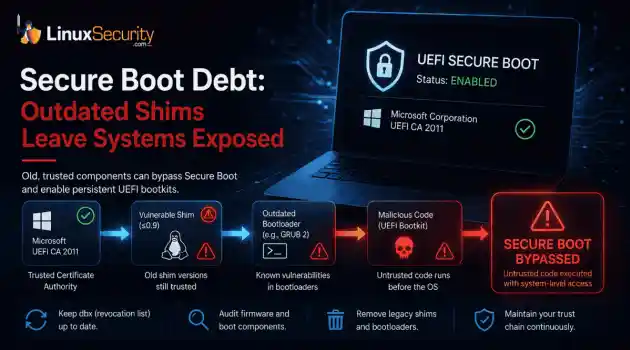
Security Vulnerabilities security advisory linux distribution
security advisory linux distribution ESET researchers identified 11 old and forgotten Linux UEFI shim bootloaders at versions 0.9 and below that can be used to bypass UEFI Secure Boot on any UEFI-based machine that trusts Microsoft’s Microsoft Corporation UEFI CA 2011 third-party certificate authority, regardless of the installed operating system (OS). Reported shims can be exploited to execute untrusted code during system boot, enabling attackers to deploy malicious UEFI bootkits even on systems with UEFI Secure Boot enabled.....
Jul 16, 2026
 Refine news
X Clear Filters
Get the latest News and Insights
Get the latest Linux and open source security news straight to your inbox.
Community Poll
Is continuous patching actually viable?
Loading...
Explore Latest Linux Security news
We found 2,760 articles for you...
83
 security advisorymalwarebotnet
SocksEscort Linux Router Malware Botnet Takedown Operation Lightning
Authorities have dismantled SocksEscort, a service that sold access to a large proxy network built from compromised residential routers. Investigators say much of the infrastructure sat on infected SOHO networking devices, many running embedded Linux firmware. . Instead of running its own servers, the operation pushed customer traffic through hijacked home and small-business routers. Over time, that created a distributed botnet where thousands of compromised systems acted as proxy nodes, letting fraud operations and credential attacks blend into normal residential traffic instead of standing out as activity from known malicious infrastructure. It’s a pattern that shows up again and again with router malware. A device gets compromised, nobody notices, and eventually that bandwidth is part of someone else’s proxy network. The SocksEscort case becomes more interesting once you look at how the network actually operated. Inside the SocksEscort Proxy Network SocksEscort presented itself as a residential proxy service, but the infrastructure behind it looked very different from the commercial proxy platforms people normally think about. Instead of volunteers or paid nodes, the traffic moved through compromised routers sitting in homes and small offices. That distinction changes the entire model. Legitimate proxy networks rely on users knowingly sharing bandwidth. The SocksEscort network relied on devices that had been quietly taken over and turned into relay points. A lot of that control came from AVRecon malware, a Linux-targeting threat uncovered by researchers at Lumen Black Lotus Labs. The malware targeted a wide range of SOHO routers, including models from Cisco, D-Link, Hikvision, MikroTik, Netgear, TP-Link, and Zyxel, which tend to run continuously and often sit untouched for years once they’re installed. Once a device was infected, the router effectively became part of the proxy network. AVRecon malware capabilities Linux router malware targeting SOHO networkingdevices device reconnaissance and system information collection command-and-control communication remote command execution proxy relay configuration for routing external traffic The result was a residential proxy network built almost entirely from compromised infrastructure. From the outside, it looked like a typical proxy service, but in reality, the network relied on thousands of infected routers acting as relay points for customer traffic. Once researchers started mapping the SocksEscort infrastructure, it became clear that the network had been running for years. The Scale of the SocksEscort Botnet Once researchers started mapping the SocksEscort infrastructure, it became clear that the network had been running for years. The service itself dates back more than a decade, gradually growing into a proxy network built from compromised residential devices. Investigators eventually tied more than 369,000 compromised IP addresses across 163 countries to the service. Researchers were also seeing around 20,000 devices communicating with the infrastructure each week, suggesting the botnet was constantly shifting as systems dropped off and new ones appeared. At that point, it stops looking like a niche proxy service. It starts looking like a long-running cybercrime infrastructure. The operation generated roughly $5.8 million (€5 million) in criminal revenue before the infrastructure was disrupted. The question I keep coming back to is why routers, especially Linux-based ones, keep showing up in operations like this. Why Linux Routers Keep Becoming Botnet Infrastructure Cases like SocksEscort tend to circle back to the same kind of device. Not servers. Not desktops. Home and small-office routers. Most of those systems run some form of embedded Linux, which makes sense once you think about how networking hardware is built. The operating system itself isn’t the problem. What matters is how long these devices stay online and how rarely they’re updated after they’reinstalled. A router might sit in a closet or under a desk for years without anyone logging into it. When attackers find a way in, that device can quietly become part of a botnet or proxy network and continue operating as if nothing changed. Where attackers usually get in Outdated firmware Default administrative credentials Exposed remote administration interfaces Unsupported hardware that no longer receives updates None of these weaknesses is particularly exotic. They’re the same entry points that have shown up in router botnet campaigns for years. Why infections often go unnoticed Routers operate continuously with little user interaction Proxy network activity generates minimal visible disruption Router security monitoring is uncommon in most environments •AVRecon has been observed flashing custom firmware images through the router’s update mechanism, allowing the malware to persist even after a reboot. That combination makes routers an unusually durable infrastructure once they’re compromised. A device can sit inside a botnet-backed proxy network for months, sometimes years, before anyone realizes it’s participating in the traffic. Which brings us back to the SocksEscort case and how authorities eventually disrupted that infrastructure. Why the SocksEscort Takedown Doesn’t Solve the Router Problem After years of operating in the background, the infrastructure behind SocksEscort eventually drew the attention of authorities . The joint investigation, known as Operation Lightning, focused on dismantling the service itself rather than attempting to track down every compromised router spread across residential networks. The response focused on dismantling the service itself rather than trying to track down every compromised router spread across residential networks. Authorities seized 34 domains and 23 servers across seven countries, dismantling the infrastructure used to operate the proxy service, and cryptocurrency connected to theoperation was frozen. In practical terms, that removed the platform that had been selling access to the proxy network. But taking down the service doesn’t automatically clean the devices that were already compromised. Many of the routers that once formed part of the SocksEscort network may still be online today, running the same firmware and configurations that allowed the compromise in the first place. What This Means for Linux Users and Administrators For most administrators, the takeaway from the SocksEscort case isn’t the malware itself. It’s the device lifecycle behind it. Routers and edge devices often stay in service far longer than the systems around them. They get installed, configured once, and then quietly run for years without firmware updates, configuration reviews, or security monitoring. That’s exactly the kind of environment operations like this depend on. If a router ends up inside a botnet or proxy network, the device may continue operating normally while routing traffic for someone else. In many cases, the first signal is an abuse notice from an ISP or unusual outbound traffic patterns that don’t match normal network activity. For administrators responsible for Linux-based networking devices, a few checks are worth making: Confirm routers are running the current firmware Replace hardware that no longer receives vendor updates Disable remote administration interfaces that are not required Change default or long-standing administrative credentials Review outbound traffic patterns from edge devices Isolate routers and IoT devices from internal networks where possible Administrators investigating suspicious router activity may also want to check for processes listening on port 48102 or the presence of a jid.pid file in /tmp, both indicators previously associated with AVRecon infections. None of these steps is complicated, but they’re often overlooked once a device is deployed, which is exactly the kind of gap operations like SocksEscorttend to rely on. That’s also why incidents like this keep resurfacing. The devices involved are rarely high-profile servers or hardened infrastructure. More often, they’re ordinary routers sitting at the edge of a network, quietly running the same firmware they had the day they were installed. . SocksEscort proxy network dismantled by authorities using compromised Linux routers shows ongoing threats from malware.. Linux Router Malicious Activity, SocksEscort Malware Disruption, Embedded Linux Security Issues, Cybercrime Infrastructure, SOHO Device Protection. . MaK Ulac
 Mar 13, 2026
•
Mar 13, 2026
• Hacks/Cracks
83
 security advisoryUbuntumalware
Linux Users Targeted as Crypto-stealing Malware Hits Snap Packages
We’ve been telling ourselves that Snap apps are sandboxed, signed, and therefore low-risk. Not perfect, but good enough. That assumption has been holding for years, mostly because it hasn’t been tested in a way that mattered to day-to-day operations. . Recently, it was. Several crypto-stealing campaigns are using Snap packages to land quietly on Ubuntu Linux systems. No exploit chains. No privilege escalation. Just software that looked legitimate enough to install, then stayed resident long enough to make money. For attackers focused on cryptomining, that’s ideal. CPU is consumed slowly, the system keeps working, and nothing obviously breaks. This isn’t about one bad Snap slipping through review. It’s about how much trust we place in packaging ecosystems once they become familiar. Snap’s design favors convenience, automatic updates, and a clean user experience. Those same traits also reduce friction for abuse when something malicious does get through. What matters for admins is not whether Snap is “secure” in the abstract. It’s how these choices change risk in real environments. We’ll walk through how the attack worked, why Snap was a good fit for it, what similar abuse has looked like before, and what’s worth locking down now if you don’t want packaging convenience to quietly expand your attack surface. What Actually Happened with Malicious Snap Packages? The recent campaign itself was not technically impressive, which is part of the problem. Attackers published Snap packages that looked legitimate and behaved well enough to avoid attention. There was no snapd vulnerability involved, and no sandbox escape to dissect afterward. The entry point was trust, not code execution. Distribution leaned on normal Snapcraft usage. A user searched for a tool, found a package that looked right, and installed it. From there, the payload focused on cryptomining and, in some cases, credential harvesting. Nothing destructive. No ransom notes. Just quiet resource use thatblended into the everyday system load, especially on developer workstations and lightly monitored servers. You start to notice the trend when you look at timelines instead of spikes. CPU usage that never quite drops. Processes that respawn under names that don’t raise flags. Outbound traffic that looks like any other long-lived connection unless you already know where it’s going. In Ubuntu environments where Snap is enabled by default, this kind of activity can sit undisturbed for longer than most admins are comfortable admitting. Cleanup was also less clean than people expect. Uninstalling the Snap removed the visible package, but not always the whole problem. Persistence mechanisms varied, and in a few cases, admins had to hunt down leftover processes or user-level artifacts before systems actually returned to baseline. The important takeaway is not that Snap is broken. It’s that “official” packaging has been treated as a proxy for safety in Ubuntu security models, and this campaign shows the limits of that assumption. Once a malicious package looks normal enough, the rest of the system tends to cooperate. Why Is Snap Attractive to Attackers? Once you step back from the individual incident, the choice of Snap starts to make sense. This wasn’t about bypassing defenses. It was about fitting in. Snap’s design decisions, most of them reasonable on their own, create an environment where long-lived, low-noise abuse doesn’t immediately look wrong. A few traits stand out when you compare Snap to more traditional packaging approaches like apt, or even to other modern formats such as Flatpak . Centralized distribution gives attackers reach without having to build their own delivery channel. If a package is discoverable through Snapcraft, it already has an audience. Auto-updates are expected behavior. Users rarely question why a Snap changes over time, or what exactly changed. Confinement reduces obvious breakage. A malicious Snap that stays within its sandbox can keep thesystem stable while still doing useful work for the attacker. Background services are normal. Many Snaps run persistently, so a process that never exits doesn’t immediately look suspicious. Classic confinement is available and often granted with little scrutiny, expanding what a Snap can touch once it’s installed. Publisher trust is inferred from names and descriptions more than from active verification. Logging and monitoring around Snap execution is usually thinner than for system packages. This is where the contrast with other formats matters. Flatpak still carries supply chain risk, but its permission model and runtime expectations make quiet persistence harder to hide. Apps are not generally expected to run indefinitely in the background, so abuse tends to surface faster. Apt packages, on the other hand, are usually installed with a clearer sense that you’re modifying the base system, which changes how people think about trust. None of this makes Snap uniquely unsafe. It does explain why attackers targeting cryptomining workloads gravitate toward it. The platform makes it easier to stay boring, and boring is exactly what you want when the goal is to siphon CPU over time. For admins, this is the shift. Snap should be evaluated like any other third-party code source, not as a special case that inherits trust from the platform it runs on. This Isn’t the First Time Snap Has Been Abused If this were the first example, it would be tempting to treat it as an outlier and move on. It isn’t. Snap has seen malicious or deceptive packages before, and the pattern is familiar if you’ve been watching other software ecosystems long enough. There have been Snap packages that slipped through review while doing something other than what they advertised. Others leaned on lookalike names or vague descriptions to catch casual searches. In several cases, packages were only pulled after users reported odd behavior, not because automated checks caught anything definitive. That delaymatters. It’s the window where quiet abuse pays off. What’s happening here mirrors what played out earlier in npm, PyPI, and container registries. Once an ecosystem makes distribution easy and normalizes fast installs, attackers start probing its edges. They’re not looking for perfect exploits. They’re looking for places where trust is assumed, and verification is light. It’s also worth zooming out for a moment. This isn’t unique to Snap. Flatpak, AppImage, and even the old habit of piping a curl command straight into a shell all scale the same mistake. Convenience lowers friction. Lower friction increases the chance that something untrusted runs without much thought. Packaging format changes the mechanics, not the underlying risk. The practical implication is straightforward. This wasn’t a fluke tied to one bad package or one review failure. It’s a repeatable delivery path that will keep resurfacing as long as software ecosystems optimize for speed and ease of use. At that point, the question for admins stops being “will this happen again” and becomes “how prepared are we when it does?” What Does Crypto-stealing Malware Look Like on Linux in the Real World? On Linux, crypto-stealing malware rarely announces itself. It settles in and tries to look like part of the background. That’s why it’s easy to miss if you’re only watching for spikes, crashes, or obvious failures. What usually shows up first is a sense that something is slightly off. A workstation that never quite goes idle. A server that runs warm even when demand is low. Users start mentioning fans or battery drain, but nothing is broken enough to trigger an incident. When you dig in, the signs tend to cluster around a few patterns: CPU usage that stays modest but persistent, even during periods when the system should be quiet. Processes with generic or misleading names that respawn when killed. Outbound connections to mining pools, proxies, or unfamiliar hosts that remain open for longperiods. Executables running from Snap-specific mount paths rather than expected system locations. Resource consumption that looks “normal” in isolation but wrong when viewed over days instead of minutes. Logs that appear clean unless you correlate process behavior, network traffic, and user actions over time. This is also where differences between packaging systems start to matter operationally. On Flatpak-based systems, similar abuse tends to stand out sooner. Applications are not typically expected to run indefinitely in the background, so long-lived processes attract attention faster. With Snap, persistent services are common enough that they blend in more easily. The monitoring lesson here is uncomfortable but important. You don’t catch this kind of cryptomining by waiting for alarms. You catch it by paying attention to low-grade anomalies that never quite resolve themselves. Once you start looking for those patterns, you realize how long this sort of activity can sit unnoticed. Securing Snapcraft Apps Without Banning Snap Outright Most environments can’t just rip Snap out and move on. Developers rely on it. Some tools only exist there. The goal isn’t to make Snap disappear. It’s to make its presence deliberate instead of incidental. The first shift is mental. Snap packages are not part of the base operating system. They’re third-party software delivered through a convenient channel. Once you frame them that way, the hardening steps stop feeling heavy-handed and start feeling familiar. Start with inventory. Many teams don’t have a clean answer to a simple question. What Snaps are installed, and who put them there. Until you can answer that, everything else is guesswork. From there, publisher review matters more than package names. Well-known projects with verified publishers behave very differently, over time, than one-off utilities with thin histories. Classic confinement deserves special attention. It exists for good reasons, but it quietly undoes many ofthe assumptions people make about Snap safety. If a Snap needs classic confinement, that should be a conscious approval, not a default outcome of clicking through an install prompt. Server environments are where discipline usually slips. Snap auto-installation and auto-updates make sense on desktops. On servers, they introduce change outside your normal review cycle. Disabling or tightly restricting Snap aligns better with how most teams already treat change control, especially in regulated Ubuntu security contexts. It also helps to make decisions visible. Document why a Snap is allowed, what it’s used for, and what level of access it has. That record pays off later, when something looks odd, and you need to decide quickly whether a process belongs. None of this guarantees safety. What it does is shrink the space where quiet abuse can live. When Snap usage is intentional, deviations stand out faster, and response becomes less about cleanup and more about containment. Monitoring and Logging Snap Activity that Actually Helps The hardest part of this class of abuse is that it doesn’t trigger the alerts we’re used to trusting. Nothing crashes. Services stay up. Users keep working. If you only look for sharp edges, you miss the slow ones. Effective monitoring around Snap starts by treating it as its own execution layer. Install and update events should be visible outside the local system. If a Snap appears or changes, you want that fact recorded somewhere central, with a timestamp you can line up against everything else that happened that day. Runtime behavior matters more than package metadata. CPU, memory, and network usage tied back to Snap mount paths is where patterns start to emerge. A single host using a little extra CPU is easy to ignore. Ten hosts doing it in the same way, over the same time window, is not. A few monitoring actions consistently prove their value: Track Snap install and update events centrally, not just locally. Watch for long-running Snap processes onsystems that shouldn’t have them, especially servers. Correlate outbound network connections with Snap executables and user context. Look for resource usage that never quite returns to baseline. Retain logs long enough to see slow-burn behavior, not just short incidents. Assume an attacker’s goal is to look boring, not noisy. What tends to surprise newer admins is how little raw data you need once you know what to correlate. You don’t need deep packet inspection or exotic tooling to spot cryptomining behavior. You need time windows, context, and the discipline to look at patterns instead of peaks. Once Snap activity is visible alongside the rest of your system telemetry, it stops being a blind spot. At that point, the risk shifts from “we wouldn’t notice” to “we might miss it if we’re not paying attention,” which is a much more manageable place to be. Policy Decisions Linux Admins Should Revisit Now Most of the risk exposed by this incident isn’t technical. It’s procedural. Snap behaves the way it was designed to behave, and on Ubuntu, those behaviors are defaults. Snap is enabled out of the box. Auto-updates are on. Classic confinement is available. None of that is a flaw. It does mean those defaults quietly shape your risk profile, whether you’ve discussed them or not. This is where policy catches up with reality. If Snap is present in your environment, it is already making decisions on your behalf. The question is whether those decisions align with how you expect systems to be managed. There are a few areas where ambiguity tends to cause trouble: Are Snaps allowed everywhere, or only on user workstations? Who is allowed to install new Snaps, and under what conditions? What happens when a Snap is flagged as suspicious or outright malicious? How quickly can you inventory affected systems and remove a package at scale? Whether Snap usage is documented anywhere beyond tribal knowledge. How exceptions are handled when someone insiststhey need a specific Snap right now. It helps to frame these as defaults rather than judgments. You are not criticizing Ubuntu for enabling Snap. You are deciding whether those defaults make sense for your environment, your compliance obligations, and your tolerance for unmanaged change. Ubuntu security guidance gives you a baseline. Policy is where you decide how far beyond that baseline you need to go. Once these decisions are written down, a lot of the uncertainty disappears. Installs become intentional. Exceptions become visible. When something odd shows up in monitoring, you already know whether it belongs there. At that point, Snap stops being a background assumption and becomes just another managed input into your risk model. What Does this Change for Linux Security Going Forward? The most useful outcome of incidents like this is not a new rule or a new tool. It’s a quieter adjustment in how trust is handled. Linux systems are no longer ignored by attackers looking for steady financial return. CPU time, credentials, and persistence all have value now, even when nothing breaks. Packaging ecosystems are part of that reality. Snap made the mechanics visible, but the pattern applies anywhere software is easy to install and rarely revisited. Sandboxing still matters. It limits damage and contains mistakes. It does not tell you whether the code inside the sandbox deserves to be there. For admins, the shift is less about adding controls and more about knowing what is running, why it is there, and how it behaves over time. Asset awareness does more work here than another layer of detection. Once you see that, the focus naturally moves from chasing individual threats to managing assumptions. Cryptomining will keep showing up in different forms because it fits this model so well. It is quiet, persistent, and profitable enough to justify patience. That makes it a good stress test for how much implicit trust exists in your environment. When trust is explicit, accepted risk is easier toexplain and easier to defend. When it isn’t, packaging convenience quietly expands the attack surface without anyone signing off on it. The difference between those two states is not dramatic. It’s procedural. And once you notice it, it’s hard to unsee. . Recent campaign exposes how Snap packages can conceal crypto-stealing malware in Ubuntu systems, risking resource theft.. Crypto-stealing Malware, Snap Packaging, Linux Security, Ubuntu Administration, Package Monitoring. . Brittany Day
Jan 29, 2026
•
Hacks/Cracks

83
 security advisorymalwarebreach
UNC2891: Banking Heists with Linux Malware Exploiting Physical Access
UNC2891 has been working its way through gaps in ATM security and broader banking security by slipping small hardware implants into places most teams assume are locked down. Investigators found Raspberry Pi systems sitting near ATM transaction switches, quietly feeding access back to the operators while Linux tooling handled the heavier work inside the network. The group paired that access with cloned cards and a mule network that turned compromised infrastructure into predictable cashouts. . The whole operation shows how easily a determined crew can turn physical access and an overlooked embedded device into long-term leverage inside a financial environment that otherwise looks hardened on paper. How Did UNC2891 Breach ATM Security Using Hardware Implants and Linux Malware? Investigators traced the initial access point to a series of Raspberry Pi boards tucked into network paths that should never see unvetted hardware. Each device sat close to the ATM transaction switch, which gave the operators a clean line into systems that handle the core transaction flow. A small 4G modem handled the outbound channel, letting the attackers reach those boards without touching the bank’s perimeter or dealing with its change controls. Once inside, the group leaned on familiar Linux and Unix tooling. CAKETAP used CVE-2021-3156 to climb privileges on older hosts that had not fully cycled through patching. SLAPSTICK exploited CVE-2021-4034 through Polkit to reach the same goal on better-maintained systems. TINYSHELL kept things simple by giving the operators a lightweight remote shell that blended into normal process lists. None of these tools was complex, but they were quiet and reliable. The more interesting part came from the way UNC2891 relied on bind mounts to mask activity. By shifting sensitive paths into controlled views, they hid directories, logs, and even some of the tooling from routine inspections. It is the kind of trick that slips past teams that rely heavily on perimeter sensors andassume internal hosts are stable. With control of the transaction switch and the surrounding infrastructure, the group moved from reconnaissance to monetization. Cloned cards were produced using data from the compromised environment, and mule crews handled the withdrawals across several countries. The hardware implants and the Linux malware stack gave them a foothold that survived audits for years because nothing looked obviously broken in the banking security stack. Banking Security Risks and Real-World Campaign Activity By the time forensic teams pieced the campaign together, it was clear UNC2891 had been active far longer than anyone assumed. Several banks in Southeast Asia reported activity dating back to 2017 , which means the group operated through multiple hardware refresh cycles and at least one core-network redesign. That kind of persistence tells you the operators understood how ATM networks are built and where the weak seams sit between on-prem systems and switching infrastructure. The affected systems weren’t limited to the ATMs themselves. The intrusion paths stretched across Linux and Unix hosts that supported transaction processing, card-issuing systems, and internal monitoring pipelines. Those hosts were often segmented on paper, but still exposed enough shared services to give an attacker room to move once the hardware implant was in place. Physical access gave them the starting point, and host-level access filled in the rest. The financial losses tied to the cloned-card withdrawals added up quickly because the activity looked like routine consumer traffic at first glance. Mules cashed out across different ATM fleets and different regions, which made correlation harder until analysts started comparing timestamps and withdrawal patterns. It became clear that the issue wasn’t a single ATM model or a software defect. It was a structural weakness in how ATM security controls are layered inside modern banking environments. For many teams, the uncomfortable part of thiscase is how ordinary the attack chain was. Nothing about the malware or operational playbook would surprise anyone who has worked in incident response. The scale came from patience, physical access, and a banking security model that still assumes internal networks are trusted once you get past the branch perimeter. Strengthening ATM Security and Banking Security Controls Most of the recommendations that came out of this investigation were not new. What changed was the emphasis. Teams realized how much trust had accumulated around network closets, switch cabinets, and other places that rarely see routine inspection. Locking those areas down and tracking who enters them became just as important as patching a high-severity Linux bug. Once the Raspberry Pi boards were removed, several banks started logging physical access through the same lens they use for privileged account activity. Scanning for unauthorized hardware turned into a practical exercise instead of a theoretical one. Some teams added periodic sweeps of ATM network segments with simple inventory scripts, backed by NAC policies that flag devices with unexpected MAC prefixes or cellular interfaces. This isn’t glamorous work, but it closes the gap that allowed the 4G implants to sit unnoticed for so long. Segmentation reviews followed. Many banks had ATM networks separated on paper while still sharing authentication paths, update channels, or internal monitoring systems with the broader environment. Cleaning up those links took time, and in some cases, it required coordination with vendors who had quietly relied on those shared services. Once those pathways were clarified, the Linux privilege-escalation vulnerabilities used by CAKETAP and SLAPSTICK became less useful to an attacker. Operational teams also began monitoring for unusual bind-mount behavior. Bind mounts are common in container platforms and maintenance workflows, but they stand out on hosts that normally run a predictable set of banking applications. Alerting on thatactivity gave analysts something concrete to investigate instead of relying on signature-based detections. The last piece involved fraud teams. They rebuilt their processes for spotting mule behavior and repeated cloned-card withdrawals. Instead of monitoring only per-card anomalies, they began correlating ATM usage across regions and providers. This tied the operational side of banking security to the cash-out phase in a way that hadn’t been done before. Closing Thoughts: What This Means for Linux, ATM Security, and Modern Banking Security The UNC2891 case shows how much risk sits in the gaps between well-defended systems. The Linux hosts involved in this incident were not fragile or outdated. They were typical production machines running standard banking workloads, and they failed only because an attacker reached them through a path no one was watching. Once the hardware implant was in place, the group had time to learn the environment and adjust their tooling until it blended in. It also highlights how hybrid operations are becoming normal for financially motivated crews. They mix physical access, off-the-shelf hardware, and quiet Linux malware to build a foothold that lasts. This is less about zero-day exploits and more about understanding how real networks behave when they age. The longer the infrastructure remains unchanged, the more predictable it becomes to someone who has already found a way inside. For security teams, the insight is simple but uncomfortable. Strong perimeter controls and regular patching are not enough when the attacker starts from a position that bypasses both. Modern banking security depends on treating every layer, including the physical one, as part of the threat surface. That means monitoring embedded devices, verifying internal assumptions, and treating unexpected behavior on stable systems as a signal rather than noise. Finally, the case is a reminder that the people involved in these operations matter as much as the tooling. The cashouts only workedbecause mule networks were available and coordinated. Without that human layer, the malware and the Raspberry Pi hardware would have been interesting but unprofitable. Understanding how these mule networks operate helps teams see where technical controls stop being effective and where operational gaps begin. . Investigators reveal how UNC2891 exploited physical access and Linux malware to compromise bank security systems.. UNC2891, ATM Security, Linux Malware, Banking Breach, Physical Access. . Brittany Day
Nov 27, 2025
•
Hacks/Cracks
83

Arch Linux Under Fire: DDoS Attack Enters Second Week
If you’ve tried pulling files from Arch’s main site, hit the AUR, or popped into their forums recently, then you’ve probably noticed things are off. Maybe you hit a dead end. Maybe you’re still cursing at your terminal trying to get a package. That’s because the Arch Linux project is under an ongoing DDoS (Distributed Denial of Service) attack , and it has been two weeks of intermittent outages. For an ecosystem as lightweight and DIY-friendly as Arch, these disruptions hit users and admins hard. . What’s happening, you ask? In a nutshell, their main site, archlinux.org, has been consistently hammered. The AUR, which is basically a treasure chest of user-submitted packages (a lifeline for custom setups), isn’t free from the hits either. And if you’ve been tracking troubleshooting discussions or Arch gossip on their forums, those are under siege, too. The team behind Arch isn’t sitting idle – they’re working with their hosting provider and are actively considering partnering with a DDoS protection service. But progress takes time, and for now, both admins and end users need to adjust to the fallout. Why Is Arch Linux Being Targeted in a DDoS Attack? We’d all like to think there’s some logic behind these DDoS attacks – maybe a reason tied to Arch’s open-source ethos, its outspoken DIY hacking culture, or its visibility among Linux enthusiasts. But it might not be that deep. To date, Arch hasn’t disclosed much about the who or the why behind this attack. It could be politically motivated, a financial extortion attempt, or just someone testing tools and looking for an easy, high-profile target in the Linux world. The Arch team is playing it close to the vest, giving away no technical details about the attack’s structure, origin, or their defense mechanisms. To be fair, they’re smart to keep quiet while they’re still in the thick of it. Fighting a DDoS attack isn’t exactly straightforward – the attackers may pivot the second you close one door. For now, thecommunity’s left guessing. Here’s Why This Arch Linux DDoS Attack Matters It’s easy to shrug off a DDoS attack as simple noise. After all, your systems aren’t exposed to CVEs or database breaches, right? But there’s more to consider here. First is the service disruption. Arch Linux is beloved precisely because it offers users a raw, bleeding-edge experience – no frills, just functionality. That model works when Arch’s repositories, AUR, and forums are consistently accessible. Take that away, even briefly, and you introduce a significant pain point for sysadmins who depend on Arch’s uptime, or developers who use AUR dependencies for automation. Next is the question of data access and integrity. Now, Arch hasn’t reported a single data breach , which is reassuring. However, when availability becomes an issue over an extended period, admins inevitably start asking questions. Will these systems remain resilient? Have mirrors been bashed around by bad traffic, too? No one likes prolonged downtime, let alone one that could stretch resources or leave tools slightly out of sync across mirrors. And then there’s infrastructure strain on the Arch team. Sustained attacks over weeks hammer systems, increase hosting costs, and bog DevOps folks down trying to plug every hole. Projects funded heavily by donations, like Arch, don’t have endless resources to throw at mitigation. This raises the bigger question: how long can even high-profile open-source projects fend off repeated infrastructure assaults? Workarounds – You Aren’t Completely Stuck If you’re an admin in the weeds trying to keep systems alive while Arch rides this storm out, you still have options. One of the beauties of this community is redundancy – here’s how to keep things moving: Hit the Mirrors for Core Arch Files Forget the main Arch Linux website if it’s down. The mirrors tied to your pacman-mirrorlist package are still your best friend. Installation ISOs? Package files? All of that is stillhosted across the dozens of globally distributed mirror servers. Pro tip: Make sure to verify integrity and check for a trusted signature before pulling anything. The official Arch wiki gives the rundown on the process, and you’ll want that 0x54449A5C key handy. AUR Access Alternatives The AUR slowdown feels like the real bottleneck for most Arch users right now, but there’s still an escape hatch. A GitHub-maintained mirror of AUR packages exists. You’ll need to manually clone the repo for each package you need. It’s as simple as running: git clone --branch --single-branch https://github.com/archlinux/aur It’s slightly inconvenient, but it gets the job done until things stabilize. Is This the First Time? While this incident is dragging on longer than anyone hoped, it’s likely not Arch’s first brush with a DDoS situation. Open-source projects – especially ones as widely used and adored as Arch – are no strangers to bad actors. If not now, they’ll get hit eventually, just because running an open, transparent project makes you a pretty easy target. And Arch isn’t alone here. Major distributions like Debian , the daddy of stable repos, and even polished players like Ubuntu have faced similar attacks on their infrastructure. DDoS is just noise, but noise at scale is hard to fight. It’s an unfortunate part of running anything relevant on the internet these days. Arch’s handling of this attack is a good reminder – every distribution should be assessing their resilience against this kind of disruption. When the Dust Settles Arch users are a pragmatic bunch. Odds are, you’re already used to rolling with the punches when something goes sideways. Maybe you’ve been through similar outages, or maybe this is your first time dealing with an Arch infrastructure wobble. Either way, this is frustrating – no question about it – but it’s nothing we haven’t weathered before. The Arch Linux team will get this sorted. Whether that involves new DDoSprotections, improved hosting partnerships, or something behind the curtain, they’ve been upfront that they’re in the trenches working on it. Until then, lean on mirrors, GitHub AUR mirrors, and keep your systems humming the best you can. This is just another reminder that being an Arch admin sometimes means scrapping together what works when your ideal isn’t on the table. Admins, stay sharp. Server chaos doesn’t wait on convenience – and neither does Arch Linux. . Arch Linux faces a prolonged DDoS attack, disrupting services and raising concerns for users and admins alike.. you’ve, tried, pulling, files, arch’s, popped, their, forums. . Brittany Day
Aug 25, 2025
•
Hacks/Cracks
83
 data breachcybersecuritysecurity assessment
The Rise of Cloud-Native Ransomware Threats and Prevention Strategies
Over the past few years, ransomware has evolved into a highly advanced type of malicious software, targeting individual systems and entire enterprises with increasingly sophisticated attacks. However, the most recent and worrying trend in this evolution is the advent of the cloud-native ransomware. . Unlike conventional ransomware, which targets endpoints or local servers, cloud-native versions are specifically designed to target cloud infrastructure. As more businesses shift their workloads to platforms like AWS, Azure, and Google Cloud, threat actors are adapting their strategies to keep pace. For example, SOC Managed Services have played a pivotal role in this environment, assisting organizations to track, identify, and counter these new threats in real time. The need to defend against ransomware is no longer met by the traditional approach since attackers can now exploit native cloud features and configurations. Many organizations now rely on third-party security monitoring to provide 24/7 visibility and response capabilities tailored to complex cloud environments Learning the Cloud-Native Ransomware Threat Cloud-native ransomware is created to target applications, data, and backup in a cloud environment. Such attacks do not simply encrypt the data on an individual machine, but rather exploit misconfigurations in cloud services to gain access to complete storage buckets, database instances, or containerized applications. After gaining access, such strains of ransomware can spread horizontally within cloud accounts, destroy backup snapshots, and encrypt essential resources. The stealth of this new wave of ransomware is one of its most concerning aspects. Most of these attacks never even get detected by the endpoint, since they do not use traditional file-based malware. They would rather employ APIs , automated scripts, and stolen credentials via phishing or identity theft. The attackers can go undetected until it is too late by taking advantage of the cloud infrastructuredirectly. Such a change represents a paradigm shift in the way organizations must approach security. The traditional perimeter-based endpoint and network firewall defense model does not translate well to the cloud. Identity, access management, and automation controls are the new gatekeepers in the cloud--and they are constantly under attack. The Reason Cloud Environments are a Popular Target The cloud infrastructure offers massive scalability and flexibility, but it also creates a much broader attack surface. Attackers access through misconfigured storage buckets, overly permissive roles, and weak credential hygiene, to name only a few. This is further complicated in a multi-cloud and hybrid environment where there may be significant differences in visibility and control across platforms. The second way that makes cloud environments such good targets is the use of backups and disaster recovery systems. These are intended to be the last resort for an organization. Yet, contemporary ransomware gangs are aware of this as well. Access to the control plane allows them typically to destroy or corrupt cloud backups before initiating the encryption stage of their attack. This makes organizations unable to restore data without paying the ransom, which makes a payout more likely. The risks can be mitigated through a cloud security assessment. Periodic review of configuration, access controls, and backup procedures is a good way to identify vulnerabilities before they are exploited. Security teams should also evaluate process vulnerabilities, as they may enable attackers to use automation scripts or API keys in publicly available repositories. Case Studies and Practical Influence Several high-profile cases of ransomware actors targeting cloud-native services have already occurred. Attackers have primarily used poorly configured permissions to gain access and encrypt object storage services, such as Amazon S3 or Azure Blob Storage. In others, they compromised administrative credentials, disabled security monitoring tools , and deleted system logs. Such attacks are financially devastating. In addition to the ransom itself, which may cost millions of dollars, organizations have to cope with downtime, reputational loss, and regulatory and legal risks. In controlled sectors such as healthcare or finance, the ramifications of a data breach resulting from an incident involving ransomware may include compliance fines and reputational damage. Furthermore, cloud-native attacks may be on a much bigger scale than conventional ransomware attacks. Since cloud services tend to concentrate essential data and functions, one breach can cause a chain effect on various applications and departments. The Changing Perimeter in a Cloud-First World Organizations should include a cloud-first cybersecurity strategy to keep up with these threats. This involves the incorporation of security in each phase of the cloud lifecycle, including design and deployment, maintenance, and monitoring. It also implies the automation of not only operations, but also the enforcement of security. Cloud-based security tools, such as cloud workload protection platforms (CWPP) and cloud security posture management (CSPM), as well as identity governance solutions, are increasingly critical tools in the ransomware battle. These tools help monitor the configurations, policy enforcement, and detect anomalous behavior, which could imply that an attack is in progress. Cloud teams often turn to CIEM to understand who really has access to sensitive workloads and to cut back excessive permissions before they are abused. Teams trying to reduce hidden exposure are increasingly looking to Identity Security Posture Management for better visibility into risky permissions, weak controls, and identity misconfigurations. However, it is not only the technology. A contemporary ransomware response strategy should include playbooks tailored to specific cloud events. These playbooks should be tested by the teams regularly, and the membersshould simulate their attacks to know where they are vulnerable. The presence of an escalation plan, with legal and communications strategies, would help significantly to eliminate the confusion during a real incident. The Future of Ransomware Is in the Cloud The hypothetical threat of cloud-native ransomware is not a thing. It is upon us and is transforming the scenery of cybercrime , compelling organizations to reimagine their security measures on an entirely new level. With more companies using cloud-based infrastructure, the targets are growing too, and with it, the sophistication of attacks. Although no system is immune to it, being vigilant by conducting proactive assessments, robust access controls, and constant monitoring can greatly minimize it. The advanced tooling, coupled with well-trained teams, presents the most significant possibility of defense in a world where data is no longer stored in physical vaults but is freely passed across the cloud. Organizations that will succeed in this new age are those that view security not as a reactive role, but as an ongoing, seamless component of their cloud strategy. . As cyber threats evolve, cloud-native ransomware emerges as a major risk, targeting cloud infrastructures and critical data with advanced tactics that exploit vulnerabilities. Cloud-Native Ransomware, Cybersecurity Threats, Data Breach Prevention, Cloud Infrastructure Security. . MaK Ulac
Aug 13, 2025
•
Hacks/Cracks
83

Plague: A Stealthy PAM-Based Backdoor Targeting Linux Systems
Alright, let’s talk Plague . If you’re a Linux admin or someone knee-deep in securing systems, this little beast of a backdoor should have your full attention. It’s not like the typical brute-force, ransomware-type malware that makes headlines. This one’s subtle — it creeps into the very thing that defines user authentication on Linux machines: PAM (Pluggable Authentication Modules) . And, to add insult to injury, it does so while keeping its tracks covered so well that no major antivirus solutions have been able to flag it. . That’s bad news. Really bad news. PAM isn’t just some optional component of your Linux server setup. It’s the core stack of authentication — practically the gateway to SSH access, sudo privileges, and even basic login functionality. An attacker leveraging a compromised PAM module isn’t just knocking on the door; they’ve found the spare key hidden under your mat and can walk in at will. Let’s dig into what “Plague” does, how it operates, and most importantly, what you can do about it. What Is the Plague Linux Backdoor Malware? To sum it up, “Plague” is Linux malware disguised as a PAM module. Think of PAM as the decision-maker in your Linux system that controls who gets in and who doesn’t. This particular backdoor hooks into PAM so it can bypass normal authentication flows entirely. With Plague installed, attackers can gain persistent SSH access using hardcoded static passwords — stuff like Mvi4Odm6tld7 or IpV57KNK32Ih — effectively giving them their own permanent VIP pass to your system. And here’s the kicker: Plague doesn’t run wild or make a racket when it’s inside. It’s quiet. Obfuscated. It’s built to blend in and erase its fingerprints. Variables like SSH_CONNECTION ? Wiped clean. User shell history ( HISTFILE )? Redirected to oblivion ( /dev/null ). It’s like the attacker never logged in; their session might as well have existed in a parallel dimension. How Has Plague Flown Under the Radar? VirusTotalSubmissions of Plague Samples Here’s the standout feature of Plague: stealth. Antivirus engines? They’ve got nothing — no flags, no alerts. Over the past year, multiple samples of Plague have been uploaded to VirusTotal, and still, not a single AV tool has identified them as malicious. That’s no accident; whoever authored this backdoor clearly knows how to slip past traditional defenses. Plague uses three-layer string obfuscation — XOR’d, PRGA-like routines, and pseudo-random generation. What does that mean, exactly? It means even the sensitive strings and memory offsets inside its code are scrambled in ways that make reverse engineering painfully tedious. Combine that with anti-debugging techniques (i.e., checking for renamed binaries or preload anomalies), and you’ve got malware built to evade analysis. Good luck figuring out where it’s hiding or how it’s behaving without some serious digging. Why PAM? This isn’t just some run-of-the-mill exploit hitting files or configuration settings. It’s PAM — the literal backbone bridging Linux’s authentication mechanism for everything from SSH sessions to sudo commands. Once PAM’s trust is breached, the attacker can redefine how authentication works without getting caught. That’s far more impactful than simply brute-forcing an SSH password or exploiting a forgotten service that nobody patched. Why mess with the front door when you can just alter the lock itself? The Real Danger: Persistence and Control Let’s paint the worst-case scenario: an attacker deploys Plague on a multi-user Linux server. They’ve now got static passwords baked into authentication flows, meaning they can log in repeatedly without tripping alarms. And even if you patch something upstream or restart processes, Plague sticks around. It survives system updates, integrates with PAM so deeply it feels native, and doesn’t leave behind loose ends for your forensic tools to discover. At that point, it’s not just a matter of unauthorized access.Your system becomes a resource for data theft, lateral movement attacks, or manipulation of sensitive operations. Maybe they’re grabbing corporate data quietly — nothing loud enough to alert your IDS. Maybe they’re pivoting from your machine to cloud infrastructure or external resources. The possibilities expand fast when the underlying system is fully compromised. Okay, So How Do I Spot Plague? Detecting Plague isn’t simple, but it’s doable if you know where to look. Here are some things worth focusing on: Hunt for Strange PAM Modules Suspicious binaries masquerading as system files are a clue. File names like libselinux.so.8 or binary metadata linked to GCC toolchains from Debian, Ubuntu, or Red Hat might raise eyebrows. If it doesn’t belong, investigate. Use YARA Rules Security researchers have developed a YARA rule targeting the backdoor’s ELF files. Specifically, it looks for strings like decrypt_phrase or init_phrases in files less than 1MB with ELF headers. Run scans periodically, and flag any hits for deeper review. Behavioral Red Flags Weird SSH activity isn’t normal. If you spot gaps in connection logs or unexplained anomalies in authentication flows, don’t shrug it off. These are signs that something’s altering PAM behavior behind your back. Prevention Instead of Panic Taking steps to harden your system against Plague isn’t rocket science; it’s really about cleaning house and locking things down. Here’s how you can make life harder for malware like this: Audit PAM Regularly: Don’t assume PAM modules are untouchable. Compare their binaries against known good states, hash them, and keep backups. If something looks off, dig deeper. Restrict PAM Modifications: Don’t let just anyone mess with authentication configurations. PAM should only be accessible to admins with verified credentials. Lock it down tighter than a drum. Harden SSH: Static passwords? No thanks. Enable multi-factor authentication (MFA) , and disableunused methods to cut down on attack surfaces. If you’re still relying on basic password-only SSH setups, it’s time for a rethink. Log Everything: If authentication is happening, you should be logging it. Keep access logs properly secured so attackers don’t erase them. Spotting an anomaly early can save you from dealing with the aftermath later. And seriously, patch your systems . Not just core packages but every dependency that interacts with your authentication stack. Plague might evade detection, but staying current on security updates reduces vulnerability windows and limits other entry points. What If You Find Plague? Discovering Plague in your system isn’t fun, but it’s also not the time to panic. Immediate steps like isolating the machine from your network should stop the attacker from pivoting elsewhere. From there: Analyze it: Custom deobfuscation scripts can help you understand what’s actually happening on your system. Reverse engineer, study its hooks, and figure out its scope. Rebuild your OS: Once Plague compromises critical modules like PAM, the safest route is a full system rebuild. Don’t cut corners — start fresh, rotate all credentials, and lock things down better than before. Share your findings: This part’s optional but crucial. Malware like this spreads because admins don’t report it or share indicators of compromise (IOCs). By publishing your insights to threat intel platforms, you contribute to faster global detection. Our Final Thoughts on Preparing for & Mitigating Plague Malware Plague isn’t your garden-variety malware. It’s the kind that slides past antivirus engines, alters core authentication mechanics, and makes life miserable for sysadmins once it digs in. And while viruses, worms, and trojans may dominate headlines, the subtle nature of PAM-based threats like Plague could pose even greater risks to Linux systems moving forward. You don’t need magic to defend against this stuff — just sharp detectionhabits, rigorous PAM auditing, and a healthy dose of paranoia about where and how authentication happens. Lock it down, stay vigilant, and maybe check in with your PAM config files more often than you’ve been doing. Threats like Plague grow in the cracks, and it’s your job to seal those up tight! . Plague is a stealthy PAM-based backdoor targeting Linux systems, enabling persistent SSH access and challenging detection efforts.. alright, let’s, plague, you’re, linux, admin, someone, knee-deep, securing, systems. . Brittany Day
Aug 04, 2025
•
Hacks/Cracks
83
Linux Servers Under Siege: CVE-2025-31324 & the Auto-Color Backdoor Malware Explained
If you’re an admin managing Linux machines, you’ve got a couple of things on your radar right now. One is CVE-2025-31324, a vulnerability that’s got the potential to turn your well-behaved servers into someone else’s playground. The other is Auto-Color, a backdoor that’s sneaky, persistent, and ruthless when it gets into your systems. . This isn’t just theory—we’re talking ongoing exploitation in the wild. Fair warning: once you understand what Auto-Color does, you’re not going to look at /var/log the same way ever again. Let me walk you through this, step by step, so you’re not just better informed—you’re better equipped to keep your systems out of the crosshairs. The Skinny on CVE-2025-31324: What’s the Big Deal? Auto-Color Malware Attack Stages (Source: Darktrace) Here’s what we know: CVE-2025-31324 is a critical vulnerability in SAP NetWeaver, disclosed in April 2025. It allows attackers to upload files directly to the application server. Sounds tame? It’s not. Those files can trigger remote code execution (RCE), giving attackers a foothold on your Linux system—think persistence, lateral movement, and full compromise if they get their way. Security researchers have already observed threat actors exploiting this in the wild. They’re not just testing the waters, either—they’re deploying payloads like the Auto-Color backdoor to gain long-term control. If your network has anything SAP-related running, especially if it’s accessible from outside, it’s time to hit pause on whatever you were doing and shore up your defenses. Critical vulnerabilities like these aren’t theoretical. The bad guys are ahead of you—they’re already using it. What Is the Auto-Color Backdoor Malware? Let’s talk about the charming piece of malware that’s been popping up as part of CVE-2025-31324 attacks: Auto-Color. First discovered toward the end of 2024, it’s a Remote Access Trojan (RAT) that has a thing for Linux systems, especially ones inenvironments like universities, government networks, and organizations in the U.S. and Asia. But don’t assume you're in the clear if you’re not one of those—you could end up in its sights anyway. The name “Auto-Color” probably sounds harmless. Don’t let it fool you. Once this thing lands on your box, it renames itself to /var/log/cross/auto-color , blending into log directories like it belongs there. Its tactics are deliberate, its mechanisms slick, and it’s got some clever quirks that make it incredibly slippery. This is not low-tier script-kiddie malware—it’s something you take seriously. The Nitty-Gritty: How Does Auto-Color Operate? Auto-Color is no ordinary malware—it's a master of adaptation and stealth, leveraging tools like /etc/ld.so.preload to infiltrate systems and maintain persistence without raising suspicion. As a Linux admin, understanding how it operates is crucial to uncovering its tricks and securing your environment. It Adapts The first thing Auto-Color does is check what it’s up against. Is it running as a non-root user? No problem—the malware tones things down, limits its actions, and behaves like it’s genuinely trying to fly under the radar. But if it’s got root? Game on. That’s when it digs in, modifies critical files for persistence, and sets up camp. It Hides in Plain Sight One of the clever tricks in its toolkit is using /etc/ld.so.preload . Familiar with it? If not, now’s the time to be. It’s a mechanism that forces the loader to preload specific libraries. Auto-Color uses this to inject a shared object file ( libcext.so.2 ) into your system calls, effectively hijacking them. The shared library is disguised as something innocent—just a utility library for C programs—but there’s nothing innocent about what it’s doing. By hooking into /etc/ld.so.preload , the malware ensures its code gets loaded into every process that starts. Every single one. That’s system-wide persistence without the mess of modifying binariesor core utilities. It’s clean, efficient, and… terrifying. Cloak-and-Dagger Tactics Here’s where things get slick: if Auto-Color can’t connect to its command-and-control (C2) server, it dials everything down. The RAT goes dormant, suppressing its malicious activities to avoid drawing attention. No suspicious network traffic. No obvious malicious processes. It just waits. This makes it a nightmare to analyze in isolated environments or sandboxes, as it behaves like a perfectly benign (if invisible) guest until the C2 server says otherwise. What Should You Watch For? If you’re managing Linux systems, you’ll want to keep your eyes peeled for a few specific red flags: Odd Directories: Check for anything resembling /var/log/cross/auto-color. It’s not a directory you should see, period. Modified Config Files: Keep an eye on /etc/ld.so.preload . Normal usage for this file is rare. If it’s been modified—or exists at all—you need to investigate. Suspicious Files: Look for unusual shared objects (e.g., libcext.so.2 ) pretending to be runtime libraries. Strange Network Activity: Auto-Color establishes outbound connections over TLS to hardcoded IPs. If your firewall or network monitoring tools flag connections to, say, IPs like 146.70.41.178 , don’t shrug it off. It’s also worth beefing up your process monitoring. Anything acting out of character—unexpected renames, odd privilege changes—deserves your attention. The Path Forward: Prevention and Practical Mitigation Alright, now that we know what we’re dealing with, how do we keep this kind of thing out of our systems—or kick it out if it’s already there? Apply SAP’s Patches (Like, Yesterday): CVE-2025-31324 is your entry point here. Close this hole before an attacker finds it. Simple as that. Revisit /etc/ld.so.preload : Unless you’re explicitly using this (for legitimate reasons only you know about!), consider disabling it entirely. Yes, it’s that risky. Harden User Access: Root access shouldn’t be anyone’s default. Enforce principles like least privilege. The harder it is for malware to operate as root, the more restricted malware like Auto-Color becomes. Segment Your Network: Keep sensitive systems—like SAP NetWeaver—isolated. The less accessible they are from outside, the better. Require VPN connections , whitelist IPs, and set up firewalls to block untrusted connections. Run File Integrity Monitoring (FIM): Keeping an eye on critical directories and files can make it easier to detect malicious modifications before they have time to embed themselves. Stay Updated on Threat Intel: Indicators of compromise (IOCs) for Auto-Color include the aforementioned IP addresses and certain file artifacts. Keep your tools loaded with the latest signature databases. Our Final Thoughts on Navigating the Auto-Color Linux Malware Threat Auto-Color isn’t just another “interesting malware story” you’ll skim in a security report. It’s actively exploiting Linux systems, hiding in plain sight, and using tactics that outpace many traditional defense mechanisms. Combine it with a vulnerability like CVE-2025-31324, and you’re dealing with a real, present danger. But you’ve got everything you need to put up a good fight. Patch your systems, monitor the activity that matters, and make it hard for malware like Auto-Color to leave its mark. The smarter and more vigilant you are now, the less cleanup you’ll have to do later. And look—while it’s tempting to hope these things won’t happen to you, good sysadmins don’t bank on luck. So roll up your sleeves, check your logs, and keep the bad guys out. . Ongoing exploitation in the wild involves the Auto-Color backdoor attacking systems through CVE-2025-31324 vulnerabilities.. you’re, admin, managing, linux, machines, you’ve, couple, things, radar, right. . Brittany Day
Jul 31, 2025
•
Hacks/Cracks
83

From Windows to Linux: Gunra Ransomware's Strategic Evolution
You and I know Linux environments have always been the sturdy, reliable workhorses of IT ecosystems. For decades, they’ve been hailed as these relentless guardians of security—lean, stable, and, for a long time, not really worth the headache for ransomware groups. But that bubble is shrinking quickly. The Gunra ransomware group has changed the rules with its new Linux variant , and this one's got features designed to make Linux admins sweat. So, let’s dive into why this is more than just a footnote in the ransom-game evolution—and why you might need to rethink what you call “secure.” . I’ll say this upfront: Gunra ransomware’s leap into Linux isn’t a random experiment. It’s deliberate. As hybrid environments become the norm—combining Windows servers with Linux clusters to run essential systems—this isn’t just malware diversification. It’s a strategy. Gunra’s Linux variant isn’t content with attacking just another endpoint; it’s built to hit broad, multi-platform setups used in healthcare, IT, and all those industries that run their critical systems on Linux. It's fast, configurable, and in some ways, unnervingly quiet. Execution That Speaks to Its Sophistication Here’s what makes this malware tick—and why it might have you thinking twice about your setups. This ransomware isn’t just dumped into a system like some brute-force script. It requires runtime arguments to even function, which sounds strangely polished for malware. No argument provided? It pauses for instructions or outright displays usage tips like a proper application. Once the payload gets going, Gunra’s Linux ransomware variant operates like a predator zeroing in on its prey—specific files and directories. You can imagine how its targeting works: extensions fed as a comma-separated list. Feeding it a directory? It doesn’t stop at surface-level files; it scans deep into subdirectories with the kind of recursive precision that makes sysadmins groan. Oh, and scalability? That’swhere it gets even more interesting. This variant can juggle up to 100 encryption threads simultaneously. That's absurdly fast—even compared to ransomware families that tap out at the processor count or a comfy 50 threads, like BERT ransomware . Gunra’s approach doesn’t pretend to care how resource-intensive it is. It’s built for efficiency, like whatever gets encrypted will stay that way before you even get a chance to blink. The Encryption Game This isn’t messy, brute-force encryption; Gunra’s new Linux variant keeps its encryption routine modular, precise, and surprisingly customizable. Admins have to watch out for parameters like -r/--ratio and -l/--limit , which give attackers crazy control over how much of each file is encrypted—sometimes only a chunk here, a piece there. The goal? To trick mitigation efforts like file recovery tools and make encryption fast enough to beat backup systems to the punch. Files are encrypted in 1MB chunks, layered with dual protection—RSA public key encryption alongside ChaCha20 (a legit stream cipher). The result is data locked up tight, slapped with a .ENCRT extension for good measure. Oh, and it doesn’t leave any ransom note behind, which feels like such an intentional move. Most ransomware announces itself proudly, demanding payment with barely veiled threats. Gunra’s Linux variant? Silent, clinical, and focused entirely on locking up your system before you even realize what’s happening. Another standout feature: Instead of just embedding encryption keys into files, this malware can store RSA-encrypted blobs in external keystore files. Combine that with the lack of ransom notes, and you’re left with an attack that’s both stealthy and frustratingly unpredictable when it comes to recovery options. Why Should Linux Admins Pay Attention to Gunra’s New Linux Ransomware? Gunra’s pivot to Linux says something about its maturity and foresight. It’s not just picking off casual victims here. By targeting Linux systems—whichpower everything from enterprise servers to DevOps environments—the group is zeroing in on high-value prey. It’s also worth noting how configurable this variant is. Multi-threading, selective encryption, external key storage—you don’t build something this robust without purpose. This isn’t a group with half-baked ideas; this is the product of thoughtful design, the result of resources poured into making ransomware more scalable, efficient, and adaptable than it arguably needs to be. For Linux admins, all of this means a few key things: faster attacks, harder detection, and way more punch for your prevention strategies. Gunra isn’t just knocking on a new door—it’s kicking it in, with every intention of outpacing standard security practices, especially in production environments that lean on Linux. What Should I Look For—and How Can I Fight Back? You can’t defend against a threat without understanding it, so let’s break this into parts. First up: detection. Watch for files being renamed to .ENCRT. That’s an obvious but critical sign. Track runtime processes for excessive thread spikes or binaries requesting arguments for PEM files—those are huge red flags. And don’t forget encryption patterns. Ransomware doesn’t encrypt casually, especially at scale. If files across several directories suddenly light up with activity in tight time windows, start digging. ChaCha20 and RSA algorithms are usually reserved for high-grade encryption, not casual processes. If your environment flags them executing alongside thread overloads, go straight into investigation. Now, preventive measures. Patch until you think you’ve patched everything—and then double-check. Regular updates for the kernel and related systems can stop ransomware from exploiting unpatched vulnerabilities. Keep permissions locked down; it might sound basic, but least-privilege setups for files and user directories can seriously limit how far attackers can go. Segmentation is your friend. The moreisolated your network layers, the harder it is for ransomware to spread across systems like wildfire. Add immutable backups to the mix—stored offline and somewhere attackers can’t touch—and you’ll buy yourself breathing room if disaster hits. Our Final Thoughts: A Quiet but Dangerous Advance Gunra ransomware’s Linux variant feels like a quiet revolution in how ransomware groups approach their craft. It doesn’t shout its presence. It doesn’t make demands the moment it lands. Instead, it encrypts methodically, with speed and sophistication designed to frustrate detection and exploit secure environments in industries like IT and critical infrastructure. For Linux admins and infosec pros, this isn’t just another name to add to the “watchlist.” It’s a wake-up call. Even the platforms we once thought safe from large-scale attacks are vulnerable—vulnerable in ways that force us to reconsider how we detect, prevent, and respond. Take this as an opportunity to rethink your practices—because Gunra isn't playing a small game anymore. It’s aiming high, and without proactive defenses, Linux environments could be caught flat-footed. With the right tools and solid mitigation strategies, there’s no reason why resilience can’t keep up. But it starts with paying attention—because Gunra certainly is. . Gunra ransomware's Linux variant signifies a strategic threat evolution, demanding urgent attention from admins. Detect, protect, secure!. linux, environments, always, sturdy, reliable, workhorses, ecosystems. . Brittany Day
Jul 30, 2025
•
Hacks/Cracks

Get the latest News and Insights
Get the latest Linux and open source security news straight to your inbox.
Community Poll
Is continuous patching actually viable?
Search Topics
Powered By

Linux Security - Your source for Top Linux News, Advisories, HOWTOs and Feature Releases
QUICK LINKS
subscribe to newsletters!
Like staying secure? So do we.
Sign up for updates, tips, and alerts!