



Security Trends  fedora security assessment
fedora security assessment A Fedora contributor account recently came under scrutiny for apparently AI-generated activity that disrupted the project's bug tracker. . Questionable Bugzilla comments, flawed patches, and improperly closed or reassigned bugs forced maintainers to spend time cleaning up the fallout. There is no evidence that malware was deployed or a backdoor reached production, but the incident exposed a different problem. Open-source projects can be disrupted without compromising a single line of code....
 Jun 12, 2026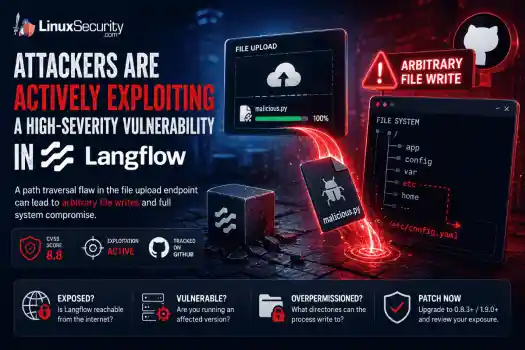
Security Vulnerabilities security advisory critical
security advisory critical Attackers are actively exploiting a high-severity vulnerability in Langflow , an open-source platform used to build and run AI workflows. . The flaw turns a file upload into a filesystem write, allowing a user-controlled file to escape the application's intended upload directory and land in locations Langflow was never supposed to touch. The vulnerable upload endpoint permits path traversal through crafted filenames. From there, the impact depends heavily on how the platform is deployed. A...
Jun 11, 2026 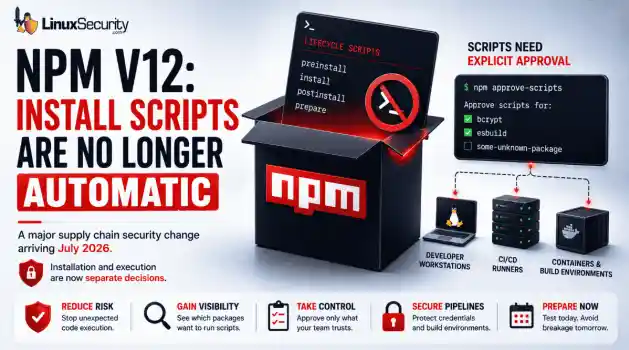
Vendors/Productssecurity advisory linux
security advisory linux With npm v12 , dependency preinstall, install, and postinstall scripts will no longer execute automatically during package installation. Script execution will require explicit approval through new controls such as npm approve-scripts, with the change expected to arrive in July 2026. . The announcement targets a part of the software supply chain that has repeatedly appeared in package registry abuse, credential theft, and CI/CD compromise investigations. A single npm install could trigger code...
Jun 11, 2026 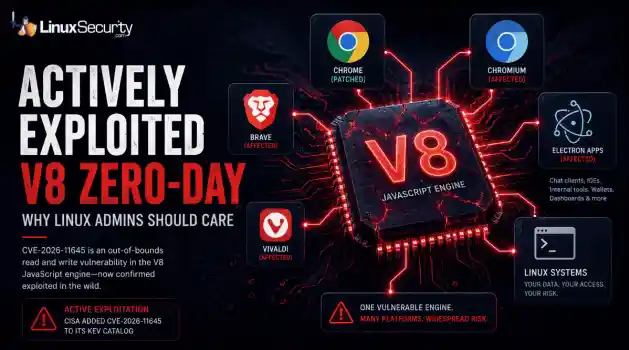
Security Vulnerabilities security advisory zero-day
security advisory zero-day CISA added CVE-2026-11645 to its Known Exploited Vulnerabilities catalog after Google confirmed active exploitation of the flaw. The bug sits in V8, the JavaScript engine behind Chrome and Chromium. . That's where this gets more interesting. Most coverage will focus on Chrome because that's where the patch landed. But the affected component is V8. Chromium relies on it. Electron relies on it. Plenty of desktop software Linux users interact with every day relies on it too, often without much...
Jun 10, 2026 
Network Securitysecurity advisory networking
security advisory networking For years, IPv4 was the only proxy type that really mattered for anyone running automation off a Linux box. IPv6 was the protocol everyone said they’d migrate to, but almost nobody actually did. In 2026, that’s finally starting to shift. . The problem is that most admins stick with IPv4 out of habit. They know it; it’s what their tooling defaults to, and they don’t see a reason to change. Some are overpaying for addresses they don’t need. Others would quietly break their scrapers, scripts, or...
Jun 09, 2026  Refine news
X Clear Filters Get the latest News and Insights
Get the latest Linux and open source security news straight to your inbox.
Community Poll
What got you started with Linux?
Loading...

Explore Latest Linux Security news
We found -4 articles for you...
79
 security enhancementsystem securityLinux architecture
Linux 6.15: MSEAL Memory Protection Enhancements for System Security
With the roll-out of Linux 6.15, security administrators are gaining access to a powerful new tool: MSEAL protection for system mappings. This feature safeguards critical virtual memory areas (VMAs) by locking down system mappings like vdso, vvar, and sigpage, ensuring they remain unchanged throughout a process’s lifecycle. . Especially beneficial for x86-64 and arm64 architectures, MSEAL is set to transform how admins approach memory protection in their environments. Let’s dive into the practical applications and benefits this new feature brings to the Linux security community. Understanding the Need for MSEAL The concept of system memory protection is a cornerstone of operating system security. Unfortunately, attackers who find innovative ways to exploit vulnerabilities, particularly memory corruption , often target this security. Many of these attacks manipulate pointers or commands to remap areas of memory that should be immutable. Traditionally, Linux has had mechanisms to protect certain areas of system memory. Still, the advent of MSEAL kicks this protection into high gear, providing a new level of defense against such vulnerabilities. What MSEAL Brings to the Table MSEAL offers a lock-down mechanism for critical memory components at its core, making them impervious to runtime modifications. This means you can prevent re-mapping of protected areas once they're set, which is crucial in preventing unauthorized access or tampering. The ability to maintain read-only and execute-only permissions on specific VMAs elevates the overall security, ensuring that threat actors cannot exploit these memory areas for malicious purposes. Understanding How MSEAL Works MSEAL achieves its protection by using a new system call that effectively seals certain VMAs. Doing so ensures that areas like vdso, vvar, and sigpage remain constant during the execution of a process. This is especially useful in environments where the integrity of these mappings is critical for system operations andsecurity. By using MSEAL, administrators can block attempts to remap these pages or change their protections after a process has started, closing a gap that has been historically exploited. Notable Benefits of Implementing MSEAL For us, Linux security admins, the benefits of implementing MSEAL are multifold. Firstly, protecting against a common vector for memory corruption exploits significantly reduces the attack surface. By maintaining the integrity of VMAs, we can have increased confidence that our systems are resilient against attacks that rely on altering process memory. Furthermore, this feature is supported on popular architectures like x86-64 and arm64, which have been widely adopted in enterprise environments, maximizing MSEAL's impact. Architectural Considerations While MSEAL currently supports x86-64 and arm64 architectures, we admins must understand its application within different system architectures. These architectures are prevalent in desktop and server environments, representing most systems used in business and enterprise settings. Implementing MSEAL on these platforms ensures a broad scope of security applications, providing a uniform method to secure memory across diverse systems. Plans for expanding support to other architectures could further this reliability, ensuring no potential exploitation paths are left open for attackers. Implementing MSEAL in Your Environment Getting started with MSEAL involves understanding your current memory protection mechanisms and identifying areas where MSEAL can enhance security. Incorporating MSEAL into existing security protocols requires a methodical approach: review current processes, identify critical VMAs for your applications, and evaluate how sealing these mappings will affect system performance and security. Additionally, we admins must keep abreast of the latest developments and best practices for implementing MSEAL to effectively leverage its full potential. Challenges and Considerations While MSEAL brings substantialbenefits, there are considerations to weigh. Admins must ensure that the locked-down VMAs do not interfere with legitimate operations requiring dynamic memory management. Understanding the trade-offs between immutability and functionality is key, as is testing in a controlled environment before rolling out broad changes. Additionally, staying informed about ongoing updates and improvements in MSEAL’s functionality will ensure compliance with the latest security standards and practices. Our Final Thoughts on MSEAL Protection in Linux 6.15 Linux 6.15's introduction of MSEAL protection for system mappings is a significant advancement for Linux security administrators, offering a robust solution to protect against memory corruption exploits. By ensuring essential VMAs are locked from modification, MSEAL significantly enhances system security, particularly on widely used x86-64 and arm64 platforms. As we look to strengthen our security posture, adopting MSEAL reflects a proactive step towards securing our environments against emerging threats. With a focus on implementation and ongoing adaptation of this tool, organizations can secure memory integrity and ensure robust protection against unauthorized modifications. . MSHIELD unveils groundbreaking improvements for safeguarding memory, bolstering defense for x86-64 and arm64 systems.. Memory Protection Techniques, System Security Enhancements, Linux Architecture Innovations, MSEAL Implementation Guide. . Brittany Day
 Apr 08, 2025 •
 Security Projects
Get the latest News and Insights
Get the latest Linux and open source security news straight to your inbox.
Community Poll
What got you started with Linux?
Search Topics
Powered By

Linux Security - Your source for Top Linux News, Advisories, HOWTOs and Feature Releases
QUICK LINKS
subscribe to newsletters!
Like staying secure? So do we.
Sign up for updates, tips, and alerts!
Discover faster search, smarter navigation, and deeper Linux security insights. Read More