Audit Linux privileges now to limit compromise, escalation, and system-wide damage. Review Linux Privileges×



Security Vulnerabilities  email security Linux server
email security Linux server You've probably trained your team to look for red flags. Odd sender names, urgent language, mismatched links. But a well-crafted spoofed email won't trip any of those wires. It looks legitimate, sounds legitimate, and often comes from a domain that passes every automated check you throw at it. . Attackers know exactly how humans scan an inbox. They design around it. This guide walks you through the techniques attackers use to slip a spoofed email past both your filters and your users and what...
 Jul 25, 2026

Security Vulnerabilities cisa kev vulnerability prioritization
cisa kev vulnerability prioritization Most Linux teams don't struggle to find vulnerabilities anymore. They struggle to decide which ones deserve attention first. Between daily scanner results, vendor advisories, and hundreds of new CVEs each month, the challenge isn't visibility—it's prioritization. . To solve this, organizations typically lean on the National Vulnerability Database (NVD) and CISA’s Known Exploited Vulnerabilities Catalog. But these aren’t competing lists. They answer two entirely different questions. While the...
Jul 22, 2026

Desktop Securitysecurity advisory vulnerability
security advisory vulnerability GNOME is officially shortening its standard vulnerability disclosure window from 90 days to 30 days, a change that impacts upstream maintainers, downstream Linux distributions, and system administrators in how they handle software vulnerabilities. The policy shift, announced by long-time security coordinator Michael Catanzaro , addresses modern software patching realities and a growing influx of automated submissions. . Because GNOME is the default desktop environment on several major Linux...
Jul 21, 2026

Security Vulnerabilities security advisory moderate
security advisory moderate For organizations that run a self-hosted Git platform, it’s no longer just about hosting static code repositories. Today, Git servers are responsible for deployment pipelines, API tokens, SSH keys, package repositories, and the automation scripts that push code directly. Confirm that the upgrade addresses known vulnerabilities but also provides production environments. . That makes them trusted systems within the development environment and attractive targets for attackers looking to move...
Jul 20, 2026

Server Securitydata privacy automation
data privacy automation Every system admin has lived through the same Monday morning ritual. A queue of forty tickets, half of them password resets, permission errors, or disk space warnings that any experienced technician could resolve in under two minutes. The other half require actual judgment. For years, automation promised that software would eventually sort the two apart on its own. That promise is now being tested in production Linux environments. . Early results are reshaping how IT teams think about tier-1...
Jul 17, 2026
 Refine news
X Clear Filters
Get the latest News and Insights
Get the latest Linux and open source security news straight to your inbox.
Community Poll
Should Linux servers automatically install security updates?
Trending News
Loading...
Explore Latest Linux Security news
We found -3 articles for you...
81
 user experiencebloatwareandroid devices
Understanding Bloatware's Impact on Android Smart Devices
One of the oft-discused downsides of choosing an Android device is the phenomenon of pre-loaded “bloatware.” . Broadly speaking, these are apps and services pre-loaded on smartphones and tablets by phone vendors, mobile carriers, and their partners along with the basic suite of Google apps and Android itself. Not all of this software is necessarily useless, and some vendors load less than others, but often it can’t be uninstalled, leaving users stuck with space-consuming software they might never use. The link for this article located at NakedSecurity is no longer available. . Bloatware refers to unwanted pre-installed apps on Android devices that disrupt functionality and user experience, causing storage issues and performance drops. Android Devices, Bloatware Effects, Smartphone Management, Pre-loaded Software. . LinuxSecurity.com Team
 May 13, 2019
•
May 13, 2019
• Privacy
81
 data collectionsecurity analysisprivacy threat
Privacy Risks of Pre-Installed Apps on Android Smartphones
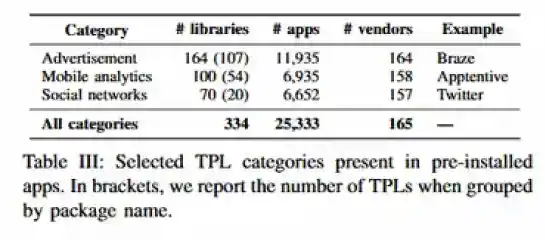
An academic study that analyzed 82,501 apps that were pre-installed on 1,742 Android smartphones sold by 214 vendors concluded that users are woefully unaware of the huge security and privacy-related threats that come from pre-installed applications. . Researchers found that many of these pre-installed apps have access to very intrusive permissions out of the box, collect and send data about users to advertisers, and have security flaws that often remain unmatched. On top of this, many pre-installed apps (also referred to as bloatware) can't be removed, and also use third-party libraries that secretly collect user data from within benign-looking and innocently-named applications. The link for this article located at ZDNet is no longer available. . Recent studies uncover significant security concerns associated with factory-loaded applications on Android devices, pointing to a lack of user knowledge.. Android Privacy Risks, Pre-installed App Security, Data Collector Apps, Bloatware Issues. . LinuxSecurity.com Team
Mar 26, 2019
•
Privacy


Get the latest News and Insights
Get the latest Linux and open source security news straight to your inbox.
Community Poll
Should Linux servers automatically install security updates?
Trending News
Search Topics
Powered By

Linux Security - Your source for Top Linux News, Advisories, HOWTOs and Feature Releases
QUICK LINKS
subscribe to newsletters!
Like staying secure? So do we.
Sign up for updates, tips, and alerts!