



Security Trends  fedora security assessment
fedora security assessment A Fedora contributor account recently came under scrutiny for apparently AI-generated activity that disrupted the project's bug tracker. . Questionable Bugzilla comments, flawed patches, and improperly closed or reassigned bugs forced maintainers to spend time cleaning up the fallout. There is no evidence that malware was deployed or a backdoor reached production, but the incident exposed a different problem. Open-source projects can be disrupted without compromising a single line of code....
 Jun 12, 2026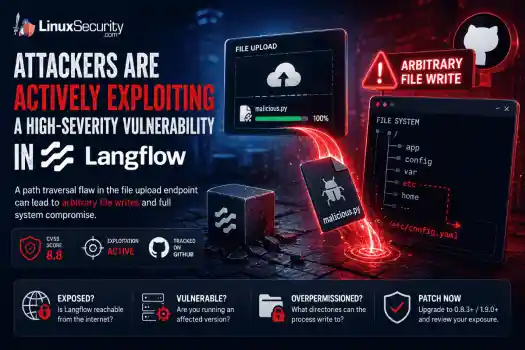
Security Vulnerabilities security advisory critical
security advisory critical Attackers are actively exploiting a high-severity vulnerability in Langflow , an open-source platform used to build and run AI workflows. . The flaw turns a file upload into a filesystem write, allowing a user-controlled file to escape the application's intended upload directory and land in locations Langflow was never supposed to touch. The vulnerable upload endpoint permits path traversal through crafted filenames. From there, the impact depends heavily on how the platform is deployed. A...
Jun 11, 2026 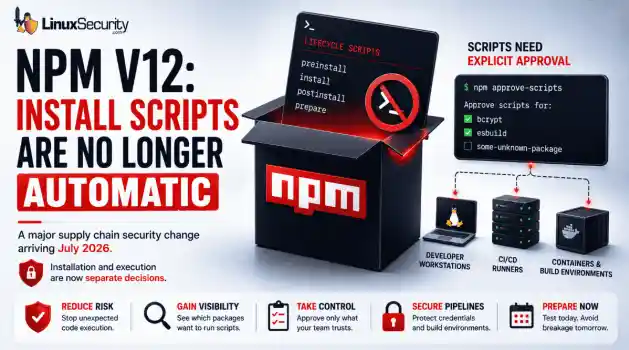
Vendors/Productssecurity advisory linux
security advisory linux With npm v12 , dependency preinstall, install, and postinstall scripts will no longer execute automatically during package installation. Script execution will require explicit approval through new controls such as npm approve-scripts, with the change expected to arrive in July 2026. . The announcement targets a part of the software supply chain that has repeatedly appeared in package registry abuse, credential theft, and CI/CD compromise investigations. A single npm install could trigger code...
Jun 11, 2026 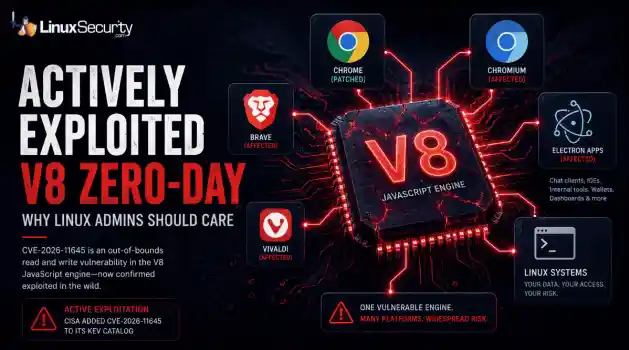
Security Vulnerabilities security advisory zero-day
security advisory zero-day CISA added CVE-2026-11645 to its Known Exploited Vulnerabilities catalog after Google confirmed active exploitation of the flaw. The bug sits in V8, the JavaScript engine behind Chrome and Chromium. . That's where this gets more interesting. Most coverage will focus on Chrome because that's where the patch landed. But the affected component is V8. Chromium relies on it. Electron relies on it. Plenty of desktop software Linux users interact with every day relies on it too, often without much...
Jun 10, 2026 
Network Securitysecurity advisory networking
security advisory networking For years, IPv4 was the only proxy type that really mattered for anyone running automation off a Linux box. IPv6 was the protocol everyone said they’d migrate to, but almost nobody actually did. In 2026, that’s finally starting to shift. . The problem is that most admins stick with IPv4 out of habit. They know it; it’s what their tooling defaults to, and they don’t see a reason to change. Some are overpaying for addresses they don’t need. Others would quietly break their scrapers, scripts, or...
Jun 09, 2026  Refine news
X Clear Filters Get the latest News and Insights
Get the latest Linux and open source security news straight to your inbox.
Community Poll
What got you started with Linux?
Loading...

Explore Latest Linux Security news
We found -4 articles for you...
210
 security advisorycriticalIntel
Intel: Branch Authority Exploitation Severe Threat CVE-2024-45333
In modern computing, the line dividing speed from security is razor-thin. Performance innovations have helped processors handle billions of instructions per second, but these optimizations often come with cracks in their armor. This couldn’t be more apparent following the discovery of the Branch Privilege Injection flaw , a vulnerability impacting Intel processors and tracked as CVE-2024-45332 . For us admins, the implications are serious, with the potential for sensitive data leaks, cross-domain attacks, and undermined kernel protections. . This isn’t just another entry in the long list of hardware vulnerabilities. Branch Privilege Injection represents a fundamental breakdown in the defenses Intel processors have relied upon to protect against Spectre-BTI attacks—a type of side-channel attack that most admins thought had been contained years ago. Let’s unpack this newly discovered flaw, how it works, and why Linux environments are potentially at risk. Understanding The Flaw: What Is Branch Privilege Injection? To understand Branch Privilege Injection, you must first consider how modern CPUs handle branch predictions. When a program executes, processors often “guess” the next execution path to improve performance. These guesses aren’t arbitrary but are based on historical program behavior and stored in the branch predictor component. For years, hardware and operating system mitigations have refined how processors handle these predictions, ensuring that guesses made in one security domain (say, user space) don’t leak into another, like kernel space. But Branch Privilege Injection exploits something overlooked for years: race conditions in branch predictor updates. Here’s the problem in simpler terms. When processors switch between privilege levels—like moving from a user process to kernel code—the branch predictor should be sanitized, ensuring that predictions from one domain don’t affect another. Mitigations like IBPB (Indirect Branch Prediction Barrier) weresupposed to handle this, clearing branch predictor states during transitions. However, processors don’t update all aspects of the branch predictor instantaneously. Updates run asynchronously, often with a slight delay. This delay, which Intel designed consciously to optimize performance, introduces a vulnerability. During privilege switches, branch predictors remain briefly susceptible to manipulation. An attacker can exploit this window to insert malicious inputs into the branch predictor, undermining even the most robust mitigations like enhanced Indirect Branch Restricted Speculation (eIBRS). Through this exploitation, attackers can access arbitrary memory and read sensitive data stored outside their privilege domain—a breach that should not be possible under normal operation. Whether it’s accessing kernel data or extracting sensitive information from virtual machines, this flaw opens up alarming possibilities for exploitation. Why We Need to Care About This Issue Linux systems are at particular risk, not because of any failings in the OS itself, but because of how widespread Intel processors are in the server landscape. This vulnerabilities doesn’t discriminate—if you’re using Intel hardware, your machines likely harbor this flaw. And it’s not limited to specific workloads. The vulnerability penetrates hardware-level protections, whether you’re managing virtual machines, containers, or bare-metal systems. In proof-of-concept research, Branch Privilege Injection was successfully exploited on a Linux system running Ubuntu 24.04. This discovery is especially concerning because every standard Spectre mitigation was enabled. The attack wasn’t some edge case; it targeted a default configuration on retail-grade Intel hardware. This flaw introduces risks to administrators managing sensitive infrastructure like web servers, databases, and virtualized environments. Because branch predictor manipulations can bypass privilege boundaries, attackers could theoretically jump betweencontainers or virtual machines. What might have been isolated workloads now face the threat of cross-domain attacks. But there’s an even bigger concern. Spectre vulnerabilities typically fall under the “side-channel” attack umbrella—a category that banks on minute timing differences and speculative execution behavior. However, Branch Privilege Injection operates with striking reliability, exploiting the predictable latency of branch predictor updates. This consistency allows attackers to leak memory at speeds of up to 5.6 KiB/s, putting practical exploitation within reach of real-world adversaries. Am I Affected? Branch Privilege Injection primarily impacts Intel processors, specifically those built from the Ninth Generation (Coffee Lake Refresh) onward. Processors based on older architectures, such as Kaby Lake, may exhibit some weaknesses but have not been definitively confirmed as fully vulnerable. Current research points directly to Intel’s design decisions regarding asynchronous branch predictor updates—a design choice not shared by AMD or ARM processors. This makes Intel users uniquely exposed. You might be managing a fleet of servers using something as recent as Ice Lake or Raptor Lake chips. Or maybe you’re running older-generation systems on Coffee Lake, assuming they’re “good enough” for your environment. If you're using Intel processors that fall into this vulnerable range, this flaw applies to your systems, regardless of the workload or application layer above the hardware. And it doesn’t stop with Linux. While Branch Privilege Injection was explored specifically on Linux systems, the vulnerability lies at the hardware level. It impacts any operating system running on affected Intel processors, which means Windows, macOS, and other OS environments are just as susceptible. This universality should concern anyone responsible for infrastructure security. Whether you’re dealing with bare-metal Linux servers or mixed operating systems running virtualizationsolutions, this flaw can compromise your security. How Can I Protect Against This Flaw? Knowing there’s a vulnerability impacting your systems doesn’t mean you’re helpless. Since this flaw was disclosed, Intel and the broader security community have been hard at work, and mitigations are already starting to surface. However, these mitigations come with trade-offs, particularly in performance. First and foremost, you should prioritize firmware updates. Intel has released microcode updates to address the issue, pushing BIOS and UEFI firmware fixes. These updates patch the asynchronous branch predictor flows that enable Branch Privilege Injection, ensuring mitigation tools like IBPB and eIBRS function as intended. Applying this microcode may introduce performance penalties ranging from roughly 1.6% to 2.7%, depending on your processor generation. Next, update your Linux kernel. When vulnerabilities like this surface, kernel developers waste no time integrating software-level mitigations. Patching your systems with the latest kernel updates from your Linux distribution ensures that defense-in-depth mechanisms kick in. Even if your hardware remains vulnerable, kernel patches can add additional barriers, limiting what attackers can access and exploit. Lastly, stay informed about emerging mitigations. Intel has signaled that further work is being done to improve security while reducing performance impacts. Future Linux kernel versions and microcode updates may refine or enhance protections. Follow your distribution’s release notes closely, particularly those targeting Spectre-related vulnerabilities. Facing the Real Risks As a Linux administrator, you must deal with the ugly truth: the hardware you rely on may not be as secure as you thought. Branch Privilege Injection rewrites the trust model we’ve built around modern CPUs. For years, mitigations like IBPB and eIBRS were deployed as silver bullets to combat speculative execution vulnerabilities. They were supposed to separatesecurity domains, ensuring attackers couldn’t tunnel their way out of sandboxes or virtual machines. Now, those defenses are circumvented. And while firmware updates and kernel patches are critical responses, there’s a deeper lesson here: side-channel attacks are evolving and aren’t going away anytime soon. The architectural complexity of modern processors is fertile ground for new vulnerabilities, and every discovery leaves us playing catch-up. What’s particularly troubling about Branch Privilege Injection is that it chips away at assumptions we took for granted. Security mitigations designed to protect against a well-known vulnerability are effectively subverted, turning yesterday’s solution into today’s liability. That should make every admin pause and rethink their approach to infrastructure security. Our Final Thoughts on Staying Ahead of This Threat Looking forward, Linux admins need more than just software updates. Mitigating side-channel attacks demands proactive, holistic strategies. Architectures vulnerable to speculative execution flaws are in widespread use and won’t disappear overnight. But staying ahead means more than rolling out patches. Consider using hardware built with more robust defenses—AMD processors or ARM-based alternatives may minimize exposure to similar flaws. As more research emerges, stay open to the possibility of rearchitecting workloads that are particularly sensitive to these types of vulnerabilities. Branch Privilege Injection is more than a one-off problem—a sign of the times. Hardware weaknesses will continue to surface, often undermining trusted mitigations. As custodians of complex infrastructures, admins must adapt and respond to this vulnerability and whatever comes next. The stakes are high, and the race to secure computing environments is unending. . Branch Privilege Injection in Intel processors poses serious risks, affecting sensitive data and undermining kernel protections.. Intel Processors, Branch Privilege Injection, SecurityThreats. . Brittany Day
 May 14, 2025 •
 Security Vulnerabilities
Get the latest News and Insights
Get the latest Linux and open source security news straight to your inbox.
Community Poll
What got you started with Linux?
Search Topics
Powered By

Linux Security - Your source for Top Linux News, Advisories, HOWTOs and Feature Releases
QUICK LINKS
subscribe to newsletters!
Like staying secure? So do we.
Sign up for updates, tips, and alerts!
Discover faster search, smarter navigation, and deeper Linux security insights. Read More