



Security Trends  fedora security assessment
fedora security assessment A Fedora contributor account recently came under scrutiny for apparently AI-generated activity that disrupted the project's bug tracker. . Questionable Bugzilla comments, flawed patches, and improperly closed or reassigned bugs forced maintainers to spend time cleaning up the fallout. There is no evidence that malware was deployed or a backdoor reached production, but the incident exposed a different problem. Open-source projects can be disrupted without compromising a single line of code....
 Jun 12, 2026
Security Vulnerabilities security advisory critical
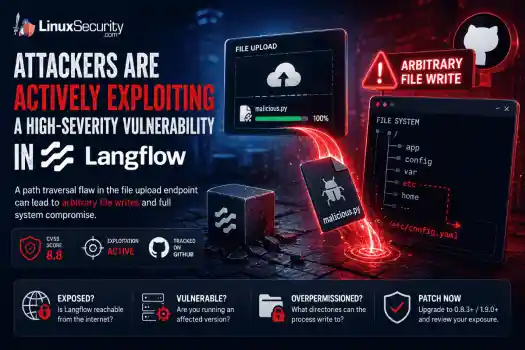
security advisory critical Attackers are actively exploiting a high-severity vulnerability in Langflow , an open-source platform used to build and run AI workflows. . The flaw turns a file upload into a filesystem write, allowing a user-controlled file to escape the application's intended upload directory and land in locations Langflow was never supposed to touch. The vulnerable upload endpoint permits path traversal through crafted filenames. From there, the impact depends heavily on how the platform is deployed. A...
Jun 11, 2026
Vendors/Productssecurity advisory linux
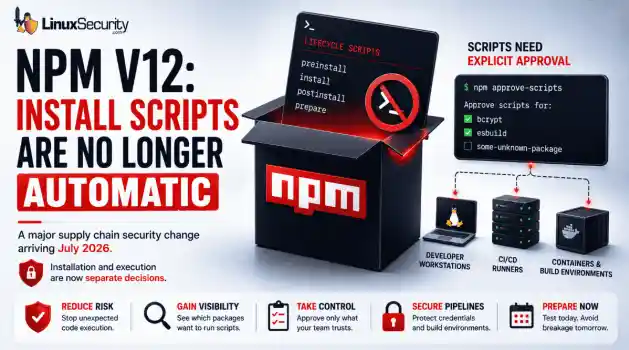
security advisory linux With npm v12 , dependency preinstall, install, and postinstall scripts will no longer execute automatically during package installation. Script execution will require explicit approval through new controls such as npm approve-scripts, with the change expected to arrive in July 2026. . The announcement targets a part of the software supply chain that has repeatedly appeared in package registry abuse, credential theft, and CI/CD compromise investigations. A single npm install could trigger code...
Jun 11, 2026
Security Vulnerabilities security advisory zero-day
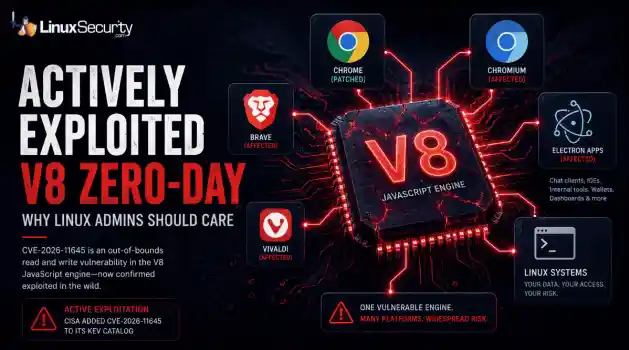
security advisory zero-day CISA added CVE-2026-11645 to its Known Exploited Vulnerabilities catalog after Google confirmed active exploitation of the flaw. The bug sits in V8, the JavaScript engine behind Chrome and Chromium. . That's where this gets more interesting. Most coverage will focus on Chrome because that's where the patch landed. But the affected component is V8. Chromium relies on it. Electron relies on it. Plenty of desktop software Linux users interact with every day relies on it too, often without much...
Jun 10, 2026

Network Securitysecurity advisory networking
security advisory networking For years, IPv4 was the only proxy type that really mattered for anyone running automation off a Linux box. IPv6 was the protocol everyone said they’d migrate to, but almost nobody actually did. In 2026, that’s finally starting to shift. . The problem is that most admins stick with IPv4 out of habit. They know it; it’s what their tooling defaults to, and they don’t see a reason to change. Some are overpaying for addresses they don’t need. Others would quietly break their scrapers, scripts, or...
Jun 09, 2026
 Refine news
X Clear Filters
Get the latest News and Insights
Get the latest Linux and open source security news straight to your inbox.
Community Poll
What got you started with Linux?
Loading...

Explore Latest Linux Security news
We found -4 articles for you...
212
 open-sourceLinux administrationemail security
Cloud Security: Addressing Email Issues in Postfix Environments
Perimeter-based email security assumes mail reliably passes a single inspection point. That’s how most Linux mail stacks were designed to operate: one choke point in front of the MTA, one place to enforce policy, one place to log what happened. In cloud environments, that stops being true fast. Some mail hits the gateway, some go directly to the tenant, and internal messages often bypass it entirely. . The incidents that matter most don’t trigger gateway logic anyway. Business email compromise and impersonation arrive clean. No payload, no link, nothing for a secure email gateway to score. I’ve seen authentication pass at the gateway while the mailbox activity downstream was already doing damage. Gateways still exist in most stacks, but they no longer describe where control actually lives. Email security now depends more on authentication, visibility into mail behavior, and how quickly you can act once something slips through. For Linux admins running Postfix-based relays, hybrid MTAs, or mail security infrastructure around cloud tenants, this is the core failure mode of perimeter-based email security in the cloud era. Cloud Mail Flow Breaks the Gateway Assumption Cloud email security changes where the mail actually enters the system. In Microsoft 365 and Google Workspace, mail flow is distributed by design, and that makes consistent inspection harder to guarantee. A secure email gateway can still play a role, but it’s no longer the single control point it used to be. That’s why cloud email security increasingly depends on visibility and enforcement inside the tenant, not just at the perimeter. Hybrid environments make this inconsistent. Some domains still route through a gateway, others deliver directly to the tenant, and internal messages often never touch the perimeter at all. I’ve seen investigations stall because gateway logs looked clean while the message in question never passed through that layer. If you’re on the hook for mail traceability, those gaps show upimmediately. MX rewiring is the usual workaround. Force mail back through the gateway and recreate a choke point. In practice, it adds latency, creates fragile dependencies, and introduces a single failure that can take mail down. I’ve had to unwind those designs during outages when queues backed up, and the gateway itself became the incident. Linux admins know how quickly “mail just works” becomes “mail is the outage” once your routing assumptions break. This is where perimeter-based email security breaks down. The gateway still exists, but cloud email security no longer treats it as authoritative. If your controls assume every message crosses that edge, cloud delivery keeps proving otherwise. Identity-Based Threats Beat Content Filters Even when mail does pass through the email security gateway, the attacks that cause the most damage don’t give it much to work with. Business email compromise and vendor impersonation arrive intact. No attachment. No link. Nothing malformed. From the gateway side, these messages usually look normal. Authentication passes. Headers line up. Delivery completes without delay. I’ve pulled logs where the only notable event was successful acceptance, while the mailbox activity that followed caused the actual incident. If you’ve ever stared at clean Postfix logs while users insist something is wrong, the feeling is familiar. Here’s what these messages tend to look like during review: SPF, DKIM, and DMARC all pass No URLs rewritten or detonated No attachment hashes to score Sender domain already trusted or previously seen The message stays inside an existing thread Spear phishing fits the same pattern. The content is shaped to match prior conversation history and expected tone. From a filtering perspective, it’s valid mail behaving like valid mail. Tightening content rules enough to catch this usually breaks routine business traffic first, which becomes your problem the moment you’re supporting mail delivery and securityat the same time. This is where perimeter-based email security stops being decisive. The email security gateway evaluates the message at delivery. Identity-based abuse plays out after that point, using trust and context that already exist inside the mailbox. By the time the action matters, the perimeter decision has already been made, and it wasn’t wrong. Why SEGs Fail Operationally: Visibility, Control, and Integration Gaps Most secure email gateways don’t break. They keep accepting mail and logging decisions. The trouble starts when you need more than “accepted” or “blocked.” For Linux admins, that’s when you need enough telemetry to prove what happened, tune it, and feed it into everything else you already operate. During incident review, the gateway usually has one event. Message received. Checks passed. Delivered. After that, it’s quiet. Replies, forwards, and internal handoffs all happen elsewhere. I’ve had cases where the gateway data ended before the user even saw the message. What I end up staring at: One inbound message at the SEG A mailbox full of follow-up activity No clean way to line the two up Tuning is similar. Gateways surface outcomes, not much detail behind them. When a rule misfires, the choice is usually to loosen it or shut it off. I’ve left detections weaker than I wanted because there wasn’t enough visibility to tune them without breaking normal traffic. Linux admins expect systems to be debuggable. Most SEGs are not. Once alerts leave the gateway, context drops again. In the SIEM, it’s a verdict and some headers. Thread history is gone. Identity context is missing. When that feeds into SOAR, automation usually stops at tagging or enrichment. There isn’t enough signal to do anything else safely. That’s the operational failure. The secure email gateway does what it says it will, but it doesn’t stay useful once mail moves past the perimeter. For email security operations, that gap shows up fast. The New Model: ALayered Email Security Stack (Not a Single Gateway) What replaces the gateway isn’t another box sitting in front of MX. Control shifts to places that still see the message after it’s delivered. This is the same pattern Linux admins have already lived through in other domains: one appliance stops scaling, and the stack becomes modular, observable, and integrated. Authentication is where that starts. SPF, DKIM, and DMARC are where policy drift shows up first. Domain alignment breaks, forwarding chains change, and third-party senders get added without notice. Those signals show up there before they show up anywhere else. That’s why teams need to circle back to fundamentals and ask what DKIM is in this context, because that’s where the trust story starts to break when a sender is legit. Filtering and malware scanning stay in the path: Commodity spam Bulk phishing Drive-by malware That layer does what it’s always done. After delivery, the indicators change: Replies that don’t line up with prior sender behavior Threads that change intent midstream Messages that trigger action without triggering any filters That activity doesn’t belong to the gateway. It shows up when you look across mailboxes and threads instead of individual messages. In most of the incidents I’ve worked, nothing stood out until the mail was viewed in that wider context. Orchestration is what keeps this from turning into manual correlation. Mail logs, authentication results, identity events, and mailbox activity need to be visible together. Without that, every investigation starts by rebuilding context that already exists somewhere else. That’s the shape of an email security stack in practice. The secure email gateway is still part of it, but it’s no longer the place where decisions stop. Open source email security fits this model because the underlying data stays available, which makes defense in depth possible without relying on opaque verdicts. Open-SourceBuilding Blocks Linux Admins Are Actually Using What makes open source workable here isn’t ideology. It’s that the components stay inspectable once mail is delivered and the gateway stops being useful. If you already run Linux infrastructure, you already have the operational tooling for this model: logs, pipelines, automation, and the ability to debug what your stack is doing. Authentication and mail hardening OpenDKIM and OpenDMARC sit closest to the mail flow. This is where alignment problems show up first. Forwarding chains break. Third-party senders drift. Domains get added without anyone updating the policy. I spend more time looking at reports and trends here than tweaking policy itself, because that’s where you see changes before they turn into incidents. Filtering and scanning Rspamd and ClamAV handle volume. Spam, bulk phishing, basic malware. This layer isn’t interesting, but it’s necessary. When it’s missing or misbehaving, everything else gets noisy fast. When it’s working, you mostly forget about it. Threat hunting and analytics CATAPULT Spider and similar log-driven setups are where BEC starts to stand out. Not from content, but from metadata. Message timing, reply chains, sender reuse, and mailbox overlap. The incidents I’ve worked that involved impersonation didn’t surface until someone correlated across messages instead of staring at a single email. Human layer Gophish shows up here as a signal, not education. Who reports what, how fast, and what gets ignored. That data ends up being useful during review, especially when you’re trying to figure out how long a thread was active before anyone noticed. Orchestration and case management TheHive and Shuffle are where mail stops being a pile of disconnected events. Headers, auth results, mailbox logs, enrichment, and response actions land in one place. Without this, investigations turn into tabs and screenshots. With it, you at least start from a shared context. These aren’t“best in class” picks or a reference architecture. They’re the pieces that stay visible and composable once you stop relying on a single secure email gateway. That’s why open source email security keeps showing up in real email security stacks. How to Move Beyond Perimeter-Based Email Security Without Breaking Mail This usually doesn’t start with removing anything. The gateway stays. What changes is where problems start showing up. For Linux admins, the goal is simple: keep mail reliable, make incidents traceable, and reduce the time it takes to understand what happened. Authentication data starts getting looked at more closely. SPF, DKIM, and DMARC are already wired in. Alignment breaks, forwarding chains change, and third-party senders drift. Those changes tend to show up there before anyone opens a ticket about mail delivery. Filtering and scanning stay in the path. Spam and basic malware still get handled at ingress. Messages continue to arrive clean from the gateway’s point of view. After delivery, the activity looks different. Replies move laterally. Threads change intent. Actions get taken without anything standing out in the inbound logs. When incidents get reviewed, the gateway event is usually the least interesting part. Response work shifts accordingly. Investigations stop starting with headers alone. Mail events, authentication results, identity logs, and mailbox activity end up getting pulled together just to reconstruct what already happened. Some of that gets automated over time. Some of it stays manual. That’s how the dependency changes without breaking mail flow. Perimeter-based email security remains in place, but it no longer describes where most of the work happens. Open source email security fits this pattern because the data stays accessible when you need to follow it past delivery. What Open Source Solves (and What It Doesn’t) Open source shows up in email security because it exposes what’s happening and doesn’t disappear once mail isdelivered. That matters in security operations, especially if you’re already responsible for Linux systems where auditability is a baseline expectation. What it does well: Transparency : Logs, decisions, and data paths are visible. When something breaks, there’s something to look at besides a verdict. Local control : You decide where data lives and how long it sticks around. That’s useful when incidents stretch across days or weeks. Faster adaptation : Rules, parsers, and integrations change without waiting for a vendor release cycle. Integration flexibility : Mail data, auth results, and case systems can be wired together without fighting proprietary formats. Tradeoffs that don’t go away: Operational ownership : You run it. You debug it. You keep it alive. Maintenance : Updates, compatibility, and drift are your problem. Consistency : Different tools behave differently. Normalizing data takes work. Open source email security doesn’t remove effort from security operations. It moves that effort into places you can actually see and control. Conclusion: Stop Defending a Boundary That Doesn’t Exist Cloud mail flow and identity-based attacks have made gateway-only security insufficient. Mail doesn’t reliably cross a single edge, and the most damaging messages don’t look broken when they do. Perimeter-based email security still has a role, but it’s a baseline layer now, not the architecture. It blocks volume. It doesn’t describe where incidents play out. What’s replacing it is an observable email security stack. Authentication, filtering, hunting, and response stay connected after delivery. Linux admins are building these stacks with open tools because the data stays accessible and the integrations don’t stop at the gateway. . Learn how Linux admins can adapt to the challenges of cloud email security and enhance their perimeter strategies effectively.. cloud email security, Linux admin tools, Postfix email gateway,identity-based attacks, open source security. . MaK Ulac
 Jan 04, 2026
•
Jan 04, 2026
• Cloud Security

Get the latest News and Insights
Get the latest Linux and open source security news straight to your inbox.
Community Poll
What got you started with Linux?
Search Topics
Powered By

Linux Security - Your source for Top Linux News, Advisories, HOWTOs and Feature Releases
QUICK LINKS
subscribe to newsletters!
Like staying secure? So do we.
Sign up for updates, tips, and alerts!
Discover faster search, smarter navigation, and deeper Linux security insights. Read More