



Security Trends  fedora security assessment
fedora security assessment A Fedora contributor account recently came under scrutiny for apparently AI-generated activity that disrupted the project's bug tracker. . Questionable Bugzilla comments, flawed patches, and improperly closed or reassigned bugs forced maintainers to spend time cleaning up the fallout. There is no evidence that malware was deployed or a backdoor reached production, but the incident exposed a different problem. Open-source projects can be disrupted without compromising a single line of code....
 Jun 12, 2026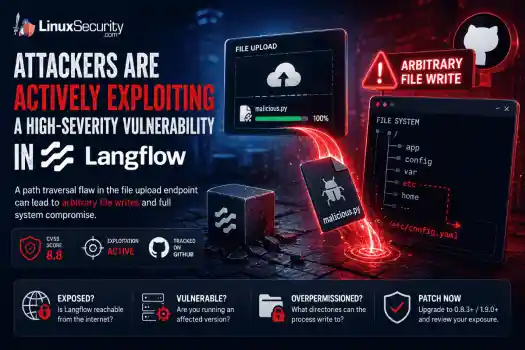
Security Vulnerabilities security advisory critical
security advisory critical Attackers are actively exploiting a high-severity vulnerability in Langflow , an open-source platform used to build and run AI workflows. . The flaw turns a file upload into a filesystem write, allowing a user-controlled file to escape the application's intended upload directory and land in locations Langflow was never supposed to touch. The vulnerable upload endpoint permits path traversal through crafted filenames. From there, the impact depends heavily on how the platform is deployed. A...
Jun 11, 2026 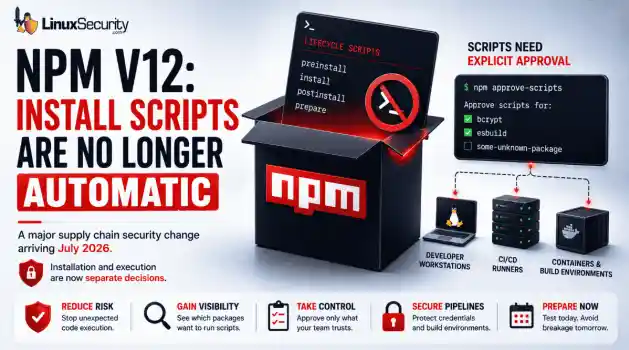
Vendors/Productssecurity advisory linux
security advisory linux With npm v12 , dependency preinstall, install, and postinstall scripts will no longer execute automatically during package installation. Script execution will require explicit approval through new controls such as npm approve-scripts, with the change expected to arrive in July 2026. . The announcement targets a part of the software supply chain that has repeatedly appeared in package registry abuse, credential theft, and CI/CD compromise investigations. A single npm install could trigger code...
Jun 11, 2026 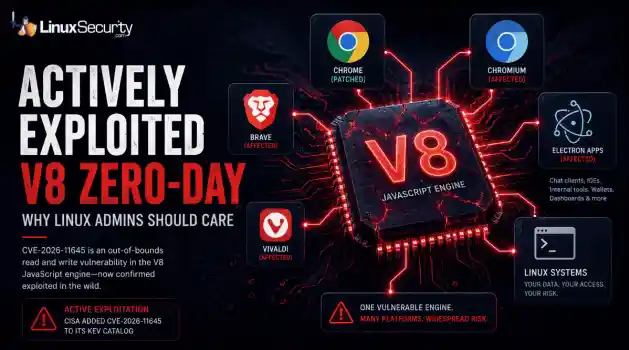
Security Vulnerabilities security advisory zero-day
security advisory zero-day CISA added CVE-2026-11645 to its Known Exploited Vulnerabilities catalog after Google confirmed active exploitation of the flaw. The bug sits in V8, the JavaScript engine behind Chrome and Chromium. . That's where this gets more interesting. Most coverage will focus on Chrome because that's where the patch landed. But the affected component is V8. Chromium relies on it. Electron relies on it. Plenty of desktop software Linux users interact with every day relies on it too, often without much...
Jun 10, 2026 
Network Securitysecurity advisory networking
security advisory networking For years, IPv4 was the only proxy type that really mattered for anyone running automation off a Linux box. IPv6 was the protocol everyone said they’d migrate to, but almost nobody actually did. In 2026, that’s finally starting to shift. . The problem is that most admins stick with IPv4 out of habit. They know it; it’s what their tooling defaults to, and they don’t see a reason to change. Some are overpaying for addresses they don’t need. Others would quietly break their scrapers, scripts, or...
Jun 09, 2026  Refine news
X Clear Filters Get the latest News and Insights
Get the latest Linux and open source security news straight to your inbox.
Community Poll
What got you started with Linux?
Loading...

Explore Latest Linux Security news
We found -4 articles for you...
209
 security advisoryopen-source managementLinux Foundation
Linux Foundation Census III Key Insights for Secure Management Practices
The Linux Foundation's recent Census III report provides critical insights for Linux administrators, information security professionals, and anyone interested in maintaining secure and efficient systems. This report highlights significant open-source security trends, such as the growth of cloud-service-specific and Rust packages and the migration to Python 3. These trends directly impact how systems are managed and underscore critical areas that need attention and adaptation. . The report highlights the importance of standardizing naming schemas to effectively manage dependencies and the security risks of centralizing open-source software . It also discusses challenges with legacy software and emphasizes the importance of protecting individual developer accounts to prevent supply-chain attacks. We will examine these findings and explore their practical implications for improving the security of Linux systems. Developers and sysadmins can use this analysis to improve security strategies and ensure their infrastructure is robust and secure. This discussion provides an interpretation of the data and actionable insights tailored for those in charge of managing and securing Linux environments. Key Findings & Practical Takeaways from the Census III Report This report presents key findings and practical takeaways regarding current software management trends and security practices. Some of the most notable insights and strategies include: Increasing Use of Cloud Service-Specific Packages The adoption of cloud service-specific packages is rising, highlighting the growing dependency on cloud infrastructures. This shift necessitates libraries that are finely tuned to cloud environments' unique demands and specifications. A recent industry report shows that cloud-specific software packages have increased by approximately 30% over the past two years, underscoring a significant trend toward cloud-native development. Linux admins must regularly update these libraries againstvulnerabilities, enforce strict access limits to sensitive resources, and utilize monitoring tools that detect unusual activities or attempts at unauthorized access to cloud services. The Transition from Python 2 to Python 3 Additionally, Python 2's end-of-life (EOL) has accelerated the transition from Python 2 to Python 3. Despite the official discontinuation, many systems still run Python 2 due to the complexity of migrating existing codebases. Reports indicate that as of 2022, approximately 20% of projects still involve Python 2, although this number is steadily decreasing. Administrators should assist migration efforts by reviewing Python 2 codebases for compatibility with Python 3, upgrading dependencies as necessary, and thoroughly testing to avoid bugs or security vulnerabilities. They must also adopt consistent management and security practices when handling these packages, including using central repositories for internal management, regularly scanning for vulnerabilities , and maintaining strict version control procedures and audit trails. Growing Importance of Rust Packages The report emphasizes the increasing prominence of Rust packages, valued for their safety and performance. According to a survey by Stack Overflow, Rust has been the most loved programming language for five consecutive years as of 2022, highlighting its growing adoption. Administrators should evaluate where Rust could improve projects, invest in developer training, and conduct regular security reviews to ensure Rust packages comply with organizational security standards. A Need for Standardized Naming Schema There is also an increasing need to standardize software component names to ease dependency management and security analysis. Non-standardized naming leads to inconsistencies, making managing and securing software components effectively difficult. Data from a survey indicates that nearly 40% of developers face naming conflicts and dependencies issues. Implementing standardized namingconventions and documenting comprehensively can simplify administration and security efforts while being enforced with tools designed to implement these standards. Concentration of FOSS Development A significant concern raised in the Census III report is that widely used free and open-source software (FOSS) development by a small group of contributors poses security risks. A recent report reveals that approximately 50% of the top 500 most-used open-source projects are maintained by just 10% of contributors. To minimize these risks, broad community engagement must occur, critical FOSS project maintainers must receive financial or resource support, and dependencies must be spread out to reduce dependency on software managed by a few contributors. Individual developer accounts must be protected to protect supply chains against attacks . Best practices for safeguarding individual developer accounts include using multi-factor authentication , conducting regular account activity audits, and creating secure development workflows with code reviews and automated testing capabilities. Our Final Thoughts on the Census III Report's Significance for Secure Linux Administration The Linux Foundation's Census III report offers invaluable insights into FOSS usage and provides key areas of improvement in security and administration. By understanding and applying its findings and noting their practical takeaways, Linux administrators and infosec professionals can significantly boost their security posture and ensure an efficient Linux administration experience. As Linux and open-source software become increasingly prevalent in society, organizations must take proactive steps and continuously improve security practices to stay abreast of evolving FOSS ecosystems, protect their infrastructure, and contribute to the health and well-being of the broader open-source community. . Gain insights from the Linux Foundation Census III report to enhance secure practices in Linux administration and open-sourcesoftware management.. the linux, foundation', recent, census, report provides, critical, insights, linux, admin. . Brittany Day
 Dec 05, 2024 •
 Security Trends
Get the latest News and Insights
Get the latest Linux and open source security news straight to your inbox.
Community Poll
What got you started with Linux?
Search Topics
Powered By

Linux Security - Your source for Top Linux News, Advisories, HOWTOs and Feature Releases
QUICK LINKS
subscribe to newsletters!
Like staying secure? So do we.
Sign up for updates, tips, and alerts!
Discover faster search, smarter navigation, and deeper Linux security insights. Read More