



Security Trends  fedora security assessment
fedora security assessment A Fedora contributor account recently came under scrutiny for apparently AI-generated activity that disrupted the project's bug tracker. . Questionable Bugzilla comments, flawed patches, and improperly closed or reassigned bugs forced maintainers to spend time cleaning up the fallout. There is no evidence that malware was deployed or a backdoor reached production, but the incident exposed a different problem. Open-source projects can be disrupted without compromising a single line of code....
 Jun 12, 2026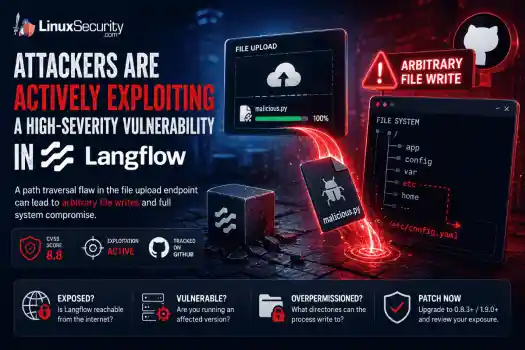
Security Vulnerabilities security advisory critical
security advisory critical Attackers are actively exploiting a high-severity vulnerability in Langflow , an open-source platform used to build and run AI workflows. . The flaw turns a file upload into a filesystem write, allowing a user-controlled file to escape the application's intended upload directory and land in locations Langflow was never supposed to touch. The vulnerable upload endpoint permits path traversal through crafted filenames. From there, the impact depends heavily on how the platform is deployed. A...
Jun 11, 2026 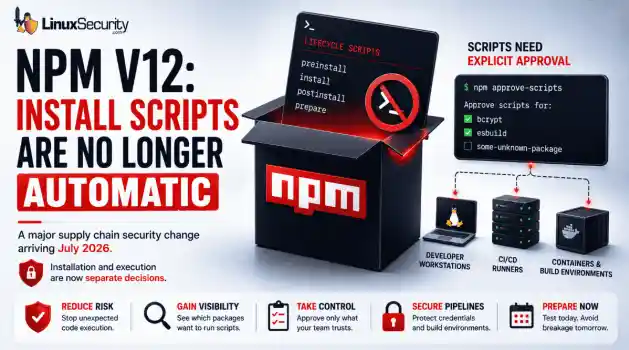
Vendors/Productssecurity advisory linux
security advisory linux With npm v12 , dependency preinstall, install, and postinstall scripts will no longer execute automatically during package installation. Script execution will require explicit approval through new controls such as npm approve-scripts, with the change expected to arrive in July 2026. . The announcement targets a part of the software supply chain that has repeatedly appeared in package registry abuse, credential theft, and CI/CD compromise investigations. A single npm install could trigger code...
Jun 11, 2026 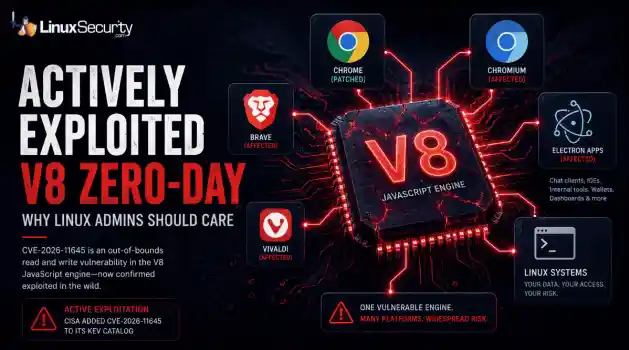
Security Vulnerabilities security advisory zero-day
security advisory zero-day CISA added CVE-2026-11645 to its Known Exploited Vulnerabilities catalog after Google confirmed active exploitation of the flaw. The bug sits in V8, the JavaScript engine behind Chrome and Chromium. . That's where this gets more interesting. Most coverage will focus on Chrome because that's where the patch landed. But the affected component is V8. Chromium relies on it. Electron relies on it. Plenty of desktop software Linux users interact with every day relies on it too, often without much...
Jun 10, 2026 
Network Securitysecurity advisory networking
security advisory networking For years, IPv4 was the only proxy type that really mattered for anyone running automation off a Linux box. IPv6 was the protocol everyone said they’d migrate to, but almost nobody actually did. In 2026, that’s finally starting to shift. . The problem is that most admins stick with IPv4 out of habit. They know it; it’s what their tooling defaults to, and they don’t see a reason to change. Some are overpaying for addresses they don’t need. Others would quietly break their scrapers, scripts, or...
Jun 09, 2026  Refine news
X Clear Filters Get the latest News and Insights
Get the latest Linux and open source security news straight to your inbox.
Community Poll
What got you started with Linux?
Loading...

Explore Latest Linux Security news
We found -4 articles for you...
209
 access controlmulti-tenantkubernetes
Addressing Multi-Tenant Risks in Linux Workloads on the Cloud
Linux administrators often face an ugly choice in the cloud: prioritize convenience and cost-efficiency by sharing infrastructure, or sacrifice those benefits for the sake of total isolation. Most modern Linux workloads don't live on their own private servers anymore. They live in shared environments like Kubernetes clusters, where multiple teams and services run side-by-side. It sounds efficient, and it usually is. . But cloud isolation isn't as ironclad as it looks on the diagram. If you don't know where the boundaries actually sit, a single misconfiguration can turn a shared server into an open door for an attacker. What “Multi-Tenant” Actually Means Most Kubernetes environments are shared whether teams realize it or not. Different workloads end up on the same worker nodes, using the same kernel underneath, separated mostly by configuration and orchestration rules. That separation holds until somebody exposes a service they forgot about, over-permissions a service account, or leaves lateral movement paths sitting open inside the cluster. Organizations love this model because it’s cheap and fast to scale. However, there is a big difference between "soft" and "hard" multi-tenancy. As explained in the official Kubernetes guidance on multi-tenancy , most setups are "soft." This means isolation depends heavily on configuration. Features like namespaces help separate workloads, but they are not always enough to contain an attacker after a system has been compromised. Why Linux Workloads Become Exposed in Shared Environments The fundamental security challenge in a shared Linux environment is that, despite the abstraction, the containers still share the same Linux kernel. When you deploy a pod, you are creating a logical boundary. But underneath that boundary, your workload is just a process—or a set of processes—running on a worker node that likely hosts dozens of other containers. Isolation here depends entirely on configuration. If the kernel is the "foundation" ofyour apartment building, the containers are just drywall partitions. They provide privacy, but they don't provide structural protection. If you are looking for more technical context on why this matters, the AWS tenant isolation guidance is an essential read. It breaks down why Kubernetes is not a hard security boundary and explores the reality of shared-node risks. In practice, this changes the threat model considerably. Attackers rarely need to "break" the cloud provider. They only need to find one weak, misconfigured workload on a shared node, and they can often use that foothold to begin enumerating the rest of your environment. Real-World Reality Check: The Tesla Breach The 2018 Tesla breach showed how quickly a weak Kubernetes configuration can turn into a larger cloud security problem. Security researchers found that one of Tesla’s Kubernetes consoles had been exposed to the public internet without password protection. Once attackers reached that management interface, they were able to view how containers were deployed and managed inside the environment. The bigger issue was what they found next. Cloud credentials were stored inside the cluster, giving the attackers a path from the Kubernetes environment into Tesla’s AWS storage. From there, they used Tesla’s compute resources to mine cryptocurrency. The lesson is blunt: configuration is part of the security boundary. The attackers did not need to break AWS isolation or exploit an advanced zero-day. They found an exposed control plane, pulled credentials from the environment, and moved laterally from there. For DevOps and platform teams, that is the real risk in multi-tenant infrastructure. If the management plane is exposed, the separation between workloads stops meaning much in practice. How Weak Isolation Leads to Real Security Problems When isolation fails, the damage usually starts small. An attacker gains access to one exposed workload, identifies overly broad permissions, and begins moving through theenvironment from there. In many cases, the first step is privilege escalation or lateral movement. A compromised container may expose access to the underlying node, shared resources, or internal services that were never meant to be reachable from that workload. Suddenly, that stolen service account token isn't just a key to one app; it’s a that token may provide access far beyond the workload it was originally created for. As discussed in Kubernetes RBAC best practices , these mistakes are almost always configuration-based. It is easy to accidentally grant "cluster-admin" or overly broad access to a service account that only needed to read a single secret. Why Cloud Security Gets Harder at Scale Security becomes harder once environments grow beyond what a single team can realistically track day to day. A cluster that started with a few workloads can eventually turn into thousands of pods spread across multiple environments, teams, and cloud accounts. At that point, consistency becomes the real problem. One team allows broad service account access for convenience. Another disables a network policy temporarily and forgets to restore it. Someone spins up a test workload that never gets cleaned up. Months later, nobody remembers which exceptions were intentional and which were accidents. This is why multi-tenant Kubernetes environments become difficult to secure at scale. The issue usually is not a single catastrophic mistake. It is the accumulation of small configuration decisions across hundreds of workloads and administrators. Google’s GKE enterprise multi-tenancy recommendations highlight that the challenge isn't just technology; it's governance. The Tradeoff Between Cost, Scalability, and Isolation If shared environments carry these risks, why do we use them? The answer is simple: business necessity. Dedicated clusters for every single team or customer are prohibitively expensive and difficult to maintain. Most organizations—especially those running SaaSplatforms—rely on tenant density to keep costs manageable. As outlined in the Azure Kubernetes multi-tenant architecture guidance , this is an operational decision. It forces a trade-off between the desire for perfect isolation and the reality of budget and operational efficiency. The goal for a modern engineering team isn't to eliminate shared infrastructure—it's to manage the risk that comes with it. Practical Ways to Reduce Multi-Tenant Linux Risks You don't need to abandon your cloud platform to stay secure, but you do need to stop relying on default isolation. Hardening a shared environment requires a layered approach: Implement Least Privilege: Audit your RBAC roles religiously. If a service account doesn't need it, don't give it. Segment Your Workloads: Use dedicated node pools for sensitive workloads. If an application handles PII or financial data, it shouldn't be sitting on the same physical host as your public-facing dev environment. Enforce Network Policies: Don't let your pods talk to everything. Use a "deny-all" default and explicitly allow only the traffic that is necessary. Monitor East-West Traffic: Most attacks happen laterally. If you aren't logging the traffic inside your cluster, you are blind to how an attacker moves once they get in. Audit Regularly: Use automated tools to scan for overly broad service accounts and risky container configurations. For those looking to build a more robust architecture, the AWS SaaS security best practices offer excellent guidance on how to build security decisions into the environment early instead of trying to retrofit them later. Conclusion Multi-tenant cloud infrastructure is the standard for modern Linux environments, but shared infrastructure inherently expands the importance of strong isolation and consistent governance. Organizations don't need to abandon shared cloud platforms, but they do need to understand where software-based isolation can fail. By moving toward a model ofleast-privilege access and layered controls, we can reduce our exposure. Shared infrastructure is not going away, which means containment matters just as much as prevention. Strong isolation and least-privilege controls help limit how far an attacker can move after gaining access to a workload. Linux threats evolve quickly, especially in shared cloud environments where a single weak configuration can expose an entire workload. Subscribe to the LinuxSecurity.com newsletter for the latest research, breach analysis, hardening guidance, and Linux-focused security updates delivered directly to your inbox. Related Reading What Is Kubernetes Security? A Linux Admin’s Practical Guide What Is a Container Escape Vulnerability? Kubernetes Security: Top Strategies for 2025 Against Emerging Threats Securing Kubernetes: DevSecOps Strategies for Cloud-Native Environments Beyond the Sandbox: Container Escape Techniques Observed in Recent Research . Explore the complexities of multi-tenant security in Linux workloads, and learn strategies to enhance your cloud environment.. Kubernetes Security, multi-tenant Linux workloads, cloud isolation strategies, container security best practices. . Dave Wreski
 May 21, 2026 •
 Security Trends
Get the latest News and Insights
Get the latest Linux and open source security news straight to your inbox.
Community Poll
What got you started with Linux?
Search Topics
Powered By

Linux Security - Your source for Top Linux News, Advisories, HOWTOs and Feature Releases
QUICK LINKS
subscribe to newsletters!
Like staying secure? So do we.
Sign up for updates, tips, and alerts!
Discover faster search, smarter navigation, and deeper Linux security insights. Read More