


Security Trends  fedora security assessment
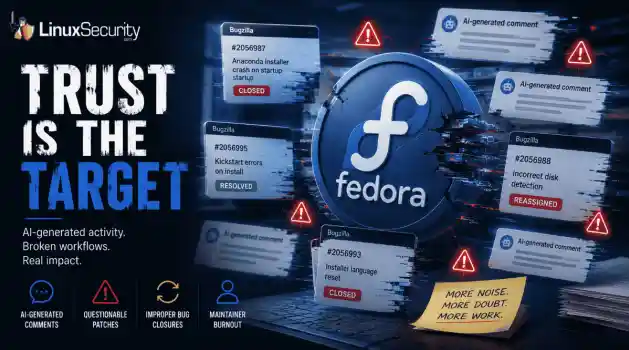
fedora security assessment A Fedora contributor account recently came under scrutiny for apparently AI-generated activity that disrupted the project's bug tracker. . Questionable Bugzilla comments, flawed patches, and improperly closed or reassigned bugs forced maintainers to spend time cleaning up the fallout. There is no evidence that malware was deployed or a backdoor reached production, but the incident exposed a different problem. Open-source projects can be disrupted without compromising a single line of code....
 Jun 12, 2026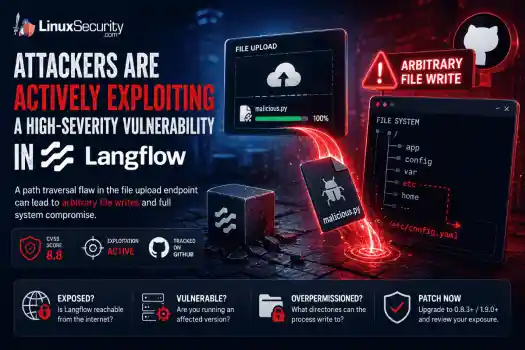
Security Vulnerabilities security advisory critical
security advisory critical Attackers are actively exploiting a high-severity vulnerability in Langflow , an open-source platform used to build and run AI workflows. . The flaw turns a file upload into a filesystem write, allowing a user-controlled file to escape the application's intended upload directory and land in locations Langflow was never supposed to touch. The vulnerable upload endpoint permits path traversal through crafted filenames. From there, the impact depends heavily on how the platform is deployed. A...
Jun 11, 2026 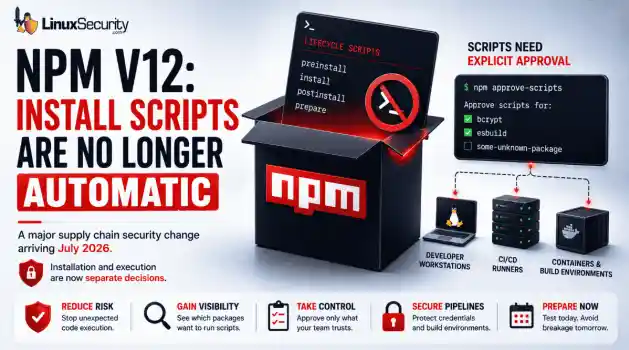
Vendors/Productssecurity advisory linux
security advisory linux With npm v12 , dependency preinstall, install, and postinstall scripts will no longer execute automatically during package installation. Script execution will require explicit approval through new controls such as npm approve-scripts, with the change expected to arrive in July 2026. . The announcement targets a part of the software supply chain that has repeatedly appeared in package registry abuse, credential theft, and CI/CD compromise investigations. A single npm install could trigger code...
Jun 11, 2026 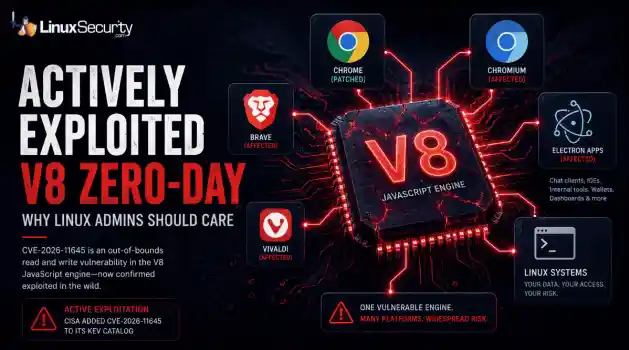
Security Vulnerabilities security advisory zero-day
security advisory zero-day CISA added CVE-2026-11645 to its Known Exploited Vulnerabilities catalog after Google confirmed active exploitation of the flaw. The bug sits in V8, the JavaScript engine behind Chrome and Chromium. . That's where this gets more interesting. Most coverage will focus on Chrome because that's where the patch landed. But the affected component is V8. Chromium relies on it. Electron relies on it. Plenty of desktop software Linux users interact with every day relies on it too, often without much...
Jun 10, 2026 
Network Securitysecurity advisory networking
security advisory networking For years, IPv4 was the only proxy type that really mattered for anyone running automation off a Linux box. IPv6 was the protocol everyone said they’d migrate to, but almost nobody actually did. In 2026, that’s finally starting to shift. . The problem is that most admins stick with IPv4 out of habit. They know it; it’s what their tooling defaults to, and they don’t see a reason to change. Some are overpaying for addresses they don’t need. Others would quietly break their scrapers, scripts, or...
Jun 09, 2026  Refine news
X Clear Filters Get the latest News and Insights
Get the latest Linux and open source security news straight to your inbox.
Community Poll
What got you started with Linux?
Loading...
Explore Latest Linux Security news
We found 1 articles for you...
83
 telecommunicationshacking historyphreaking
Exploring Phreaking's Legacy and Its Relevance in Android Hacking
In the 1960s and 70s, technically savvy enthusiasts sought to game telecommunications systems to make free calls, keeping telecom engineers on their toes. . That practice, known as phreaking, involved such luminaries as Steve Jobs, Steve Wozniak and John Draper, known as Cap'n Crunch, who used a whistle from a cereal box to meddle with AT&T's long-distance trunk lines. . Phreaking, a blend of "phone" and "freaking," emerged in the late 20th century as a subculture exploring and manipulating telephone networks.. Phreaking, Android Hacking, Telecommunications Techniques, Historical Cybersecurity. . LinuxSecurity.com Team
 Mar 14, 2017 •
 Hacks/Cracks
 83
hacking historyinfosec culturedial-up accessReflecting on Dial-Up Hacking's Lasting Impact in Infosec
The last day of Infosec brought nostalgia for the old days of hacking. Robert Schifreen, the ex-hacker and author famous for breaking into Prince Phillips' Prestel account 20 odd years ago, recalled a more innocent age during his stint chairing a hackers panel. "You didn't have flat rate hacking before the internet. It was all dial-up and hacking attacks tending to occur after 6pm when cheap rate began. At that time, admins were back watching Neighbours or the Magic Roundabout." . The link for this article located at TheRegister.co.uk is no longer available. . Investigating the roots of early modem breaches and their influence on the development of cybersecurity protocols.. Dial-Up Hacking, Infosec Culture, Security Evolution, Hacker History. . LinuxSecurity.com Team
Apr 28, 2006 • Hacks/Cracks 
76
hacking historyhacker cultureMITExploring Hacking's Journey: How MIT Shaped Modern Hacker Culture
In the truest sense, hacking is not an act; rather, it is a viewpoint, a set of tools for thinking about how to interact with systems. The late Judith Milhon, one of the first female hackers ever, defined hacking as "the clever circumvention of imposed limits." The early hackers at MIT and Stanford had limited access to the huge, expensive mainframes on which they worked, and so they devised clever and exotic ways both to gain more time and make their programming time more efficient. . . .. In the truest sense, hacking is not an act; rather, it is a viewpoint, a set of tools for thinking about how to interact with systems. The late Judith Milhon, one of the first female hackers ever, defined hacking as "the clever circumvention of imposed limits." The early hackers at MIT and Stanford had limited access to the huge, expensive mainframes on which they worked, and so they devised clever and exotic ways both to gain more time and make their programming time more efficient. One classic story details a computer manager who began locking the door to the computer room to keep the scruffy hippies out at night. When he returned in the morning, he found the entire door to his office had been removed, along with an apologetic note explaining that it had gotten in the way of someone's work. Of course, things have changed over the decades. These days, your average hacker is just as likely to be a 17-year-old junior punk or goth with an anarchy T-shirt and a sticker of Tux the Penguin (the mascot for the free operating system Linux) on his or her laptop. And while DefCon may have begun as an invite-only affair for the old guard of the computer security elite, these days you're more likely to see the punk kid sitting poolside, making out with a goth chick wearing nothing but strategically placed duct tape, drunk on vodka and Red Bull and the simple gleeful awareness that comes from being surrounded by 5,000 people who are just like you. This is what DefCon has come to represent for the hacking community: a combination of tradeshow and Burning Man, debauchery and deconstruction in one sleepless package. . Hacking has evolved from covert exploits to a dynamic culture rooted in innovation and ethics, shaping our understanding of technology and society. Hacking Evolution, Hacking Perspectives, DefCon Festival, Hacking History. . Anthony Pell
Aug 05, 2004 • Organizations/Events 83
cyber crimehacking historydigital transformationKevin Mitnick's Evolution From Notorious Hacker To Security Professional
Until 1995, when he was jailed for five years in a US federal prison, Kevin Mitnick was at the top of the FBI's "most wanted" list, yet he had killed no one, had no links with the Mafia, had never dealt in drugs, committed serial rape or held up a bank.. . .. Until 1995, when he was jailed for five years in a US federal prison, Kevin Mitnick was at the top of the FBI's "most wanted" list, yet he had killed no one, had no links with the Mafia, had never dealt in drugs, committed serial rape or held up a bank. Yet he struck fear into the heart of the US Government and corporate America. He was, and remains, America's most notorious cyber criminal, a hacker of great skill who, according to the evidence against him, penetrated some of the most sensitive databases in the world, stole software worth millions of dollars and cost the US Government a fortune before he was caught. Today, Mr Mitnick is the poacher turned gamekeeper. Released from prison in January, 2000, he is still banned from using a computer, logging into the Internet, using e-mail or a mobile phone, a prohibition due to be lifted on January 20, 2003 unless, as his supporters suspect it may, the US Government presses further charges against him. . Until 1995, when he was jailed for five years in a US federal prison, Kevin Mitnick was at the top o. until, jailed, years, federal, prison, kevin, mitnick. . LinuxSecurity.com Team
Mar 18, 2002 • Hacks/Cracks 83
cyber threatsIT securityhacking historyHacker Tracking Journey at MIT in 1989: Steven Lynch's Story
Steven Lynch was first introduced to the joys of hunting down hackers in MIT in 1989. While working in the University's IT department he came across Australia's very own Leftist and Urvile, as they took control of the institutions servers and used them to poke holes in systems on the other side of the world.. . .. Steven Lynch was first introduced to the joys of hunting down hackers in MIT in 1989. While working in the University's IT department he came across Australia's very own Leftist and Urvile, as they took control of the institutions servers and used them to poke holes in systems on the other side of the world. Phoenix and Electron were eventually tracked down to a flat in Melbourne, but not before Lynch spent countless hours following their clandestine progress through unsuspecting networks. "We became aware they were using machines in the IT department to hack into machines in the US," Lynch said. "They were setting up back doors in the computers they hacked so they could get back in again later." Lynch can't recall what alerted the university's IT department to the suspicious goings on within the university network. Nonetheless when asked by the police to keep an eye on the character's movements, he first had to figure out how to monitor their progress without giving the game away. The link for this article located at ZDNet AU is no longer available. . Steven Lynch was first introduced to the joys of hunting down hackers in MIT in 1989. While working . steven, lynch, first, introduced, hunting, hackers, while, working. . LinuxSecurity.com Team
Oct 30, 2001 • Hacks/Cracks 83
hacking historyphone phreaktech consultantThe Remarkable Journey of John T. Draper: A Legacy of Innovation
... there may be no tale so poignant as that of John T. Draper, the mythical "phone phreak" who became a national figure in 1971 after being one of the first to discover that a toy whistle in the Cap'n Crunch . . . . ... there may be no tale so poignant as that of John T. Draper, the mythical "phone phreak" who became a national figure in 1971 after being one of the first to discover that a toy whistle in the Cap'n Crunch cereal box could trick the telephone network into giving free telephone calls. Widely known as Captain Crunch, Mr. Draper has had a remarkable career since then. He was arrested and sent to prison for his telephone exploits several times and graduated from phones to computers. He did the early design from a jail cell for EasyWriter, the word processing program that came with the first I.B.M. PC in 1981. In the intervening decades he was for a while a millionaire who owned a house in Hawaii. But he has also lost jobs and been homeless more than once. He hacked into computer networks, using some of the same skills he honed on the telephone system. His back was permanently injured in a prison beating in Pennsylvania. He was robbed on a Texas highway where he lost a notebook computer containing the only copy of his autobiography. For years he wandered the world working where he could as a high-tech hobo - including the Goa coast in India, where in 1999 he spent six months coding Web sites for an Indian entrepreneur. . ... there may be no tale so poignant as that of John T. Draper, the mythical 'phone phreak' who beca. there, poignant, draper, mythical, 'phone, phreak'. . LinuxSecurity.com Team
Jan 29, 2001 • Hacks/Cracks 
Get the latest News and Insights
Get the latest Linux and open source security news straight to your inbox.
Community Poll
What got you started with Linux?
Search Topics
Powered By

Linux Security - Your source for Top Linux News, Advisories, HOWTOs and Feature Releases
QUICK LINKS
subscribe to newsletters!
Like staying secure? So do we.
Sign up for updates, tips, and alerts!
Discover faster search, smarter navigation, and deeper Linux security insights. Read More