



Security Trends  fedora security assessment
fedora security assessment A Fedora contributor account recently came under scrutiny for apparently AI-generated activity that disrupted the project's bug tracker. . Questionable Bugzilla comments, flawed patches, and improperly closed or reassigned bugs forced maintainers to spend time cleaning up the fallout. There is no evidence that malware was deployed or a backdoor reached production, but the incident exposed a different problem. Open-source projects can be disrupted without compromising a single line of code....
 Jun 12, 2026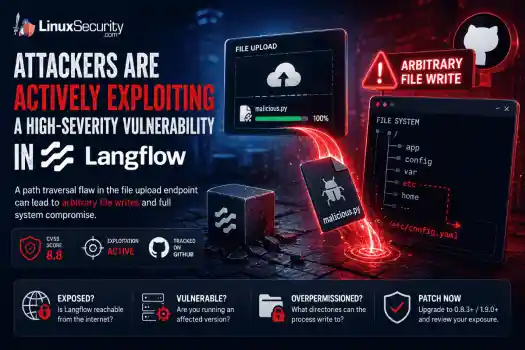
Security Vulnerabilities security advisory critical
security advisory critical Attackers are actively exploiting a high-severity vulnerability in Langflow , an open-source platform used to build and run AI workflows. . The flaw turns a file upload into a filesystem write, allowing a user-controlled file to escape the application's intended upload directory and land in locations Langflow was never supposed to touch. The vulnerable upload endpoint permits path traversal through crafted filenames. From there, the impact depends heavily on how the platform is deployed. A...
Jun 11, 2026 
Vendors/Productssecurity advisory linux
security advisory linux With npm v12 , dependency preinstall, install, and postinstall scripts will no longer execute automatically during package installation. Script execution will require explicit approval through new controls such as npm approve-scripts, with the change expected to arrive in July 2026. . The announcement targets a part of the software supply chain that has repeatedly appeared in package registry abuse, credential theft, and CI/CD compromise investigations. A single npm install could trigger code...
Jun 11, 2026 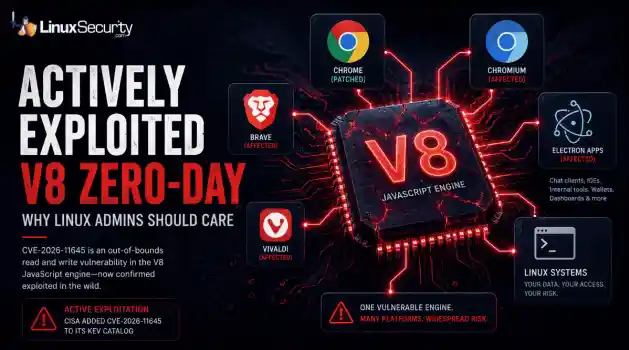
Security Vulnerabilities security advisory zero-day
security advisory zero-day CISA added CVE-2026-11645 to its Known Exploited Vulnerabilities catalog after Google confirmed active exploitation of the flaw. The bug sits in V8, the JavaScript engine behind Chrome and Chromium. . That's where this gets more interesting. Most coverage will focus on Chrome because that's where the patch landed. But the affected component is V8. Chromium relies on it. Electron relies on it. Plenty of desktop software Linux users interact with every day relies on it too, often without much...
Jun 10, 2026 
Network Securitysecurity advisory networking
security advisory networking For years, IPv4 was the only proxy type that really mattered for anyone running automation off a Linux box. IPv6 was the protocol everyone said they’d migrate to, but almost nobody actually did. In 2026, that’s finally starting to shift. . The problem is that most admins stick with IPv4 out of habit. They know it; it’s what their tooling defaults to, and they don’t see a reason to change. Some are overpaying for addresses they don’t need. Others would quietly break their scrapers, scripts, or...
Jun 09, 2026  Refine news
X Clear Filters Get the latest News and Insights
Get the latest Linux and open source security news straight to your inbox.
Community Poll
What got you started with Linux?
Loading...
Explore Latest Linux Security news
We found -1 articles for you...
74
 network securitypacket analysisicmp
Exploring DNS and ICMP Challenges Through Unique Packet Analysis
This time around, packets from one of my own DNS servers. If you would like to follow along, you can find the full unobfuscated packet trace here. (quick update... turns out that the router and DNS queries involved are part of www.nlnetlabs.nl, a network research labs that does experiment with DNS servers... so maybe this is all some side effect of an experiment they are running. Thanks to Don for pointing this out to me. After visiting their website, I did see a number of similar ICMP admin prohibited packets with flipped fragmentation bytes, but the embeded packet's source port was 80! . The link for this article located at SANS is no longer available. . Explore packet scrutiny, focusing on DNS evaluations and ICMP trials. Understanding these protocols uncovers networking challenges and helps optimize efficiencies.. Packet Analysis,DNS Issues,ICMP Operations,Network Security,Data Experimentation. . Benjamin D. Thomas
 Nov 14, 2006 •
 Network Security
 74
firewallnetwork administrationping solutionOvercoming Firewall Limitations: ICMP vs. ARP Ping Solutions
Today almost every organization employs firewalls for enhanced security. Firewalls can be set up in such a way that Internet Control Message Protocol (ICMP) requests are blocked, which means that traditional pings do not work. Setting a firewall to block ICMP requests is based on the theory that if a would-be hacker cannot "see" the target, he may not attack the host. . This makes system and network administration more difficult. A failed ping is no longer a valid test -- the user may have enabled a firewall that is blocking the ping, but the host may still be up. Before a network administrator can accurately determine if a host is down, the user needs to turn off all firewall applications -- or at least turn off any rules blocking ICMP -- which is probably asking too much of the average user. If traditional ICMP-based pings are no longer reliable unless you know in advance that there is no firewall blocking ICMP echo requests, what other options exist? One option is an Address Resolution Protocol (ARP) based ping using the arping utility. To know why ARP pings are virtually guaranteed to work while ICMP pings may not, one should understand the importance of ARP in networking. ARP is used by hosts on a network to resolve IP addresses into Media Access Control (MAC) addresses, which can be interpreted as a network interface's unique serial number. Hosts on an Ethernet network use MAC addresses rather than IP addresses to communicate. The link for this article located at Linux.com is no longer available. . Explore the role of firewalls in the realm of system and network administration, particularly in their ability to restrict ping operations and provide alternatives to ARP.. Firewall Configuration, Network Administration, ICMP Alternatives. . Brittany Day
Dec 22, 2005 • Network Security 
72
network securityicmpfirewall techniquesEnhancing Linux Network Security With ICMP and Request Limits
The following article is part two of a two part series. "Alternately, you could create limit rules to accept only a certain number of requests every second. Or if you have monitoring software that requires your box to be "pingable," you could accept ICMP requests from only a certain IP or set of IP addresses." . . .. The following article is part two of a two part series. "Alternately, you could create limit rules to accept only a certain number of requests every second. Or if you have monitoring software that requires your box to be "pingable," you could accept ICMP requests from only a certain IP or set of IP addresses." The link for this article located at ZDNet AU is no longer available. . Delve into sophisticated firewall setups that incorporate connection quotas and ICMP policies to strengthen your Linux networking defenses.. Linux Firewall, Advanced Configurations, ICMP Security, Network Defense. . Anthony Pell
May 08, 2002 • Firewalls 74
network securitysecurity issuefirewallExploring ICMP Security Issues And Effective Safeguards
The Internet Control Message Protocol (ICMP) is simple, as Internet protocols go. Originally described in RFC 792 by Jon Postel, ICMP provides a way for IP stacks to send simple messages containing information or errors. ICMP is important for the Internet . . . . The Internet Control Message Protocol (ICMP) is simple, as Internet protocols go. Originally described in RFC 792 by Jon Postel, ICMP provides a way for IP stacks to send simple messages containing information or errors. ICMP is important for the Internet (and IP networks) to function correctly; however, ICMP can also have a negative effect on your network's security. For instance, ICMP has been used for scanning, Denial of Service (DoS) attacks, and tunneling (see "Distributed Denial of Service Attacks," March 2000, and "Firewall Vulnerabilities," August 1999,). A recent research paper by Israeli security consultant Ofir Arkin draws attention to some of the more arcane ways that ICMP can be employed in scanning networks (see Resources). At the end of his paper, Arkin suggests permitting only one of the 52 ICMP types and codes through a firewall, and that one only inbound. The link for this article located at Network Magazine is no longer available. . The Internet Control Message Protocol (ICMP) is simple, as Internet protocols go. Originally describ. internet, control, message, protocol, (icmp), simple, protocols, originally, describ. . Anthony Pell
Oct 02, 2000 • Network Security 
Get the latest News and Insights
Get the latest Linux and open source security news straight to your inbox.
Community Poll
What got you started with Linux?
Search Topics
Powered By

Linux Security - Your source for Top Linux News, Advisories, HOWTOs and Feature Releases
QUICK LINKS
subscribe to newsletters!
Like staying secure? So do we.
Sign up for updates, tips, and alerts!
Discover faster search, smarter navigation, and deeper Linux security insights. Read More