



Security Trends  fedora security assessment
fedora security assessment A Fedora contributor account recently came under scrutiny for apparently AI-generated activity that disrupted the project's bug tracker. . Questionable Bugzilla comments, flawed patches, and improperly closed or reassigned bugs forced maintainers to spend time cleaning up the fallout. There is no evidence that malware was deployed or a backdoor reached production, but the incident exposed a different problem. Open-source projects can be disrupted without compromising a single line of code....
 Jun 12, 2026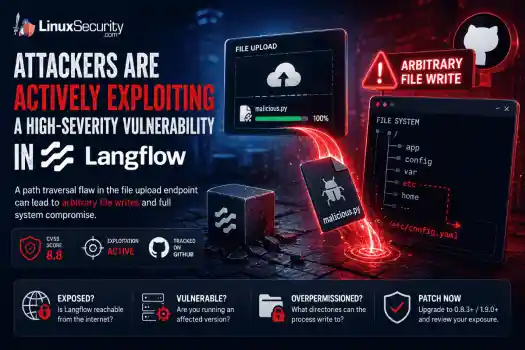
Security Vulnerabilities security advisory critical
security advisory critical Attackers are actively exploiting a high-severity vulnerability in Langflow , an open-source platform used to build and run AI workflows. . The flaw turns a file upload into a filesystem write, allowing a user-controlled file to escape the application's intended upload directory and land in locations Langflow was never supposed to touch. The vulnerable upload endpoint permits path traversal through crafted filenames. From there, the impact depends heavily on how the platform is deployed. A...
Jun 11, 2026 
Vendors/Productssecurity advisory linux
security advisory linux With npm v12 , dependency preinstall, install, and postinstall scripts will no longer execute automatically during package installation. Script execution will require explicit approval through new controls such as npm approve-scripts, with the change expected to arrive in July 2026. . The announcement targets a part of the software supply chain that has repeatedly appeared in package registry abuse, credential theft, and CI/CD compromise investigations. A single npm install could trigger code...
Jun 11, 2026 
Security Vulnerabilities security advisory zero-day
security advisory zero-day CISA added CVE-2026-11645 to its Known Exploited Vulnerabilities catalog after Google confirmed active exploitation of the flaw. The bug sits in V8, the JavaScript engine behind Chrome and Chromium. . That's where this gets more interesting. Most coverage will focus on Chrome because that's where the patch landed. But the affected component is V8. Chromium relies on it. Electron relies on it. Plenty of desktop software Linux users interact with every day relies on it too, often without much...
Jun 10, 2026 
Network Securitysecurity advisory networking
security advisory networking For years, IPv4 was the only proxy type that really mattered for anyone running automation off a Linux box. IPv6 was the protocol everyone said they’d migrate to, but almost nobody actually did. In 2026, that’s finally starting to shift. . The problem is that most admins stick with IPv4 out of habit. They know it; it’s what their tooling defaults to, and they don’t see a reason to change. Some are overpaying for addresses they don’t need. Others would quietly break their scrapers, scripts, or...
Jun 09, 2026  Refine news
X Clear Filters Get the latest News and Insights
Get the latest Linux and open source security news straight to your inbox.
Community Poll
What got you started with Linux?
Loading...
Explore Latest Linux Security news
We found -3 articles for you...
81
 data centersecurity technologyintrusion protection
Adapting Intrusion Protection Systems to Virtual Environments
Intrusion protection system (IPS) technology is gradually adapting to virtual computing, as IPS vendors add to their product lines actual virtual IPSes as well as IPSes that protect virtual machines. Sourcefire's recent release of VMware-based virtual appliances was the latest arrival to the market of IPSes that work with virtual machines. IBM ISS also offers a virtual IPS, and TippingPoint has plans to roll out a virtual IPS offering as well.. What's driving the IPS to virtualization? A combination of trends in IPS evolution, including the convergence of IPS technology with other security functions (think firewalls and data leakage protection), the consolidation of data centers using virtualization technology, and compliance. It's not so much that the IPS is changing in what it can do technology-wise, but more that it's changing in the type of environment it runs in, notes Matt Watchinski, senior director of Sourcefire's Vulnerability Research Team. "Most [IPS vendors] are making their software work in those [virtual] environments," he says. "The point is that we're taking that step forward to embracing virtualization." Virtual IPSes are still a fairly new approach for IPS perimeter defenses. "The virtualization of these security appliances starts small, and most people are still dipping their toes in the water," Watchinski says. "You're not going to see massive deployments here [for now]." The link for this article located at Dark Reading is no longer available. . Intrusion protection systems (IPS) are evolving to meet the demands of virtualization and complex IT environments, ensuring robust security for virtual assets.. Intrusion Prevention System, Virtual IPS, Security Technology. . LinuxSecurity.com Team
 Dec 08, 2009 •
 Privacy
 74
network securitysecurity strategiesfirewall managementEssential Strategies For Securing Your Computers Against Threats
In this introduction to protecting your computers from intrusion, the author discusses concepts of computer security. Selecting good passwords, using firewalls, and other security concepts are introduced. If your computer is not connected to any other computers and doesn't have . . . . In this introduction to protecting your computers from intrusion, the author discusses concepts of computer security. Selecting good passwords, using firewalls, and other security concepts are introduced. If your computer is not connected to any other computers and doesn't have a modem, the only way anyone can access your computer's information is by physically coming to the computer and sitting at it. So securing the room it's in will secure the computer[1]. As soon as your computer is connected to another computer you add the possibility that someone using the other computer can access your computer's information. If your network (your connected computers) consists only of other computers in the same building you can still secure the network by securing the rooms the computers are in. An example of this would be two computers sharing the same files and printer, but not having a modem and not being connected to any other computers. However, it's wise to learn about other ways to secure a network of connected computers, in case you add something later. Networks have a tendency to grow. If you have a network, an intruder who gains access to one computer has at least some access to all of them. The link for this article located at Jennifer Vesperman is no longer available. . Uncover essential methods to protect your devices from unauthorized access, concentrating on password management, network barriers, and protective measures.. Intrusion Protection, Network Security, Firewall Management, Computer Safety. . Anthony Pell
Mar 23, 2002 • Network Security 

Get the latest News and Insights
Get the latest Linux and open source security news straight to your inbox.
Community Poll
What got you started with Linux?
Search Topics
Powered By

Linux Security - Your source for Top Linux News, Advisories, HOWTOs and Feature Releases
QUICK LINKS
subscribe to newsletters!
Like staying secure? So do we.
Sign up for updates, tips, and alerts!
Discover faster search, smarter navigation, and deeper Linux security insights. Read More