Explore top 10 tips to secure your open-source projects now. Read More
×



Server Security data privacy automation
data privacy automation Every system admin has lived through the same Monday morning ritual. A queue of forty tickets, half of them password resets, permission errors, or disk space warnings that any experienced technician could resolve in under two minutes. The other half require actual judgment. For years, automation promised that software would eventually sort the two apart on its own. That promise is now being tested in production Linux environments. . Early results are reshaping how IT teams think about tier-1...
 Jul 17, 2026

Privacydata collection automation
data collection automation You're running a web scraping project to collect pricing data from e-commerce sites. You set up a pool of datacenter proxies, launch your scripts, and within minutes — banned . CAPTCHAs everywhere. Your data pipeline stops before it really begins. . It's a frustrating scenario that plays out daily in ad verification, market research, and multi-account management. The website doesn't know you're doing legitimate research or monitoring. It just sees traffic coming from IP ranges it recognizes as...
Jul 17, 2026

Security Trends security advisory social engineering
security advisory social engineering Business Email Compromise used to be a numbers game — mass-blasted emails, broken English, an obvious "URGENT WIRE TRANSFER" subject line. That era is over. Generative AI has turned BEC into a tailored, low-noise operation that mimics writing style, voice, and even video presence. This piece looks at what's actually changed under the hood, what defenders are testing in response, and why so many organizations are still structurally unprepared for it. . The Infrastructure Problem Nobody Wants to...
Jul 17, 2026

Security Trends cybersecurity Linux documentation
cybersecurity Linux documentation Linux operating systems have gained prominence due to their stability, adaptability, and excellent security options. In the case of developing documentation, designing cybersecurity dashboards, or educational material, visuals are of vital importance when it comes to making things clear. The use of icons allows one to understand the message regarding alerts, authorization, encryption, authentication, or the state of the system just by looking at the visual cue without having to read long...
Jul 17, 2026
Security Vulnerabilities security advisory linux distribution
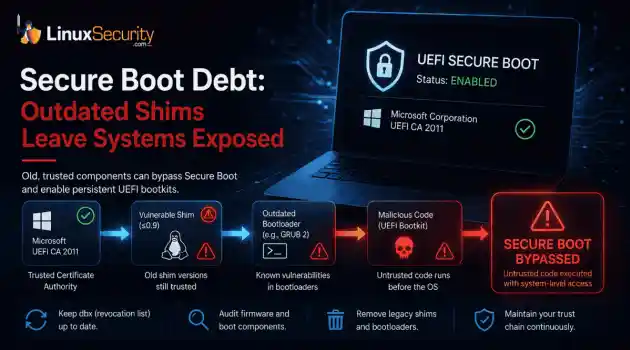
security advisory linux distribution ESET researchers identified 11 old and forgotten Linux UEFI shim bootloaders at versions 0.9 and below that can be used to bypass UEFI Secure Boot on any UEFI-based machine that trusts Microsoft’s Microsoft Corporation UEFI CA 2011 third-party certificate authority, regardless of the installed operating system (OS). Reported shims can be exploited to execute untrusted code during system boot, enabling attackers to deploy malicious UEFI bootkits even on systems with UEFI Secure Boot enabled.....
Jul 16, 2026
 Refine news
X Clear Filters
Get the latest News and Insights
Get the latest Linux and open source security news straight to your inbox.
Community Poll
Is continuous patching actually viable?
Trending News
Loading...
Explore Latest Linux Security news
We found -2 articles for you...
79
 security advisoryvirtualizationkernel enhancement
Linux 6.8 Kernel: KVM Enhancements Impacting Security Protocols
Notable virtualization changes and enhancements have been integrated into the Linux kernel 6.8 . Significant features include enhanced support for confidential VMs, software-protected VMs, and improvements for specific architectures like x86 and ARM. These changes offer intriguing possibilities for Linux admins, infosec professionals, Internet security enthusiasts, and sysadmins but also raise important considerations for security and long-term consequences. Let's have a look at these changes and their implications for the security of your Linux systems. . Notable Virtualization Changes in the Linux 6.8 Kernel The inclusion of the new KVM_SET_MEMORY_ATTRIBUTES ioctl in Linux 6.8 brings about improved support for confidential and secure VMs. The ability to specify per-page attributes for guest memory enables stronger isolation and protection for VMs utilizing technologies like AMD SEV-SNP, Intel TDX, and ARM pKVM. This feature is particularly relevant for security practitioners who deal with sensitive workloads and require robust mechanisms to ensure data confidentiality. Another intriguing feature mentioned in the article is the support for "software-protected VMs" on x86, which serves as a testing method for interfaces related to guest_memfd and page attributes. While this may not have immediate practical implications, it represents an effort to innovate and develop more secure mechanisms for VMs. Security practitioners should keep an eye on these advancements to ensure they align with their requirements and evaluate the potential impact on their security posture. The addition of Intel Linear Address Masking (LAM) support for KVM guests allows better control over guest access to memory, which can enhance security by ensuring that guests only have access to the appropriate memory regions. Linux admins and infosec professionals should consider the implications of these advancements and assess how they can leverage this feature to strengthen the security of their virtualized environments. Additionally, flush-by-ASID support now exists for nSVM, unconditionally on KVM. This change facilitates compatibility with the latest versions of VMware Workstation, a widely used virtualization platform. While this may seem like a minor improvement, compatibility with popular platforms is crucial for security practitioners to manage and secure their virtualized infrastructure effectively. Furthermore, the introduction of the "CONFIG_KVM_HYPERV" Kconfig option raises questions about the potential impact on KVM support for Microsoft Hyper-V emulation. This option provides flexibility to disable Microsoft Hyper-V emulation support at build time. It raises concerns for security practitioners relying on Hyper-V and KVM integration. They have to weigh the pros and cons of such a decision and assess if the trade-off is worth it regarding security, performance, and management. Our Final Thoughts on the Impact of Linux 6.8 Kernel Enhancements on Security In conclusion, the KVM changes in Linux 6.8 bring promising enhancements for virtualization and security. The improved support for confidential VMs, software-protected VMs, Intel LAM, and architectural-specific features like ARM64 LPA2 and LoongArch LSX/LAX SIMD CPU instructions provide opportunities for security practitioners to strengthen their virtualized environments. However, it is crucial to consider the long-term consequences and potential trade-offs associated with these changes. By staying informed and analyzing the implications of these advancements, Linux admins, infosec professionals, Internet security enthusiasts, and sysadmins can make informed decisions to enhance the security of their systems and stay ahead of emerging threats. We encourage you to stay up-to-date on the latest Linux security news, updates, and advisories by subscribing to our weekly newsletters. Stay informed and secure, fellow Linux users! . The Linux kernel 6.8 showcases major upgrades to KVM, enhancing memory management, strong security measures, and performancetools for virtual settings. Linux Kernel 6.8, KVM Features, Virtualization Security, Software Protection. . LinuxSecurity.com Team
 Jan 14, 2024
•
Jan 14, 2024
• Security Projects
79
 security featureperformance improvementkernel enhancement
Linux 6.3 Releases Enhanced Security Features And Multi-Actuator Support
The latest version of Linux , Linux 6.3, has been released following a "nice, controlled release cycle," according to project boss Linus Torvalds . The release cycle required seven release candidates, which were supported by helpful developer behavior. . However, Torvalds cautioned that "something nasty couldn't have been lurking all these weeks," urging real-world testing to ensure the release is ready for prime-time consumption. Despite not being a long-term support (LTS) release, Linux 6.3 includes some interesting features that will be beneficial for users. One of the most significant is improved support for multi-actuator hard disk drives. This is becoming increasingly important as more hyperscale cloud operators adopt these drives, which feature a second set of read/write heads that enable faster performance. With Linux 6.3, the kernel is now better equipped to handle these drives, providing users with improved functionality. Linux 6.3 also includes support for Kernel Address Space Layout Randomization on China's Loongson RISC-V processors. This security feature allows the kernel to load into different areas of memory each time it boots, making it more difficult for attackers to target specific areas. The link for this article located at ghacks.net is no longer available. . Linux version 6.3 brings forward advanced security enhancements and multi-actuator capabilities, pushing for practical evaluations to ensure dependability.. Linux 6.3, Multi-Actuator Support, Security Feature, Kernel Enhancement. . LinuxSecurity.com Team
May 01, 2023
•
Security Projects

79
 system stabilitysecurity improvementprogramming language
Rust Officially Integrates Into Linux Kernel For Improved Security
Rust is creeping into the Linux kernel - which could mean a major step forward for Linux security. . Rust has been threatening to creep into Linux in various ways for some time now. We're talking Rust, the programming language, not rust the iron oxide. And the creeping shows zero signs of slowing. In fact, Rust has finally (and officially) found its way into the Linux kernel. And that's a good thing. According to the Google Security Blog , the company declared (back in April) that Android now supported Rust programming language for developing the OS and they (Google) were participating in the effort to evaluate the use of Rust as a supported programming language for the Linux kernel. . The integration of Rust into the Linux kernel marks a significant step forward, promising improved safety and reliability for Linux environments.. Linux Kernel Rust Integration, Enhanced Security, Kernel Development. . LinuxSecurity.com Team
Jul 22, 2021
•
Security Projects

Get the latest News and Insights
Get the latest Linux and open source security news straight to your inbox.
Community Poll
Is continuous patching actually viable?
Trending News
Search Topics
Powered By

Linux Security - Your source for Top Linux News, Advisories, HOWTOs and Feature Releases
QUICK LINKS
subscribe to newsletters!
Like staying secure? So do we.
Sign up for updates, tips, and alerts!