



Security Trends  fedora security assessment
fedora security assessment A Fedora contributor account recently came under scrutiny for apparently AI-generated activity that disrupted the project's bug tracker. . Questionable Bugzilla comments, flawed patches, and improperly closed or reassigned bugs forced maintainers to spend time cleaning up the fallout. There is no evidence that malware was deployed or a backdoor reached production, but the incident exposed a different problem. Open-source projects can be disrupted without compromising a single line of code....
 Jun 12, 2026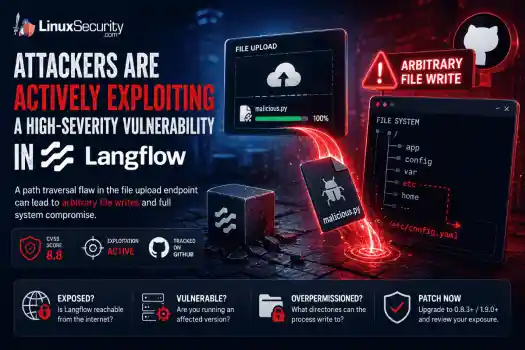
Security Vulnerabilities security advisory critical
security advisory critical Attackers are actively exploiting a high-severity vulnerability in Langflow , an open-source platform used to build and run AI workflows. . The flaw turns a file upload into a filesystem write, allowing a user-controlled file to escape the application's intended upload directory and land in locations Langflow was never supposed to touch. The vulnerable upload endpoint permits path traversal through crafted filenames. From there, the impact depends heavily on how the platform is deployed. A...
Jun 11, 2026 
Vendors/Productssecurity advisory linux
security advisory linux With npm v12 , dependency preinstall, install, and postinstall scripts will no longer execute automatically during package installation. Script execution will require explicit approval through new controls such as npm approve-scripts, with the change expected to arrive in July 2026. . The announcement targets a part of the software supply chain that has repeatedly appeared in package registry abuse, credential theft, and CI/CD compromise investigations. A single npm install could trigger code...
Jun 11, 2026 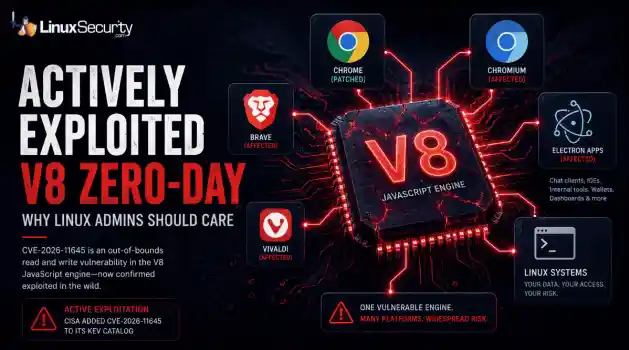
Security Vulnerabilities security advisory zero-day
security advisory zero-day CISA added CVE-2026-11645 to its Known Exploited Vulnerabilities catalog after Google confirmed active exploitation of the flaw. The bug sits in V8, the JavaScript engine behind Chrome and Chromium. . That's where this gets more interesting. Most coverage will focus on Chrome because that's where the patch landed. But the affected component is V8. Chromium relies on it. Electron relies on it. Plenty of desktop software Linux users interact with every day relies on it too, often without much...
Jun 10, 2026 
Network Securitysecurity advisory networking
security advisory networking For years, IPv4 was the only proxy type that really mattered for anyone running automation off a Linux box. IPv6 was the protocol everyone said they’d migrate to, but almost nobody actually did. In 2026, that’s finally starting to shift. . The problem is that most admins stick with IPv4 out of habit. They know it; it’s what their tooling defaults to, and they don’t see a reason to change. Some are overpaying for addresses they don’t need. Others would quietly break their scrapers, scripts, or...
Jun 09, 2026  Refine news
X Clear Filters Get the latest News and Insights
Get the latest Linux and open source security news straight to your inbox.
Community Poll
What got you started with Linux?
Loading...
Explore Latest Linux Security news
We found -1 articles for you...
81
 file sharingcourt rulingcopyright
Court Decision On File Sharing: Unmasking Anonymous Users
A federal judge has handed a preliminary victory to the recording industry by granting its request to unmask anonymous file swappers accused of copyright infringement. U.S. District Judge Denny Chin ruled Monday that Cablevision, which provides broadband Internet access in Connecticut, New Jersey and New York, can be required to divulge the identities of its subscribers sued over copyright violations. . . .. A federal judge has handed a preliminary victory to the recording industry by granting its request to unmask anonymous file swappers accused of copyright infringement. U.S. District Judge Denny Chin ruled Monday that Cablevision, which provides broadband Internet access in Connecticut, New Jersey and New York, can be required to divulge the identities of its subscribers sued over copyright violations. This ruling is the latest decision to clarify what legal methods copyright holders may use when hunting down people who are trading files on peer-to-peer networks. Courts have spent the last few years grappling with how to reconcile Americans' right to be anonymous with the entertainment industry's own right to sue people who violate copyright law. Chin, in Manhattan, said that the implicit guarantee of anonymity in the Bill of Rights is an insufficient shield in this case: "Such a person's identity is not protected from disclosure by the First Amendment." . A district court permits music industry to reveal identities of anonymous peer-to-peer file sharers over copyright infringement concerns.. Copyright Law, File Sharing, Legal Decision. . LinuxSecurity.com Team
 Aug 04, 2004 •
 Privacy
 81
court rulinglegal decisioninternet regulationSupreme Court: Child Online Protection Act Ruling Affects Minors' Access
The US Supreme Court wrapped up its session by announcing a decision which bars the enforcement of the Child Online Protection Act (COPA). The COPA, passed in 1998, was an attempt by Congress to keep pornography out of the reach of children on the Internet by requiring credit cards, access codes, or other means of age verification to access adult content, with fines of up to US$50,000 for violations. . . .. The US Supreme Court wrapped up its session by announcing a decision which bars the enforcement of the Child Online Protection Act (COPA). The COPA, passed in 1998, was an attempt by Congress to keep pornography out of the reach of children on the Internet by requiring credit cards, access codes, or other means of age verification to access adult content, with fines of up to US$50,000 for violations. By a 5-4 decision, the Court remanded the case back to a lower court for a trial to resolve the issues raised in the original lawsuit filed by the ACLU, saying that the law as written violates free speech: For now, the law, known as the Child Online Protection Act, would sweep with too broad a brush, [Justice] Kennedy wrote. "There is a potential for extraordinary harm and a serious chill upon protected speech" if the law took effect, he said. The link for this article located at arstechnica.com is no longer available. . A ruling from the US Supreme Court halts implementation of the Children’s Internet Protection Act, shaping the landscape of online safety for young users.. Child Online Protection Act, US Supreme Court, internet regulations, minors protection, legal enforcement. . LinuxSecurity.com Team
Jun 29, 2004 • Privacy 
82
consumer rightscourt rulinganti-spam lawSupreme Court Ruling on Spam Regulations in Washington State
The U.S. Supreme Court on Monday rejected an appeal challenging Washington state's law against unsolicited commercial e-mail, also known as "spam." The justices will allow a state superior court to hear a lawsuit against an alleged spammer. Without comment, the court . . . . The U.S. Supreme Court on Monday rejected an appeal challenging Washington state's law against unsolicited commercial e-mail, also known as "spam." The justices will allow a state superior court to hear a lawsuit against an alleged spammer. Without comment, the court denied a petition by spammer Jason Heckel to reconsider the Washington Supreme Court's judgment against him, which upheld the state's strict anti-spam law. Washington Attorney General Christine Gregoire in 1998 sued Heckel, from Salem, Ore., under the state Consumer Protection Act. The state claimed Heckel violated the law by spamming millions of users to spur sales of his book, which, among other things, gives readers tips on using unsolicited e-mail to turn a profit. The link for this article located at ComputerUser is no longer available. . The Supreme Court of the United States affirmed the anti-spam regulations of Washington on Monday, dismissing a challenge from an unsolicited email marketer.. Spam Regulation, Washington Law, Consumer Rights. . Anthony Pell
Nov 01, 2001 • Government 81
court rulinginternet lawlegal decisionVirginia Court Ruling: Overturning 1999 Law on Online Porn Censorship
A U.S. court has stopped the state of Virginia from enforcing a 1999 law that criminalizes use of the Internet to sell or otherwise provide sexually explicit material that is "harmful to minors." U.S. District Court Judge J. Harry Michael, Jr. . . . . A U.S. court has stopped the state of Virginia from enforcing a 1999 law that criminalizes use of the Internet to sell or otherwise provide sexually explicit material that is "harmful to minors." U.S. District Court Judge J. Harry Michael, Jr. ruled that the law violates the First Amendment. The link for this article located at E-CommerceTimes is no longer available. The link for this article located at E-CommerceTimes is no longer available. The link for this article located at E-CommerceTimes is no longer available. The link for this article located at E-CommerceTimes is no longer available. The link for this article located at E-CommerceTimes is no longer available. . A federal judge blocks the 1999 Virginia statute regarding internet pornography regulation, deeming it a breach of First Amendment rights.. Virginia Law, Online Regulation, Internet Censorship, First Amendment. . LinuxSecurity.com Team
Aug 11, 2000 • Privacy 
Get the latest News and Insights
Get the latest Linux and open source security news straight to your inbox.
Community Poll
What got you started with Linux?
Search Topics
Powered By

Linux Security - Your source for Top Linux News, Advisories, HOWTOs and Feature Releases
QUICK LINKS
subscribe to newsletters!
Like staying secure? So do we.
Sign up for updates, tips, and alerts!
Discover faster search, smarter navigation, and deeper Linux security insights. Read More