Explore top 10 tips to secure your open-source projects now. Read More
×



Server Security data privacy automation
data privacy automation Every system admin has lived through the same Monday morning ritual. A queue of forty tickets, half of them password resets, permission errors, or disk space warnings that any experienced technician could resolve in under two minutes. The other half require actual judgment. For years, automation promised that software would eventually sort the two apart on its own. That promise is now being tested in production Linux environments. . Early results are reshaping how IT teams think about tier-1...
 Jul 17, 2026

Privacydata collection automation
data collection automation You're running a web scraping project to collect pricing data from e-commerce sites. You set up a pool of datacenter proxies, launch your scripts, and within minutes — banned . CAPTCHAs everywhere. Your data pipeline stops before it really begins. . It's a frustrating scenario that plays out daily in ad verification, market research, and multi-account management. The website doesn't know you're doing legitimate research or monitoring. It just sees traffic coming from IP ranges it recognizes as...
Jul 17, 2026

Security Trends security advisory social engineering
security advisory social engineering Business Email Compromise used to be a numbers game — mass-blasted emails, broken English, an obvious "URGENT WIRE TRANSFER" subject line. That era is over. Generative AI has turned BEC into a tailored, low-noise operation that mimics writing style, voice, and even video presence. This piece looks at what's actually changed under the hood, what defenders are testing in response, and why so many organizations are still structurally unprepared for it. . The Infrastructure Problem Nobody Wants to...
Jul 17, 2026

Security Trends cybersecurity Linux documentation
cybersecurity Linux documentation Linux operating systems have gained prominence due to their stability, adaptability, and excellent security options. In the case of developing documentation, designing cybersecurity dashboards, or educational material, visuals are of vital importance when it comes to making things clear. The use of icons allows one to understand the message regarding alerts, authorization, encryption, authentication, or the state of the system just by looking at the visual cue without having to read long...
Jul 17, 2026
Security Vulnerabilities security advisory linux distribution
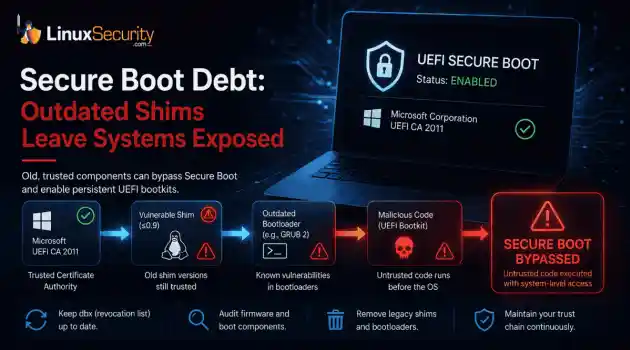
security advisory linux distribution ESET researchers identified 11 old and forgotten Linux UEFI shim bootloaders at versions 0.9 and below that can be used to bypass UEFI Secure Boot on any UEFI-based machine that trusts Microsoft’s Microsoft Corporation UEFI CA 2011 third-party certificate authority, regardless of the installed operating system (OS). Reported shims can be exploited to execute untrusted code during system boot, enabling attackers to deploy malicious UEFI bootkits even on systems with UEFI Secure Boot enabled.....
Jul 16, 2026
 Refine news
X Clear Filters
Get the latest News and Insights
Get the latest Linux and open source security news straight to your inbox.
Community Poll
Is continuous patching actually viable?
Trending News
Loading...
Explore Latest Linux Security news
We found 11 articles for you...
209
 cyber threatsdata protectionmalware
Infostealer Epidemic: Essential Security Measures for Linux Systems
As Linux admins, protecting our sensitive data and securing our systems against the growing threat of Linux malware is a crucial concern. After all, none of us can afford to have our sensitive information end up in the hands of an attacker or lose access to our critical systems. . Infostealers, a malware designed to extract sensitive data from infected computers, have become a defining part of the cybersecurity landscape. Recently, infostealers have made headlines as a growing threat to Linux systems. Once viewed as a more secure and less frequently targeted operating system, Linux is now experiencing a concerning rise in attention from cybercriminals employing these malicious tools. To help you understand this troubling trend and proactively secure your Linux systems against this threat, I'll explain what infostealers are, their impact, and the reasons they are now targeting Linux systems. I'll also provide practical measures for Linux administrators looking to strengthen their defenses. What Are Infostealers & How Do They Work? Infostealers are a category of malware designed to extract sensitive data from infected computers, including personal and financial details, login credentials, and browsing histories. Once extracted from victim machines, this data may be used for identity theft, financial fraud, or even sold on the dark web for profit. Infostealers operate quickly and straightforwardly: upon infection, their malware scans for specific types of data specified by its creator, such as stored passwords or autofill data on browsers and specific files (e.g., documents containing financial information). More sophisticated versions may even take screenshots or log keystrokes to capture information that may not yet exist or is encrypted in memory or elsewhere on a device. What Are the Consequences of an Infostealer Infection? Infostealer infections can have devastating results for both individuals and organizations. Individual victims can suffer financial losses, damagedcredit scores, and an invasion of privacy. Businesses face even more severe fallout. Loss of client trust, legal implications, and costly repairs of security breaches are just a few potential repercussions. Research and cybersecurity reports have begun revealing an uncomfortable truth: infostealers are increasingly targeting Linux systems, even though traditionally, they were considered more secure and less frequently targeted than operating systems such as Windows. Statistics reveal that incidents involving infostealers targeting Linux systems more than doubled within the first quarter of 2023 . What Are the Reasons Behind the Rise in Infostealers Targeting Linux? Several factors account for cybercriminals' growing attention on Linux servers. First, their increasing prevalence in enterprise environments makes them attractive targets, as these servers frequently host or provide access to vast quantities of valuable data. Second, some believe Linux is inherently secure, making exploiting vulnerabilities or configuration errors easier for attackers. Additionally, cryptocurrency's rapid rise and crypto mining operations based on Linux have made these systems attractive targets for attackers looking to steal digital currencies. Practical Measures for Protecting Linux Systems From Infostealers Despite this growing concern, Linux admins can take several practical measures to reduce the threat posed by infostealers: Regular Updates and Patch Management: Maintaining an up-to-date Linux system and patching software is critical to reducing the risk of infostealers exploiting known vulnerabilities. Security Audits and Hardening: Routine configuration reviews and hardening measures can significantly lower an attack surface. Lynis is a security auditing tool for Unix/Linux systems that can aid this process. Antivirus and Antimalware Tools for Linux: Though often forgotten on Linux systems, effective antivirus and antimalware solutions exist that detect and eliminate infostealers. Employee Training and Awareness: Informing users about phishing attacks —an increasingly prevalent means of spreading infostealer infections—is vital, as raising their awareness can prevent many potential infections. Use of Firewalls and Secure Networking Practices: Proper firewall configuration and ensuring all data transmission occurs securely (such as using VPNs for remote access) can help thwart information thieves from accessing their command and control servers. Data Encryption: Encryption can protect sensitive information at rest and during transport, even if an infostealer infiltrates a system. Regular Backups: Maintaining regular backups of critical data ensures that not all is lost should an infection arise. A robust recovery plan should also be part of any preventive strategy. Our Final Thoughts on This Troubling Trend While infostealers targeting Linux systems are undeniably growing increasingly prevalent, administrators still possess effective strategies to safeguard against this emerging threat. A combination of technological solutions and vigilant practices is required, but with proper implementation, admins can boost the security of their systems to combat evolving threats. . Malware designed to harvest credentials target critical information in Linux environments; employ measures to safeguard against these threats.. Data Theft, Linux Security, Malware Protection, Infostealer Prevention. . Brittany Day
 Jul 30, 2024
•
Jul 30, 2024
• Security Trends
210
 security advisorylocal privilege escalationlinux administration
GRUB LPE Threat: Mitigation Strategies for Linux Admins
In the ever-evolving cybersecurity landscape, a new concern has come to light for Linux admins—a claimed zero-day vulnerability for Local Privilege Escalation (LPE) in Linux systems through the GRUB bootloader . This new threat underscores the perpetual cat-and-mouse game between threat actors and the open-source community. . Let's examine the flaw, its impact, and practical strategies for protecting against it to help you understand this threat and the measures you can take to secure your systems against it. Understanding This Vulnerability The GRand Unified Bootloader (GRUB) is an integral component of Linux systems responsible for loading kernel modules and booting the operating system. If GRUB contains undocumented vulnerabilities that allow attackers to gain unauthorized access, like the zero-day recently identified, malicious actors could leverage them to escalate privileges on compromised machines, potentially taking full control of the system without prior authorization. Exploitation of this LPE vulnerability involves manipulating the boot process. Attackers could insert malicious code or modify existing bootloader entries to gain elevated privileges during system startup. Given its high privilege status as one of the initial software services to run on any machine, the potential scope for exploitation of GRUB flaws is significant. This bug impacts GRUB versions 1.98 to 2.02. This is far from the first time GRUB has been targeted. In 2015, CVE-2015-8370 was discovered and fixed, which allowed attackers to bypass authentication by pressing the backspace key 28 times at the GRUB username prompt. Then in 2020, the notorious BootHole flaw ( CVE-2020-10713 ), which could be exploited to install malware during the boot process, was identified and mitigated. What Are the Security Implications for Linux Admins? The security implications of this issue are substantial, including but not limited to: Data Theft: Access to sensitive information and intellectualproperty. System Damage: Potential for wide-reaching damage to system integrity and operations. Persistent Access: Ability to establish a foothold on the system for ongoing exploitation. Lateral Movement: Compromising additional systems within the network from the initial foothold. Compliance Concerns: Violating regulatory requirements by failing to protect against known vulnerabilities. Practical Mitigation Advice for Linux Admins While fixes for this bug have not yet been released, there are several steps that Linux admins can take to mitigate the threat posed by this and similar vulnerabilities: Set Up a GRUB Password: Bypass the security risks caused by unauthenticated users editing boot entries or entering single-user mode with an effective password-protected GRUB menu, as well as safeguarding /etc/grub.d/00_header file to set a secure configuration file GRUB is more difficult for others to gain entry to and edit than before. Secure the GRUB Configuration File: Set the correct file permissions on /boot/grub/grub.cfg to prevent unauthorized modifications of its content. Typically, permissions should be set so that root can read them only (chmod 400 or 0400). Use Full Disk Encryption (FDE): Implementing FDE can prevent attackers from accessing or altering files on the disk, including those associated with the GRUB configuration. Utilize United Extensible Firmware Interface Secure Boot: Secure Boot ensures that only signed bootloaders and kernels approved by the platform owner can be executed, helping prevent the execution of an infected GRUB bootloader. Use Integrity Monitoring Tools (TPMs): These tools should be employed to safeguard bootloader integrity. Integrity-checking mechanisms like Grub-verify can help detect unapproved changes. Restrict Boot Options: Reduce available boot options in GRUB to essential ones, eliminating extraneous options that could weaken boot-time security. Physically Secure Machines: Physicallysecure machines, as attackers with local access could use bootable devices or tools to bypass bootloader security. Back Up the GRUB Configurations Files Regularly: In case of an attack, this will allow for faster restoration and analysis of any changes introduced by threat actors. Monitoring & Auditing: Monitor GRUB logs, audit any modifications to bootloader configuration, and enable auditing for access or alterations of these changes. Restrict Permissions: To prevent any possible tampering with the Grub.cfg file generated in /etc/grub.d/ , its scripts should have restricted permissions and should be owned by root to ensure maximum protection from potential compromise. Use Security Modules: Security modules, like GRUB's own password_pbkdf2 feature, can encrypt passwords within GRUB configuration files. Restrict Recovery Mode: To avoid unauthorized access to recovery options, disable or password-protect recovery mode entry in GRUB to prevent access. Stay Informed: Keep up-to-date with security advisories released by your Linux distribution. Regularly check resources like the CVE database and security mailing lists. Regular Updates: Apply system updates promptly. This includes updates to the bootloader, kernel, and all system packages. To maintain integrity during the update process, use trusted repositories and signatures when updating GRUB. Focusing on these GRUB-specific strategies can significantly decrease the odds of successfully exploiting the bootloader and help uphold system integrity. If new security patches become available that address specific vulnerabilities in GRUB, implement them quickly while adhering to best practices for ongoing security management of this crucial software component. Our Final Thoughts: What Can We Learn From This Discovery? Security in open-source software is community-driven. While a zero-day vulnerability in GRUB poses a severe threat to system integrity, its discovery should serve as a wake-up callfor administrators who must strengthen their defenses against such exploits. As part of its response plan, the Linux ecosystem must collaborate in analyzing, patching, and communicating any vulnerabilities like these to ensure its resilience against further attacks. Diligence is critical in cybersecurity. A combination of proactive measures, community cooperation, and robust policies can help protect Linux systems against current and potential future exploits. . Assess the recent zero-day local privilege escalation (LPE) vulnerability found in GRUB and explore effective measures to secure your Linux environments.. Linux GRUB Threat, Privilege Escalation Linux, GRUB Vulnerability Management. . Brittany Day
Jun 24, 2024
•
Security Vulnerabilities

209
 security assessmentthreat mitigationlinux administration
130% Increase in Cyberattacks Targeting Linux Systems: Key Insights
Recently conducted research by Kaspersky indicates an alarming rise in cyberattacks using exploits against Linux systems. Data from Kaspersky Security Network indicates a nearly 130 percent spike in attacks targeting Linux users over the same timeframe last year compared with this quarter's timeframe. Furthermore, 65 percent more CVEs (Common Vulnerabilities and Exposures) were registered over four years, which indicates an increasing trend in Linux vulnerabilities. . These findings highlight the critical need for Linux admins to remain vigilant and prioritize system security, emphasizing proactive measures such as staying informed on potential vulnerabilities , installing patches promptly , and employing robust security solutions to protect their systems from vulnerabilities. To secure your systems from bugs in response to this alarming trend, let's explore some practical measures and tools you can employ. Let's begin by examining the threat that Linux vulnerabilities pose to system security for admins and organizations. Why Are Unpatched Vulnerabilities Such a Serious Threat to Linux Systems? Unpatched Linux vulnerabilities can have severe repercussions for organizations, from data theft and exposure to ransomware attacks . Cybercriminals may use unpatched vulnerabilities to gain persistent server access, potentially allowing them to breach entire networks and disrupt critical operations. Moreover, unpatched systems may serve as vectors for malware distribution , such as botnets or cryptocurrency miners. Unpatched Linux vulnerabilities can also lead to regulatory noncompliance that can incur significant penalties and harm an organization's reputation. For instance, CISA recently added a high-severity Linux kernel privilege elevation flaw in the netfilter: nf_tables component to its Known Exploited Vulnerabilities (KEV) catalog . Exploitation of this vulnerability ( CVE-2024-1086 ) potentially enables a local attacker to gain root-level access on impacted systems. Practical Adviceand Best Practices for Protecting against Linux Bugs With an ever-increasing prevalence of Linux vulnerabilities, employing best practices is increasingly vital to safeguard systems. Proactively protecting your systems doesn't need to be hard. Here are some simple yet effective tips for increasing Linux security: Make Use of Linux Kernel Lockdown: When enabled, Linux Kernel Lockdown restricts access to the kernel by preventing unprivileged access, loading unsigned kernel modules, and overriding secure boot restrictions, increasing system security significantly. Regular Port Audits: Conducting port audits at regular intervals helps detect and close unintentionally or accidentally left open ports, thus reducing risks such as unauthorized access and cyberattacks. Maintain Regular Security Audits: With the Linux Auditing System, administrators can conduct regular security audits on their network to capture vital system activity logs that provide valuable insight into its security and stability. Make Timely Updates to OS and Software: Keeping your OS and third-party applications updated is critical for mitigating cybersecurity vulnerabilities, addressing kernel and third-party issues, and protecting yourself against them. Regular patching/updating is necessary for mitigating cybersecurity vulnerabilities and safeguarding against kernel/third-party issues. Implementing best practices alone won't do it, though. An open-source vulnerability scanner is essential in detecting and mitigating vulnerabilities in Linux systems. Let's explore the advantages of vulnerability scanning and some tools we recommend to get you started! How Can Vulnerability Scanners Mitigate the Risks Associated With Linux Vulnerabilities? A vulnerability scanner is a software tool designed to identify, assess, and report potential security flaws within a network, infrastructure, or application. Linux administrators need a vulnerability scanner to proactively identify weaknesses or gaps in theirsystem's security posture, including outdated software, misconfiguration, or known vulnerabilities. Administrators of Linux environments can use scanning to gain valuable insight into potential security risks, enabling them to prioritize and address them before malicious actors can exploit them. As vulnerability scanners often provide detailed reports and recommendations for remediation, Linux admins can take informed actions to bolster overall system security. This proactive approach can prevent cyberattacks and ensure compliance with security standards and regulations. Our Top Open-Source Vulnerability Scanners & Assessment Tools for Linux Regarding vulnerability scanning in Linux environments, there are plenty of useful tools and scanners admins can utilize. Here are a few of our preferred choices: Aircrack-ng is a widely recognized open-source vulnerability scanning tool for identifying Wi-Fi and wireless cybersecurity flaws. With speed, accuracy, and flexibility as its hallmark features, this scanning tool makes an invaluable asset to security professionals. Support for numerous wireless hardware/protocol combinations is offered; comprehensive coverage is provided across network security issues; it integrates easily with security toolkits or cloud frameworks can also be integrated. Arachni is an open-source vulnerability scanner specialized in web application security vulnerabilities. It extensively covers SQL injection, cross-site scripting vulnerabilities , customized scanning options, and reports. Arachni also seamlessly integrates into other network security toolkits and cloud security frameworks, making it a versatile and useful asset for security professionals. Burp Suite is an extensive network security toolkit and vulnerability scanner for web applications. It offers scanning, intercepting, and modifying HTTP requests to analyze responses and supporting multiple operating systems with powerful scanning capabilities to identify various web application securityvulnerabilities. Furthermore, its user-friendly interface, extensive documentation, and integration with other network security frameworks make Burp Suite an invaluable security asset. Clair is an API-based vulnerability scanner designed to monitor open-source container layers. It collects vulnerability metadata from various sources to help detect known cybersecurity risks within containerized environments and maintain secure container deployments. Clair focuses on web application security vulnerabilities while helping secure container deployments. Our Final Thoughts: Linux Administrators Need to Respond Proactively to This Troublesome Trend With cyberattacks and vulnerabilities on Linux systems increasing alarmingly, administrators must remain vigilant and take preventive steps to combat them. Following best practices like employing Linux Kernel Lockdown, regularly auditing ports for openness, conducting security audits, and applying timely patches can all strengthen system security and protect against future breaches. Utilizing vulnerability scanning tools is also critical to mitigating risks posed by Linux vulnerabilities. These tools allow administrators to identify weaknesses and gaps in a system's security posture, prioritize and address issues, and receive reports with recommendations for remediation. Their proactive nature protects against cyberattacks and ensures compliance with security standards and regulations. By adopting best practices and employing the tools discussed, Linux administrators can bolster the security of their systems, safeguard against cyber threats, and preserve the integrity of their infrastructure. . Given the alarming increase in cyber threats, Linux administrators are compelled to implement robust strategies that bolster both system protection and integrity.. Linux Exploitation Trends, System Security Practices, Open Source Security Tools, Cybersecurity Threats. . Brittany Day
May 31, 2024
•
Security Trends
215
 security managementnetwork configurationlinux administration
Introducing Canonical's Desktop Security Center for Ubuntu Users
Canonical is introducing a new Desktop Security Center , aiming to enhance accessibility to underlying security features for users of Ubuntu and other Linux distros. Although still a work in progress, this Flutter-based tool has generated considerable interest. . This article delves into the details of this center, discussing its notable features and potential benefits. Furthermore, it explores the implications of this development and raises questions about its long-term consequences. What Features Does Ubuntu's Desktop Security Center Offer Linux Admins? Canonical's Desktop Security Center addresses the need for a dedicated hub to streamline the accessibility of Ubuntu's security features. By consolidating scattered elements across various tools, the Desktop Security Center aims to provide a comprehensive platform for managing and controlling key security aspects. This initiative is particularly valuable for Linux administrators, infosec professionals, and sysadmins who deal with the intricate security requirements of their systems. The integration of Ubuntu Pro into the Desktop Security Center must not be overlooked. Enabling users to attach their machines to a Ubuntu Pro plan allows for features like ESM coverage, kernel liv e-patching, compliance, and hardening options. This integration implies that Canonical envisions the Desktop Security Center as a fundamental component of its premium offering, catering to enterprise-level security needs. Another notable feature is the ability to manage file access requests from confined apps. This functionality provides enhanced control over app permissions, making it easier for users to handle security aspects related to application access. Additionally, including a Network section allows users to enable or disable the firewall, configure ports, and utilize "stealth mode," which emphasizes Canonical's commitment to empowering users in securing their systems. From a long-term perspective, this release raises thought-provoking questions about thepotential robustness of the Desktop Security Center. As Ubuntu plans to ship it with the LTS release, Ubuntu 24.04, it positions the center as a critical dashboard for Ubuntu Pro users. However, further development and improvement is needed at the moment. The fact that the GitHub project page currently lacks documentation adds to the uncertainty regarding the maturity and stability of the tool. Implications & Consequences The introduction of the Desktop Security Center has several implications for security practitioners. Firstly, it simplifies the management of Ubuntu's security features, making it more accessible to users without extensive technical expertise. This can potentially bridge the gap between security requirements and user capabilities, improving protection against threats. However, admins must question if the current state of the tool is sufficient for its intended release. The absence of a functional snap permissions section and incomplete documentation on the project page raises concerns about stability and user experience. Delivering a robust and feature-complete Desktop Security Center is crucial to ensure the trust and adoption of the tool by security-conscious users and enterprises. Our Final Thoughts on Canonical's Desktop Security Center In conclusion, Canonical's new Desktop Security Center holds promise as a central hub for managing and controlling security aspects. By consolidating diverse features into a unified interface, it aims to enhance the security practices of Linux admins, infosec professionals, and sysadmins. However, concerns about the tool's completeness and maturity must be addressed to ensure its effectiveness and long-term viability. As security practitioners, it is essential to closely monitor the development and improvements of the Desktop Security Center to assess its potential impact on securing Ubuntu-based systems. Be sure to subscribe to our weekly newsletters for updates on timely, impactful Linux security-related topics like this. Stay safe outthere, fellow Linux enthusiasts! . Dive into Canonical's Desktop Protection Hub, a central platform for Ubuntu safeguarding tools tailored for Linux administrators and information security experts.. Desktop Security Center, Linux Administration, Ubuntu Pro, Security Management, Sysadmin Tools. . Brittany Day
Feb 14, 2024
•
Desktop Security
77
 user managementremote managementfirewall configuration
Manage Linux Servers Remotely With Cockpit's User-Friendly GUI
Linux admins can use Cockpit to view Linux logs, monitor server performance and manage users. Use the tool to help admins manage servers, regardless of experience level. . The Linux command line is a fast and flexible tool for automation and scripting. However, sometimes, there is a benefit to using a GUI like the web-based administrative tool Cockpit instead. The GUI can be faster or more comfortable for admins who need to quickly look at several pieces of information. In those situations, consider the use of Cockpit. Cockpit provides a simple, intuitive graphical connection to remote Linux servers. The interface enables admins to manage users and groups, configure firewall settings and display hardware information. In terms of efficiency, Cockpit is easy to implement across an organization, especially those with less familiarity with the CLI . Cockpit also doesn't interfere with other administration and configuration tools. For example, it's independent of Ansible, which means admins still manage settings across the board with standard configuration utilities. With its standard security features, getting Cockpit approved for use in your organization shouldn't be difficult. It also supports the expected encryption levels. . Discover Cockpit, a powerful tool designed for efficient management and monitoring of Linux servers, enhancing administrative processes through a user-friendly interface.. Cockpit Administration, Linux Server Management, User Management Tool, Linux GUI Tool. . LinuxSecurity.com Team
Mar 02, 2023
•
Server Security
209
 security practicessystem hardeningLinux administration
The Essential Reasons for Keeping SELinux Active for Optimal Security
Too many admins disable SELinux or set it to Permissive on their data center systems, as opposed to spending the necessary time to make the projects they're working on work with SELinux. Jack Wallen warns that admins are playing with fire by shrugging off SELinux, leaving their OSes weakened and susceptible to attacks. . Given the kerfuffle that has been CentOS lately, and the number of inevitable forks that will rise out of the ashes, there will probably be a large percentage of admins migrating to, or finally deploying, a Linux distribution based on Red Hat Enterprise Linux in some form or fashion. It may be Rocky Linux or AlmaLinux . It may be that you stick with CentOS Stream , or even purchase a license for Red Hat Enterprise Linux . If you're a non-profit or another eligible organization, you might qualify for RHEL for Open Source Infrastructure . No matter which route you take, you'll be using a solid Linux distribution with serious security systems in place. However... It's such a powerful word, "however." It stops all natural flow of the narrative to make you wonder just what comes next. You wait, and you wait, and you wait. Until the inevitable: SELinux. . Numerous administrators opt to deactivate SELinux or configure it in Permissive mode, jeopardizing overall system security. Discover the reasons this approach needs to change.. SELinux Management,System Security,Linux Best Practices,Admin Recommendations,Data Center Security. . Brittany Day
Mar 03, 2021
•
Security Trends
79
 network securitysystem hardeninglinux administration
Improve Linux Port Security Using Knockd Port-Knocking Server
Today, I. knockd is a port-knock server. It listens to all traffic on an ethernet (or PPP) interface, looking for special The link for this article located at Linuxaria is no longer available. . Protect your Linux system ports using fail2ban, a smart intrusion prevention framework that regulates incoming connections across multiple interfaces.. knockd, port knock, network management, traffic control, linux administration. . LinuxSecurity.com Team
Apr 19, 2011
•
Security Projects
77
network securitylinux administrationopenvpn setupOpenVPN Client Configuration on CentOS 5 Version 2.0.9: Secure Setup Guide
In a previous tip, we looked at setting up an OpenVPN server. Now, I'll take you through the setup of a Linux OpenVPN client. The Linux client will be based on CentOS 5 using OpenVPN 2.0.9.. For each client, you will need to have copied the client's certificate and key, as well as the CA certificate, from the server. This should be done in a secure manner so you can ensure the files are not altered in any way, such as using SSH to transfer or a USB stick in your possession. Once they are on the client, copy them to the /etc/openvpn/ directory: # cd /etc/openvpn # cp ~/client.{key,crt} . # cp ~/ca.crt . # cp /usr/share/doc/openvpn-2.0.9/sample-config-files/client.conf . # vim client.conf The link for this article located at ZDNet Asia is no longer available. . Follow these steps to set up an OpenVPN client on CentOS, from installation to verification, ensuring secure traffic routing through your VPN. OpenVPN Client Setup, CentOS Network Configuration, Linux OpenVPN Security. . LinuxSecurity.com Team
Nov 15, 2010
•
Server Security

Get the latest News and Insights
Get the latest Linux and open source security news straight to your inbox.
Community Poll
Is continuous patching actually viable?
Trending News
Search Topics
Powered By

Linux Security - Your source for Top Linux News, Advisories, HOWTOs and Feature Releases
QUICK LINKS
subscribe to newsletters!
Like staying secure? So do we.
Sign up for updates, tips, and alerts!