


Security Trends  fedora security assessment
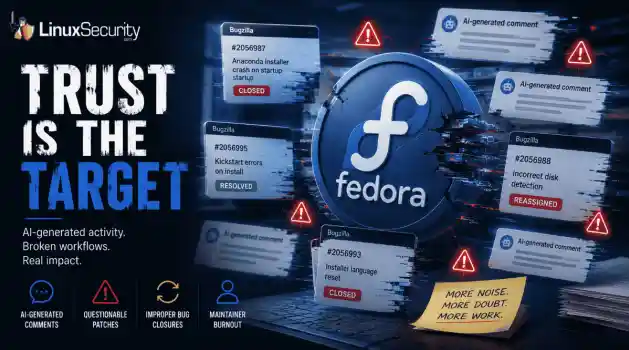
fedora security assessment A Fedora contributor account recently came under scrutiny for apparently AI-generated activity that disrupted the project's bug tracker. . Questionable Bugzilla comments, flawed patches, and improperly closed or reassigned bugs forced maintainers to spend time cleaning up the fallout. There is no evidence that malware was deployed or a backdoor reached production, but the incident exposed a different problem. Open-source projects can be disrupted without compromising a single line of code....
 Jun 12, 2026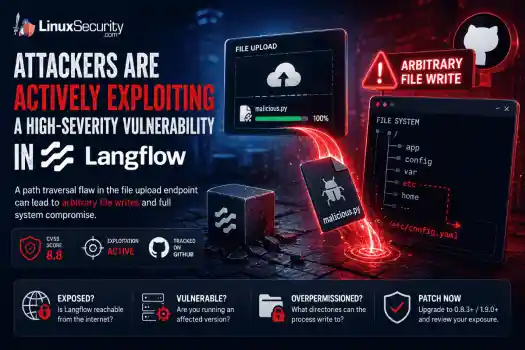
Security Vulnerabilities security advisory critical
security advisory critical Attackers are actively exploiting a high-severity vulnerability in Langflow , an open-source platform used to build and run AI workflows. . The flaw turns a file upload into a filesystem write, allowing a user-controlled file to escape the application's intended upload directory and land in locations Langflow was never supposed to touch. The vulnerable upload endpoint permits path traversal through crafted filenames. From there, the impact depends heavily on how the platform is deployed. A...
Jun 11, 2026 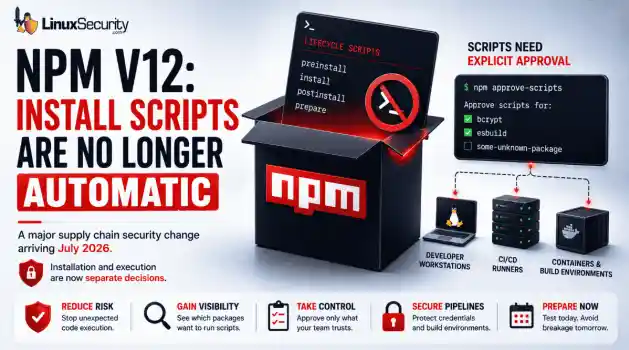
Vendors/Productssecurity advisory linux
security advisory linux With npm v12 , dependency preinstall, install, and postinstall scripts will no longer execute automatically during package installation. Script execution will require explicit approval through new controls such as npm approve-scripts, with the change expected to arrive in July 2026. . The announcement targets a part of the software supply chain that has repeatedly appeared in package registry abuse, credential theft, and CI/CD compromise investigations. A single npm install could trigger code...
Jun 11, 2026 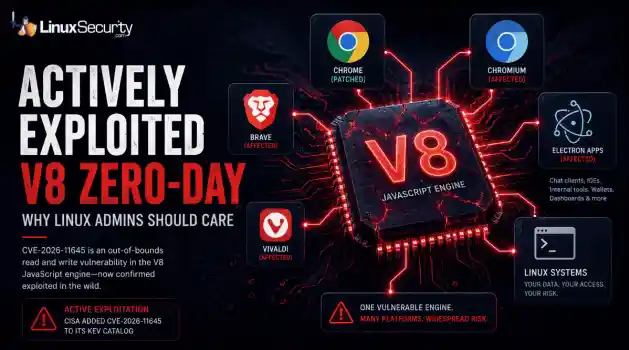
Security Vulnerabilities security advisory zero-day
security advisory zero-day CISA added CVE-2026-11645 to its Known Exploited Vulnerabilities catalog after Google confirmed active exploitation of the flaw. The bug sits in V8, the JavaScript engine behind Chrome and Chromium. . That's where this gets more interesting. Most coverage will focus on Chrome because that's where the patch landed. But the affected component is V8. Chromium relies on it. Electron relies on it. Plenty of desktop software Linux users interact with every day relies on it too, often without much...
Jun 10, 2026 
Network Securitysecurity advisory networking
security advisory networking For years, IPv4 was the only proxy type that really mattered for anyone running automation off a Linux box. IPv6 was the protocol everyone said they’d migrate to, but almost nobody actually did. In 2026, that’s finally starting to shift. . The problem is that most admins stick with IPv4 out of habit. They know it; it’s what their tooling defaults to, and they don’t see a reason to change. Some are overpaying for addresses they don’t need. Others would quietly break their scrapers, scripts, or...
Jun 09, 2026  Refine news
X Clear Filters Get the latest News and Insights
Get the latest Linux and open source security news straight to your inbox.
Community Poll
What got you started with Linux?
Loading...
Explore Latest Linux Security news
We found -2 articles for you...
81
 privacy rightsmedia influenceEdward Snowden
Glenn Greenwald on Edward Snowden's Influence on Privacy and Media
Nearly seven months after journalist and privacy activist Glenn Greenwald publicized Edward Snowden. Living in Brazil, he is advised not to travel. He The link for this article located at Wired is no longer available. . Glenn Greenwald analyzes the lasting effects of Edward Snowden's disclosures on civil liberties and media integrity.. Glenn Greenwald, Edward Snowden, privacy rights, media influence. . LinuxSecurity.com Team
 Jan 06, 2014 •
 Privacy
 78
government technologylinux adoptionmedia influenceExamining Linux Adoption's Effect on Political Regimes and Incumbents
To effect a regime change, you first need to determine whether an incumbent has committed a violation of trust and if the incumbent has serious vulnerabilities. What does that do to a candidate, even a dictator? It creates the motivation for and a platform on which a change of leadership can occur. It provides the means to put the change into action. You can accomplish this, however, only if a viable alternative exists. You cannot change it if the incumbent shows no weakness in public. If the incumbent controls the media, then few will understand the violations or the vulnerabilities. . . .. Despite the riotous cheerleading occuring among Democrats in Boston this week and that soon to occur among Republicans in New York, it's the summer doldrums in a still flat technology market. At times like this, you can imagine tumbleweeds rolling by as the saloon doors flap and creek to stillness. Can we imagine that GNU/Linux adoption patterns are analogous to the adoption model of other systems, biological or even political ones? No matter what kind of system you want to talk about, shoving out the dominant species takes some reckoning. The public soon will see that the major party conventions in Boston and New York have less to do with love for their respective candidates than they do with dislike for the opponents. As much as each party wants to quiet the anti-opponent rhetoric, it won't work. A vocal and visual minority on each end of the political spectrum dislikes the other end's candidates. The media continuously reminds us of that fact. Unfortunately for the election, passion doesn't unseat incumbent office-holders. So, each party is attempting to work the adoption model for the challengers. They are looking for acceptance for their candidates. They are discovering their inability to reach into the installed base of incumbents to get their candidates' message accepted. Sociologists and marketing people understand the adoption model: the incumbents do not have enough blemishes to make an alternative candidateattractive enough. Even the political vulnerabilities around Bill Clinton failed to unseat him as an incumbent. Radical innovators make up about only 3% of the US population. That can't win you an election. The early adopters make up around 10% of the population, and this segment consists of young, conservative business types. They drive opinion leadership in this country. Even media bias doesn't move the opinion leaders enough to take an anti-incumbent stance. The link for this article located at linuxjournal.com is no longer available. . Adopting Linux as a national operating system can reshape its political environment by promoting transparency, fostering citizen empowerment, and decentralizing information flow. Linux Adoption, Political Dynamics, Incumbent Challenges. . LinuxSecurity.com Team
Jul 30, 2004 • Vendors/Products 
83
cybersecurityUK lawhacking cultureInsights from a Welsh Ex-Hacker on UK Hacking and Media Impact
A Welsh ex-hacker, famed for cracking the Pentagon's computers from his Cardiff bedroom, claims inadequacies in UK law and erratic media coverage guarantee leniency for British hackers -- even for serious offences.. . .. A Welsh ex-hacker, famed for cracking the Pentagon's computers from his Cardiff bedroom, claims inadequacies in UK law and erratic media coverage guarantee leniency for British hackers -- even for serious offences. Mathew "Kuji" Bevan, who was acquitted of endangering the national security of the United States by the High Court in November 1997 says, "The American media has quite an anti hacker view. Over here they have a much more positive attitude. They believe in the 'cool hacker', the anarchist kind of thing. In my case the press was saying 'Cardiff boy done good' and that sort of thing. I had a very positive response from the press... it makes are real difference to the number of successful prosecutions there are over here." The link for this article located at ZDNet is no longer available. . A former Welsh hacker reflects on the flexibility of UK regulations, examining how media narratives shape public perception of hacking and influence the likelihood of successful prosecutions.. Welsh Hacker, UK Cybersecurity, Hacking Culture, Media Influence. . LinuxSecurity.com Team
Jul 07, 2000 • Hacks/Cracks 
Get the latest News and Insights
Get the latest Linux and open source security news straight to your inbox.
Community Poll
What got you started with Linux?
Search Topics
Powered By

Linux Security - Your source for Top Linux News, Advisories, HOWTOs and Feature Releases
QUICK LINKS
subscribe to newsletters!
Like staying secure? So do we.
Sign up for updates, tips, and alerts!
Discover faster search, smarter navigation, and deeper Linux security insights. Read More