



Security Trends  fedora security assessment
fedora security assessment A Fedora contributor account recently came under scrutiny for apparently AI-generated activity that disrupted the project's bug tracker. . Questionable Bugzilla comments, flawed patches, and improperly closed or reassigned bugs forced maintainers to spend time cleaning up the fallout. There is no evidence that malware was deployed or a backdoor reached production, but the incident exposed a different problem. Open-source projects can be disrupted without compromising a single line of code....
 Jun 12, 2026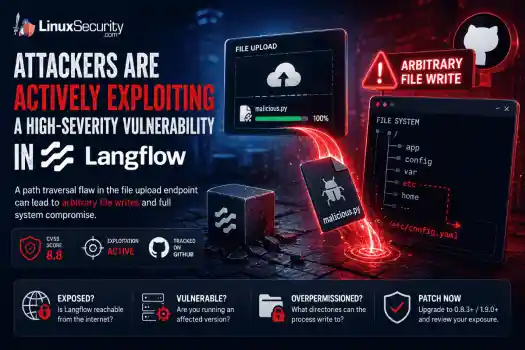
Security Vulnerabilities security advisory critical
security advisory critical Attackers are actively exploiting a high-severity vulnerability in Langflow , an open-source platform used to build and run AI workflows. . The flaw turns a file upload into a filesystem write, allowing a user-controlled file to escape the application's intended upload directory and land in locations Langflow was never supposed to touch. The vulnerable upload endpoint permits path traversal through crafted filenames. From there, the impact depends heavily on how the platform is deployed. A...
Jun 11, 2026 
Vendors/Productssecurity advisory linux
security advisory linux With npm v12 , dependency preinstall, install, and postinstall scripts will no longer execute automatically during package installation. Script execution will require explicit approval through new controls such as npm approve-scripts, with the change expected to arrive in July 2026. . The announcement targets a part of the software supply chain that has repeatedly appeared in package registry abuse, credential theft, and CI/CD compromise investigations. A single npm install could trigger code...
Jun 11, 2026 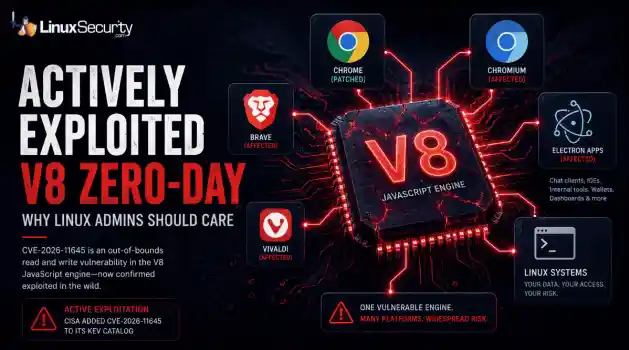
Security Vulnerabilities security advisory zero-day
security advisory zero-day CISA added CVE-2026-11645 to its Known Exploited Vulnerabilities catalog after Google confirmed active exploitation of the flaw. The bug sits in V8, the JavaScript engine behind Chrome and Chromium. . That's where this gets more interesting. Most coverage will focus on Chrome because that's where the patch landed. But the affected component is V8. Chromium relies on it. Electron relies on it. Plenty of desktop software Linux users interact with every day relies on it too, often without much...
Jun 10, 2026 
Network Securitysecurity advisory networking
security advisory networking For years, IPv4 was the only proxy type that really mattered for anyone running automation off a Linux box. IPv6 was the protocol everyone said they’d migrate to, but almost nobody actually did. In 2026, that’s finally starting to shift. . The problem is that most admins stick with IPv4 out of habit. They know it; it’s what their tooling defaults to, and they don’t see a reason to change. Some are overpaying for addresses they don’t need. Others would quietly break their scrapers, scripts, or...
Jun 09, 2026  Refine news
X Clear Filters Get the latest News and Insights
Get the latest Linux and open source security news straight to your inbox.
Community Poll
What got you started with Linux?
Loading...

Explore Latest Linux Security news
We found -4 articles for you...
67
 security advisoryIntelside channel
Intel: DOITM Security Feature Requires Revisions for Linux Kernel
Last week I wrote about Linux developers evaluating a new "DOITM" security mitigation for the latest Intel CPUs. While the cost for now of engaging the Data Operand Independent Timing Mode (DOITM) functionality is minimal, following internal Intel engineering discussions it looks like the Linux kernel patches will need to be re-worked with this functionality not intended to always be enabled. . As summed up in last week's testing article, recent and future Intel processors aren't guaranteed to be "constant time" with respect to their data operands unless a special model specific register flag is set. This caused concerns particularly around the cryptography code for Linux that there is no longer a guarantee of constant time and that the instruction execution time can vary depending upon the data operated on. The constant time execution is necessary to avoid possible side channel attacks. But in enabling the new Intel flag to ensure constant time, it comes with admitted performance implications. The performance implications with current generation processors didn't end up being all that significant, but Intel documentation indicates that could increase in the future. With the Linux handling in it's current form is about always having the Data Operand Independent Timing Mode enabled. But now Intel is warning against such a move. The link for this article located at Phoronix is no longer available. . The DOITM security function by Intel demands careful analysis since Linux updates necessitate modifications to guarantee both security and operational efficiency.. Intel Timing Mode,Linux Kernel Patch,DOITM Security Feature,Side Channel Attack. . LinuxSecurity.com Team
 Feb 06, 2023 •
 Cryptography
Get the latest News and Insights
Get the latest Linux and open source security news straight to your inbox.
Community Poll
What got you started with Linux?
Search Topics
Powered By

Linux Security - Your source for Top Linux News, Advisories, HOWTOs and Feature Releases
QUICK LINKS
subscribe to newsletters!
Like staying secure? So do we.
Sign up for updates, tips, and alerts!
Discover faster search, smarter navigation, and deeper Linux security insights. Read More