Explore top 10 tips to secure your open-source projects now. Read More
×



Server Security data privacy automation
data privacy automation Every system admin has lived through the same Monday morning ritual. A queue of forty tickets, half of them password resets, permission errors, or disk space warnings that any experienced technician could resolve in under two minutes. The other half require actual judgment. For years, automation promised that software would eventually sort the two apart on its own. That promise is now being tested in production Linux environments. . Early results are reshaping how IT teams think about tier-1...
 Jul 17, 2026

Privacydata collection automation
data collection automation You're running a web scraping project to collect pricing data from e-commerce sites. You set up a pool of datacenter proxies, launch your scripts, and within minutes — banned . CAPTCHAs everywhere. Your data pipeline stops before it really begins. . It's a frustrating scenario that plays out daily in ad verification, market research, and multi-account management. The website doesn't know you're doing legitimate research or monitoring. It just sees traffic coming from IP ranges it recognizes as...
Jul 17, 2026

Security Trends security advisory social engineering
security advisory social engineering Business Email Compromise used to be a numbers game — mass-blasted emails, broken English, an obvious "URGENT WIRE TRANSFER" subject line. That era is over. Generative AI has turned BEC into a tailored, low-noise operation that mimics writing style, voice, and even video presence. This piece looks at what's actually changed under the hood, what defenders are testing in response, and why so many organizations are still structurally unprepared for it. . The Infrastructure Problem Nobody Wants to...
Jul 17, 2026

Security Trends cybersecurity Linux documentation
cybersecurity Linux documentation Linux operating systems have gained prominence due to their stability, adaptability, and excellent security options. In the case of developing documentation, designing cybersecurity dashboards, or educational material, visuals are of vital importance when it comes to making things clear. The use of icons allows one to understand the message regarding alerts, authorization, encryption, authentication, or the state of the system just by looking at the visual cue without having to read long...
Jul 17, 2026
Security Vulnerabilities security advisory linux distribution
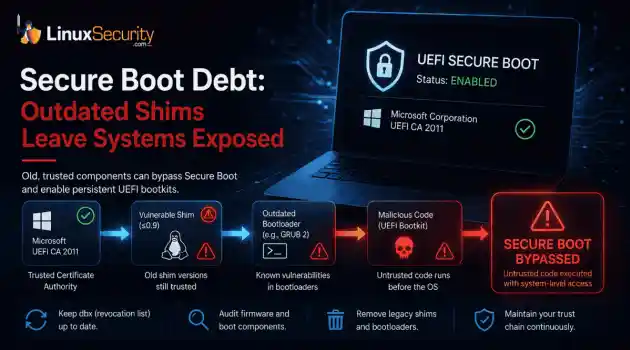
security advisory linux distribution ESET researchers identified 11 old and forgotten Linux UEFI shim bootloaders at versions 0.9 and below that can be used to bypass UEFI Secure Boot on any UEFI-based machine that trusts Microsoft’s Microsoft Corporation UEFI CA 2011 third-party certificate authority, regardless of the installed operating system (OS). Reported shims can be exploited to execute untrusted code during system boot, enabling attackers to deploy malicious UEFI bootkits even on systems with UEFI Secure Boot enabled.....
Jul 16, 2026
 Refine news
X Clear Filters
Get the latest News and Insights
Get the latest Linux and open source security news straight to your inbox.
Community Poll
Is continuous patching actually viable?
Loading...
Explore Latest Linux Security news
We found 89 articles for you...
210
 security advisorycriticalremote code execution
FFmpeg PixelSmash Vulnerability Exposes Linux Media Servers to Remote Code Execution Risk
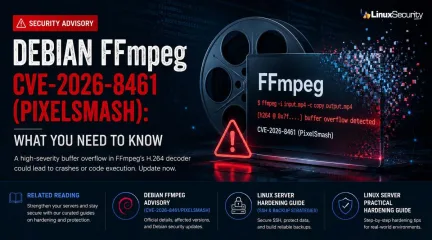
A newly disclosed FFmpeg vulnerability, known as PixelSmash ( CVE-2026-8461 ), affects the MagicYUV decoder and can be triggered by specially crafted video files. . Researchers demonstrated remote code execution against Jellyfin under specific conditions and found multiple Linux applications that could be exposed through normal media processing workflows. Even where code execution is not practical, the vulnerability can still be used to crash affected applications. What Is FFmpeg? FFmpeg is one of the most widely deployed multimedia frameworks in the Linux ecosystem. It handles: Video decoding, encoding, and transcoding. Streaming and format conversion. Thumbnail generation and metadata extraction. Most users never interact with it directly. Applications call FFmpeg behind the scenes whenever media needs to be processed. That dependency chain becomes surprisingly large once administrators start looking for it: Media servers such as Jellyfin rely on FFmpeg for library scanning and transcoding. Photo management platforms use it to generate previews. Content management systems use it to inspect uploaded media. Desktop environments invoke it during thumbnail generation. Video production tools, streaming software, and automation workflows include FFmpeg in the processing path. The result is a shared component that exists across servers, workstations, containers, NAS appliances, and self-hosted platforms. A flaw inside FFmpeg often reaches much further than administrators initially expect. What Is PixelSmash? PixelSmash is the name given to CVE-2026-8461 , a heap out-of-bounds write vulnerability located in FFmpeg's MagicYUV decoder. MagicYUV is a lossless video codec designed for high-performance video processing. Researchers at JFrog discovered that specially crafted AVI, MKV, or MOV files can trigger memory corruption while the decoder processes video frame data. The vulnerability received a CVSS score of 8.8 and affects applications that relyon FFmpeg's vulnerable decoder implementation. The issue occurs because memory is allocated using one set of frame calculations while portions of the decoder later write data using different calculations. Under the right conditions, those writes extend beyond the intended heap boundary. Memory corruption follows. How the Vulnerability Works PixelSmash is a heap out-of-bounds write vulnerability in FFmpeg's MagicYUV decoder. A specially crafted video can cause the decoder to write beyond allocated memory, leading to application crashes or, under specific conditions, arbitrary code execution. How to Check If You're Affected ffmpeg -version ffprobe -version Debian/Ubuntu: dpkg -l | grep ffmpeg RHEL/CentOS/Rocky/Alma: rpm -qa | grep ffmpeg Arch Linux: pacman -Qs ffmpeg Containerized deployments: docker exec ffmpeg -version Why PixelSmash Changes the Linux Threat Model Most malicious file attacks depend on user interaction. Someone downloads a file, opens it, and triggers the exploit. PixelSmash breaks that pattern in common Linux deployments. Media servers such as Jellyfin monitor directories and immediately process new files using ffprobe. Desktop environments like GNOME and KDE generate thumbnails as soon as a directory is opened. Platforms such as Nextcloud and PhotoPrism automatically extract metadata and create previews for uploaded content. None of these workflows requires a user to play the video. The vulnerable decoder runs as part of routine system behavior. That matters because Linux environments often centralize media processing. A single server may ingest files from torrents, shared network mounts, automated download pipelines, or user uploads. Each of those paths feeds directly into background processing jobs that trust FFmpeg to handle untrusted input safely. PixelSmash turns those trusted workflows into an attack surface. A crafted video file does not need to trick a user. It only needs to reach a location where Linuxservices expect media to exist. Media Library Scanning Creates an Attack Surface Self-hosted media servers represent a clear example. Jellyfin continuously scans media libraries for new content. When a new video arrives, FFmpeg utilities such as ffprobe are often invoked automatically to extract metadata and catalog the file. The user does not need to click anything. The service sees a new file, starts processing, and executes the vulnerable code path as part of routine library management. Researchers demonstrated this behavior against Jellyfin by placing a crafted MagicYUV video into a monitored media directory. During the normal scan process, the malformed file triggered the overflow condition. For administrators running large media libraries, NAS appliances, or automated content ingestion pipelines, this is the scenario that deserves attention. Thumbnail Generation May Trigger Processing Automatically Desktop Linux systems introduce another exposure path. GNOME, KDE, and XFCE commonly generate previews and thumbnails when users browse directories. The goal is convenience, but behind that convenience sits media processing logic. A file manager opening a directory may trigger FFmpeg operations without the user ever launching a media player. Administrators investigating workstation exposure should consider thumbnail generation workflows when evaluating affected systems. The vulnerable file may be processed simply because someone browsed a folder. Automated Download Workflows Increase Risk Media automation environments often combine multiple services: Torrent clients download content. Scripts move files into library directories. Media servers scan new arrivals. Metadata services perform indexing. Preview generators create thumbnails. Transcoding services prepare content for playback. Each step expands the opportunities for FFmpeg to encounter untrusted input. JFrog researchers highlighted a scenario involving malicious torrent content entering a Jellyfin libraryautomatically. Once the file appears in a monitored directory, normal media processing begins, and the vulnerable decoder executes without user involvement. Administrators frequently focus on exposed web services, but media pipelines deserve similar scrutiny. Remote Code Execution Against Jellyfin The most significant finding from the research involved successful remote code execution against Jellyfin. Researchers demonstrated a chain in which a crafted MagicYUV AVI file entered a Jellyfin media library and triggered FFmpeg processing during metadata extraction. The overflow corrupted memory structures and ultimately redirected execution flow, allowing arbitrary commands to execute under the Jellyfin service account. That detail matters. The result was not root access, but the process executed with the privileges assigned to the Jellyfin service. Even so, service account access provides a foothold into the broader environment. Stored credentials, network shares, API tokens, configuration files, and weak sudo rules can all become relevant after initial compromise. Attackers rarely stop at the first process they reach. Why ASLR Still Matters The research does not suggest that PixelSmash reliably bypasses modern Linux memory protections on its own. Address Space Layout Randomization (ASLR) remains an important defensive barrier. The demonstrated remote code execution scenario required ASLR to be disabled. Researchers noted that CVE-2026-8461 by itself does not defeat that protection. This distinction is important because vulnerability headlines often compress technical limitations into a single phrase such as "RCE vulnerability." The overflow exists and the memory corruption is real, but exploitation becomes substantially more difficult when modern memory protections remain active and properly configured. Which Linux Applications May Be Affected? Jellyfin received much of the attention because researchers successfully demonstrated code execution against it, but the concern extends further.Applications that rely on FFmpeg and expose the MagicYUV decoder may be affected if they process attacker-controlled media files: Jellyfin Nextcloud configurations that generate video previews PhotoPrism Kodi OBS Studio Desktop thumbnail generation frameworks The exact level of exposure depends on implementation details. Decoder configuration, build options, security hardening, and application behavior all influence risk. Plex provides an interesting contrast: researchers found that Plex uses a more restrictive FFmpeg configuration with decoder limitations that reduce exposure to this specific attack path. Same dependency, different attack surface. What Defenders Should Do The immediate priority is identifying systems that process untrusted video content. Media servers deserve attention first, followed by content management platforms, photo management systems, preview generators, and automated upload workflows. Administrators should: Verify installed FFmpeg versions and apply available patches. Confirm containerized applications are not using outdated bundled FFmpeg builds. Review media libraries that automatically ingest content from torrents, uploads, shared folders, or external sources. Ensure services such as Jellyfin run with minimal privileges and do not have unnecessary access to sensitive files or network shares. Monitor vendor advisories for FFmpeg and dependent applications. PixelSmash is a reminder that some of the most important Linux attack surfaces are not internet-facing services but the background processes that automatically handle untrusted content. A media library scan or thumbnail generation task may seem routine, yet both can expose systems to vulnerabilities hidden deep within widely used dependencies. Want more Linux security news, vulnerability analysis, and software supply chain updates? Subscribe to the LinuxSecurity Newsletter and get the latest threats, advisories, and expert insights delivered directly to your inbox. Related Reading Debian FFmpeg Advisory (CVE-2026-8461/PixelSmash) Linux Server Hardening Guide (SSH & Backup Strategies) Linux Server Practical Hardening Guide . Researchers demonstrated remote code execution against Jellyfin under specific conditions and found . newly, disclosed, ffmpeg, vulnerability, known, pixelsmash, (cve-2026-8461), affects, magicyuv. . MaK Ulac
 Jun 23, 2026
•
Jun 23, 2026
• Security Vulnerabilities
210
 security advisorycriticalremote code execution
Critical Joomla JCE RCE Added to CISA KEV as Attacks Target Linux Web Servers
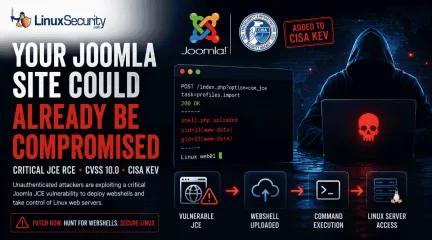
The Joomla Content Editor (JCE), one of the most widely deployed editor extensions for Joomla websites, is currently under active attack due to a critical vulnerability. . The issue, tracked as CVE-2026-48907 , affects JCE versions earlier than 2.9.99.5 and carries a CVSS score of 10.0. Because JCE is installed on a large number of public-facing Joomla sites, the vulnerability has quickly become a high-priority target for attackers and automated scanning campaigns. CISA has added the flaw to its Known Exploited Vulnerabilities (KEV) catalog , indicating active exploitation in the wild. The root cause is a broken access control issue in JCE's profile import function. Attackers do not need valid credentials to exploit it. By sending crafted requests to the import endpoint, they can bypass security checks, create a new editor profile, upload malicious PHP files, and execute them remotely. In practice, this allows an attacker to deploy a web shell and gain full remote code execution on a vulnerable server. Who Is Affected? JCE versions earlier than 2.9.99.5 are exposed. Patched: Get to 2.9.99.5, with 2.9.99.6 adding additional hardening. Legacy: The vendor pushed free patches for older sites. This Joomla Content Editor vulnerability affects websites running vulnerable JCE releases and should be treated as an emergency patching priority. Why You Should Care You’re not just patching a plugin; you’re defending the underlying OS. Joomla is the guest, but Linux is the host. When an attacker exploits this RCE, they aren't just messing with your CMS; they’re executing code as the web server user—the same user that owns your PHP files, your config files, and often your database credentials. If your permissions aren't tight, you aren't just looking at a defaced site. You're looking at a pivot point in your infrastructure. Attackers use these shells to sniff for adjacent apps, lateral movement, or root escalation. For a Linux admin, a "CMS vulnerability" is just the frontdoor being kicked in. The Webshell Reality A successful exploit often results in a Joomla webshell being deployed inside a writable directory. Webshells are a classic post-exploitation tool used on web servers. Once they’re sitting in your /images/ or /tmp/ directory, the attacker has a permanent backdoor. They can run commands, move files, and open new accounts long after you’ve updated the plugin. You don't "patch" a webshell out of existence; you have to hunt it. Why KEV Inclusion Changes the Priority The addition of this CISA KEV Joomla vulnerability to the catalog isn't a suggestion. It means CISA has proof of real-world exploitation. For a Linux admin, this shifts the task from "run a plugin update" to "incident response." Assume the server is already burned. You update the software, but you also check the box for a pulse. Remediation Path Identify: Check your current JCE release. Patch: Apply the latest secure version and install the latest Joomla security update provided by the JCE team. Audit: The patch stops the next attempt. It does nothing for the shell currently on your disk. You need to verify the file integrity. Harden: Lock down the file system. Block PHP execution in directories that don't need it. Use a WAF to stop the com_jce POST requests before they hit your code. Hunting for CVE-2026-48907 Indicators You have to look for the footprints. Parse the logs, audit the disk. Apache/Nginx Logs The exploit targets the profile import task. Search your logs for this specific path: grep "option=com_jce" /var/log/apache2/access.log | grep "task=profiles.import" Look for POST requests. Anything that isn't a legitimate admin session or comes from a suspicious IP is a lead. A 200 status code means they likely got in. Filesystem Audit Attackers love hiding in writable directories. Run this to catch recent changes: find /var/www/html -name "*.php" -mtime -3 If you find a new file, grep it for the usual suspects: grep -rnE"(eval|base64_decode|system|shell_exec)" /var/www/html/path/to/uploads Administrator Accounts Check for new accounts in the database. SELECT name, username, email, registerDate FROM jos_users ORDER BY registerDate DESC; If you see an admin account you don't recognize, you’re compromised. Kill it and start the forensics. Persistence and Beacons If the attacker got a shell, they might have set up a cron job or a persistent beacon. Cron: for user in $(cut -f1 -d: /etc/passwd); do crontab -u $user -l; done Network: Look for outbound connections from the web server process: ss -tp | grep -E "php|apache|nginx" Log-Parsing Strategy For high-traffic servers, summarize the noise: awk '/option=com_jce/ && /task=profiles.import/ {print $1}' /var/log/apache2/access.log | sort | uniq -c | sort -nr If one IP shows up dozens of times hitting that import task, they were scanning you. If they were successful, they’re still there. Want more Linux security news, vulnerability analysis, and software supply chain updates? Subscribe to the LinuxSecurity Newsletter and get the latest threats, advisories, and expert insights delivered directly to your inbox. Related Reading Joomla: 5.0.3/4.4.3 Moderate: RCE Risk from Critical XSS Bug Linux Security Uncovered: Open Source, User Privilege, and Defense Tactics TARmageddon: Archive Extraction Risk in Rust async-tar on Linux . Joomla JCE faces critical RCE issues as attackers target Linux servers. Patch immediately to prevent exploitation.. joomla security, remote code execution, linux vulnerabilities, patch management, web server security. . MaK Ulac
Jun 17, 2026
•
Security Vulnerabilities

210
 security advisorycriticalremote code execution
This RCE Flaw Can Expose Your Internal Network Through a Single Linux Server
A single unpatched server opens a path into systems that were never meant to be exposed, and because nothing appears broken, that access can remain in place for weeks without drawing attention. . Most compromised systems do not crash or throw obvious errors. They keep running the way they always have, which is part of why CVE-2026-4681 stands out. In many cases, they run on Linux servers that are already trusted by other internal systems. This positioning matters more than the vulnerability itself. It means the server is already past the front gate. The issue allows remote code execution . An attacker can get the server to run their own code without requiring a username or password. If the system is reachable over the network, that is enough to attempt exploitation. Once that happens, the role of that server changes because it already has permission to interact with internal systems. Anyone Who Can Reach the Server Can Attempt to Run Code This is not just another application bug. If the server is reachable, someone can try this. No login. No setup. Just access to the system over the network. The entry point: Internal file shares Product or design data Identity systems or service accounts Are You Running These Systems? This vulnerability (CVE-2026-4681) specifically targets PTC Windchill and PTC FlexPLM . If your organization uses these platforms to manage engineering blueprints or manufacturing data on Linux, you are in the high-risk category. There Is No Patch Yet, So Exposure Depends on Access Control The vulnerability is rated critical, with a CVSS score of 9.3, and there is still no patch available. Some authorities have already stepped in and warned organizations directly. In some cases, administrators were contacted outside normal channels just to make sure the message was received. That is not how most vulnerabilities are handled. It usually means the risk is expected to translate into real use, not just remain a warning. Until thereis a patch, that does not change. The only thing that really matters is whether the system is exposed. Code Execution on This System Extends to What the Server Can Access Once code execution is possible, the system does not need to be taken over all at once. It starts quietly. A small payload gets dropped. A request is sent to another internal system. A connection is tested. Nothing that stands out on its own. But over time, you begin to see movement: The server accesses systems it normally would not New files appear that are not part of the application Requests originate from a system that behaves differently than expected At that point, the issue is no longer limited to one server. These Platforms Often Sit Inside Trusted Parts of the Network Even though this vulnerability sits in an application, it lands on the system that runs it. In many environments, that system is Linux. Once the code runs there, the distinction between application and host starts to blur. Processes launched through the application still execute on the server. Data accessed through the application still comes from the system. It is not just about one vulnerable component. It is about what that component is connected to. If the Server Is Exposed, the Risk Comes From Network Reachability If a system is reachable and mitigation is not in place, that is the risk. Right now, that means: Applying the vendor’s temporary access rules Limiting or removing internet exposure where possible Monitoring for unexpected files, requests, or process behavior Isolating affected systems if they cannot be secured What Linux Users Should Check in Their Environment Check if the system is reachable from outside the network If the server running Windchill or FlexPLM is exposed to the internet or untrusted networks, start there. Look at what the server can access internally These platforms are rarely isolated. They often connect to file storage, internal services, andidentity systems. Review anything that has changed in the system Unexpected files, processes you don’t recognize, or requests that don’t line up with how the system normally behaves are usually where this shows up first. It’s easy to ignore at that stage. Apply available mitigations and restrict access where possible There is no patch yet, so access is the only thing you can control right now. This Does Not Shut Systems Down, It Changes How They Can Be Used Most systems affected will continue to run. That is part of the risk. Nothing forces attention right away. The application stays online, users continue working, and the server still behaves as expected on the surface. What changes is where that activity comes from. This does not introduce a new failure. It changes how an existing system can be used. . A single unpatched Linux server can lead to critical exposure risks through remote code execution. Immediate action is essential.. Linux security, remote code execution, patching vulnerabilities, internal network risk. . MaK Ulac
Mar 25, 2026
•
Security Vulnerabilities
210
 security advisoryremote code executionhigh
React2Shell: How a Framework Bug Drives Full Linux Compromise
React2Shell is a server-side vulnerability that turns a normal web request into code execution. It allows unauthenticated remote code execution, without credentials, tokens, or prior access. The resulting commands run as the same Linux service user that hosts the application. . That detail matters more than it sounds like it should. Because the remote code execution happens inside the application process, the underlying platform barely matters. Containers behave the same way. Virtual machines behave the same way. Bare metal behaves the same way. Once the framework evaluates attacker input, Linux simply executes what it is given. This is not a frontend bug with cosmetic impact on your security administration. It is a host-level event driven by remote code execution that starts in application logic and ends with system state changing underneath you. What Is React2Shell and What Does It Actually Do? React2Shell ( CVE-2025-55182 ) affects React Server Components as used by Next.js. These components are designed to execute server-side logic during rendering, which is where performance and security assumptions quietly meet. The vulnerability allows attacker-controlled input to reach server-side evaluation paths that were never meant to handle untrusted data. When that input is processed, it is treated as executable logic rather than plain data, which is where remote code execution enters the picture. That evaluation step becomes remote code execution without a separate exploit stage. No memory corruption. No sandbox escape. The framework itself performs the execution. Those commands run as the Linux service account hosting the Node.js process. Whatever that user can read, write, or access over the network is now exposed through remote code execution. At that point, the distinction between application issue and system issue stops being useful. How the RCE Path Works From React Server Components to the Linux Host It helps to think about this as a straight line rather than achain of exploits , especially when explaining how remote code execution actually reaches the host. An HTTP request reaches the application. React Server Components parse and process that request as part of rendering. Next.js executes the required server-side logic to generate a response. That logic runs on the Linux host, using the privileges already assigned to the service. There is no sharp boundary where the remote code execution suddenly becomes “system-level.” The framework bridges that gap by design. Once untrusted input is evaluated server-side, Linux is simply executing instructions inside a legitimate process. That is why the remote code execution path feels deceptively simple when you map it out. Understanding the Active Exploitation and Impact of React2Shell React2Shell was adopted quickly once details surfaced. That speed is familiar to anyone who has tracked remote code execution vulnerabilities over the last decade. Observed activity shows mixed goals. Some campaigns deploy cryptominers to monetize idle CPU obtained through remote code execution. Others drop lightweight backdoors or convert hosts into covert proxy nodes for later use. The infrastructure is reused. The payloads change. What stands out is not creativity, but efficiency. This type of remote code execution fits cleanly into existing crimeware tooling, which lowers the barrier to entry and increases volume. For defenders, that usually means exposure windows matter more than novelty. Historical Context: Why React2Shell Is Not an Isolated Linux Risk You start to see it once you have responded to a few of these incidents. React2Shell is not an anomaly. It follows a pattern that has defined remote code execution on Linux systems for years. Framing it this way is what keeps the analysis useful over time. The names change. The remote code execution sequence does not. A framework flaw allows untrusted input to reach server-side execution logic. Remote code execution occurs inside a legitimateprocess. Commands run as a Linux service user. Host compromise follows, even though the operating system itself behaves correctly. Linux does exactly what it is told to do during remote code execution. Closely Related Historical Examples Apache Struts vulnerabilities, starting in 2017, exposed request handling flaws that allowed crafted HTTP requests to trigger remote code execution. The outcome was consistent. Linux hosts were compromised through application logic, not OS bugs. Drupalgeddon in 2018 followed the same structure. A server-side rendering and input handling error enabled unauthenticated remote code execution. Public-facing web applications became reliable entry points for Linux host takeover. Log4Shell in 2021 pushed the pattern into shared libraries. A message processing flaw caused remote code execution during normal application behavior. Large-scale exploitation targeted Linux systems, even though the vulnerability lived far above the kernel. Rails YAML deserialization issues tell a quieter version of the same story. Unsafe object handling on the server side led to remote code execution with Linux process privileges. Different stacks. Same outcome. React2Shell fits this sequence cleanly. Server-side framework logic processes attacker-controlled input. Execution happens inside Node.js. Remote code execution on the Linux host follows naturally. It is a new framework wearing an old shape. Examining the Impact on Linux Users and Developers Framework bugs can equal host compromise. Application patching is therefore a Linux security responsibility, not just a development task. Remote code execution delivered over HTTP is operationally equivalent to shell access once it lands. Containers and orchestration help later. They do not prevent initial remote code execution. Mitigation and Response for React2Shell on Linux Applying vendor patches for affected React and Next.js releases is the first step in limiting remote code execution exposure. It is rarely thelast. Systems that were exposed should be treated as potentially compromised, especially if exploitation timelines overlap with internet-facing deployments. Service tokens, API keys, and credentials tied to those hosts need rotation because remote code execution invalidates trust boundaries. Systemd units, cron jobs, and unfamiliar binaries deserve scrutiny. Outbound connections should be reviewed for tunnels that blend into normal traffic patterns. Hosts showing durable persistence after remote code execution are usually faster and safer to rebuild than to disinfect. That lesson predates React2Shell. The Broader Takeaway for Linux Security Teams React2Shell is best understood as an example, not an exception. It shows how modern server-side frameworks sit close enough to the operating system that their failures become Linux problems through remote code execution. The broader lesson is operational. If code executes inside a process you run, it is part of your attack surface. Once that clicks, remote code execution stops feeling abstract and starts shaping how Linux teams prioritize risk. . React2Shell reveals how a framework bug leads to severe Linux host compromise through remote code execution.. React2Shell, Linux Exploitation, Remote Code, Security Risks, Security Advisory. . Brittany Day
Dec 16, 2025
•
Security Vulnerabilities
210
 security advisorycriticalremote code execution
Oracle Linux: Advisory CVE-2025-61882 Critical RCE Threat from Cl0p
Oracle has confirmed a critical remote code execution flaw in E-Business Suite, tracked as CVE-2025-61882. The bug resides in the Concurrent Processing and BI Publisher components, which handle reporting and job scheduling. It can be reached remotely over HTTP without authentication. One exposed instance is enough for complete control. . All supported builds from 12.2.3 through 12.2.14 are vulnerable. While the flaw isn’t in Linux itself, most EBS deployments run on Oracle Linux or RHEL, making it a direct concern for linux security teams. These systems rarely operate in isolation; they often share identity stores, databases, and monitoring tools. A compromise in EBS often means compromise across the stack that supports it. Early telemetry links the activity to Cl0p, a ransomware group known for turning enterprise applications into access points. Their shift from broad data theft to targeting business platforms reflects a wider trend: attackers aren’t exploiting single products anymore; they’re exploiting the relationships between them. That’s the real risk here. Oracle EBS may be the entry point, but the damage spreads through what connects to it — authentication services, financial databases, and the Linux hosts underneath. The line between application and infrastructure security is already thin; this vulnerability just makes that boundary visible. Oracle EBS RCE Vulnerability (CVE-2025-61882): Technical Summary CVE-2025-61882 is a critical remote code execution vulnerability affecting Oracle E-Business Suite’s BI Publisher integration. It holds a CVSS score of 9.8, placing it among the most severe enterprise ERP vulnerabilities disclosed this year. The flaw can be reached over the network through HTTP, and no login is required. A single crafted request is enough to hit the vulnerable path. Once executed, the attacker gains full control of the affected EBS instance. From there, confidentiality, integrity, and availability all fall in sequence — the entire stackbecomes theirs to command. How CVE-2025-61882 Works and Post-Exploitation Impact The exploit starts with a crafted HTTP request sent to the BI Publisher interface in Oracle E-Business Suite. There’s no login, token, or session required. The request alone is enough to reach the vulnerable path and trigger remote code execution. At the core of the flaw is how BI Publisher processes input from Oracle’s Concurrent Processing framework. Under certain conditions, unvalidated data is passed straight into the rendering engine. That’s the opening attackers need — it turns a simple web request into code execution on the host. Once the exploit lands, control shifts fast. Attackers can : Run arbitrary commands on the EBS application server. Query or modify connected databases. Interrupt or alter scheduled ERP processes. Move laterally through authentication stores or file systems connected to the same network. Those actions give adversaries reach far beyond the Oracle layer. They can pivot into shared infrastructure, access credentials, or use the compromised EBS instance as a launching point for additional attacks. E-Business Suite is deeply integrated into core operations — financials, HR, and supply chain systems all depend on it. When it’s breached, data exposure and business disruption happen in the same motion. For teams responsible for linux security, this isn’t abstract risk. Most EBS instances sit on Oracle Linux or RHEL, often with broad privileges and shared network visibility. Once the application layer falls, the underlying system usually follows. Cl0p Campaign Attribution and Attack Timeline The ransomware group Cl0p has been confirmed as the actor exploiting CVE-2025-61882. Activity began in August 2025, with scanning and exploitation of exposed EBS servers observed within weeks of disclosure. By September, multiple enterprises reported extortion attempts following confirmed breaches. The approach was consistent with Cl0p’s playbook: targetunpatched enterprise software, steal data before detection, and pressure victims with timed ransom demands. Threat intelligence from Mandiant and Google TAG links these incidents to Cl0p infrastructure through overlapping domains and reused payload code. This campaign shows a clear evolution in the group’s methods — moving from large-scale data theft to precision targeting of high-value ERP systems. For defenders, the signal is clear. Enterprise applications like EBS are now part of the initial access chain, not the end target. Securing them means treating patching and network segmentation as part of standard operational hygiene, not an afterthought. Why Oracle EBS Exploit Matters for Linux Security Oracle E-Business Suite remains one of the most common enterprise applications running on Oracle Linux and RHEL. These systems aren’t just compatible — they’re the default foundation for many deployments. That means responsibility for patching, access control, and monitoring often falls directly on linux security teams, not the application owners. A successful exploit gives attackers full control of the EBS application layer, but the reach doesn’t stop there. With command execution rights on the host, they can pivot deeper into the Linux environment, access shared authentication stores, or use the compromised instance to launch attacks against connected services. For organizations that rely on Oracle Linux or RHEL in production, the path from one unpatched EBS server to a wider breach is short and direct. The Broader Threat Landscape Cl0p’s exploitation of CVE-2025-61882 continues a pattern that’s defined their recent operations. The group has previously targeted enterprise web applications such as MOVEit, Fortra GoAnywhere, and Cleo Integration Cloud — each time exploiting trusted business platforms that sit inside corporate networks. That approach works, and others are following it. Groups like Scattered Spider and ShinyHunters have shifted toward the same strategy,repurposing existing exploits against ERP and supply-chain systems hosted on Linux infrastructure. It’s a logical move: these workloads hold the data adversaries want, and their patch cycles tend to lag behind internet-facing services. The result is a steady rise in ERP-focused intrusions across Linux environments. Attackers aren’t looking for a single flaw anymore — they’re targeting the platforms that keep business running. For teams maintaining Linux workloads , keeping Oracle EBS secure now falls under the same operational urgency as patching the kernel itself. Mitigation and Response Oracle has released patches covering E-Business Suite 12.2.3 through 12.2.14, and they need to be applied immediately. Delays give attackers time to automate scanning and exploit delivery — a cycle that Cl0p and similar groups already understand well. Patching is the first step, but not the only one. Containment, monitoring, and privilege control all matter once a service has been exposed. Recommended actions: Apply the official Oracle patch for all affected EBS versions (12.2.3–12.2.14). Confirm installation through Oracle Support documentation and internal version audits. Restrict HTTP exposure for BI Publisher endpoints. Limit access to internal networks or authenticated reverse proxies only. Monitor Linux logs for indicators of compromise using tools such as journalctl, centralized SIEM feeds, or auditd. Unusual web process activity or outbound connections from the EBS host should be treated as high priority. Enforce least privilege for Oracle service accounts. Remove shell access where possible and review group permissions for any inherited escalation paths. Segment ERP and database tiers to reduce the blast radius. Lateral movement between EBS, database, and file services should not be possible under normal operating conditions. For teams managing linux security, these steps should be treated as both immediate containment and long-term practice. Patchingcloses the vulnerability, but architecture and access control determine whether a similar exploit becomes a breach the next time around. Broader Takeaway CVE-2025-61882 is a reminder that linux security doesn’t stop at the operating system. The most damaging breaches increasingly start higher up the stack — in enterprise applications that run on trusted Linux infrastructure but fall outside the usual patch cadence. Flaws like this one show how attackers view the ecosystem: not as isolated layers, but as connected surfaces that can be chained together. Application-layer vulnerabilities in tools such as Oracle EBS are attractive because they combine sensitive data, consistent deployment patterns, and broad internal access. . Oracle EBS faces critical remote code execution risk via CVE-2025-61882, exploited by Cl0p targeting Linux deployments.. Oracle EBS risk, remote code execution flaw, Linux application security, Cl0p ransomware, CVE-2025-61882. . MaK Ulac
Oct 07, 2025
•
Security Vulnerabilities
210
 security advisorycriticalremote code execution
Google Chrome: CVE-2025-6558 Critical Remote Code Execution Advisory
Let’s talk about CVE-2025-6558 —the latest zero-day vulnerability in Google Chrome. If you’re managing Linux systems or handling infosec at any level, you should care about this one. It’s actively being exploited, which means attackers aren’t waiting for you to patch—they’re already leveraging it to break into systems. . This particular flaw lives in the ANGLE (Almost Native Graphics Layer Engine) and GPU rendering components of Chrome. These systems are responsible for handling graphics processing. Now, when you’re dealing with something that sits this close to the metal in the browser, anything going wrong can open up big avenues for exploitation. With CVE-2025-6558, the issue boils down to incorrect validation of untrusted input in these components. Think of it as Chrome not double-checking its homework before rendering complex graphics or running scripts. Let's take a closer look at this bug, who it impacts, and measures you can take today to lock down your systems against exploits. Why Is CVE-2025-6558 Such A Big Deal? Here’s the thing about ANGLE and the GPU: they’re powerful tools, but vulnerabilities here can become a direct line for sandbox escapes, code execution, and privilege escalation. This isn’t hypothetical either—Google confirmed attackers are already exploiting this flaw in the wild. Imagine this: a malicious actor creates a crafted HTML page exploiting this validation weakness. Once someone visits the page in Chrome, their system could become open to the attacker. That’s not just script-kiddie-level stuff; it’s real-world exploitation that could compromise entire systems. What makes this even trickier is how sandboxing—one of Chrome’s biggest defenses—might be bypassed. If attackers are targeting rendering processes through graphics-heavy content, even something seemingly benign, such as an over-the-top web animation, could pack a payload. How Has Google Addressed This Zero-Day Flaw? Thankfully, Google rolled out an emergencypatch in the latest Stable Channel Update for Desktop (versions 138.0.7204.157 and .158). This patch directly tackles the input validation issue in the ANGLE and GPU components, closing off the weakest points. Google didn’t stop at bandaging the flaw. They’ve hardened Chrome using tools like AddressSanitizer and libFuzzer , both of which simulate exploit scenarios. These tools dig into edge-case bugs that attackers love to exploit. Whenever you see “fuzzing,” think of it as crashing the software in every imaginable way to find where it breaks, then fixing those breakpoints. That’s likely how Google zeroed in on this vulnerability. Practical Protection Measures for Security Pros If you’re running Chrome on Linux systems, now’s the time to act. Apply patches immediately. There’s no excuse to wait, especially since adversaries are already sliding through this flaw like it’s a revolving door. Look, it’s not just about clicking “update” once and forgetting about it. You need to verify that your systems are actually running the patched version. Quick tip: open Chrome and visit chrome://version . If the version isn’t 138.0.7204.157 (or higher), you’ve got work to do. Admins might want to think about temporarily disabling GPU acceleration for critical systems until everything is fully stabilized. While Chrome has done its job with the patch, history shows that vulnerabilities like these can sometimes spawn related issues. Reducing attack surfaces is never a bad move. Beyond Patching Patch management is the obvious answer, but don’t stop there: Automatic Updates Configure Linux systems to handle browser updates automatically. Yes, I get it—some admins dread the idea of anything auto-updating. But in cases like this, it could save your systems when the next zero-day shows up unannounced. Endpoint Monitoring Keep an eye on endpoints. Use tools like EDR to watch for sketchy Chrome behaviors. If suddenly Chrome is leveraging more resources than normalor reaching external IPs under weird circumstances, dig into it. Web Traffic Filtering Block risky or suspicious URLs at the DNS level to reduce the chances of accidental exploits. While it doesn’t fix the vulnerability, it can prevent users from stumbling into the wrong traps. Training and Awareness Let users know about the risks. No need for scary emails, but remind them to avoid downloading random scripts or visiting shady websites until browsers are confirmed safe. Our Final Thoughts on Proactively Addressing CVE-2025-6558 CVE-2025-6558 highlights a critical security challenge: browsers get hit hard because attackers know they’re ubiquitous. If you’re not patching systems now, you’re rolling the dice on this actively exploited vulnerability. The good news? It only takes a few steps to lock down your Linux environments and reduce exposure to attacks. So apply those patches, monitor endpoints, and keep your systems tight and clean. Security isn’t just about reacting—it’s about staying ahead of the curve. And as always, keep your eyes on LinuxSecurity advisories because this fight doesn’t end with one zero-day! . A critical flaw in Google Chrome's ANGLE impacts Linux systems; updates are essential to secure against attacks.. Google Chrome,Critical Flaw,CVE-2025-6558,Security Update. . Brittany Day
Jul 17, 2025
•
Security Vulnerabilities
210
 security advisoryRed Hatremote code execution
Red Hat: CVE-2024-36904 critical: kernel remote code execution threat
In a startling revelation, researchers have uncovered a critical vulnerability in the Linux kernel that has remained undetected for seven years, posing a significant threat to the security of Linux systems. This flaw, identified in the core TCP subsystem, results from a race condition in the inet_twsk_hashdance function, which could allow attackers to execute remote code and take over compromised devices. . Linux security administrators should be aware that this vulnerability, tracked as CVE-2024-36904 , impacts several major distributions, including Red Hat Enterprise Linux and Fedora. While real-world exploitation demands precise timing and extensive knowledge of kernel internals, the theoretical danger is substantial. Addressing this vulnerability is paramount for maintaining secure and resilient systems. The bug has been patched upstream, and affected distributions are rolling out updates . Admins must ensure their systems are updated with the latest kernel patches their distro vendors provide. This incident is a crucial reminder of the importance of timely system updates and proactive security practices to protect against long-standing and potentially devastating vulnerabilities. Let's take a closer look at this issue and its potential impact on the security of your Linux systems. I'll also explain how you can determine if you are at risk and measures you can take to secure your systems against CVE-2024-36904 and similar bugs. Understanding This Kernel Vulnerability This vulnerability has its roots in a race condition between two functions in the TCP stack: tcp_twsk_unique() and inet_twsk_hashdance() function. Essentially, a race condition occurs when the output depends on the sequence timing of uncontrollable events, potentially causing unpredictable behavior. In this case, the time-wait TCP socket’s reference counter is initialized only after it has been inserted into a hash table and a lock is released. If another lookup happens before this initialization is complete,the object found will have an uninitialized reference counter. The severity of this issue cannot be overstated. The uninitialized reference counter can trigger various warnings and lead to use-after-free conditions. In practical terms, this opens the door for attackers to manipulate this condition to execute arbitrary code within the kernel space. Kernel-level code execution means that an attacker could gain complete control over the affected system, bypassing all conventional security mechanisms and potentially causing severe damage. Who Is At Risk? The vulnerability affects several widely used Linux distributions, including Red Hat Enterprise Linux and Fedora, potentially affecting millions of systems worldwide. The threat is indiscriminate, impacting both enterprise environments and individual users. However, the complexity of exploiting this vulnerability limits its exploitation to highly skilled attackers with an in-depth understanding of kernel internals and precise timing. Despite the technical barriers to exploitation, the risk remains significant due to the broad deployment of the affected distributions. Systems running outdated kernel versions that precede the recent upstream patch are particularly at risk. This broad spectrum of potential targets means that regardless of the specifics of an individual deployment, failing to apply patches could lead to disastrous consequences should an attacker choose to exploit this vulnerability. The Critical Nature of Kernel Protection The nature of this vulnerability underscores a perennial truth in cybersecurity: the most formidable threats often lie in the most overlooked places. Kernel protections are supposed to guard the core of the operating system against such vulnerabilities, yet when flaws like this go unnoticed, it highlights the limitations of existing defenses. The kernel, being the heart of the system, has access to all hardware and system resources. Therefore, any vulnerability at this level can have catastrophic implications. Protection and Remediation The good news is that there is a solution. In May 2024, this vulnerability was patched upstream, and affected distributions have been rolling out these critical updates. The immediate action required is straightforward: update your systems to the latest kernel versions that contain the relevant security fixes. Delaying these updates only increases the window of opportunity for potential attackers. Vendor-specific updates and advisories should be monitored closely. Red Hat Enterprise Linux and other major distribution maintainers have provided clear guidance on applying these patches, and it is crucial to follow these recommendations promptly. Ensuring that automatic updates are enabled where possible can mitigate the risk of manually updating every system, though manual checks should still be conducted regularly to ensure systems remain up-to-date. Beyond merely applying patches, this incident also serves as a reminder of the broader importance of proactive kernel auditing. Routine checks and balances, coupled with comprehensive use of auditing tools such as Syzkaller, can help identify potential vulnerabilities before they can be exploited. These preemptive measures can significantly enhance system resilience. Lessons Learned The discovery of this vulnerability brings several important lessons to the forefront. First and foremost, it highlights the necessity of consistent and rigorous kernel auditing practices . The ability of a bug like this to remain undetected for seven years is a stark reminder of the depth and complexity of modern operating systems and the constant vigilance required to secure them. Furthermore, the accident of its discovery—researchers found the flaw while trying to reproduce another known bug—highlights the often serendipitous nature of security research. It underscores the importance of extensive testing and fuzzing, not only when dealing with known vulnerabilities but as a routine part of system development and maintenance. The widespread nature of this vulnerability also emphasizes the need for comprehensive patch management policies. With so many systems potentially at risk, ensuring that patches are rolled out effectively and efficiently is critical. This also extends to communication. Keeping users informed about vulnerabilities and the availability of patches helps ensure broad compliance and reduces the overall threat landscape. Finally, this incident reinforces the value of community and collaboration in the open-source world. The rapid identification, disclosure, and patching of this vulnerability were made possible thanks to the collaborative efforts of researchers, developers, and distribution maintainers. This cooperative approach is one of the pillars of open-source security and is essential for addressing the dynamic and evolving challenges in the cybersecurity landscape. Looking Forward: Our Final Thoughts on the Implications of CVE-2024-36904 The Linux community must continue creating an environment that fosters proactive security measures, timely updates, and open collaboration. The cybersecurity landscape is constantly shifting, and the discovery of a seven-year-old vulnerability is an alert that constant vigilance must always be maintained. We Linux security admins have an unmistakable path forward: prioritize updates, engage in rigorous security practices, and stay abreast of new developments and advisories to protect existing and potential vulnerabilities in their environments. By doing this, we can ensure our environments remain protected against known and emerging risks. By learning from this incident and reinforcing proactive security measures, we can ensure a more secure future for all Linux users. . Linux kernel administrators must address CVE-2024-36904 to prevent severe security threats from this long-undetected flaw.. startling, revelation, researchers, uncovered, critical, vulnerability, linux, kernel. . Brittany Day
Feb 12, 2025
•
Security Vulnerabilities
210
 security advisoryremote code executionaccess control
Ubuntu: Secure rsync from RCE issues with critical patches
Are you using rsync to synchronize files on your Ubuntu-based Linux systems? If so, s everal severe remote code execution (RCE) vulnerabilities recently found in the widely used file synchronization utility could put you at risk of full system compromise! Left unpatched, these RCE flaws allow attackers to execute arbitrary code and compromise entire systems. . In this article, I'll walk you through determining if your systems are vulnerable and applying necessary updates to secure your rsync setup. By taking immediate action and adhering to best practices, you can ensure a robust security posture in your Linux environment. Understanding These Rsync RCE Vulnerabilities Rsync has long been an indispensable tool in a Linux administrator's arsenal, revered for its speed in synchronizing files and copying changes between systems. Various RCE vulnerabilities have recently been found in the popular utility , including a critical buffer overflow on the server's heap (CVSS 9.8, CVE-2024-12084 ) . Attention has turned towards the security implications of these severe bugs, impacting up to 660,000 servers. These vulnerabilities allow attackers to execute code remotely with elevated privileges, making fixing these holes an urgent priority. A typical exploitation scenario might involve an attacker gaining access to a system where rsync is improperly configured to operate in a daemon mode without proper security structures. This can allow unauthorized users to send malicious payloads that rsync executes, inadvertently providing access to critical infrastructure. Understanding these implications, admins must assess their systems, ensuring they’re not vulnerable to such straightforward yet devastating avenues of attack. Assessing Your Risk Determining whether your systems are at risk is a vital first step. The process begins with identifying the currently installed version of rsync across all servers. This can be done easily through the command line . Upon establishing whichversion you're dealing with, the next task is to cross-reference this with the Ubuntu security advisory detailing affected versions. This step ensures that you have a clear picture of your exposure. Admins should routinely check system logs for any signs of unusual activity related to rsync, such as unexpected access requests or error messages. Ensuring access controls are in place is crucial. You can significantly reduce your risk exposure by designating rsync to operate only for trusted users and networks. Through diligent checks and balances, identifying and understanding potential risk factors become a part of routine maintenance, which creates a robust security environment. Applying the Necessary Patches Once you have assessed your risk, the next crucial step is promptly applying the necessary updates. Updating rsync to version 3.4.0, which has patched these vulnerabilities, is vital. This is a straightforward task in Ubuntu-based systems through package managers that offer seamless upgrade paths. By executing simple commands, you can ensure that your system runs the secure version of rsync, mitigating immediate risks. After applying these updates, verification is essential. It’s important to verify that the patches have been applied correctly. This means checking the version of rsync and ensuring there are no lingering issues. Regularly running system health checks post-update ensures everything operates smoothly and according to your expectations. Best Practices for Robust Rsync Security Mitigation isn't just about patching vulnerabilities; it's about instituting best practices that future-proof your systems. Establishing strict access controls on rsync usage can vastly improve security. Limiting its operation via network security groups ensures only trusted systems and users can engage with rsync services, preventing unauthorized attempts. Enabling a secure shell (SSH) for rsync operations adds another layer of security. SSH provides encrypted channels for data transfer,ensuring that even if data were intercepted, it wouldn't be usable to potential attackers. Configuring rsync to log activity diligently allows admins to monitor its usage effectively, pinpointing any unusual patterns that might indicate a security threat. Regular security audits can help uncover potential misconfigurations or overlooked vulnerabilities. Automated vulnerability scanning tools can provide robust checks across your infrastructure, assisting in the early identification and mitigation of security gaps. Combining these practices creates an environment where security isn't an afterthought but a continuous, proactive process. Preparing for the Future Staying ahead of potential security vulnerabilities requires a forward-looking approach. Stay informed by subscribing to security newsletters . This proactive information gathering allows admins to be among the first to know about potential threats and the solutions that accompany them. Education and user awareness are also significant factors. Regular training sessions can ensure all stakeholders are aware of security protocols and the importance of maintaining them. Encouraging a culture of security mindfulness means everyone is vigilant, reducing the likelihood of vulnerabilities being overlooked. Moreover, maintaining comprehensive documentation of your systems and the changes applied is critical. This documentation aids in compliance with internal and external policies, providing a clear audit trail. Should any security incident occur, detailed records of updates and configurations can be invaluable for forensics and analysis, helping you understand what went wrong and how to prevent similar incidents. Our Final Thoughts on Mitigating These Recent Rsync Flaws These recently identified rsync vulnerabilities serve as a reminder of the constant vigilance required in IT security. For us Linux security admins, taking steps to address these vulnerabilities via the patches released and engaging in best practices is imperative.Integrating these measures with ongoing education and documentation means you’re not just reacting but preparing for tomorrow’s challenges. With the right strategies and a proactive approach, you can ensure that your systems remain secure without sacrificing the efficiency that tools like rsync bring. Safeguarded systems protect sensitive data and maintain stakeholders' trust, enabling you and your organization to focus on growth and innovation without risking compromise. . Discover methods to safeguard your rsync configuration from Remote Code Execution risks, address weaknesses, and adopt optimal strategies for Unix environments.. Rsync Security, Remote Code Execution, Ubuntu Security, Linux Administration, Rsync Vulnerabilities. . Brittany Day
Jan 20, 2025
•
Security Vulnerabilities

Get the latest News and Insights
Get the latest Linux and open source security news straight to your inbox.
Community Poll
Is continuous patching actually viable?
Search Topics
Powered By

Linux Security - Your source for Top Linux News, Advisories, HOWTOs and Feature Releases
QUICK LINKS
subscribe to newsletters!
Like staying secure? So do we.
Sign up for updates, tips, and alerts!