Explore top 10 tips to secure your open-source projects now. Read More
×



Server Security data privacy automation
data privacy automation Every system admin has lived through the same Monday morning ritual. A queue of forty tickets, half of them password resets, permission errors, or disk space warnings that any experienced technician could resolve in under two minutes. The other half require actual judgment. For years, automation promised that software would eventually sort the two apart on its own. That promise is now being tested in production Linux environments. . Early results are reshaping how IT teams think about tier-1...
 Jul 17, 2026

Privacydata collection automation
data collection automation You're running a web scraping project to collect pricing data from e-commerce sites. You set up a pool of datacenter proxies, launch your scripts, and within minutes — banned . CAPTCHAs everywhere. Your data pipeline stops before it really begins. . It's a frustrating scenario that plays out daily in ad verification, market research, and multi-account management. The website doesn't know you're doing legitimate research or monitoring. It just sees traffic coming from IP ranges it recognizes as...
Jul 17, 2026

Security Trends security advisory social engineering
security advisory social engineering Business Email Compromise used to be a numbers game — mass-blasted emails, broken English, an obvious "URGENT WIRE TRANSFER" subject line. That era is over. Generative AI has turned BEC into a tailored, low-noise operation that mimics writing style, voice, and even video presence. This piece looks at what's actually changed under the hood, what defenders are testing in response, and why so many organizations are still structurally unprepared for it. . The Infrastructure Problem Nobody Wants to...
Jul 17, 2026

Security Trends cybersecurity Linux documentation
cybersecurity Linux documentation Linux operating systems have gained prominence due to their stability, adaptability, and excellent security options. In the case of developing documentation, designing cybersecurity dashboards, or educational material, visuals are of vital importance when it comes to making things clear. The use of icons allows one to understand the message regarding alerts, authorization, encryption, authentication, or the state of the system just by looking at the visual cue without having to read long...
Jul 17, 2026
Security Vulnerabilities security advisory linux distribution
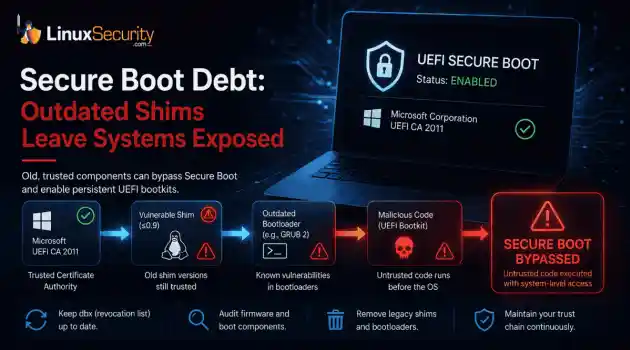
security advisory linux distribution ESET researchers identified 11 old and forgotten Linux UEFI shim bootloaders at versions 0.9 and below that can be used to bypass UEFI Secure Boot on any UEFI-based machine that trusts Microsoft’s Microsoft Corporation UEFI CA 2011 third-party certificate authority, regardless of the installed operating system (OS). Reported shims can be exploited to execute untrusted code during system boot, enabling attackers to deploy malicious UEFI bootkits even on systems with UEFI Secure Boot enabled.....
Jul 16, 2026
 Refine news
X Clear Filters
Get the latest News and Insights
Get the latest Linux and open source security news straight to your inbox.
Community Poll
Is continuous patching actually viable?
Loading...
Explore Latest Linux Security news
We found 14 articles for you...
210
 security advisoryremote accessimportant
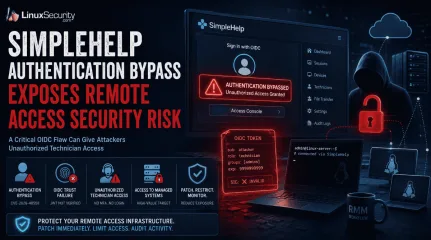
SimpleHelp Authentication Bypass Exposes Remote Access Security Risk
Remote support platforms sit close to the systems attackers want most: administrator workflows, technician accounts, and managed endpoints. That is why the SimpleHelp OIDC flaw is more serious than a routine authentication bypass vulnerability. For organizations running these platforms on Linux-based infrastructure, the risk is compounded by the ease with which these services are deployed and integrated into larger management stacks. . What Is SimpleHelp and Why Is It a High-Value Target? SimpleHelp is a remote support software platform used by IT teams, managed service providers, and internal support groups to access systems, assist users, transfer files, and manage endpoints from a central console. In many Linux-heavy environments, it becomes a core part of the daily administrative workflow. That level of trust changes the impact of a security issue. A vulnerability affecting a public-facing website might expose a single application. A flaw affecting SimpleHelp can expose the access layer administrators use to reach dozens, hundreds, or even thousands of managed devices. Operational Impact The platform also overlaps with functions commonly associated with remote monitoring and management (RMM) deployments: Persistent Visibility: Organizations use SimpleHelp RMM capabilities to maintain persistent visibility into Linux endpoints, provide unattended access, and deploy fixes across distributed environments. Trusted Bridges: Once a technician authenticates, the platform acts as a trusted bridge into systems that would otherwise remain isolated from external access. Administrative Foothold: A foothold inside a remote support system can expose technician sessions, privileged workflows, connected clients, and administrative functions already trusted throughout the environment. From an operational perspective, this makes remote support software an attractive target. An attacker does not necessarily need to compromise every Linux endpoint individually if they can gain access to themanagement platform responsible for those endpoints. What Is CVE-2026-48558? CVE-2026-48558 is an authentication bypass vulnerability affecting certain SimpleHelp deployments that use OpenID Connect (OIDC) authentication. The issue is tracked in the GitHub Advisory Database . The issue sits in the identity validation process rather than the traditional username-and-password flow. Under specific conditions, the application can accept identity information that should not be trusted, allowing an attacker to obtain technician access without successfully completing the authentication process administrators expect. How the OIDC Authentication Bypass Works The decision that matters happens when SimpleHelp receives an identity token and decides whether that token represents a legitimate user. Additional technical analysis and indicators of compromise have been published by Horizon3.ai researchers . OIDC Trust Depends on Token Verification: An OIDC token is not proof of identity by itself; it contains claims like usernames and group memberships. The Necessity of JWT Signature Verification: Before SimpleHelp can trust any of these claims, it must perform JWT signature verification and validate the supporting claims. The Failure Point: Without proper JWT signature verification, the entire authentication process becomes dependent on data the application should never have trusted. This is also where MFA bypass concerns enter the discussion. Many administrators assume their identity provider's MFA requirement protects downstream applications automatically. In reality, that protection depends on the application correctly validating the token it receives. If SimpleHelp accepts a forged token, the vulnerability can undermine the assurance administrators normally associate with MFA-protected OIDC logins. Why This SimpleHelp Flaw Is Serious A login bypass affecting a low-privilege application might expose a handful of records. A login bypass affecting remote support software isdifferent because the account behind the login often has visibility into systems, users, and administrative operations that already hold a trusted position inside the environment. Unauthorized Technician Access Can Become Endpoint Access In many Linux deployments, technicians use the platform to launch support sessions or perform administrative actions via command-line tools. An attacker who gains unauthorized technician access is not starting from scratch; the platform already contains trusted pathways into managed assets. Existing support workflows, endpoint inventories, technician permissions, and administrative functions—often managed via scripts and automation—may already be available through the same interface. This is why platforms associated with remote monitoring and management operations receive so much scrutiny during investigations. A compromise of the management layer can provide access to systems that were never directly exposed to the internet. Who Is Affected by CVE-2026-48558? Organizations should verify their deployment against the SimpleHelp vendor advisory . The highest-risk environments generally share a few characteristics: Vulnerable Versions: SimpleHelp versions identified as vulnerable by the vendor. OIDC Usage: Deployments configured to use OIDC authentication rather than local authentication alone. Public Accessibility: Internet-facing or broadly accessible SimpleHelp portals. High-Value Targets: Environments where technician accounts have access to large numbers of managed endpoints. RMM Workflows: Organizations using SimpleHelp RMM for remote administration or support operations. How Organizations Should Mitigate the SimpleHelp Vulnerability The first priority is to patch affected SimpleHelp systems and move to a fixed version as soon as possible. Because this involves an identity validation flaw, perimeter controls alone are insufficient. Limit Exposure: If the platform is running on a Linux server, restrict access to the loginportal and administrative interfaces through VPNs, local firewall rules (like nftables or iptables), or network segmentation. Audit Technician Accounts: Remove accounts that are no longer required and verify that administrative privileges are assigned only where necessary. In environments built around remote monitoring and management, old technician accounts often survive much longer than intended. Review OIDC Configuration: The vulnerability centers on identity trust. Verify your identity provider integrations, token validation settings, and signing key configuration. Prioritize Logging: Review authentication logs, technician account activity, and unexpected remote sessions. These artifacts may provide the first indication that the platform was used in ways administrators did not intend. Final Takeaway: Identity Trust Failures Can Expose Managed Infrastructure CVE-2026-48558 is more than an isolated authentication bypass vulnerability. It affects a trusted access path inside a platform used to reach systems across managed environments. When identity validation fails in that kind of system, the risk extends well beyond a single login event. Remote access security depends on more than successful authentication—it depends on ensuring every system in the chain correctly validates the identity information it receives before granting access to resources that sit close to the infrastructure administrators are trying to protect. Does your team have a specific incident response checklist for Linux-based remote management platforms, or would you like to explore how to audit your OIDC token validation settings further? Want more Linux security news, vulnerability analysis, and remote access security updates? Subscribe to the LinuxSecurity Newsletter and get the latest threats, advisories, and expert insights delivered directly to your inbox. Subscribe to the LinuxSecurity Newsletter Related Reading Securing Remote Access to Linux Servers: Best Practices for 2026 Mastering SSHfor Secure Linux Remote Server Management How Secure Is Linux? Open Source, User Privilege, and Defense Tactics Explained Does Linux Give Users a False Sense of Security? . SimpleHelp's OIDC vulnerability presents serious security risks due to improper authentication validation, affecting Linux environments.. authentication risk, remote access security, simplehelp exploit, identity validation, linux security update. . MaK Ulac
 Jun 16, 2026
•
Jun 16, 2026
• Security Vulnerabilities
212
 security advisoryphishinglinux
QR Code Phishing Linux Quishing Risks and Mitigation Strategies
QR codes were originally designed for industrial logistics. They were optimized for efficiency, not security. In recent years, they have become embedded across enterprise workflows, authentication flows, ticketing systems, packaging, and internal documentation systems. That expansion has created a new attack surface. . QR code phishing, often referred to as “quishing,” is not a new phishing variant in a technical sense. It is a delivery-layer adaptation. Instead of embedding a malicious hyperlink in an email body, the attacker encodes the URL into a QR code. In Linux-centric environments, especially in hybrid desktop and server infrastructure, the risk profile is more subtle than it appears. How QR Code Phishing Bypasses Traditional Email Security Controls Traditional phishing defenses rely heavily on URL inspection, domain reputation feeds, attachment scanning, and mail gateway filtering. This is where QR code phishing diverges from conventional campaigns. QR codes bypass that inspection layer because: The payload is embedded in image form. URL analysis requires decoding prior to scanning. Many mail filters treat QR images as static media assets. The final destination may include layered redirects and short-lived infrastructure. When a Linux user receives a PDF or email containing a QR code, no immediate domain reputation check is triggered unless the scanner application performs one. The user becomes the decoder. From a security architecture perspective, that inversion is significant. QR Code Phishing Attack Flow in Linux Environments Let’s break down a realistic scenario: A targeted user receives a notification email appearing to originate from an internal admin tool. The email includes a QR code labeled “Verify SSH Key Registration.” The recipient scans the QR using a mobile device or a desktop QR reader. The QR code resolves to a phishing page mimicking the organization’s SSO provider. The user enters credentials. Theattacker captures session tokens or initiates OAuth abuse . Nothing in this flow requires exploiting the Linux host. No buffer overflow. No local privilege escalation. It is purely an identity-layer compromise. In modern infrastructure, identity is the control plane. Linux and Open-Source Systems: Where the Risk Surfaces Linux environments frequently rely on: SSH key-based authentication Web-based identity providers OAuth integrations Self-hosted open-source dashboards Internal DevOps tooling Many of these systems are accessed from hybrid environments: Linux desktops, remote SSH sessions, container dashboards, and cloud consoles. If a QR code links to a fake Git service login or a fake internal dashboard, the breach may not be immediately visible. In some cases, attackers use reverse proxy frameworks to relay authentication in real time, capturing tokens while maintaining the appearance of a successful login. This is not Linux exploitation. It is a session interception. Why QR Code Phishing Targets Technical and DevOps Users There is an assumption that experienced Linux users are less prone to phishing. In many respects, this is true when the threat is obvious. However, QR codes change the interaction model. There is no hover preview. CLI-based workflows encourage trust in verified systems. Many security-minded users rely on password managers, but QR phishing may target OAuth approval screens rather than credential entry. Mobile scanning creates context switching between devices. That device boundary weakens situational awareness. The attacker does not need to bypass SELinux. They just need to bypass skepticism. Common QR Code Phishing (Quishing) Attacks in DevOps and Cloud Environments 1. Fake SSH Key Verification Pages QR codes claiming to help register new keys for remote Git platforms. 2. Kubernetes Dashboard Impersonation Phishing pages imitating internal cluster dashboards. 3. OAuth Consent Hijacking QR codes linking to malicious third-party integrations requesting expanded privileges. 4. Configuration Portal Spoofing QR codes in “infrastructure maintenance notices” redirect to malicious admin lookalikes. None of these attacks compromises the Linux kernel. They compromise operator access. Defensive Controls in Open-Source Environments Effective mitigation requires layered defense, not user education alone. Mail Pipeline Controls Mail servers such as Postfix, combined with SpamAssassin or Rspamd, can be configured with additional image analysis plugins. While not foolproof, integrating QR decoding heuristics into mail scanning pipelines reduces uninspected payloads. URL Proxy Validation Enterprise browsers on Linux can be configured with proxy-based URL validation layers. Squid proxy combined with threat intelligence feeds can restrict access to newly registered domains often used in QR campaigns. OAuth Scope Restrictions Avoid allowing broad OAuth consent flows inside internal tools. Restrict application-based token permissions wherever possible. Hardware-Backed Authentication FIDO2 security keys significantly reduce credential phishing risk. Even if a user is tricked, the phishing domain will fail cryptographic binding. DNS Monitoring Monitor DNS queries for unexpected outbound domains triggered immediately after document viewing events. This can detect QR-based redirection activity. Image-Based Threats Are Growing QR phishing represents a wider challenge: image-encoded threats. Security tooling in open-source ecosystems has historically focused on text payloads, signatures, and network anomalies. Image-encoded attack vectors require different inspection paradigms. Integrating image hashing and decoding analysis into mail gateways is increasingly relevant. The security community should treat QR codes as executable intent embedded visually. QR Code Governance and Secure Deployment Practices It is important to distinguish malicious QRinfrastructure from legitimate operational use. Organizations deploying QR codes internally should avoid uncontrolled static links. Static codes printed in documentation can become permanent attack targets if hijacked or replaced. Using managed systems for dynamic control reduces exposure. Managed QR systems that support dynamic redirection and centralized control provide stronger governance than static, unmanaged codes embedded in documentation. The principle is governance, not branding. Threat Modeling and Secure Design Considerations for QR Code Workflows From a DevSecOps perspective, threat modeling should explicitly include QR-based entry points. When designing systems that expose QR codes: Validate the integrity of published images. Ensure TLS enforcement is strict and certificate pinning is considered in mobile workflows. Avoid embedding administrative endpoints behind easily replicated login flows. Implement anomaly detection on sudden increases in authentication errors. QR codes should be categorized as remote link interfaces within STRIDE modeling. They are effectively remote input vectors. QR Code Phishing Impact on Containers, CI/CD Pipelines, and Cloud Access In containerized Linux environments: Phished credentials can lead to compromised CI pipelines. OAuth token theft can provide API-level access to cloud providers. Kubernetes RBAC privileges can be abused even without host compromise. Therefore, mitigating quishing indirectly protects workload isolation integrity. User Behavior Risks in QR Code Phishing Attacks Technical defenses matter, but behavioral controls also play a role. Encourage: Domain verification habits before OAuth approval. Separation of personal and administrative identities. Dedicated devices for privileged operations where possible. Disallow scanning administrative-related QR codes from unmanaged devices. Linux security has long emphasized least privilege and compartmentalization. The samephilosophy applies here. Why QR Code Phishing Reflects a Shift in Modern Attack Techniques Quishing is not about QR codes specifically. It reflects a broader shift: adversaries adapt faster than filtering models. Security tooling built around hyperlink inspection must now inspect image payloads and cross-device behavior. Linux and open-source infrastructures are not uniquely vulnerable. But they are widely deployed in identity-critical roles. That alone makes them strategic targets. Key Takeaways for Preventing QR Code Phishing in Linux Environments QR code phishing succeeds not because Linux systems are weak, but because identity systems are abstracted away from user scrutiny. Mitigation requires improvements in: Email scanning pipelines OAuth governance FIDO adoption Proxy monitoring Threat modeling awareness QR codes are simple. Identity compromise is not. In modern Linux environments, protecting the control plane means recognizing that even a small black-and-white square can act as an access vector. . QR code phishing poses risks in Linux environments. Learn effective strategies to mitigate these threats and protect systems.. QR Code Phishing, Linux Risk, Identity Threats, Security Measures, Mitigation Strategies. . MaK Ulac
Feb 24, 2026
•
Cloud Security

74
 security advisorymalwaredetection
BPFDoor: Understanding Malware Threats and Mitigation Tactics
BPFDoor malware has emerged as a serious threat to Linux systems, designed with sophisticated techniques that allow it to operate undetected. This malware leverages Berkeley Packet Filtering (BPF) to sneak past firewalls and inspect network packets for specific sequences, effectively hiding its presence. . Unlike typical malware, BPFDoor doesn’t listen on open ports, making conventional detection methods ineffective. Its ability to evade logs and seamlessly blend into your network poses a significant security risk to your system. For us, Linux security admins, staying alert to this stealthy malware is crucial. Understanding its unique behaviors and implementing advanced monitoring solutions is key to defending your network against this formidable adversary. Let's take a closer look at this malware, its malicious mechanisms and techniques, and measures you can take to secure your systems against BPFDoor attacks. Understanding the Mechanics of BPFDoor Source: TrendMicro It's vitally important to grasp BPFDoor's underlying mechanics to fully comprehend its threat. Berkeley Packet Filtering (BPF) is an inspection technology that enables deep inspection of network packets. This technology is typically employed to enhance performance for network monitoring tools. BPFDoor uses this capability maliciously by connecting directly to it and scanning network traffic for specific sequences or signatures that indicate target systems, effectively bypassing firewalls that would otherwise block them all outright. BPFDoor stands out among traditional malware because its communication channels can easily remain undetected using standard network monitoring tools. Conventional malware typically opens network ports to establish communication with its command and control server. These open ports are easily detectable using standard monitoring solutions, which quickly alert administrators about suspicious activity. BPFDoor, on the other hand, doesn't listen on open ports but employs BPF to "listen"undetected, making it harder for admins to detect using traditional techniques. Stealth and Persistence BPFDoor's stealthiness and persistence are central to its effectiveness. The malware's stealthy design allows it to blend seamlessly into a target system while remaining undetected for extended periods. Using techniques like process hiding, BPFDoor can remain hidden from security scanners while caching network packets without raising alarms, complicating any attempts at forensic investigation. Another strength of the BPFDoor malware is persistence. Once installed on a system, this infection remains visible even through reboots and security updates , using various techniques like creating hidden registry entries or exploiting existing processes to stay unnoticed. Therefore, eliminating BPFDoor requirea more than simply finding and deleting suspicious files. An organized approach must be employed so that all traces are effectively eliminated from existence. Evasion Techniques BPFDoor employs numerous evasion strategies designed to bypass traditional security measures. For instance, it tampers with system logs so its actions leave no trace. Without logs, any suspicious activities go undetected for extended periods, allowing BPFDoor plenty of time to fulfill its goals. BPFDoor's ability to blend seamlessly with regular network traffic demonstrates its sophistication. By replicating legitimate protocols and hiding malicious commands within common communications, it evades detection by Intrusion Detection Systems (IDSs) and other network security tools. Protecting Against BPFDoor Given the complexity of BPFDoor, effective defense requires a multi-layered approach. First and foremost is strengthening network monitoring capabilities, as traditional open port detection will likely miss BPFDoor. Instead, security admins should implement tools that analyze network traffic on deeper levels to detect abnormal patterns indicative of potential BPF activity. Regular system patches andupdates are another key mitigation strategy against BPFDoor malware, although its presence might linger despite updates to your systems. We admins should implement comprehensive log solutions that detect and alert us to any attempts to tamper with host-based intrusion detection systems to provide more comprehensive protection from possible intrusion attempts. Training and educating your team members to recognize the signs of a BPFDoor infection is equally vital. This can help achieve speedy detection and response times and minimize the damage caused by this malware. Be sure to incorporate regular security drills as part of ongoing security updates so everyone is adequately equipped to face this advanced threat. Incident Response Should BPFDoor infiltrate your system, having an effective incident response plan in place is vitally important. Step one in isolating it from further infection is disconnecting and quarantining it from its network. Once all components of the BPFDoor malware have been identified, an intensive forensic investigation must occur to locate them. This requires scanning for hidden processes, monitoring for unapproved network activity, and inspecting system logs for signs of manipulation since BPFDoor often hides itself using legitimate system tools. Thus, conducting exhaustive searches is critical. Once BPFDoor malware has been identified, removal proceedings should begin immediately. Care must be taken to eliminate all remnants, whether reinstalling the operating system software or recovering from backup files . Once clean systems have been restored, comprehensive security reviews are essential to prevent future infections. Our Final Thoughts on Combating BPFDoor Malware BPFDoor poses a formidable threat to Linux security admins due to its stealth, persistence, and evasion techniques. By understanding its operations and adopting advanced monitoring and protective measures against it, admins can better defend against BPFDoor infections. Regular updates, comprehensivelogging, trained security teams, and incident response plans can assist administrators in mitigating and dealing with potential infections. Even though its complexity makes fighting BPFDoor an uphill battle, you can stay one step ahead and maintain system security against this sophisticated adversary with proper protection strategies. . Stealthy BPFDoor malware poses a significant risk to Linux systems, requiring advanced detection strategies and incident response plans.. bpfdoor, malware, emerged, serious, threat, linux, systems, designed, sophisticated, techni. . Brittany Day
Apr 15, 2025
•
Network Security
210
 security advisoryman-in-the-middlerisk
Bluetooth Risk: Critical Injection Threat for Android, Apple, Linux
A newly discovered vulnerability in Bluetooth affects Android, Apple, and Linux devices and could be used to inject keystrokes into devices using a man-in-the-middle attack. . To exploit this vulnerability, an attacker must be within range of the target device, which is generally less than 30 feet. However, there are ways for attackers to increase the range of their attacks by using other wireless technologies like Wi-Fi or cellular networks. The most dangerous attack would involve injecting random characters into text fields on websites users visit with these affected operating systems. This could cause websites to display gibberish when viewed through a browser on one of these devices. The user would not realize anything was wrong until they tried to type something into their browser. At that point, they might notice that it wasn't responding correctly or behaving strangely—which could lead them back into danger if they visit another site! I found the article linked below helpful in understanding the details of this flaw and how it can be mitigated. Check it out! . A serious flaw in Bluetooth security threatens the integrity of Android, macOS, and Linux gadgets, allowing potential hackers to gain unauthorized access to keystroke functionalities.. Bluetooth Vulnerability, Device Security, Keystroke Exploit, Attack Mitigation. . Brittany Day
Dec 07, 2023
•
Security Vulnerabilities
67
 security advisoryexposureman-in-the-middle
Lenovo: Superfish Man-In-The-Middle Risk From Password Crack
Lenovo laptop owners are at risk for man-in-the-middle attacks as a vulnerability disclosed in pre-installed Superfish adware went nuclear this morning.. Researcher Rob Graham of Errata Security published a report in which he said he cracked the password protecting the digital certificate shipped with Superfish. Superfish, according to Lenovo, analyzes images on the Internet and serves up ads for products similar to the image. The link for this article located at ThreatPost is no longer available. . Studies indicate that certain Lenovo laptop models are at risk for man-in-the-middle intrusions due to vulnerabilities exposed following the breach of Superfish password security.. Lenovo Superfish, Adware Risks, Man-in-the-Middle Attack. . LinuxSecurity.com Team
Feb 20, 2015
•
Cryptography
78
security advisorycode executionmemory corruptionVLC Media Player Severe Memory Corruption Threats CVE-2023-XXXX-1
There are two memory corruption vulnerabilities in some versions of the VLC open-source media player that can allow an attacker to run arbitrary code on vulnerable machines. . Neither one of the vulnerabilities has been fixed by VideoLAN, the organization that maintains VLC. Security researcher Veysel Hatas reported the vulnerabilities to VideoLAN in December and published the advisories on Full Disclosure on Friday. One of the bugs is a DEP access violation vulnerability and the other is is a write access flaw. The link for this article located at ThreatPost is no longer available. . Two memory management vulnerabilities in VLC may allow attackers to execute unauthorized commands on unpatched systems. Stay informed about effective countermeasures. VLC Media Player, memory corruption, code execution risks. . LinuxSecurity.com Team
Jan 21, 2015
•
Vendors/Products
78
security advisoryexploitsriskSecurity Advisory: Android Devices Face Risks From Update Delays
There are millions of vulnerable Android phones in the hands of consumers today because wireless phone carriers and phone hardware makers refuse to transmit existing software security fixes to phones in a timely manner, according to a security researcher.. Unlike phones made by Apple, which has power over carriers and controls the distribution of software updates to its phones, Android users can The link for this article located at Wired is no longer available. . Countless smartphones running Android are jeopardized because of procrastinated security patches from telecom providers and device makers.. Android Device Vulnerabilities, Exploit Risks, Security Issues. . LinuxSecurity.com Team
Feb 06, 2013
•
Vendors/Products
83
security advisorysecurity issuesoftware flawOracle: Gowdiak Uncovers New Java Security Risks and Flaws
Serial Java fault-finder Adam Gowdiak has embarrassed Oracle yet again. Gowdiak hit the headlines last year when he reported a vulnerability, waited for Oracle's response, and then upped the ante with a comeback vuln.. It's d The link for this article located at Sophos is no longer available. . Java specialist Emma Carson reveals additional unrectified vulnerabilities in Oracle systems, raising the ante once more.. Java Security Risks, Oracle Software Issues, Gowdiak Findings, Java Flaws. . LinuxSecurity.com Team
Jan 21, 2013
•
Hacks/Cracks

Get the latest News and Insights
Get the latest Linux and open source security news straight to your inbox.
Community Poll
Is continuous patching actually viable?
Search Topics
Powered By

Linux Security - Your source for Top Linux News, Advisories, HOWTOs and Feature Releases
QUICK LINKS
subscribe to newsletters!
Like staying secure? So do we.
Sign up for updates, tips, and alerts!