Audit Linux privileges now to limit compromise, escalation, and system-wide damage. Review Linux Privileges×


SimpleHelp Authentication Bypass Exposes Remote Access Security Risk
 Jun 16, 2026
•
Jun 16, 2026
•
 MaK Ulac
3 - 6 min read

Topics Covered
Remote support platforms sit close to the systems attackers want most: administrator workflows, technician accounts, and managed endpoints. That is why the SimpleHelp OIDC flaw is more serious than a routine authentication bypass vulnerability. For organizations running these platforms on Linux-based infrastructure, the risk is compounded by the ease with which these services are deployed and integrated into larger management stacks.
What Is SimpleHelp and Why Is It a High-Value Target?
SimpleHelp is a remote support software platform used by IT teams, managed service providers, and internal support groups to access systems, assist users, transfer files, and manage endpoints from a central console. In many Linux-heavy environments, it becomes a core part of the daily administrative workflow.
That level of trust changes the impact of a security issue. A vulnerability affecting a public-facing website might expose a single application. A flaw affecting SimpleHelp can expose the access layer administrators use to reach dozens, hundreds, or even thousands of managed devices.
Operational Impact
The platform also overlaps with functions commonly associated with remote monitoring and management (RMM) deployments: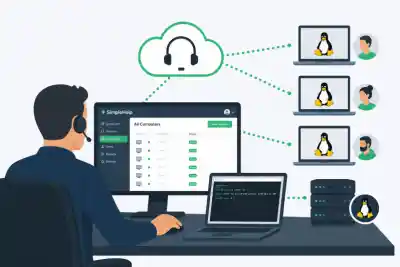
- Persistent Visibility: Organizations use SimpleHelp RMM capabilities to maintain persistent visibility into Linux endpoints, provide unattended access, and deploy fixes across distributed environments.
- Trusted Bridges: Once a technician authenticates, the platform acts as a trusted bridge into systems that would otherwise remain isolated from external access.
- Administrative Foothold: A foothold inside a remote support system can expose technician sessions, privileged workflows, connected clients, and administrative functions already trusted throughout the environment.
From an operational perspective, this makes remote support software an attractive target. An attacker does not necessarily need to compromise every Linux endpoint individually if they can gain access to the management platform responsible for those endpoints.
What Is CVE-2026-48558?
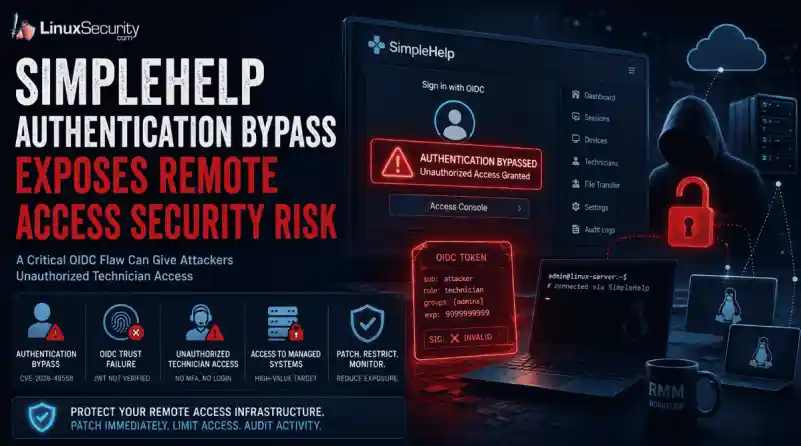
CVE-2026-48558 is an authentication bypass vulnerability affecting certain SimpleHelp deployments that use OpenID Connect (OIDC) authentication. The issue is tracked in the GitHub Advisory Database.
The issue sits in the identity validation process rather than the traditional username-and-password flow. Under specific conditions, the application can accept identity information that should not be trusted, allowing an attacker to obtain technician access without successfully completing the authentication process administrators expect.
How the OIDC Authentication Bypass Works
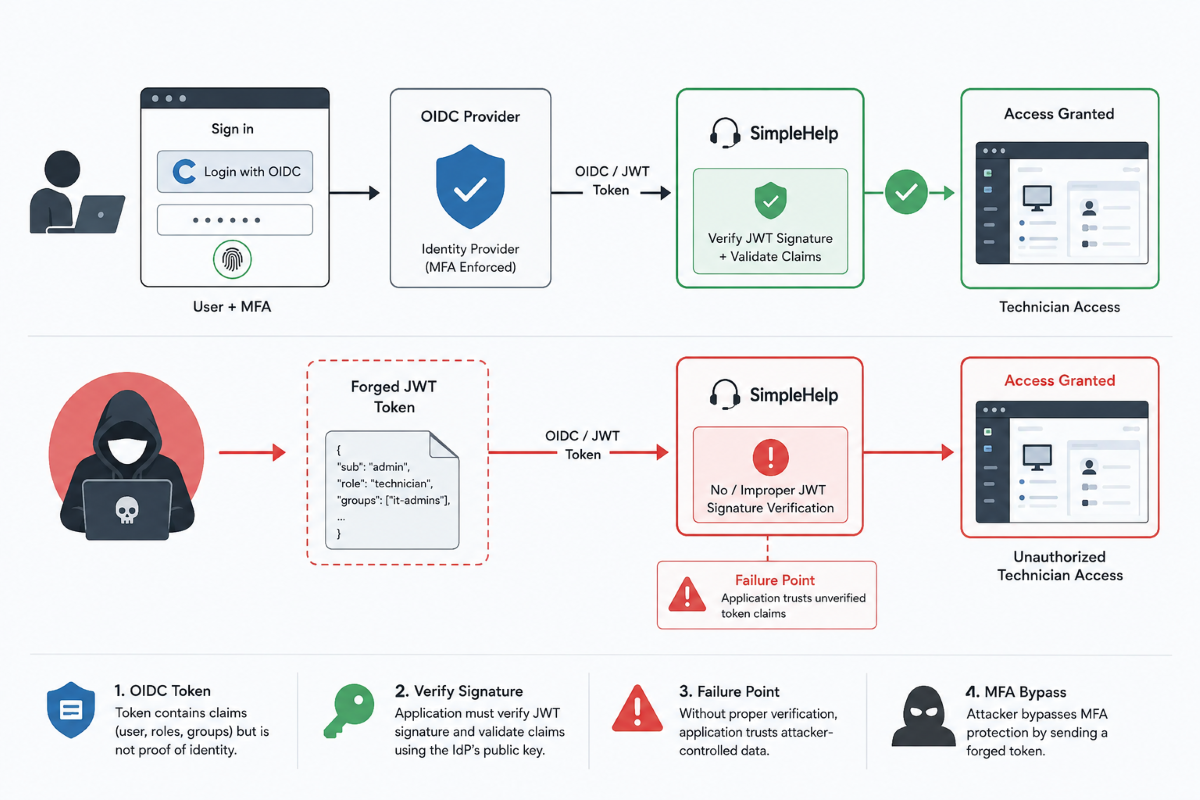
The decision that matters happens when SimpleHelp receives an identity token and decides whether that token represents a legitimate user. Additional technical analysis and indicators of compromise have been published by Horizon3.ai researchers.
- OIDC Trust Depends on Token Verification: An OIDC token is not proof of identity by itself; it contains claims like usernames and group memberships.
- The Necessity of JWT Signature Verification: Before SimpleHelp can trust any of these claims, it must perform JWT signature verification and validate the supporting claims.
- The Failure Point: Without proper JWT signature verification, the entire authentication process becomes dependent on data the application should never have trusted.
This is also where MFA bypass concerns enter the discussion. Many administrators assume their identity provider's MFA requirement protects downstream applications automatically. In reality, that protection depends on the application correctly validating the token it receives. If SimpleHelp accepts a forged token, the vulnerability can undermine the assurance administrators normally associate with MFA-protected OIDC logins.
Why This SimpleHelp Flaw Is Serious
A login bypass affecting a low-privilege application might expose a handful of records. A login bypass affecting remote support software is different because the account behind the login often has visibility into systems, users, and administrative operations that already hold a trusted position inside the environment.
Unauthorized Technician Access Can Become Endpoint Access
In many Linux deployments, technicians use the platform to launch support sessions or perform administrative actions via command-line tools. An attacker who gains unauthorized technician access is not starting from scratch; the platform already contains trusted pathways into managed assets.
Existing support workflows, endpoint inventories, technician permissions, and administrative functions—often managed via scripts and automation—may already be available through the same interface. This is why platforms associated with remote monitoring and management operations receive so much scrutiny during investigations. A compromise of the management layer can provide access to systems that were never directly exposed to the internet.
Who Is Affected by CVE-2026-48558?
Organizations should verify their deployment against the SimpleHelp vendor advisory. The highest-risk environments generally share a few characteristics:
- Vulnerable Versions: SimpleHelp versions identified as vulnerable by the vendor.
- OIDC Usage: Deployments configured to use OIDC authentication rather than local authentication alone.
- Public Accessibility: Internet-facing or broadly accessible SimpleHelp portals.
- High-Value Targets: Environments where technician accounts have access to large numbers of managed endpoints.
- RMM Workflows: Organizations using SimpleHelp RMM for remote administration or support operations.
How Organizations Should Mitigate the SimpleHelp Vulnerability
The first priority is to patch affected SimpleHelp systems and move to a fixed version as soon as possible. Because this involves an identity validation flaw, perimeter controls alone are insufficient.
- Limit Exposure: If the platform is running on a Linux server, restrict access to the login portal and administrative interfaces through VPNs, local firewall rules (like nftables or iptables), or network segmentation.
- Audit Technician Accounts: Remove accounts that are no longer required and verify that administrative privileges are assigned only where necessary. In environments built around remote monitoring and management, old technician accounts often survive much longer than intended.
- Review OIDC Configuration: The vulnerability centers on identity trust. Verify your identity provider integrations, token validation settings, and signing key configuration.
- Prioritize Logging: Review authentication logs, technician account activity, and unexpected remote sessions. These artifacts may provide the first indication that the platform was used in ways administrators did not intend.
Final Takeaway: Identity Trust Failures Can Expose Managed Infrastructure
CVE-2026-48558 is more than an isolated authentication bypass vulnerability. It affects a trusted access path inside a platform used to reach systems across managed environments.
When identity validation fails in that kind of system, the risk extends well beyond a single login event. Remote access security depends on more than successful authentication—it depends on ensuring every system in the chain correctly validates the identity information it receives before granting access to resources that sit close to the infrastructure administrators are trying to protect.
Does your team have a specific incident response checklist for Linux-based remote management platforms, or would you like to explore how to audit your OIDC token validation settings further?
Want more Linux security news, vulnerability analysis, and remote access security updates? Subscribe to the LinuxSecurity Newsletter and get the latest threats, advisories, and expert insights delivered directly to your inbox. Subscribe to the LinuxSecurity Newsletter
Related Reading
 PREVIOUS

 NEXT
NEXT


Powered By

Linux Security - Your source for Top Linux News, Advisories, HOWTOs and Feature Releases
QUICK LINKS
subscribe to newsletters!
Like staying secure? So do we.
Sign up for updates, tips, and alerts!