Explore top 10 tips to secure your open-source projects now. Read More
×



Server Security data privacy automation
data privacy automation Every system admin has lived through the same Monday morning ritual. A queue of forty tickets, half of them password resets, permission errors, or disk space warnings that any experienced technician could resolve in under two minutes. The other half require actual judgment. For years, automation promised that software would eventually sort the two apart on its own. That promise is now being tested in production Linux environments. . Early results are reshaping how IT teams think about tier-1...
 Jul 17, 2026

Privacydata collection automation
data collection automation You're running a web scraping project to collect pricing data from e-commerce sites. You set up a pool of datacenter proxies, launch your scripts, and within minutes — banned . CAPTCHAs everywhere. Your data pipeline stops before it really begins. . It's a frustrating scenario that plays out daily in ad verification, market research, and multi-account management. The website doesn't know you're doing legitimate research or monitoring. It just sees traffic coming from IP ranges it recognizes as...
Jul 17, 2026

Security Trends security advisory social engineering
security advisory social engineering Business Email Compromise used to be a numbers game — mass-blasted emails, broken English, an obvious "URGENT WIRE TRANSFER" subject line. That era is over. Generative AI has turned BEC into a tailored, low-noise operation that mimics writing style, voice, and even video presence. This piece looks at what's actually changed under the hood, what defenders are testing in response, and why so many organizations are still structurally unprepared for it. . The Infrastructure Problem Nobody Wants to...
Jul 17, 2026
Security Trends cybersecurity Linux documentation
cybersecurity Linux documentation Linux operating systems have gained prominence due to their stability, adaptability, and excellent security options. In the case of developing documentation, designing cybersecurity dashboards, or educational material, visuals are of vital importance when it comes to making things clear. The use of icons allows one to understand the message regarding alerts, authorization, encryption, authentication, or the state of the system just by looking at the visual cue without having to read long...
Jul 17, 2026
Security Vulnerabilities security advisory linux distribution
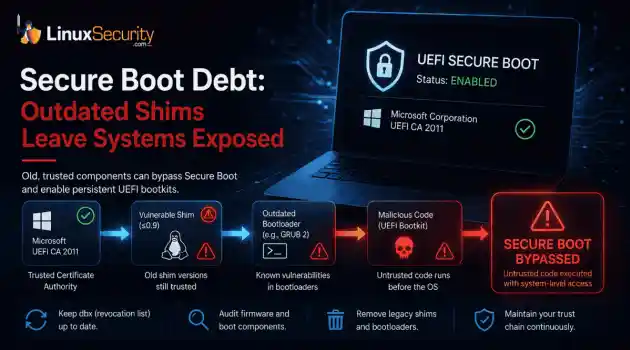
security advisory linux distribution ESET researchers identified 11 old and forgotten Linux UEFI shim bootloaders at versions 0.9 and below that can be used to bypass UEFI Secure Boot on any UEFI-based machine that trusts Microsoft’s Microsoft Corporation UEFI CA 2011 third-party certificate authority, regardless of the installed operating system (OS). Reported shims can be exploited to execute untrusted code during system boot, enabling attackers to deploy malicious UEFI bootkits even on systems with UEFI Secure Boot enabled.....
Jul 16, 2026
 Refine news
X Clear Filters
Get the latest News and Insights
Get the latest Linux and open source security news straight to your inbox.
Community Poll
Is continuous patching actually viable?
Loading...
Explore Latest Linux Security news
We found 11 articles for you...
79
 memory safetysystem resiliencedeveloper challenges
Linux Kernel: Rust Integration Offers Security and Resilience Challenges
Linux continues to form the backbone for various systems, ranging from cloud infrastructure to embedded devices, and Rust's integration in its kernel has become a hot topic. Rust offers many advantages when used with C, such as reduced security vulnerabilities due to memory safety features. . Rust could transform system security by making systems more resilient against memory-related exploits. However, adding Rust to 34 million lines of existing C code within the Linux kernel itself won't come easily. Even Linus Torvalds acknowledged the challenges he faced while trying this feat! We, Linux security administrators, must understand both the security enhancements and practical challenges presented by Rust's integration, along with any associated obstacles. Rust may offer improved reliability and security; however, its learning curve and rigorous review can present daunting hurdles to its adoption. Developers may react differently: some are wary about extra workload, while others see long-term benefits. Therefore, Linux admins must navigate these changes mindfully by understanding the perspectives involved and planning for the integration process to create more secure kernels across Linux environments. Let's examine the promise of Rust integration in Linux, potential integration challenges, and Linux kernel developers' perspectives on Rust integration in the LInux kernel. The Promise of Rust: Enhanced Memory Safety The most compelling reason for integrating Rust into the Linux kernel is its promise of enhanced memory safety. In traditional C programming , memory management is manual and prone to errors that can have profound security implications. Buffer overflows , use-after-free errors, and null pointer dereferences are common issues that plague C code, including in the Linux kernel. Attackers can exploit these vulnerabilities to gain unauthorized access, execute arbitrary code, or crash systems. Rust, designed with a strong emphasis on memory safety, prevents these classes of bugs at compile time. It achieves this through ownership, borrowing, and lifetime rules, ensuring that memory is managed safely and efficiently. The Rust compiler enforces these rules, making it virtually impossible for developers to introduce memory safety bugs. This means integrating Rust into the Linux kernel could substantially reduce the number of security vulnerabilities, leading to a more secure operating system. For security admins, this is a tantalizing prospect. Minimizing memory safety issues at such a fundamental layer of the system could lead to a significant decrease in security patches and emergency updates. This would enhance the overall stability and security of systems and allow security teams to focus on other critical tasks. However, while the benefits are clear, the integration process is fraught with challenges. The Hurdles of Integration Linus Torvalds, the creator of Linux, has acknowledged the difficulty in incorporating Rust into the existing kernel. As it contains about 34 million lines of C code, which has been developed over three decades, adding another language is no easy task. One key challenge in Rust development is maintaining compatibility between C and Rust modules. Linux relies heavily on C's capabilities for many core functionalities inside its kernel. To make Rust work alongside C, developers must bridge between languages using Foreign Function Interfaces (FFI) . While FFI provides some connectivity between languages, its additional complexity increases the potential for bugs. Rust's learning curve can also be steep. To become proficient, developers familiar with C need to devote both time and energy to becoming adept with Rust, including understanding its distinct memory management rules and idioms. Experienced kernel developers working for years with C may find transitioning difficult. Decades-long C code may need revamping or a complete rewrite to align with Rust safety requirements. Developers' Perspectives: Mixed Reactions Developers'responses to Rust being integrated into the Linux kernel have varied widely. While some are excited about how it could improve code quality and security, others worry about its additional workload and complexity in merging two languages into one. Prominent kernel developers such as Greg Kroah-Hartman have supported Rust, noting the long-term advantages it can bring when writing safer code. They believe the initial investment to learn Rust and refactor code will pay dividends in reduced vulnerabilities and creating an increasingly stable kernel. Kroah-Hartman believes such work is worth undertaking, given how problematic security issues have become in today's society. On the other hand, some developers express hesitation. Christoph Hellwig, in particular, has voiced his displeasure over Rust adoption. His concerns include the laborious integration process diverting resources from critical tasks and hindering focus on other key projects. These sentiments echo among other developers, as Rust can slow development efforts down while adding fresh challenges. Although Rust faces many hurdles in its adoption, the overall momentum seems positive. The kernel community recognizes its security benefits and has warmed up to Rust gradually. As more developers gain proficiency with the Rust programming language and tools and practices developed for integration processes created by its community, integration may become smoother over time. The Road Ahead: Preparing for Change Preparation and understanding are keys to successfully transitioning Rust into the Linux kernel, as these changes can be managed effectively with proper planning. First and foremost, it is important to keep abreast of developments within the Rust integration process. Being aware of patches, updates, and best practices is crucial to remaining compliant, while engaging with Linux community discussions may offer valuable insights and enable early warning of potential issues that arise. Second, investing in training and educationfor your team is critical. As Rust becomes more integrated into kernel codebases, having team members proficient with Rust will become an invaluable asset to any company. Giving developers opportunities to learn Rust in-depth can ease the transition and minimize the learning curve. Fostering an environment of collaboration and adaptability is key to successfully integrating Rust into the Linux kernel. Promoting open communication, cooperation, and willingness to adapt will help facilitate an easy transition process for everyone involved. Our Final Thoughts: Embracing the Future of Kernel Security with Rust Integration of Rust into the Linux kernel is an exciting venture that promises to strengthen its security and stability dramatically. While implementation will present its share of challenges, the long-term benefits of increased memory safety and reduced vulnerabilities make this endeavor worthwhile. We Linux security admins know the key to successfully making the transition involves understanding its security advantages and the practical barriers involved. By staying informed, investing in training, and cultivating a culture of collaboration among security teams, we can ensure a smooth integration of Rust into the Linux kernel. As Linux continues its journey of innovation and adaptation, accepting Rust will prove pivotal in building a more secure and resilient operating system for tomorrow. How do you feel about Rust integration in the kernel? We'd love to hear your opinion @lnxsec! . Go can strengthen Windows reliability and protection, yet incorporation presents notable hurdles for programmers and system operators.. Rust Integration, Linux Kernel Security, Memory Management, System Resilience. . Brittany Day
 Apr 08, 2025
•
Apr 08, 2025
• Security Projects
77
 data protectionsystem administrationscalability
Benefits of Cloud Linux for E-Commerce: Security and Scalability Insights
Online stores are an essential part of the modern economy. Their stability, speed, and security directly affect a business's success. However, owners of online stores often have questions about the appropriate operating system. This is understandable, as they want modern solutions and high-quality service. . Among the many options, cloud Linux can be called the ideal solution. This operating system provides many advantages, especially for those working with e-commerce . If you want a suitable alternative, dedicated server hosting will be your faithful assistant. Many modern services offer access to safe and reliable equipment, enabling you to transform your business and succeed digitally. Benefits of Using Cloud Linux for Online Stores Cloud Linux has many advantages. It can make online store management more controlled and increase efficiency while strengthening eCommerce Security Stability and Fault Tolerance : Cloud technologies ensure continuous system operation, which is critical for sites with high loads. Powerful Protection : Cloud Linux provides strong security against external threats like viruses or hacking attempts . Scalability : It allows you to quickly scale your project as traffic grows without affecting the system's stability. Data Optimization : Cloud Linux is designed to handle large amounts of data efficiently, improving request processing speed and site loading time. Resource Management : Easily control the server's memory, processor, and other capabilities to distribute resources effectively. Such features are how the operating system Cloud Linux has many advantages. They are essential for the successful operation and growth of your business. Flexibility and Scalability in Cloud Linux An online store must function effectively so customers can comfortably use its offers. When pages load quickly, visitors do not have to wait long. As a result, they are happy and will visit the site repeatedly. If you want youronline store to operate exactly like this, you must worry about fast scalability and adaptability to changing market conditions. Cloud Linux perfectly copes with this task, offering high flexibility. You can add or remove resources quickly, and this is very important. This way, it’s possible to maintain your online store at the required level of performance. You will not be afraid of seasonal fluctuations in traffic. This is an excellent option for small businesses since, as they grow, you can easily switch to more powerful servers. Compare two scaling options: a physical server and a regional platform. If adding computing power becomes more difficult as the volume increases in the first case, you can do so in the cloud without unnecessary costs and complications. Advantages of Cloud Linux Scalability: Ability to increase server capacity at any time Resource customization depending on business needs Minimization of equipment costs Reduction of time for implementing new functions Capability to work with large volumes of data The privilege of Cloud Linux is that, despite the increased traffic, the system continues to work effectively at the required speed without failures or overloads. Thus, online store owners can be confident in the reliability of their platform even during peak loads. Ease of Management and Security The most critical aspects for online store owners are ease of management and high security. Cloud Linux offers flexible administration options and robust data protection tools. The system actively uses isolation and attack defense technologies to ensure the security of business and customer data. Cloud Linux can help improve security and ease of management in the following ways: Isolation of accounts and processes to prevent attacks Automatic updates and patches to avoid vulnerabilities Protection against DDoS attacks Reliable management of passwords and access rights Integration with anti-fraud systems to protect payments The Cloud Linux safe system provides more security guarantees than traditional solutions. Such features are essential for online stores, which often face fraud or data leakage threats. To use it, you need to set the proper settings. Save Your Budget with Cloud Linux Many online store owners are looking for savings. Traditional servers require significant investments in equipment, labor costs, and regular maintenance. However, Cloud Linux saves a lot on IT infrastructure and support personnel. The cloud technology platform works on a subscription model. You can more flexibly control your expenses by paying only for the features you use. Savings are available in the following methods: There’s no need for significant investments in physical equipment Reduced energy and maintenance costs Flexibility in choosing tariff plans Optimization of resource use No need for constant support The right approach to using Cloud Linux in an online store will allow you to save money greatly. This is excellent news because you can direct the saved budget to business development, marketing, improving customer service, and other areas. Final Thoughts Cloud Linux is the preferred solution for online retailers. The solution has a lot of strengths, including excellent security, required performance, flexibility, and scalability. The system has a particular appeal for companies because it is economical and easy to use. By leveraging Cloud Linux, businesses can ensure seamless operations even during peak traffic periods while maintaining robust security and cost-efficiency. The ability to scale resources efficiently provides online store owners with long-term stability and adaptability to market changes. You need to correctly select the host of your business. Investigate the options and find the best offer that will optimize the operation and maximize the returns. . Among the many options, cloud Linux can be called the ideal solution. This operating system provides. online, stores,essential, modern, economy, their, stability, speed, security. . MaK Ulac
Feb 26, 2025
•
Server Security

79
 Debianlinux distributionapplication management
Free10: A Debian-Focused OS for Windows 10 Users Prioritizing Security
If you're a security-conscious Linux admin or a Windows 10 user considering a switch to Linux, you might be surprised to learn about Free10 . This Linux distribution offers significant security benefits while boasting a familiar Windows-like interface. . With a solid Debian foundation, Free10 makes switching easier while providing security benefits - not to mention no need to navigate around a new interface and risk introducing potential security risks! One of the key advantages of Free10 is its customization capabilities to meet your security needs. KDE Plasma-based customization options help meet admins' specific needs, from full-featured setups to interfaces that minimize the attack surface. Furthermore, with Flatpak support available within Free10, you can run applications in isolated environments, further increasing security by restricting their access to system resources. Let's take a closer look at the features that make Free10 user-friendly and robust enough to meet high-security standards and provide a viable Windows 10 alternative for admins looking to transition to Linux. A Familiar Interface with Strong Security Underpinnings Free10 makes transitioning to a new operating system less daunting by providing an interface similar to Windows 10, helping reduce learning curves for those familiar with its use. Its desktop layout, start menu, and overall design philosophy offer familiarity, reducing errors that could compromise security as users adjust to a different system. Debian, renowned for its stability and security, lies beneath this familiar Windows-like shell. Debian's strict package management and regular security updates allow Free10 users to take advantage of all the latest patches without needing to navigate a complex update process, making this environment suitable for newcomers and veteran Linux admins looking for an accessible yet secure system. Desktop Customization for Enhanced Security Free10 stands out among competing OSes because of its flexible desktopenvironment customization features. Users can select from a selection of desktop environments based on KDE Plasma , including full-featured, basic, and minimal setups. Customization does more than satisfy aesthetic preferences; it has significant security implications. Opting for a minimal desktop setup can be especially beneficial to users who prioritize security over all else. A minimal desktop features fewer programs and services running by default, reducing its attack surface and making the system more secure. Furthermore, customizing Linux admin environments to focus on security while offering a usable environment is another helpful approach, ensuring all daily tasks can be performed smoothly. Switching between desktop profiles is especially valuable for administrators overseeing multiple systems or users with differing security needs, such as handling sensitive data in an environment with a minimal setup. On the other hand, development environments might need full-featured desktops equipped with additional applications and services. KDE Discover and Flatpak: Secure Application Management Free10 uses KDE Discover to assist users in discovering and installing applications with minimal hassle, making KDE updates easily available. Hence, users always have access to the latest features and security patches. This approach ensures users can always benefit from accessing new features or patches without delay. One of the more surprising features of Free10 is its support for Flatpak , an innovative packaging format designed to increase application security. Although Free10 doesn't have this support by default, it can be easily accomplished in KDE Discover by opening its settings and clicking "Add Flathub." Flatpak applications run within isolated environments known as sandboxes, which greatly increase security by restricting access to system resources and user data. This is particularly helpful when installing proprietary or third-party applications that pose risks of system-wide issues oraccessing sensitive data. Linux admins will appreciate KDE Discover and Flatpak's sandboxing features, allowing them to monitor applications easily while protecting against security vulnerabilities. Free10 is an attractive option for tech-savvy users who require secure systems and those looking for simpler operating environments with better protections against vulnerabilities. Stability and Regular Updates OS security extends beyond inherent features and hinges upon regular and stable updates . Debian was chosen as the foundation for Free10 because of its proven record for stability, with rigorous testing processes before updates are released. This ensures each update provides improved security and is reliable enough to reduce system crashes or other issues that might compromise it. Free10 takes its inspiration from Debian by providing users with regular and secure updates that keep their systems safe from new threats and ensure users can rely on up-to-date security patches to defend against newer ones. Users can trust that Free10 will always remain up-to-date regarding its defenses against threats as time progresses. With this foundation, they know their system remains protected against persistent and emerging attacks. User and Admin-Friendly Environment Transitioning to a new operating system can be daunting for non-tech-savvy users or those deeply invested in the Windows ecosystem. Free10's design, which mimics that of Windows 10, dramatically lowers the barrier to entry for these users. They don't need to learn unfamiliar workflows or navigation methods, which could cause frustration or compromise security. Linux administrators will benefit from this user-friendly environment in that less time is spent training and supporting end-users. Instead, they can devote more of their attention to configuring and maintaining security on the system. It also empowers end-users to manage basic tasks themselves without incurring unnecessary security risks through unfamiliarity. Community andSupport Free10 benefits from having access to one of the largest and most active Linux communities - Debian . This community contributes regular updates and security patches while providing administrators with plenty of resources they can draw upon when troubleshooting and aiming to increase security on their system. Free10 users also benefit from forums, documentation, and support channels where they can pose their queries, share experiences with fellow users and developers, and get advice from other Free10 users and developers alike. This collaborative environment fosters continuous improvement while keeping an eye on security measures. Our Final Thoughts on Transitioning to Free10 Free10 provides an attractive alternative for security-conscious Linux administrators and Windows 10 users looking to switch over. Featuring a familiar Windows-like interface, robust Debian-based security, customizable desktop environments, and application management support via KDE Discover and Flatpak, Free10 is a safe yet practical choice. Free10 provides everything necessary to secure multiple systems with differing security needs or create a user-friendly yet secure environment for personal use, making it the ideal solution for maintaining high standards without compromising usability. Its familiarity, customization, and strong security foundations make Free10 an attractive alternative to Windows while offering secure workflow capabilities. You can easily download and install Free10 for free. Have you given Free10 a try? We'd love to hear what you think @lnxsec ! . Free10's Debian framework simplifies the switch from macOS, offering enhanced safety and an interface that feels like home.. Free10 Linux, Debian security, KDE Plasma customization, secure Linux alternative, Linux distribution features. . Brittany Day
Feb 25, 2025
•
Security Projects
81
 authenticationLinux usersdevice security
Google Expands Passkey Support: Enhanced Authentication for Linux Users
In a bold move towards a future without traditional passwords, Google has introduced secure passkey sign-ins across almost all devices, including Windows, macOS, Linux, and Android. This change will revolutionize how users authenticate their identity online, providing a more secure and seamless experience. . While Apple’s iOS is next in line, this widespread rollout marks a significant milestone in the broader trend of passwordless authentication. Let's examine the security benefits passkeys offer over passwords and how you can get started with passkeys on Linux today! Understanding Passkeys vs. Passwords When evaluating the pros and cons of passwords and passkeys , it is important to highlight their distinct characteristics and advantages. Passwords are a universally accepted and understood authentication method, offering a straightforward approach for users. However, they come with significant drawbacks, such as susceptibility to brute force and phishing attacks, the necessity for users to remember complex characters, and the fact that even when stored as hashes, they can still be cracked with sufficient computational power. On the other hand, passkeys present a more secure alternative, notably resistant to phishing and brute force attacks. They provide a streamlined user experience, primarily using biometrics or device PINs for authentication, and their end-to-end encryption ensures that even companies like Google cannot access the key. Despite these advantages, passkeys currently have a limited rollout and require compatible devices, making them dependent on hardware for biometric authentication. How Do Hackers Crack Passwords? Hackers employ several methods to crack passwords, including: Brute Force Attacks : Involves systematically trying every possible combination until the correct one is found. Although effective, it requires significant computational power. Phishing : Deceptively obtaining user credentials by masquerading as a legitimate entity. Keylogging : Using malware to record keystrokes as users type their passwords. Most services store passwords as hashes—a one-way math function that converts plaintext to a fixed-length binary sequence. However, with enough computational resources, even hashed passwords can be cracked using brute force. How Do Passkeys Mitigate Risk? Passkeys mitigate these risks by eliminating the need for raw password strings. Since passkeys rely on device-specific cryptographic keys and biometrics, hacking attempts would require physical access to the user's device and biometric data, making remote attacks near impossible. Getting Started with Passkeys on Linux Ready to make the switch? Linux users can get started using passkeys to improve their online security and privacy by following these steps: Ensure Your System is Updated: Ensure your OS and Google Chrome are updated to the latest versions supporting passkeys. Set Up Google Password Manager: Use the built-in password manager in Chrome, setting a strong PIN for added securi ty. Enable Biometric Authentication: If your device supports biometrics, enable this in your system settings. Sync Across Devices: Log into your Google account and sync the passkeys across your devices. Security Considerations Although passkeys offer inherent security benefits, it is crucial to engage in the following security best practices when using them: Device Security: Ensure your device is secure from physical theft and unauthorized access. Strong PINs: If using a PIN instead of biometrics, ensure it is strong and unique. Regular Audits: Review your security settings to ensure they align with best practices. Our Final Thoughts on Passkeys vs. Passwords for Improved Security Google's move towards integrating secure passkey sign-ins across various devices signifies a pivotal step towards a passwordless future. By leveraging passkeys, users can enjoy a more secure, seamless authentication process thatdramatically reduces the risk of traditional password-related attacks. As we move further into this new era of cybersecurity, embracing technologies like passkeys will undoubtedly play a crucial role in protecting our digital identities. . Google's passkey initiative is a major leap for user authentication, especially benefiting Linux users by reducing vulnerabilities and enhancing security.. passkeys, Linux authentication, passwordless security, Google sign-in, cybersecurity. . Dave Wreski
Sep 26, 2024
•
Privacy
79
 open sourceopen standardsecurity benefits
RISC-V Enhances Security in Open Standard Chip Development
RISC-V, an open-standard instruction set architecture (ISA) designed to be license-free and royalty-free, is creating a new Linux movement in the hardware industry. The goal of the project is to create a single standard for processors and other chips that can be used across different devices, which will make it easier for developers to work on multiple platforms without having to learn new languages. . RISC-V was developed as an open-source alternative to ARM processors, which are popular with many companies that build hardware. This gives developers more control over their products but also means that they must learn new programming languages. The author then goes on to discuss other companies that are building chips based on RISC-V, including AMD and Nvidia. RISC-V has notable security benefits, as a more open architecture is safer because it allows independent researchers to red-team it and find all the holes that need to be fixed. I found the article linked below very helpful in understanding the rise of RISC-V and the impact it is currently having in India. I encourage you to check it out! . RISC-V opens a fresh era for Linux in hardware, enabling open protocols and enhanced safety in silicon architecture.. RISC-V, Open-Standard Hardware, Chip Design, Instruction Set Architecture, Open Source Technology. . LinuxSecurity.com Team
Dec 18, 2023
•
Security Projects
209
 risk managementcybersecuritysecurity outsourcing
Enhancing Cybersecurity with SOC as a Service Features and Benefits
With the ever-growing threat of cyberattacks, it's more important for businesses to invest in robust cybersecurity measures. However, many businesses lack the in-house expertise to manage their security operations needs effectively. . Outsourcing your security operations can be a cost-effective solution that provides access to experienced professionals. It can free up internal resources to focus on other priorities. When done correctly, outsourcing your Security Operations Center (SOC) can provide many significant benefits for businesses. What is a SOCaaS? Security Operations Center as a Service (SOCaaS) is a managed security service where the resources normally held in-house by an organization are instead outsourced to a team of trained security professionals, equipped with the knowledge and technology to better manage the security systems and software of the organization. Instead of an organization trying to mitigate threats and trying to decipher real threats from false alarms, many organizations have turned to a dedicated business in a separate facility with dedicated resources to track down and manage these threats. This third-party works with IT security teams at the organization to manage all their threat monitoring and risk management so the in-house IT security teams are freed up to handle everything else. SOC as a Service Benefits Organizations today are looking to reap the benefits of a security team that can deliver reliable and innovative security protection. SOC implementations are expensive to manage, extremely complex and can take years to become operational. Outsourcing an organization’s security operations like assistance with compliance, continuous centralized monitoring and access to a full staff of security experts could lead to much lower operating costs and more effective security operations for the organization. Threat Detection and Response In the cybersecurity world, threat detection and response is one of the most important functions of anorganization. It's also one of the most difficult and resource-intensive. Cybercriminals constantly evolve their methods, and organizations must constantly update their defenses to stay ahead of the curve. This process is costly and time-consuming, so many organizations outsource their cybersecurity operations from companies offering SOC as a Service. The main benefit of outsourced cybersecurity operations is that it gives organizations access to a team of experts who constantly monitor for threats in corporate data and can quickly respond to them if they arise. This ensures organizations are one step ahead of cybercriminals. Outsourcing cybersecurity operations provides peace of mind and allows organizations to focus on their core business functions, knowing that their cybersecurity is in good hands. Reduced Operational Costs Hiring in-house cybersecurity experts is costly, and the costs continue to rise as the demand for these professionals grows. Many businesses lack the internal resources to manage their cybersecurity needs effectively. This often leads to organizations spending more money than necessary on cybersecurity products and services. Outsourcing your security operations can help businesses save money by giving them access to a team of experts for a fraction of the cost of hiring in-house. Sharing security resources between many different clients in a shared SOC will save every business money. Minimizing cybersecurity risks by leveraging the professional skills available at a SOCaaS facility makes business sense. Improved Security Posture Optimizing an organization’s protect, detection and response capabilities using a SOCaaS can help to improve security overall through continual monitoring, assessment and reporting of security events, as well as guidance on security strategies and policies. Access to a trained team of security experts to resolve security events as well as to analyze and respond to attacks, means organization’s can focus on their core competenciesinstead of relying on only in-house expertise. Extensive Experience and Resources Using a SOCaaS team means the organization gets an unbiased view on how to fortify their security operations. This can be used in conjunction with their in-house security and IT plans. This provides a more sophisticated approach to protecting against the latest threats Resources dedicated to tracking down malicious behavior also frees up other resources and gives businesses the opportunity to engage teams with the experience and devotion to the evolving threat landscape and always challenging security technology. Constant Monitoring Around-the-clock monitoring is vital because threats can emerge anytime, and you need to ensure that your systems are protected 24/7. An experienced managed security services provider has the tools and resources to monitor your systems constantly and quickly respond to any threats that emerge. This is beneficial for organizations that do not have the internal resources to monitor their systems constantly. Having an outsourced SOC team means a better ability to respond to threats with well-defined action plans and protocols. Peace of Mind By outsourcing their cybersecurity operations, businesses can focus on their core competencies and leave their data security to a trusted third-party provider. Knowing that your data is safe, you can trust that your provider has the experience and resources necessary to protect your data. Cost-Effective Outsourcing enables organizations to only pay for the services they need. This is different from hiring an in-house team, which can be costly. Continually upgrading your cybersecurity infrastructure will quickly drain your ability to invest in revenue-generating opportunities. In Conclusion Outsourcing your cybersecurity can be a great decision for your business. Choosing the right provider can improve your security posture while freeing up time and resources to focus on your core business objectives. . Delegating security tasksincreases efficiency and lowers expenses, simultaneously strengthening your organization's protection against cyber threats.. SOCaaS Benefits, Cybersecurity Management, Operational Cost Reduction. . Brittany Day
Jun 10, 2022
•
Security Trends
215
open sourceLinux desktopLinux advantagesThe Linux Desktop: Unmatched Performance And Security Benefits
Learn about the advantages of the Linux desktop - improved security being one of the most notable benefits. . I've used pretty much every desktop out there, and the Linux desktop is still the best of the best. I've been working with desktop computers since CP/M-80 was the operating system of the day. Since then, I've used MS-DOS, Windows, OS/2, AmigaOS, System 7, macOS, Xenix, SCO OpenDesktop, and more versions of Linux than you can shake a stick at. Even today, I have Windows 10 and 11 and macOS running on test boxes. But what I run on my production PCs and laptops is Linux. Here's why. . The Linux desktop stands tall among its peers, boasting distinct advantages in areas such as security and usability. Unveil the reasons it is unparalleled!. Linux Desktop Experience, Open Source Advantages, Linux Security Benefits. . Brittany Day
Apr 15, 2022
•
Desktop Security
67
 web performanceprivacy issuessecurity benefits
Understanding HTTP/3: Benefits And Key Issues For Security And Privacy
HTTP/3 brings improved performance and reliability, as well as various security and privacy benefits - but there are some serious concerns that need to be considered. . HTTP3, the third official version of hypertext transfer protocol (HTTP), will not use the transmission control protocol (TCP) as did its predecessors. Instead, it uses the quick UDP internet connections (QUIC) protocol developed by Google in 2012. QUIC is a transport layer protocol based on a multiplexed version of user datagram protocol (UDP) connections. Unlike TCP, UDP does not follow the TCP three-way handshake, but uses a single UDP roundtrip. Thus, the QUIC protocol exponentially improves any web component's network performances as it uses UDP for every connection between the user-agent and the web server. Also, QUIC relies on multiplexing to manage multiple interactions between the user-agent and server seamlessly over a single connection, without any one blocking another, thus helping with performance improvements compared to its predecessors. . HTTP/3, leveraging QUIC, improves web communication with stronger security and performance, while introducing challenges in compatibility and monitoring practices. HTTP/3, QUIC, Web Performance, Security Benefits, Privacy Issues. . LinuxSecurity.com Team
Jun 29, 2020
•
Cryptography

Get the latest News and Insights
Get the latest Linux and open source security news straight to your inbox.
Community Poll
Is continuous patching actually viable?
Search Topics
Powered By

Linux Security - Your source for Top Linux News, Advisories, HOWTOs and Feature Releases
QUICK LINKS
subscribe to newsletters!
Like staying secure? So do we.
Sign up for updates, tips, and alerts!