Explore top 10 tips to secure your open-source projects now. Read More
×



Server Security data privacy automation
data privacy automation Every system admin has lived through the same Monday morning ritual. A queue of forty tickets, half of them password resets, permission errors, or disk space warnings that any experienced technician could resolve in under two minutes. The other half require actual judgment. For years, automation promised that software would eventually sort the two apart on its own. That promise is now being tested in production Linux environments. . Early results are reshaping how IT teams think about tier-1...
 Jul 17, 2026

Privacydata collection automation
data collection automation You're running a web scraping project to collect pricing data from e-commerce sites. You set up a pool of datacenter proxies, launch your scripts, and within minutes — banned . CAPTCHAs everywhere. Your data pipeline stops before it really begins. . It's a frustrating scenario that plays out daily in ad verification, market research, and multi-account management. The website doesn't know you're doing legitimate research or monitoring. It just sees traffic coming from IP ranges it recognizes as...
Jul 17, 2026

Security Trends security advisory social engineering
security advisory social engineering Business Email Compromise used to be a numbers game — mass-blasted emails, broken English, an obvious "URGENT WIRE TRANSFER" subject line. That era is over. Generative AI has turned BEC into a tailored, low-noise operation that mimics writing style, voice, and even video presence. This piece looks at what's actually changed under the hood, what defenders are testing in response, and why so many organizations are still structurally unprepared for it. . The Infrastructure Problem Nobody Wants to...
Jul 17, 2026

Security Trends cybersecurity Linux documentation
cybersecurity Linux documentation Linux operating systems have gained prominence due to their stability, adaptability, and excellent security options. In the case of developing documentation, designing cybersecurity dashboards, or educational material, visuals are of vital importance when it comes to making things clear. The use of icons allows one to understand the message regarding alerts, authorization, encryption, authentication, or the state of the system just by looking at the visual cue without having to read long...
Jul 17, 2026
Security Vulnerabilities security advisory linux distribution
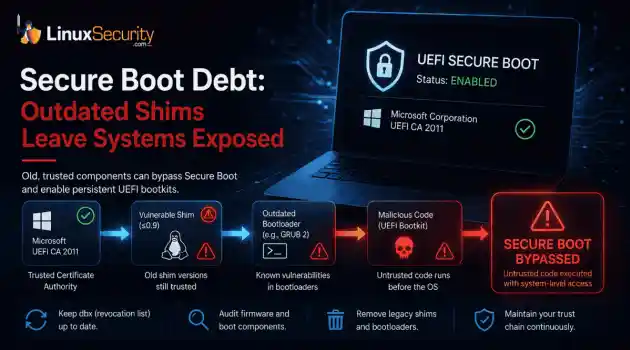
security advisory linux distribution ESET researchers identified 11 old and forgotten Linux UEFI shim bootloaders at versions 0.9 and below that can be used to bypass UEFI Secure Boot on any UEFI-based machine that trusts Microsoft’s Microsoft Corporation UEFI CA 2011 third-party certificate authority, regardless of the installed operating system (OS). Reported shims can be exploited to execute untrusted code during system boot, enabling attackers to deploy malicious UEFI bootkits even on systems with UEFI Secure Boot enabled.....
Jul 16, 2026
 Refine news
X Clear Filters
Get the latest News and Insights
Get the latest Linux and open source security news straight to your inbox.
Community Poll
Is continuous patching actually viable?
Trending News
Loading...
Explore Latest Linux Security news
We found 0 articles for you...
210
 security advisoryLinux kernelnetwork segmentation
CISA: 2024-53104 critical: Linux kernel UVC driver exploit
Recently, the Cybersecurity and Infrastructure Security Agency (CISA) issued a dire warning regarding an out-of-bounds write vulnerability in the Linux kernel tracked as CVE-2024-53104 . This issue exists within UVC drivers and has already been targeted in attacks . We admins must understand the nature of this threat, assess risks to our systems, and take adequate precautionary measures to guard against potential exploitation. . CISA recognizes the urgency of requiring government agencies to patch this flaw within three weeks, and Linux administrators should also act swiftly by applying patches from kernel versions 2.6.26 onward. Let's take a closer look at this severe Linux kernel flaw, its security implications, and measures you can take to fortify your systems against exploits. Understanding This Severe Kernel Vulnerability At the heart of this issue lies an out-of-bounds write vulnerability traced back to the uvc_parse_format function within the UVC driver . The vulnerability stems from improper parsing of UVC_VS_UNDEFINED frames, potentially leading to buffer size miscalculations and subsequent out-of-bounds writes. This vulnerability enables attackers to cause unexpected behaviors and potentially escalate privileges on the affected devices to compromise sensitive data, take over affected devices, and launch further attacks against your systems. Identifying Systems at Risk Identifying whether your systems are at risk involves a few critical steps. First, check the kernel version running on your systems. If it is 2.6.26 or later, your systems could be vulnerable, especially if you use USB Video Class (UVC) devices. The issue is especially pertinent for devices and servers with USB video devices enabled, which could act as potential vectors for exploitation. Steps to Mitigate the Risk of an Exploit Our immediate response to a vulnerability of this magnitude should be patching affected systems. Updating your systems with the latest security patches provided by yourLinux distribution maintainers can effectively mitigate this threat. CISA's mandate for U.S. federal agencies to patch this flaw within a three-week timeline emphasizes this action's critical nature and urgency. But patching alone can't be the end of your mitigation strategy. It’s essential to adopt a multi-layered approach to ensure long-term security. One practical step is reviewing and possibly revising the policy around USB device usage within your organization. If USB video devices are not essential to your operations, consider disabling or limiting their access to reduce potential entry points for attackers. Monitoring and Incident Response In addition to these measures, deploying robust monitoring tools to track device behavior and network traffic is crucial. Anomalies in network traffic or unusual device behaviors often act as early indicators of attempted exploitation. Implementing these tools will allow you to detect and respond to threats faster, potentially before significant damage is done. Preparing for incidents through regular drills and updating your incident response plans can significantly enhance your organization's resilience. Knowing exactly how to act when a vulnerability is identified and having a clear, practiced response plan can considerably reduce the chaos and confusion in the event of an attack. Tracking Advisories and Staying Informed Security is a continuous process that requires staying informed about the latest threats and best practices. Regularly checking for updates and advisories from your Linux distribution is essential. These advisories often provide critical information tailored to your specific Linux environment and contain essential patches or workaround strategies to deal with vulnerabilities. Another essential resource is the CISA’s Known Exploited Vulnerabilities catalog . This catalog is regularly updated with vulnerabilities actively exploited across industries, offering invaluable insight into the current threat landscape. Stayingplugged into these resources can distinguish between proactive defense and reactive damage control. Revising USB Device Policies This vulnerability specifically targets USB Video Class (UVC) drivers, making revisiting your USB device policies prudent. In environments where USB devices are not essential, disabling them can be a straightforward method to close off a potential attack vector. Consider implementing stringent controls and monitoring measures when USB devices are necessary. For instance, only allow USB devices that are essential for business operations and are from trusted sources. Conduct regular audits of connected USB devices to ensure no unauthorized devices are present. Enhanced monitoring of USB ports and connected devices can create an added security layer, helping detect and respond to unauthorized access attempts immediately. Network Segmentation Network segmentation is another layer of security that helps mitigate potential exploitations. By dividing your network into smaller segments, you limit an attacker’s ability to move laterally through your environment if they manage to compromise one device. Each segment should be designed with controls that restrict data flow based on necessity, minimizing the risk exposure if one segment is compromised. In implementing segmentation, ensure critical systems and sensitive data are isolated from less secure segments and employ firewalls and access controls to regulate the traffic between segments. This approach not only helps in containing breaches but also makes the detection and response process more efficient. Enhancing Employee Awareness Employees are an invaluable first line of defense against cyber threats. To inform staff of the dangers associated with USB devices and best practices for safe computing, regular training sessions should focus on recognizing phishing attempts , updating software as necessary, and the risks posed by connecting unknown USB devices. Establishing a security-conscious culture withinyour organization ensures that everyone from the IT team to the general staff is aware and vigilant against possible exploits, decreasing the chance of successful attacks. Our Final Thoughts on Mitigating This Severe Linux Kernel Flaw CVE-2024-53104 represents a serious security threat, underscoring the need for proactive and multilayered security strategies. By understanding its nature, identifying potentially at-risk systems, and creating comprehensive mitigation strategies to combat emerging threats to our networks, we can defend our Linux environments against emerging risks. Patching systems promptly, revising USB device policies, employing robust monitoring tools, staying informed through advisories and CISA resources, network segmentation, employee awareness training, and improving network segmentation are essential steps in strengthening your digital security posture to protect against current and future threats. . CISA mandates patching a serious Linux kernel flaw within three weeks for timely protection against exploits.. recently, cybersecurity, infrastructure, security, agency, (cisa) issued, warning. . Brittany Day
 Feb 13, 2025
•
Feb 13, 2025
• Security Vulnerabilities
77
 access controlserver securitylog management
Enhancing Linux Server Security: Tips for Administrators
In the current threat landscape, Linux servers have emerged as a dominant force, underpinning approximately 81% of all websites globally. Despite the prevalence of Windows in personal computing, Linux's resilience to various threats is a significant factor behind its extensive adoption, particularly in web hosting and enterprise environments. . However, the notion that Linux is impervious to malware is a misconception that can lead to dire security oversights. As a Linux administrator, understanding how to safeguard your systems and implement Linux kernel security patches is crucial—not just against direct attacks but also against the vulnerabilities posed by networked devices running different operating systems. Let's examine the Linux security paradigm and some practical strategies you can employ to boost Linux server security. Understanding the Linux Server Security Paradigm It is imperative to recognize that while Linux servers boast a robust security posture, they are not immune to the complexities of cybersecurity threats. Malware , including ransomware and stealthy rootkits, poses a real risk. Ransomware attacks targeting Linux have been on the rise, particularly impacting major institutions where software updates and security protocols may lag due to their size and complexity. This situation is exacerbated by cryptocurrency miners, which can stealthily exploit server resources, significantly degrading performance while remaining undetected. Moreover, rootkits represent a sophisticated category of malware that requires kernel-level access. These malicious tools manipulate system calls and logs, concealing their presence and actions from standard detection methods. To combat such advanced threats, Linux administrators must employ specialized detection tools like Chkrootkit or rkhunter and implement strict kernel integrity checks. Regularly monitoring critical files and configurations for unauthorized changes is essential for maintaining a secure server environment. TheRole of Antivirus in Linux Server Security Given that most of the internet operates on Linux servers, the potential attack surface for malicious actors is alarmingly expansive. One fundamental layer of defense is the integration of antivirus solutions. While Linux environments are generally more secure, the need for antivirus software arises from the reality of user behavior. Just as a life vest serves as a precaution for a boater, antivirus software provides a safety net for administrators against human error. Handling sensitive data necessitates an elevated level of security, particularly in light of stringent regulatory requirements that many organizations must adhere to today. An effective antivirus solution is not merely a reactive measure but a proactive strategy that helps mitigate the risks associated with human error and external threats. Implementing Best Practices for Enhanced Security The security of Linux servers hinges on a multi-faceted approach. Key strategies include controlling access, hardening credentials, and establishing centralized log management. Each component plays a critical role in fortifying your server against potential threats. Implementing robust strategies can help administrators enhance server security and safeguard sensitive information. We'll delve into critical areas such as controlling access, hardening credentials, establishing centralized log management, utilizing antivirus solutions, employing detection tools, securing exposed services, and maintaining up-to-date software. Control Access The principle of least privilege is foundational to securing any server environment. This principle asserts that users should be granted only those permissions necessary to perform their job functions. Administrators can significantly reduce the risk of unauthorized access by implementing strict user roles and permissions. Each user should have a set of permissions that aligns with their specific responsibilities, limiting their ability to access sensitive data orcritical system components. Administrators should establish a role-based access control (RBAC) model to facilitate effective access control. This model allows for creating user groups with defined permissions, streamlining the management process. For example, a web developer may require access to specific directories and files to deploy applications. At the same time, a system administrator would need broader access for maintenance and updates. By clearly delineating these roles, administrators can minimize the potential for human error and ensure that users are not inadvertently granted excessive permissions. Furthermore, regularly auditing user accounts and access levels is vital. Periodic reviews can help identify inconsistencies or outdated accounts that pose security risks. For instance, employees who leave the organization or change roles may retain access to critical systems if their permissions are not promptly adjusted. Implementing automated tools to manage and review access controls can enhance the efficiency and accuracy of this process. Harden Credentials In an age of increasingly common data breaches, it is crucial to utilize strong and unique passwords for all accounts. Weak passwords remain one of the most exploited vulnerabilities in cybersecurity. Therefore, administrators should enforce a password policy that mandates the use of complex passwords—those that include a mix of uppercase and lowercase letters, numbers, and special characters. Furthermore, these passwords should be unique for each account to prevent a breach in one system from compromising others. Implementing multi-factor authentication (MFA ) is essential to further enhance security. MFA requires users to provide additional verification, such as a one-time code sent to their mobile device alongside their password. This added layer of security significantly reduces the likelihood of unauthorized access, as even if a password is compromised, the attacker would still need a second form ofverification. Establish Centralized Log Management Centralized log management is a vital component of an effective security strategy. Administrators can gain a comprehensive view of server activity by consolidating logs from various systems and applications. This centralized approach facilitates the early detection of suspicious behavior, enabling prompt response to potential threats. Implementing a centralized logging system allows for real-time monitoring of activities across the server infrastructure. For instance, if an unauthorized login attempt occurs, the system can immediately alert administrators, enabling them to investigate the incident swiftly. Moreover, centralized log management aids in compliance with regulatory requirements, as it provides a clear audit trail of user actions and system changes. Utilize Antivirus Solutions While Linux systems are generally perceived as more secure than their counterparts, the integration of robust antivirus solutions remains essential. Antivirus software is a first line of defense against external threats and internal mistakes. Even though Linux is less susceptible to viruses than other operating systems, malware and other malicious software are still a concern. Selecting the right antivirus solution involves evaluating features such as real-time scanning, regular updates, and comprehensive threat detection capabilities. Administrators should choose software that is specifically designed for Linux environments, as these solutions will be better equipped to identify and mitigate threats unique to the platform. Employ Detection Tools Detection tools play a critical role in identifying anomalies within server systems. By implementing regular scans and real-time monitoring, administrators can significantly enhance their ability to respond to threats promptly. These tools can flag unusual activities, such as unexpected changes to critical files or configurations, which may indicate a security breach. Various detection tools areavailable, including intrusion detection systems (IDS) and host-based intrusion detection systems (HIDS) . IDS monitors network traffic for suspicious activity, while HIDS focuses on detecting threats at the host level. Administrators can create a layered defense strategy that provides comprehensive visibility into their server environments by deploying both types of systems. Secure Exposed Services With the increasing connectivity of services accessible from the internet, ensuring their secure configuration is paramount. Any exposed service, whether it be a web server, database, or application, can serve as a potential entry point for attackers. Therefore, administrators must implement strict security measures to protect these services from unauthorized access. This includes regularly updating and patching software to close potential vulnerabilities. Outdated software is one of the most common targets for attackers, as known vulnerabilities can be easily exploited. Administrators can significantly reduce the risk of successful attacks by establishing a routine for applying updates. Furthermore, leveraging tools such as automated patch management systems can streamline the update process, ensuring that critical patches are applied promptly. Keep Software Updated Maintaining up-to-date software is an integral part of any comprehensive security strategy. Regular updates provide new features and patch known vulnerabilities that malicious actors could exploit. Administrators should establish a routine for consistently applying updates, ensuring that system software and applications are current. To facilitate this process, organizations can implement automated update mechanisms where feasible. Automated updates can help alleviate the burden on administrators, ensuring that critical updates are applied without delay. However, balancing automation and manual oversight is essential, as some updates may require testing in a staging environment before deployment to productionsystems. Maintain Robust Cyber Hygiene Cyber hygiene practices form the foundation of a secure operational environment. Utilizing strong passwords, regularly updating software, exercising caution when clicking links, and activating multi-factor authentication are basic yet effective strategies. These measures are crucial for individual users and organizations, enhancing overall security posture and resilience against cyber threats. The Need for Continuous Education and Awareness The evolving nature of cyber threats necessitates that Linux administrators remain vigilant and informed . Continuous education on emerging threats, security patches, and best practices is vital. Organizations should foster a culture of security awareness, ensuring that all personnel understand the importance of cybersecurity measures and their role in maintaining a secure environment. As administrators implement these strategies, they must also stay abreast of the latest security patches and kernel updates provided by the Linux community. Keeping systems current with the latest patches is critical to closing vulnerabilities attackers may exploit. Our Final Thoughts on Enhancing Linux Server Security While Linux servers provide a resilient backbone for much of today’s digital infrastructure, they are not immune to threats. A comprehensive security approach that includes antivirus solutions, proactive monitoring, and adherence to best practices is essential for future-proofing Linux servers against advanced and emerging threats. . Understanding Linux server security is crucial for administrators to defend against threats and implement robust protection measures.. Linux Server Security, Antivirus Solutions, Access Control Best Practices, Cyber Hygiene Techniques. . Brittany Day
Oct 03, 2024
•
Server Security

78
 system hardeningsubscription servicesecurity patching
Explore Ubuntu Pro: Security, Compliance, And Extensive Application Support
Operating system (OS) technology is constantly evolving. From laptops to mobile phones, the OS is like the heart of all computing technology. . Ubuntu, which was first launched in 2004 is considered one of the best open-source OS alternatives to Windows or Mac today. Canonical, the company that publishes Ubuntu, has consistently made the software secure, reliable, and user-friendly. With benefits like instant customisation and smooth performance, Ubuntu's free availability makes it a favourite OS worldwide. Now, building on Ubuntu's wide-reaching popularity, Canonical is introducing Ubuntu Pro. Ubuntu Pro is a comprehensive subscription for security, maintenance and compliance. The subscription helps teams get timely patches for common vulnerabilities and exposures (CVE), harden their systems at sc,ale and remain compliant with regimes such as FedRAMP, HIPAA and PCI-DSS. Ubuntu Pro will offer an excellent 10-year security coverage that not only covers the operating system but over 23,000 applications, such as Ansible, Apache Tomcat, Apache Zookeeper, Docker, Drupal, Nagios, Node.js, phpMyAdmin, Puppet, PowerDNS, Python 2, Redis, Rust, WordPress, and others. This means all your security woes come to an end with Ubuntu Pro. . Ubuntu Pro offers comprehensive protection, upkeep, and regulatory assistance for over 23,000 applications and platforms.. Ubuntu Pro, Security Patching, Compliance Support, Open Source OS, System Hardening. . LinuxSecurity.com Team
Mar 23, 2023
•
Vendors/Products
215
debiansecurity patchingrolling releaseGoogle Transitions From Ubuntu To Debian For Enhanced Linux Releases
A few years ago Google completed its switch from an Ubuntu-based Linux desktop to Debian. Now Google has detailed how this change has led to rolling releases for Linux desktops with faster and smoother upgrades as well as faster security patching. . After over 15 years with Ubuntu as the base for Google's internal devices, the company switched to Debian to avoid major OS upgrades every two years and spread the upgrade workload out over time. Google announced it had completed the move in 2018 as ZDNet reported at the time . Margarita Manterola, a Google engineer, explained it was moving from Goobuntu, the Google build of Ubuntu, to gLinux, a rolling release based on Debian Testing , which is the beta for the next stable version of Debian. . Following a decade and a half of utilizing Ubuntu, Google made a shift to Debian for its Linux workstations, improving the processes for desktop updates and bolstering security measures.. Google Desktop Linux, Debian Transition, Rolling Releases, Upgrade Strategies, Open Source Advances. . Brittany Day
Jul 14, 2022
•
Desktop Security
212
 security advisorysecurity patchinglong-term support
Ubuntu Pro Launches On Google Cloud With 10-Year Support
Ubuntu Pro - the premium version of Ubuntu - is now available for Google Cloud users looking for a secure DevOps environment with bug patches and updates guaranteed for 10 years. . Canonical's Ubuntu Pro is making its debut on another cloud-based service. On Monday, Canonical and Google announced the availability of Ubuntu Pro for all Google Cloud users. A premium version of Ubuntu geared for developers and administrators at enterprises, Ubuntu Pro offers a secure DevOps environment with instant security patching, 10-year support, and compliance for regulated applications and workloads. Canonical has offered Ubuntu for Google Cloud since 2014. But the pro version of Ubuntu has also been available on two other major cloud providers, namely Amazon Web Services and Microsoft Azure . Through Ubuntu Pro , cloud users gain a more secure, hardened, and cost-effective environment to drive their cloud adoption and development. . Ubuntu Pro's debut on Google Cloud is a key enhancement in cloud solutions, offering a secure platform for DevOps, stability, and compliance for businesses. Ubuntu Pro, Google Cloud, Secure DevOps, Patch Management. . Brittany Day
Jun 15, 2021
•
Cloud Security

Get the latest News and Insights
Get the latest Linux and open source security news straight to your inbox.
Community Poll
Is continuous patching actually viable?
Trending News
Search Topics
Powered By

Linux Security - Your source for Top Linux News, Advisories, HOWTOs and Feature Releases
QUICK LINKS
subscribe to newsletters!
Like staying secure? So do we.
Sign up for updates, tips, and alerts!