



Security Trends  fedora security assessment
fedora security assessment A Fedora contributor account recently came under scrutiny for apparently AI-generated activity that disrupted the project's bug tracker. . Questionable Bugzilla comments, flawed patches, and improperly closed or reassigned bugs forced maintainers to spend time cleaning up the fallout. There is no evidence that malware was deployed or a backdoor reached production, but the incident exposed a different problem. Open-source projects can be disrupted without compromising a single line of code....
 Jun 12, 2026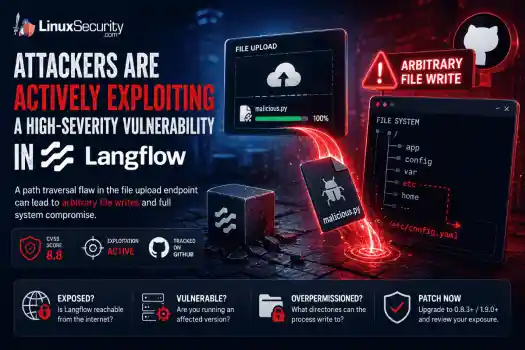
Security Vulnerabilities security advisory critical
security advisory critical Attackers are actively exploiting a high-severity vulnerability in Langflow , an open-source platform used to build and run AI workflows. . The flaw turns a file upload into a filesystem write, allowing a user-controlled file to escape the application's intended upload directory and land in locations Langflow was never supposed to touch. The vulnerable upload endpoint permits path traversal through crafted filenames. From there, the impact depends heavily on how the platform is deployed. A...
Jun 11, 2026 
Vendors/Productssecurity advisory linux
security advisory linux With npm v12 , dependency preinstall, install, and postinstall scripts will no longer execute automatically during package installation. Script execution will require explicit approval through new controls such as npm approve-scripts, with the change expected to arrive in July 2026. . The announcement targets a part of the software supply chain that has repeatedly appeared in package registry abuse, credential theft, and CI/CD compromise investigations. A single npm install could trigger code...
Jun 11, 2026 
Security Vulnerabilities security advisory zero-day
security advisory zero-day CISA added CVE-2026-11645 to its Known Exploited Vulnerabilities catalog after Google confirmed active exploitation of the flaw. The bug sits in V8, the JavaScript engine behind Chrome and Chromium. . That's where this gets more interesting. Most coverage will focus on Chrome because that's where the patch landed. But the affected component is V8. Chromium relies on it. Electron relies on it. Plenty of desktop software Linux users interact with every day relies on it too, often without much...
Jun 10, 2026 
Network Securitysecurity advisory networking
security advisory networking For years, IPv4 was the only proxy type that really mattered for anyone running automation off a Linux box. IPv6 was the protocol everyone said they’d migrate to, but almost nobody actually did. In 2026, that’s finally starting to shift. . The problem is that most admins stick with IPv4 out of habit. They know it; it’s what their tooling defaults to, and they don’t see a reason to change. Some are overpaying for addresses they don’t need. Others would quietly break their scrapers, scripts, or...
Jun 09, 2026  Refine news
X Clear Filters Get the latest News and Insights
Get the latest Linux and open source security news straight to your inbox.
Community Poll
What got you started with Linux?
Loading...
Explore Latest Linux Security news
We found -1 articles for you...
76
 security researchersinternet freedomopen source advocacy
Internet Freedom and Research Rights: Highlights from Black Hat 2015
Security researchers need to fight for the rights to study, modify and reverse engineer Internet hardware and software or the general population risks losing Internet freedom, the Black Hat 2015 conference was told.. . Security researchers need to fight for the rights to study, modify and reverse engineer Internet har. security, researchers, fight, rights, study, modify, reverse, engineer, internet. . Anthony Pell
 Aug 06, 2015 •
 Organizations/Events
 79
security researchersvulnerability managementcybersecurity reportNavigating Vendor Dilemmas in Patching Cybersecurity Flaws
Booming numbers of security researchers are uncovering so many flaws that vendors are finding it almost impossible to patch them all in a reasonable timeframe, the latest SANS report has found. . This paradox is one of a number of findings contained in the Top Cyber Security Risks report, which the organisation now plans to publish twice yearly in association with data provided by customers of partners TippingPoint and Qualys, upgrading the annual reports it has produced for some years. More researchers hunting for flaws should be a good thing, but the report for March to August 2009 suggests that this has created logistical problems for an industry that is still heavily focused on adding features and product enhancement as its main priority. The link for this article located at Network World is no longer available. . As cybersecurity evolves, vendors face challenges from an increasing number of vulnerabilities, making swift patch management even more crucial in today's landscape. Security Flaws,Vulnerability Management,Cybersecurity Challenges. . LinuxSecurity.com Team
Sep 23, 2009 • Security Projects 
83
network threatsbotnetsecurity researchersEmerging Botnets: P2P Architecture Changes Threat Dynamics
Think botnets are bad now? We ain't seen nothin' yet. A select group of some 40 security researchers gathered on April 10 in the first Usenix event devoted to these networks of infected machines. The invitation-only event, called HotBots, was held in Cambridge, Mass. At the event, researchers warned that botnets. Specifically, security researchers have spotted the early development stages of resilient botnets that have included peer-to-peer architectures. Botnets have traditionally been organized in a hierarchical structure, with one central command-and-control location. This centralization has been a blessing to researchers, as it gives them a single point of failure on which to focus. With a P2P botnet, however, there is no centralized point for command and control. Each node in the network acts as both client and server, eliminating the central chokepoint. Individual nodes can be knocked offline, but the gaps in the network will be closed without the loss affecting the botnet's operation or the attacker's control. The link for this article located at eWeek is no longer available. . Cybersecurity analysts alert about the preliminary emergence of a robust botnet structure utilizing decentralized networking, influencing management strategies.. Resilient Botnets, P2P Architecture, Distributed Attack Strategies. . LinuxSecurity.com Team
Apr 17, 2007 • Hacks/Cracks 82
law enforcementinternet crimecybersecurity collaborationFBI Urges Hackers To Partner Against Organized Cybercrime Efforts
The FBI's point man for Internet crime wants hackers to join the fight against international gangs of Web mobsters. Dan Larkin, unit chief of the FBI's Internet Crime Complaint Center, used the spotlight of the Black Hat security conference here to call for a new level of trust and cooperation between security researchers and law enforcement, warning that online crime is being controlled by "very sophisticated, very organized" attackers. . "More often than not, valuable information ends up in your hands before it gets to us," Larkin told a standing room only gathering of security professionals. "We need to leverage your capabilities and your strengths. You have to be able to tap into us. We have to figure out how to team up and be better partners," he added. The link for this article located at eWeek is no longer available. . The Bureau advocates for partnerships between cyber experts and police forces to tackle advanced internet criminal syndicates.. Hacker Community, Internet Crime, Cybersecurity Collaboration, Law Enforcement Partnership. . Brittany Day
Aug 02, 2006 • Government 
Get the latest News and Insights
Get the latest Linux and open source security news straight to your inbox.
Community Poll
What got you started with Linux?
Search Topics
Powered By

Linux Security - Your source for Top Linux News, Advisories, HOWTOs and Feature Releases
QUICK LINKS
subscribe to newsletters!
Like staying secure? So do we.
Sign up for updates, tips, and alerts!
Discover faster search, smarter navigation, and deeper Linux security insights. Read More