Explore top 10 tips to secure your open-source projects now. Read More
×



Server Security data privacy automation
data privacy automation Every system admin has lived through the same Monday morning ritual. A queue of forty tickets, half of them password resets, permission errors, or disk space warnings that any experienced technician could resolve in under two minutes. The other half require actual judgment. For years, automation promised that software would eventually sort the two apart on its own. That promise is now being tested in production Linux environments. . Early results are reshaping how IT teams think about tier-1...
 Jul 17, 2026

Privacydata collection automation
data collection automation You're running a web scraping project to collect pricing data from e-commerce sites. You set up a pool of datacenter proxies, launch your scripts, and within minutes — banned . CAPTCHAs everywhere. Your data pipeline stops before it really begins. . It's a frustrating scenario that plays out daily in ad verification, market research, and multi-account management. The website doesn't know you're doing legitimate research or monitoring. It just sees traffic coming from IP ranges it recognizes as...
Jul 17, 2026

Security Trends security advisory social engineering
security advisory social engineering Business Email Compromise used to be a numbers game — mass-blasted emails, broken English, an obvious "URGENT WIRE TRANSFER" subject line. That era is over. Generative AI has turned BEC into a tailored, low-noise operation that mimics writing style, voice, and even video presence. This piece looks at what's actually changed under the hood, what defenders are testing in response, and why so many organizations are still structurally unprepared for it. . The Infrastructure Problem Nobody Wants to...
Jul 17, 2026

Security Trends cybersecurity Linux documentation
cybersecurity Linux documentation Linux operating systems have gained prominence due to their stability, adaptability, and excellent security options. In the case of developing documentation, designing cybersecurity dashboards, or educational material, visuals are of vital importance when it comes to making things clear. The use of icons allows one to understand the message regarding alerts, authorization, encryption, authentication, or the state of the system just by looking at the visual cue without having to read long...
Jul 17, 2026
Security Vulnerabilities security advisory linux distribution
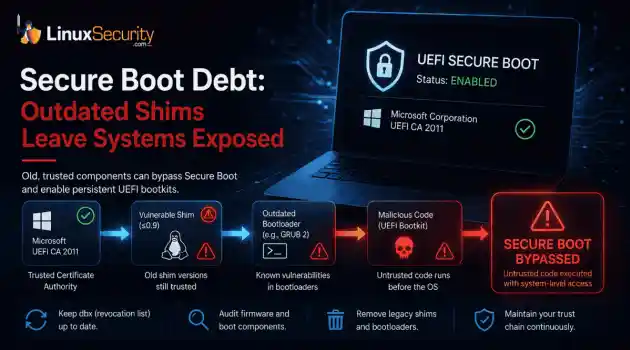
security advisory linux distribution ESET researchers identified 11 old and forgotten Linux UEFI shim bootloaders at versions 0.9 and below that can be used to bypass UEFI Secure Boot on any UEFI-based machine that trusts Microsoft’s Microsoft Corporation UEFI CA 2011 third-party certificate authority, regardless of the installed operating system (OS). Reported shims can be exploited to execute untrusted code during system boot, enabling attackers to deploy malicious UEFI bootkits even on systems with UEFI Secure Boot enabled.....
Jul 16, 2026
 Refine news
X Clear Filters
Get the latest News and Insights
Get the latest Linux and open source security news straight to your inbox.
Community Poll
Is continuous patching actually viable?
Loading...
Explore Latest Linux Security news
We found 75 articles for you...
209
 security updatemobile securityoffensive security
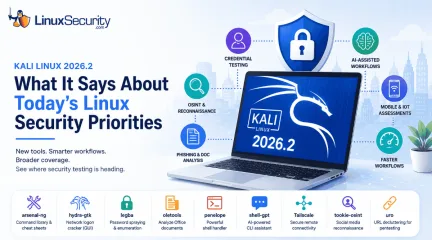
What Kali Linux 2026.2 Says About Today's Linux Security Priorities
Offensive Security just dropped Kali Linux 2026.2 , and at first glance, it looks like a standard quarterly refresh. You’ve got the usual kernel bumps, desktop environment updates, and a handful of new utilities. But don't write this off as just another routine version update. If you look past the changelog, this release highlights several capabilities that continue to be important in offensive security. From AI-assisted workflows to credential testing and mobile assessments, Kali Linux 2026.2 reflects the techniques many security professionals are incorporating into modern Linux security testing. For Linux administrators and defenders, understanding what tools are being added to Kali can be just as valuable as using them; they reflect the techniques security teams—and attackers—consider most relevant for evaluating modern Linux environments. . Why Kali Releases Matter Even If You Don't Use Kali Most enterprise Linux systems will never run Kali Linux, but administrators still benefit from following its development. New tools often reflect the techniques penetration testers are actively using during real-world assessments. Reviewing each release helps defenders identify emerging testing priorities and evaluate whether their own monitoring, authentication controls, and hardening practices address those attack paths. What's New in Kali Linux 2026.2 The headline for 2026.2 is the inclusion of nine new security tools, but the platform improvements are what really move the needle for daily operations. The distribution is now running on the Linux kernel 6.19, with the desktop experience receiving a facelift through GNOME 50 and KDE Plasma 6.6. Tool Primary Purpose arsenal-ng Cybersecurity command reference and cheat sheets hydra-gtk GUI for Hydra credential testing legba Password spraying and authentication testing oletools Analyze Microsoft Office documents andmacros penelope Shell handler for post-exploitation shell-gpt AI-assisted command generation Tailscale Secure remote connectivity tookie-osint Social media reconnaissance uro URL normalization for web testing Taken together, the new tools cover credential auditing, OSINT, phishing analysis, AI-assisted workflows, remote connectivity, and shell management. They reinforce a broader reality: modern security assessments rarely focus on a single system. Today's engagements often combine identity testing, cloud infrastructure, web applications, mobile devices, and social engineering into a single assessment. Beyond the aesthetics, the team focused on friction reduction. VM deployments are significantly faster this time around, thanks to the removal of graphics firmware from pre-built images, and there’s a marked improvement in NetHunter’s stability. For those running security assessments in virtualized labs, these workflow optimizations save real time when you're spinning up or tearing down testing environments. Another notable addition is Tailscale, which gives security teams a straightforward way to create encrypted connections between testing systems. For organizations with distributed labs or remote team members, it can simplify access to assessment environments without exposing them directly to the internet. Credential Attacks Continue to Be a Priority Among the new tools are additions focused on credential testing, including legba and the re-added hydra-gtk . Their inclusion reflects how identity-based attacks—including password spraying, credential reuse, and authentication testing—continue to play a central role in modern security assessments. If an administrator uses the same password for a local Linux server and a corporate SSO account, that’s an open door. These tools act as a wake-up call: if you aren't enforcing MFA, disabling legacyauthentication, and proactively monitoring for password-spraying attempts, your infrastructure is likely the low-hanging fruit in a credential-stuffing campaign. AI Is Becoming Part of Everyday Security Operations The inclusion of shell-gpt might trigger a knee-jerk reaction about AI replacing security pros, but that’s missing the point. Tools like shell-gpt illustrate how AI is beginning to reduce repetitive command-line work. Rather than replacing expertise, they help security professionals generate commands, reference syntax, and automate routine tasks more efficiently. Offensive security is notoriously repetitive. Whether it's drafting boilerplate command syntax or normalizing log output, the friction of manual scripting slows down an assessment. These tools reduce repetitive command-line work and make common workflows easier to reproduce, allowing analysts to spend more time interpreting results than writing boilerplate commands. Mobile Devices Are Now Part of Enterprise Security Assessments The latest NetHunter improvements highlight a shift in scope. Many organizations that rely on Linux servers also manage Android devices, embedded Linux systems, and IoT endpoints. Expanding NetHunter reflects the reality that enterprise security assessments increasingly extend beyond traditional servers. Strong Linux server hardening is only one part of the equation. If attackers can gain network access through an insecure Android device or wireless infrastructure, they may still be able to pivot toward Linux systems. Kali 2026.2 provides the tools to assess these wireless "flanks" of the enterprise, ensuring that mobile and IoT devices are part of your broader security program. Security Testing Is Becoming Faster There’s a clear emphasis on speed in 2026.2, from the faster VM boot times to the smaller initrd. When you're building disposable lab environments, validating detections, or conducting repeated penetration tests, time is your most limited resource. Faster deployments meanassessments can happen more frequently, which makes security validation a natural part of daily operations rather than a painful, quarterly event. By removing unnecessary graphics firmware from pre-built virtual machine images, Kali reduces boot times for many VM-based testing environments while leaving bare-metal installations unchanged. Office Documents Still Matter in Linux Environments Kali 2026.2 also highlights the ongoing relevance of oletools . While Linux endpoints are less commonly associated with Office malware than Windows systems, Linux administrators frequently investigate phishing campaigns, analyze suspicious attachments, and protect mixed-platform environments. Tools like oletools help incident responders inspect Office documents for embedded macros and other malicious content before those files reach users or move deeper into an organization. What Linux Administrators Should Take Away From the Release One of the most useful aspects of following Kali releases isn't deciding whether to upgrade immediately. It's understanding where offensive security is investing its attention. The tools that enter Kali often mirror the techniques organizations are increasingly testing during security assessments, giving defenders an opportunity to evaluate whether their own controls keep pace. Use this table as a checklist for your own hardening efforts: Area Question to Ask Authentication Could your SSH service withstand password spraying? AI Workflows Have you established guidelines for using AI tools without exposing sensitive commands or data? Email Security Are Office documents scanned for malicious content before users open them? OSINT Is unnecessary organizational information publicly exposed? Mobile Security Are Android and IoT devices included in security assessments? Detection Can your monitoringidentify credential attacks and suspicious shell activity regardless of the specific tool used? Conclusion Kali Linux 2026.2 is more than a collection of new packages and version upgrades. Its newest tools and platform improvements reflect the techniques security professionals are using to evaluate modern Linux environments. Whether your organization performs formal penetration tests or simply wants to strengthen its defenses, the release highlights where security testing is placing increasing emphasis: identity, automation, mobile devices, and operational efficiency. Pay attention to the techniques these tools are designed to test; they reflect the attack paths that penetration testers evaluate today and the behaviors defenders should be prepared to detect. Want more Linux security news, vulnerability analysis, and software supply chain updates? Subscribe to the LinuxSecurity Newsletter and get the latest threats, advisories, and expert insights delivered directly to your inbox. . Kali Linux 2026.2 showcases new capabilities in offensive security, highlighting tools for credential testing, AI, and mobile assessments.. Linux Security Tools,Kali Linux 2026.2,Cybersecurity Tools,Credential Testing Techniques,AI in Security. . MaK Ulac
 Jun 30, 2026
•
Jun 30, 2026
• Security Trends
79
 security advisorysecurity updateencryption
FreeRDP 3.27 Raises the Baseline for Secure Remote Access
Remote access tools do not need dramatic new features to improve security. Sometimes the more useful change is quieter, like stronger defaults that make weak encryption harder to use by accident. . What FreeRDP Is and Why This Release Matters FreeRDP is an open-source implementation of Microsoft’s Remote Desktop Protocol, used as both a library and a set of clients across Linux, Windows, macOS, Android, and other systems. In Linux environments, it is often the practical RDP client administrators reach for when they need console access to Windows hosts, jump systems, lab machines, or remote desktops without moving through a full Windows workstation. FreeRDP 3.27 matters because it changes the floor for encrypted remote access. The release sets the default TLS security level to 2 and requires at least TLS 1.2 , while still leaving client-side override options through /tls:seclevel: and /tls:enforce: for environments that have not caught up yet. That is the operational detail. A Linux RDP client connecting with safer defaults creates fewer accidental weak sessions, fewer legacy negotiation surprises, and less cleanup later when remote access security gets reviewed after a finding. What Changed in FreeRDP 3.27 FreeRDP 3.27 is not a feature-heavy release. The important changes are in the defaults that control encrypted connections and RDP security. TLS security level 2 is now the default. TLS 1.2 or newer is required by default. Multiple security advisories were addressed as part of the release. Environments that still rely on older TLS configurations should be tested before deployment. In practical terms, FreeRDP now makes it harder to fall back to weaker encryption settings and easier to force TLS 1.2 or newer across remote access deployments. For administrators using FreeRDP as a Linux RDP client, the change is mostly about reducing the number of weak connection paths that remain available simply because nobody disabled them. Why Stronger Remote AccessSecurity Defaults Matter Remote access tools tend to accumulate compatibility settings over time. They stay around because somebody still has an old server, an old gateway, or a forgotten system that breaks when defaults change. That flexibility comes with a cost. Permissive settings can keep weak remote access security configurations alive for years. Secure remote access becomes harder to enforce when legacy encryption remains available by default. Weak TLS settings often persist long after they should have been retired. Raising the minimum requirement removes many of them by default. TLS 1.2 is still a valid baseline. The problem is usually what sits below it. When admins look up TLS 1.2 end of life or a TLS 1.2 vulnerability, they are usually trying to understand whether old TLS support is still exposed anywhere in the environment. TLS 1.2 vs 1.3 is a separate decision. TLS 1.3 is better where both sides support it, but FreeRDP’s change is simpler than that. Requiring TLS 1.2 or newer, it cuts off older negotiation paths that still show up during remote desktop security reviews and remote access assessments. What Admins Should Check Before Updating FreeRDP 3.27 raises the default security baseline, but stronger defaults do not replace existing remote access security controls. Before updating, administrators should verify a few things: Test connections to older RDP servers, gateways, and legacy systems that may not fully support TLS 1.2 or newer. Review Azure AD (Entra ID) and authentication-related changes if those features are part of the deployment. Confirm that logging, MFA, access restrictions, and patch management processes continue to operate as expected. Validate that existing remote access security solutions still behave correctly after the upgrade. The release aligns with common remote access security best practices, but it is only one layer. Secure remote access depends on authentication controls, monitoring, patching, and accessmanagement. FreeRDP can support those efforts, but it is not a complete answer to how to secure remote access by itself. FreeRDP Reflects the Secure-by-Default Shift FreeRDP 3.27 is part of a broader move toward stronger remote access security defaults. The release does not introduce a new security model. It removes more of the weak negotiation paths that tend to survive in long-lived environments simply because nobody revisited the configuration. For organizations using FreeRDP, the change is straightforward. Secure remote access becomes less dependent on manual hardening and less likely to inherit outdated settings by default. Administrators still need to test systems, validate compatibility, and maintain their remote access security controls, but FreeRDP 3.27 raises the baseline in the right direction. Want more Linux security news, vulnerability analysis, and remote access security updates? Subscribe to the LinuxSecurity Newslette r for the latest threats, advisories, and practical guidance on Linux systems. Related Reading Securing Remote Access to Linux Servers: Best Practices for 2026 Mastering SSH for Secure Linux Remote Server Management How Secure Is Linux? Exploring Security Design and User Privilege Models Oracle Linux 10 FreeRDP Important Security Update ELSA-2026-5939 . FreeRDP 3.27 emphasizes stronger remote access defaults with TLS 1.2 level security for enhanced protection.. FreeRDP remote access encryption TLS Linux. . MaK Ulac
Jun 16, 2026
•
Security Projects

79
 security advisorysecurity updatesystem performance
Linux 6.15: essential security updates improving x86_64 performance
A "x86/bugs" pull request has been submitted for Linux 6.15, introducing crucial security mitigations to enhance system defenses against various attack vectors. Unlike previous approaches focusing on individual vulnerabilities, these new mitigations tackle broader issues, promising more comprehensive protection. Key changes include the removal of the outdated X86_FEATURE_USE_IBPB flag, integration of Speculative Return Stack Overflow (SRSO) mitigation for Zen5 CPUs, and automated responses to threats like MDS, TAA, MMIO, and RFDS. . This means a safer, more resilient environment for us admins, though it may come with some performance considerations. Balancing the improved security with potential impacts on system performance is critical. By understanding these updates and their implications, you can ensure your systems are secure and run efficiently, keeping downtime and disruptions to a minimum. In this article, we'll examine the details of these updates and offer practical insights on managing the balance between security and performance. Moving Beyond Single Vulnerability Mitigations Traditionally, Linux security updates have addressed vulnerabilities on a case-by-case basis. While effective, this method often led to a patchwork of temporary fixes that could leave systems vulnerable to new variants of similar attacks. Linux 6.15 takes a significant leap forward by implementing mitigations aimed at entire classes of vulnerabilities . This strategy simplifies the patching process and elevates the security baseline across the board. The shift towards broader mitigations means you, as an admin, can expect a more robust defense mechanism for your x86_64 systems. For instance, the automatic mitigation of vulnerabilities such as Microarchitectural Data Sampling (MDS), Transactional Asynchronous Abort (TAA), MMIO Stale Data, and Rogue Data Store (RFDS) is now part of the kernel’s proactive security measures. This evolution highlights a shift to avoiding potential threats rather thanplaying catch-up. The End of the X86_FEATURE_USE_IBPB Era One of the notable changes in this update is the removal of the X86_FEATURE_USE_IBPB flag. This flag, which was historically used to trigger Indirect Branch Prediction Barrier (IBPB) as a mitigation for Spectre attacks , had become somewhat redundant with new security improvements. Its removal simplifies kernel code and reduces potential overhead, allowing for streamlined execution paths and a slight performance boost. This change means less clutter in the kernel's security mechanisms and a unified approach to managing indirect branch predictions. While this might seem like a minor adjustment, it reflects a broader trend towards eliminating outdated components in favor of more efficient and effective solutions. Enhanced Support for AMD’s Zen5: Mitigating Speculative Return Stack Overflow (SRSO) This new kernel release addresses existing vulnerabilities and anticipates emerging hardware architectures. A prime example is the integration of Speculative Return Stack Overflow (SRSO) mitigation specifically for CPUs based on AMD’s Zen5 architecture. This foresight is crucial because speculative execution attacks, like those that exploit the return stack buffer, have proven to be a persistent threat in modern processors. This built-in mitigation offers peace of mind for those running Zen5 CPUs or planning to upgrade. The kernel’s capabilities to handle speculative execution risks are now more robust, ensuring that your systems are protected against both known and yet-to-be-discovered variants of these attacks. Weighing Security Against Performance While the security enhancements in Linux 6.15 are undoubtedly significant, it’s essential to consider their impact on system performance. Security updates invariably introduce some overhead, as additional checks and mitigations require computing resources. The challenge for admins is to find the right balance. Understanding how these changes may affect your workloads and tuningyour system accordingly is crucial. For example, enabling all mitigations might be necessary for environments with sensitive data or high exposure to public networks. However, in a closed environment with lower threat levels, it might be possible to disable some mitigations to reclaim performance. Tools and settings within Linux allow for fine-tuning these options, giving you the flexibility needed to achieve the optimum security-performance balance. Practical Advice for Admins To maximize these updates without compromising performance, admins should first assess their specific environment and threat model. Conducting a risk assessment helps determine which mitigations are essential and where there might be room to optimize. This should include: Evaluating Your Existing Security Posture: The first step is understanding your current security measures and identifying gaps. Look into your system logs, audit records, and security reports to get a clear picture of your vulnerabilities and performance bottlenecks. Testing New Mitigations in a Controlled Environment: Before rolling out the new kernel to your production servers, deploy it in a testing environment. Monitor the performance and security metrics to see how the new mitigations affect your typical workload. Adjusting Kernel Parameters: Linux provides the flexibility to enable or disable specific mitigations through kernel parameters. Use this feature to tailor the security settings according to your needs. Document these changes thoroughly to maintain an accurate system baseline against which future updates can be tested. Monitoring System Performance: After implementing the new kernel, monitor system performance closely. Use monitoring tools to track CPU usage, memory consumption, and application responsiveness. Adjust the tuning to ensure security enhancements do not unduly impact system efficiency. Future-Proofing Your Security Strategy Linux 6.15’s updates address immediate security needs and set thestage for future-proofing your systems. As hardware advancements and new classes of vulnerabilities continue to arise, a kernel that adopts a proactive and comprehensive approach is invaluable. Maintaining a forward-thinking mindset will help you adapt to upcoming changes more seamlessly. Our Final Thoughts: A Big Step Forward in Linux Security The introduction of broad-spectrum security mitigations in Linux 6.15 represents a significant advancement for us Linux security admins. This update offers a more streamlined and fortified system environment by moving away from single vulnerability fixes, removing outdated components like the X86_FEATURE_USE_IBPB flag, and incorporating forward-looking mitigations for new CPU architectures. Admins now have to balance these improved security measures with system performance. Through careful evaluation, testing, and adjustment, a harmonious balance that ensures both the security and efficiency of your systems can be achieved. With Linux 6.15, you’re not just keeping pace with current threats; you’re anticipating and preparing for the future of Linux system security! This proactive approach is essential in maintaining resilient, robust systems that can withstand increasingly advanced and complex threats. . Developments in Linux version 6.15 bring significant security upgrades and address their potential effects on system efficiency.. Linux 6.15 security, performance and security balance, x86_64 optimizations, kernel security mitigations. . Brittany Day
Apr 01, 2025
•
Security Projects
210
 security advisorysecurity updatesoftware update
PostgreSQL and BeyondTrust: High Severity Risk Requires Immediate Patch
Recent vulnerabilities in BeyondTrust Remote Support ( CVE-2024-12356 ) and PostgreSQL ( CVE-2025-1094 ) are being actively exploited by threat actors and require urgent mitigation by admins using the popular SQL database and BeyondTrust Remote Support solution. Attackers are using this PostgreSQL SQL injection flaw to sneak SQL commands past security checks, then execute remote commands against vulnerable versions of BeyondTrust for access and control over systems running vulnerable versions. . With attackers potentially having access to sensitive data or disrupting services via BeyondTrust systems running vulnerable versions, those impacted by these flaws must act now before it's too late! Here's what you need to know about this exploit and measures you can take to keep your systems operational and safeguard your sensitive data. Understanding the Nature of This PostgreSQL SQLi Vulnerability Let's delve further into this PostgreSQL SQL injection (SQLi) vulnerability that's caused widespread alarm. In general, SQLi bugs occur when an attacker inserts malicious SQL code into an input field, which is then executed by the database. This enables the attacker to manipulate the database, access unauthorized data, and perform privileged operations by exploiting poorly validated or sanitized inputs. SQLi vulnerabilities can lead to unauthorized access to sensitive data, and potentially full system compromise - so they are not something to take lightly! In the specific case of CVE-2025-1094 , PQescapeLiteral(), PQescapeIdentifier(), PQescapeString(), and PQescapeStringConn() all improperly handle quoting syntax that allows attackers to inject malicious SQL commands using key libpq functions. PQescapeLiteral() and PQescapeIdentifier() were intended to safely escape user input and prevent injection attacks. Now, however, they've become targets, allowing attackers to exploit them and insert malicious SQL commands directly into databases running against them. When you use these functions to feedinto PostgreSQL interactive terminal psql, they become dangerous. An attacker could exploit how these functions' process input to bypass your defenses with malicious SQL statements and then execute remote commands against vulnerable versions of BeyondTrust Remote Support to gain complete control of impacted systems. Not only are libpq functions vulnerable, but command line utilities of PostgreSQL may also be susceptible. This becomes especially apparent when client_encoding is set to BIG5 while server_encoding differs - opening up an opportunity to inject potentially dangerous SQL commands through command-line operations. Affected Versions and Patches It is crucial to understand which PostgreSQL versions are at risk and the patches released address to address the issue. Specifically, those using versions prior to 17.3, 16.7, 15.11, 14.16 or 13.19 could be vulnerable to this exploit Patches for this issue have already been released to address it. PostgreSQL 16.7, 15.11, 14.16, and 13.19 versions were patched on February 13, 2025, and should be upgraded immediately to protect yourself against potential exploitation and close any security gaps in your systems. Mageia and Oracle have released critical advisory updates to mitigate this bug. At this stage, it would be prudent to conduct an in-depth audit of your current PostgreSQL version and, if any vulnerable versions exist on your server, formulate an update plan immediately. Applying patches can protect systems against sophisticated attacks targeting them. Exploring the Security Impact of This PostgreSQL Flaw Let's discuss the security implications of this vulnerability in greater depth. It has been assigned a CVSS 3.0 score of 8.1, which indicates it as a high-severity threat with significant risks to confidentiality, integrity, and availability if successfully exploited. As this vulnerability requires certain conditions, such as specific encoding settings and usage patterns to exploit, don't let its low severity fool youinto believing you are safe. An attacker with enough knowledge could still cause significant harm, possibly accessing sensitive data or destabilizing your system. Take this bug seriously despite its limited exploitation conditions, and implement patches now to protect against potentially devastating security breaches and ensure your infrastructure remains robust and secure. Beyond Patching: Practical Measures for Securing PostgreSQL PostgreSQL users can take several measures beyond patching to protect their systems from vulnerabilities like CVE-2025-1094. First, focus on hardening your PostgreSQL configuration by disabling any unused services and features and reviewing all database settings for compliance with security best practices. For instance, admins should limit listening addresses to trusted networks while using strong authentication methods like scram-sha-256 for login security. Implementing stringent access controls is another essential measure. Ensure only authorized users have access to your databases, with only the privileges necessary to do their jobs effectively. Use roles and permissions wisely to prevent unauthorized access or data manipulation, regularly audit user access and revoke any no longer necessary permissions, audit user access regularly as part of an overall security strategy, and implement network-level measures such as firewalls or VPNs for remote access. Keep a keen eye on your database's activity by activating logging and monitoring. By watching its activity, you can quickly detect any unusual or suspicious activity, while PostgreSQL log files provide insight into access patterns and potential threats. Couple this with an effective incident response plan so your team can respond efficiently should any security breaches arise. Our Final Thoughts on Mitigating Risk for PostgreSQL & BeyondTrust Users As soon as threats like this emerge, you must swiftly secure your systems against them. CVE-2024-12356 in BeyondTrust Remote Support and CVE-2025-1094 inPostgreSQL should not be overlooked as together they provide attackers access to and control over your systems. By applying patches from BeyondTrust and PostgreSQL, you will close these security holes and prevent attacks from occurring in your Linux environment. Wait no longer - take proactive measures to protect yourself and your data and operations! Immediately update your systems , review security protocols, and take measures to secure against these vulnerabilities that threaten the integrity and safety of impacted IT infrastructures. It is well worth the time and effort to prevent attacks that could cripple your systems or expose sensitive data! . Safeguard critical information and applications in BeyondTrust and PostgreSQL against ongoing threats through immediate update implementations.. PostgreSQL Flaws, BeyondTrust Risk Management, SQLi Prevention, Security Patch Updates. . Brittany Day
Feb 27, 2025
•
Security Vulnerabilities
210
 security advisorysecurity updatekernel patch
Kernel DMA Vulnerability CVE-2024-43856: Critical Update for Linux Admins
The Linux operating system, widely acclaimed for its robustness and security , recently received widespread media attention due to a significant kernel vulnerability, CVE-2024-43856 . The issue involves race conditions in the dmam_free_coherent() function, which could allow race condition-based attacks against various kernel versions. . In this article, I'll describe this flaw, its potential impacts, and various kernel vendors' attempts to address its risks with security patches. Understanding This Vulnerability This vulnerability lies within a race condition, in which system stability and security depend upon uncontrollable events occurring at random times and sequences. This race condition was discovered within the Linux kernel's dmam_free_coherent() function due to improper operation order when freeing Direct Memory Access allocations and managing associated resources. DMA (Direct Memory Access) is an integral feature that enables hardware devices to directly move data between system memory and hardware devices without going through the CPU, significantly increasing performance and improving overall system reliability. However, if an issue arose with DMA, such as that seen in CVE-2024-43856, this process could become compromised, leading to incorrect memory access, data corruption, unexpected behavior, or even system crashes. Exploitation and Impact An attacker would need to carefully time their operations to coincide with when the kernel is reallocating DMA memory, freeing and reallocating it at specific moments. If successful, devres_destroy() might prematurely free an entry, which causes WARN_ON() assertion errors within dmam_match(), which forms part of the Linux kernel's DMA management subsystem. An exploit of this nature is certainly no simple matter, as it requires an in-depth knowledge of kernel inner workings and the ability to manipulate or anticipate the exact timing of events within a targeted system. A race condition could enable an attacker with such skills towrite arbitrary data into CPU memory - unquestionably posing severe security threats. What Patches & Solutions Are Available? In response to this threat, Greg Kroah-Hartman submitted a patch written by Lance Richardson from Google designed to mitigate DMA allocation vulnerabilities by switching their order of operations within dmam_free_coherent(). Now, this function ensures tracking data structures are deleted using devres_destroy() before freeing the DMA allocation via dma_free_coherent(). Restructuring is essential as it removes the chance that concurrent tasks could interfere with the cleanup process, thus closing a window through which an attacker could exploit a race condition to exploit the vulnerability. This patch received approval from key Linux kernel contributors such as Christoph Hellwig and Sasha Levin for inclusion into the mainline Linux kernel, providing users with assurance regarding its stability and reliability. Admins should implement this patch as soon as possible to safeguard their systems. They can do this via their Linux distribution's package management system using standard package updates, including CVE-2024-43856 fixes. Administrators on Debian-based systems or Red Hat-based servers can utilize commands like apt-get or yum to update kernel packages, with updates automatically downloaded and installed. This makes it simple for even less experienced administrators to secure their servers. After installing a kernel update, a reboot must be performed to activate its effects. Administrators should plan this reboot carefully to minimize impactful disruption to services and users. Our Final Thoughts on This DMA Security Vulnerability CVE-2024-43856 underscores the complexities associated with low-level system administration. Although the Linux kernel is widely recognized for its stability and security , its component modules occasionally exhibit flaws. What sets the Linux community apart is how quickly flaws such as CVE-2024-43856 can be addressed,demonstrated by their proactive development and deployment of patches such as those needed to address CVE-2024-43856. System administrators must remain vigilant in installing kernel updates promptly to protect their Linux systems against potential threats. . The DMA vulnerability in the Linux kernel threatens system integrity and data security, allowing unauthorized memory access. Timely patches are essential to mitigate risks.. Linux Kernel,Patch Management,Direct Memory Access,Kernel Vulnerabilities,Security Flaws. . Brittany Day
Sep 10, 2024
•
Security Vulnerabilities
79
 security updatesystem managementperformance enhancement
Linux Kernel 6.9: Upgrades In Security And Performance For Linux Systems
The recently released Linux Kernel 6.9 brings forth a blend of crucial upgrades and enhancements, catering to the ever-evolving needs of the Linux ecosystem. Linus Torvalds, the creator of Linux, underscores this by stating, "a more powerful arm64 machine (thanks to Ampere)," signaling promising optimizations for ARM64 architecture in this new release. . Let's delve deeper into the key highlights that make this update noteworthy for Linux admins and security practitioners. What's New in the Linux Kernel 6.9 Release? The release packs various features that add significant value to the Linux community. One striking addition is the support for AMD Preferred Core, prioritizing high-performance cores for demanding tasks. This shift aims to enhance overall system efficiency by leveraging the full potential of AMD processors. On the Intel front, notable refinements include support for the Fastboot feature on old platforms and the introduction of Intel's FRED architecture, promising improved performance for Meteor Lake chips. Furthermore, the enhancements in ARM support stand out, including Rust support for ARM64 architecture, which opens the door for Rust-based kernel codes in the future. Alongside this, the extended hardware support for various devices like MediaTek MT7981B and NXP i.MX8DXP showcases the kernel's adaptability to newer technologies. Long-Term Consequences & Considerations As we look toward the future, the broader implications of these updates on Linux security and system management are worth considering. The introduction of Rust support for ARM64 architecture might pave the way for a more secure and robust kernel structure. However, will introducing Rust-based code potentially introduce new vulnerabilities or complexities in the long run? The extended hardware support raises questions about how these diverse devices will interact with the unified kernel framework and the security implications that come with it. Linux Kernel 6.9: Our Final Thoughts The Linux Kernel 6.9release is a significant milestone that brings about essential upgrades and hints at the future direction of Linux development. With a strong focus on performance optimization, security enhancements , and extended hardware support, this release promises to catapult Linux systems to new heights. As security practitioners and sysadmins, we must stay informed , delve deeper into these changes, anticipate their impact on system security, and adapt our strategies to ensure a seamless and secure user experience. You can download Linux Kernel 6.9 here. . This release highlights essential tools for network administrators and cybersecurity professionals, enhancing efficiency and compatibility among various systems.. Linux Kernel Updates, ARM64 Improvements, Security Features, Software Enhancements. . Brittany Day
Jun 03, 2024
•
Security Projects
81
 security advisorysecurity updatelinux distribution
Tails 6.2 Security Update: 21 New Languages For Online Privacy
Tails 6.2 is a new Linux distribution release that expands its multilingual support and improves security features. The distribution is a Debian-based operating system that enables users to remain incognito online and securely browse the web. . Tails 6.2 now supports 21 new languages, including Albanian, Bengali, Icelandic, Korean, and Ukrainian. This expansion makes Tails accessible to more individuals, allowing them to navigate in their native languages and enhance online privacy. Tails encourages participation through the Tor Project Weblate , stating that new languages will be added to future versions once 25% of strings are translated. Why Is This Release So Significant for Admins and Security Practitioners? Along with the expanded language support, Tails 6.2 introduces critical updates that strengthen the system's hardware compatibility, reliability, and security. Updates to critical components, such as the Tor Browser and client , ensure users have the latest secure browsing technology. The operating system's resilience against potential security vulnerabilities like the Spectre v4 has also been enhanced by disabling speculative store bypass. As a result, users can feel more secure while using Tails. The operating system's developers have demonstrated their commitment to the open-source community by encouraging them to contribute to the translation efforts. The improved language support is a welcome addition that shows the developer's attention to detail. The more people using secure operating systems, the lower the incidence of cyberattacks and data breaches . Tails 6.2's expanded language support, reliability, security and hardware compatibility improvements, and streamlined upgrade process must be highlighted. These improvements make Tails 6.2 a dependable option for individuals to strengthen their online privacy and security. However, It’s vital to note that while Tails 6.2 provides a secure operating system, it's not bulletproof. It is essential to remain vigilant and usebest practices for secure browsing while using Tails 6.2, such as utilizing a VPN, regularly updating the operating system, avoiding suspicious websites, and only connecting to trusted Wi-Fi networks. It should be noted that installing a new version instead of upgrading will result in losing all data stored in Persistent Storage on the USB stick. Hence, it is crucial to carry out the correct installation process to ensure the safety of user data. You can view instructions on downloading, installing, and upgrading Tails 6.2 here . Our Final Thoughts on the Tails 6.2 Release Tails 6.2 is an excellent tool for individuals prioritizing online privacy and security. Its expanded language support will make it more accessible to individuals worldwide, further increasing its popularity. Security practitioners, Linux admins, infosec professionals, internet security enthusiasts, and sysadmins should give Tails 6.2 a try. Its improved features and simplistic installation ensure that everyone interested in enhancing their online privacy can use it. . Tails 6.2 boosts protection and introduces 21 languages, significantly enhancing user satisfaction and internet confidentiality.. Tails 6.2, Multilingual Security, Privacy Enhancements. . Brittany Day
Apr 24, 2024
•
Privacy
210
 security advisorysecurity updatehigh severity
Critical Vulnerabilities in Chrome 122.0.6261.128: DoS and Data Exposures
Multiple severe security issues were discovered in Chromium before version 122.0.6261.128, which could result in arbitrary code execution, denial of service, or information disclosure. Let's examine these vulnerabilities, their impact, and how to protect against them. . What Security Bugs Have Been Discovered in Chromium? Security vulnerabilities recently identified in Chromium include: CVE-2024-2173 : Out-of-bounds memory access in V8 allows a remote attacker to access out-of-bounds memory via a crafted HTML page. CVE-2024-2174 : Inappropriate implementation in V8 allows a remote attacker to exploit heap corruption via a crafted HTML page. CVE-2024-2176 : Use after free in FedCM allows a remote attacker to exploit heap corruption via a crafted HTML page. CVE-2024-2400 : Use after free in Performance Manager allows a remote attacker to exploit heap corruption via a crafted HTML page. CVE-2024-1669 : Out-of-bounds memory access in Blink. CVE-2024-1670 : Use after free in Mojo. CVE-2024-1671 : Inappropriate implementation in Site Isolation. CVE-2024-1672 : Inappropriate implementation in Content Security Policy. CVE-2024-1673 : Use after free in Accessibility. Inappropriate implementation in Navigation. CVE-2024-1675 : Insufficient policy enforcement in Download. CVE-2024-1676 : Inappropriate implementation in Navigation. These flaws have all received a Chromium security severity rating of "High," as they could allow attackers to corrupt your data, disrupt services, or run rogue programs on your computer. How Can I Secure My Systems Against These Vulnerabilities? An essential update for Chromium, version 122.0.6261.128, has been released to fix these harmful vulnerabilities. Given these bugs’ severe threat to affected systems, if left unpatched, we strongly recommend all impacted users apply the updates released to protect against data compromise and service disruption. Tostay informed of essential updates released by the open-source programs and applications you use, register as a LinuxSecurity user , subscribe to our Linux Advisory Watch newsletter , and customize your advisories for your distro(s). This will enable you to stay up-to-date on the latest, most significant issues impacting the security of your systems. Follow @LS_Advisories on X for real-time updates on advisories for your distro(s) . . Critical vulnerabilities found in Chromium may result in code execution, denial of service, or data leakage. Ensure your systems are updated immediately!. Chromium Vulnerabilities, Security Issues, Code Execution Risks. . Brittany Day
Mar 24, 2024
•
Security Vulnerabilities

Get the latest News and Insights
Get the latest Linux and open source security news straight to your inbox.
Community Poll
Is continuous patching actually viable?
Search Topics
Powered By

Linux Security - Your source for Top Linux News, Advisories, HOWTOs and Feature Releases
QUICK LINKS
subscribe to newsletters!
Like staying secure? So do we.
Sign up for updates, tips, and alerts!