



Security Trends  fedora security assessment
fedora security assessment A Fedora contributor account recently came under scrutiny for apparently AI-generated activity that disrupted the project's bug tracker. . Questionable Bugzilla comments, flawed patches, and improperly closed or reassigned bugs forced maintainers to spend time cleaning up the fallout. There is no evidence that malware was deployed or a backdoor reached production, but the incident exposed a different problem. Open-source projects can be disrupted without compromising a single line of code....
 Jun 12, 2026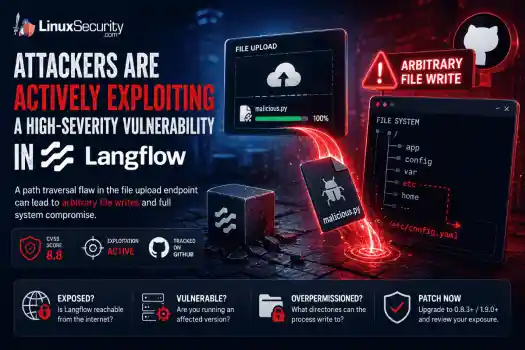
Security Vulnerabilities security advisory critical
security advisory critical Attackers are actively exploiting a high-severity vulnerability in Langflow , an open-source platform used to build and run AI workflows. . The flaw turns a file upload into a filesystem write, allowing a user-controlled file to escape the application's intended upload directory and land in locations Langflow was never supposed to touch. The vulnerable upload endpoint permits path traversal through crafted filenames. From there, the impact depends heavily on how the platform is deployed. A...
Jun 11, 2026 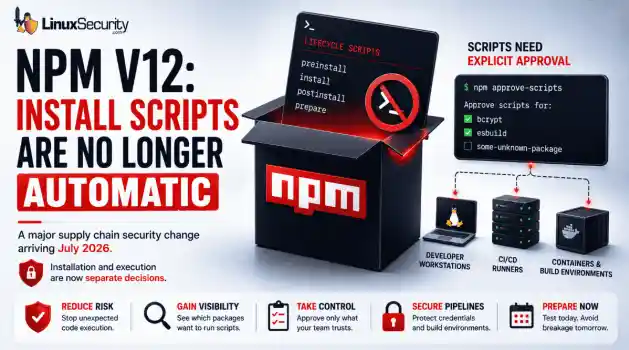
Vendors/Productssecurity advisory linux
security advisory linux With npm v12 , dependency preinstall, install, and postinstall scripts will no longer execute automatically during package installation. Script execution will require explicit approval through new controls such as npm approve-scripts, with the change expected to arrive in July 2026. . The announcement targets a part of the software supply chain that has repeatedly appeared in package registry abuse, credential theft, and CI/CD compromise investigations. A single npm install could trigger code...
Jun 11, 2026 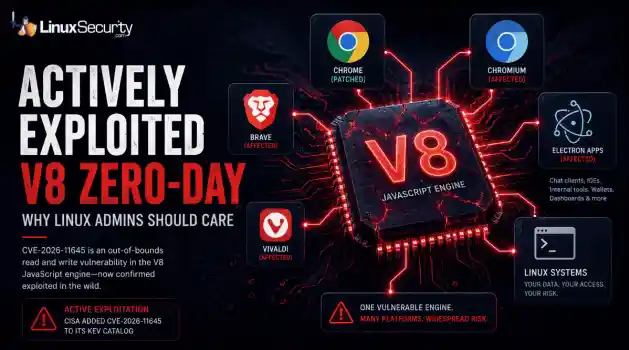
Security Vulnerabilities security advisory zero-day
security advisory zero-day CISA added CVE-2026-11645 to its Known Exploited Vulnerabilities catalog after Google confirmed active exploitation of the flaw. The bug sits in V8, the JavaScript engine behind Chrome and Chromium. . That's where this gets more interesting. Most coverage will focus on Chrome because that's where the patch landed. But the affected component is V8. Chromium relies on it. Electron relies on it. Plenty of desktop software Linux users interact with every day relies on it too, often without much...
Jun 10, 2026 
Network Securitysecurity advisory networking
security advisory networking For years, IPv4 was the only proxy type that really mattered for anyone running automation off a Linux box. IPv6 was the protocol everyone said they’d migrate to, but almost nobody actually did. In 2026, that’s finally starting to shift. . The problem is that most admins stick with IPv4 out of habit. They know it; it’s what their tooling defaults to, and they don’t see a reason to change. Some are overpaying for addresses they don’t need. Others would quietly break their scrapers, scripts, or...
Jun 09, 2026  Refine news
X Clear Filters Get the latest News and Insights
Get the latest Linux and open source security news straight to your inbox.
Community Poll
What got you started with Linux?
Loading...

Explore Latest Linux Security news
We found -4 articles for you...
209
 detectionsecurity monitoringarchitecture
Developing a Successful Open Source Security Information Management System
Open source SIEM gives teams flexibility, but it also shifts the burden of keeping everything running onto the architecture itself. This guide looks at how SIEM pipelines actually behave once they’re live, where they start to break down, and what small teams need to get right to keep detection usable. . Most SIEM failures don’t show up at deployment. They show up later, when ingestion starts failing, logs stop lining up cleanly, and alert noise makes the system harder to trust. The pipeline keeps running, but detection quality drops, and that’s where most teams lose visibility without realizing it. This post breaks down realistic SIEM architecture patterns, common failure points, and how to build a pipeline that stays stable under real conditions without overbuilding something your team can’t maintain. What a SIEM Pipeline Actually Needs A SIEM platform isn’t one system. It’s a chain of systems that either hold together or fall apart under load. Data ingestion from endpoints, apps, and infrastructure Transport layer moving logs reliably Log aggregation into a central point Processing and normalization for consistency (turning different log formats into a standard structure) Storage is split between hot and warm data Detection and correlation logic Visualization for analysts That’s the baseline SIEM architecture. Miss one layer and things get messy fast. Most teams focus on ingestion and dashboards. The problems usually sit in the middle, where log aggregation breaks down or normalization never really happens, which leaves the rest of the pipeline working with inconsistent data and unreliable signals. Constraints Small Teams Actually Face This is where most SIEM platform advice drifts away from reality. It assumes time and staffing that just aren’t there. Limited engineering time to maintain pipelines Budget constraints around storage and compute No dedicated detection or SOC team Operational overhead from complex SIEM tools Alert fatigue from noisy rules None of these are edge cases. They’re the default. You don’t build the same SIEM tools setup with two engineers that you would with a full security team, and trying to mirror enterprise patterns usually leads to half-built systems that generate more noise than value. Architecture Pattern 1: Lightweight Centralized Logging This is where most open source SIEM tool deployments start. It’s simple, and that’s the point. Flow looks like this. Sources send logs through agents (small programs installed on systems to collect and forward logs), agents forward to a central log aggregation layer, and that layer feeds a dashboard for basic visibility. Pros: Fast to deploy Low operational overhead Cons: Limited detection capability Doesn’t scale cleanly Log aggregation tools handle most of the heavy lifting here. You get visibility quickly, but detection is mostly manual or rule-light, which means this works best when you need coverage fast and can accept gaps while the system matures over time. Architecture Pattern 2: Queue-Based SIEM Pipeline This is where things start to resemble a proper SIEM architecture. Not cleaner, just more contro lled. Sources send logs through agents Agents push data into a queue (a buffer that temporarily holds logs so spikes don’t overwhelm the system) Processors pull from the queue and normalize logs Data moves into storage and detection layers The queue changes everything. It decouples ingestion from processing. Log aggregation still exists, but it’s no longer the choke point. You can buffer spikes, retry failed processing, and scale different parts of the pipeline independently, which makes this model more stable under load but also introduces more moving parts that need to be maintained and monitored continuously. Pros: Better scalability More resilient data flow Cons: Higher complexity More operational overhead Architecture Pattern 3: Hybrid SIEM Platform + Detection Layer At some point, centralized logging isn’t enough. Teams start layering detection on top of their existing pipeline instead of rebuilding from scratch. Detection Layer Rule-based detection sits on top of your data. Not perfect, but predictable. You define what matters and tune over time. Enrichment Logs without context don’t help much. Adding t hreat intel , asset data, or user context turns raw events into something actionable, though it also increases processing overhead and dependency on external data sources. Response Basic automation starts to creep in. Triggering alerts, isolating hosts, or flagging accounts. Not full SOAR, just enough to reduce manual triage. This is where open source SIEM starts to feel like a real SIEM platform. Still fragmented, still DIY, but capable. It also comes with the same tradeoff. More capability means more maintenance, and SIEM software doesn’t get easier to manage as you add layers. It just becomes more critical to keep it stable. Where Open Source SIEM Works (and Where It Breaks) Open-source SIEM has clear appeal. Control, cost, flexibility. It works well when you need to shape the pipeline around your environment instead of adapting to a fixed platform, and when your team can handle the operational side without relying on vendor support. Strengths: Flexible architecture design Lower upfront cost Full control over data and pipelines Limitations: Ongoing maintenance burden Complex tuning and rule management Limited support compared to commercial SIEM tools The gap shows up over time. Not at deployment. Commercial SIEM tools smooth out operations but limit customization. Open source SIEM tools give you control but expect you to handle everything that comes with it, and that tradeoff only becomes visible once the system is under real load. Common Failure Points in SIEM Pipelines Most SIEM architecture failures aren’ttechnical limitations. There are design issues that show up later. Ingesting too much data without filtering Weak log aggregation strategy leading to gaps Poor normalization across sources Alert overload from unrefined rules No retention planning for long-term storage These don’t break things immediately. They degrade the system slowly. By the time teams notice, detection quality has already dropped, and logs are either missing, inconsistent, or too noisy to trust, which turns the SIEM into a storage system instead of a detection tool. How to Choose the Right SIEM Architecture There’s no single model that fits every team. The right SIEM architecture depends on what you can actually support. Team size and available engineering time Log volume and data growth Detection requirements and risk tolerance Budget for infrastructure and storage Operational capacity to maintain the system Most mistakes happen when teams overbuild early. A SIEM platform that looks “complete” on paper but isn’t maintainable in practice ends up being ignored, and unused visibility is the same as no visibility at all. Practical Build Strategy You don’t need a full pipeline on day one. You need something that works and can evolve. Centralize log aggregation across critical systems Prioritize high-value log sources first Add basic alerting on obvious signals Introduce detection rules gradually Expand coverage as the pipeline stabilizes This approach keeps the system usable while it grows. Most open source SIEM deployments fail because they try to solve everything up front, and that usually leads to stalled builds, partial pipelines, and systems that never reach a stable operational state. Closing Insight An open source SIEM doesn’t fail because of the tools. It fails because the SIEM architecture behind it can’t hold up under real conditions. Small teams don’t need perfect pipelines. They need stable ones, and thedifference usually comes down to how much complexity they introduce early versus how much they can actually maintain once logs start flowing and the system stops being a diagram and starts behaving like infrastructure. Open Source SIEM and Log Aggregation FAQs What is an open source SIEM? An open source SIEM is a security information and event management system built using open technologies. It collects, processes, and analyzes logs from different systems, giving teams visibility without relying on commercial SIEM software, but it also requires internal effort to design, deploy, and maintain the pipeline. How does SIEM architecture work? SIEM architecture works as a pipeline. Data is ingested, transported, aggregated, processed, stored, and analyzed. Each layer depends on the others, and weaknesses in one part, especially log aggregation or normalization, tend to affect the entire system’s reliability. What are log aggregation tools? Log aggregation tools collect logs from multiple sources and centralize them. They form the foundation of most SIEM pipelines, enabling storage, search, and analysis, though on their own they don’t provide full detection or correlation capabilities. What are the best open source SIEM tools? There isn’t a single best option. Open source SIEM tools vary based on architecture and use case. Some focus on log aggregation, others on detection or visualization, and most deployments combine multiple tools rather than relying on a single platform. What is log aggregation in a SIEM pipeline? Log aggregation is the process of collecting and centralizing logs from systems, applications, and infrastructure. In a SIEM pipeline, it acts as the entry point for data processing, and if it’s unreliable or incomplete, the rest of the pipeline inherits those issues. . Explore open source SIEM architectures and learn how small teams can overcome challenges in log management and detection.. Open Source SIEM, Log Aggregation, SIEM Architecture, Detection Tools.. MaK Ulac
 May 06, 2026 •
 Security Trends
Get the latest News and Insights
Get the latest Linux and open source security news straight to your inbox.
Community Poll
What got you started with Linux?
Search Topics
Powered By

Linux Security - Your source for Top Linux News, Advisories, HOWTOs and Feature Releases
QUICK LINKS
subscribe to newsletters!
Like staying secure? So do we.
Sign up for updates, tips, and alerts!
Discover faster search, smarter navigation, and deeper Linux security insights. Read More