Explore top 10 tips to secure your open-source projects now. Read More
×



Server Security data privacy automation
data privacy automation Every system admin has lived through the same Monday morning ritual. A queue of forty tickets, half of them password resets, permission errors, or disk space warnings that any experienced technician could resolve in under two minutes. The other half require actual judgment. For years, automation promised that software would eventually sort the two apart on its own. That promise is now being tested in production Linux environments. . Early results are reshaping how IT teams think about tier-1...
 Jul 17, 2026

Privacydata collection automation
data collection automation You're running a web scraping project to collect pricing data from e-commerce sites. You set up a pool of datacenter proxies, launch your scripts, and within minutes — banned . CAPTCHAs everywhere. Your data pipeline stops before it really begins. . It's a frustrating scenario that plays out daily in ad verification, market research, and multi-account management. The website doesn't know you're doing legitimate research or monitoring. It just sees traffic coming from IP ranges it recognizes as...
Jul 17, 2026

Security Trends security advisory social engineering
security advisory social engineering Business Email Compromise used to be a numbers game — mass-blasted emails, broken English, an obvious "URGENT WIRE TRANSFER" subject line. That era is over. Generative AI has turned BEC into a tailored, low-noise operation that mimics writing style, voice, and even video presence. This piece looks at what's actually changed under the hood, what defenders are testing in response, and why so many organizations are still structurally unprepared for it. . The Infrastructure Problem Nobody Wants to...
Jul 17, 2026

Security Trends cybersecurity Linux documentation
cybersecurity Linux documentation Linux operating systems have gained prominence due to their stability, adaptability, and excellent security options. In the case of developing documentation, designing cybersecurity dashboards, or educational material, visuals are of vital importance when it comes to making things clear. The use of icons allows one to understand the message regarding alerts, authorization, encryption, authentication, or the state of the system just by looking at the visual cue without having to read long...
Jul 17, 2026
Security Vulnerabilities security advisory linux distribution
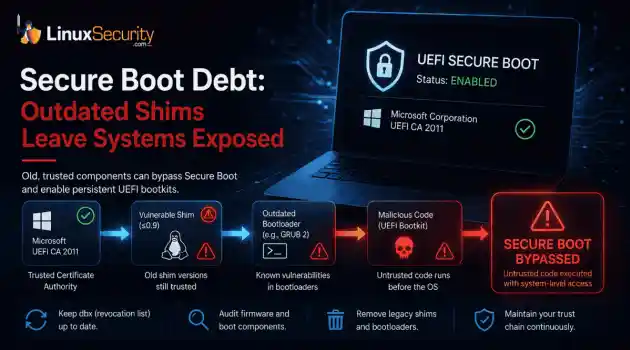
security advisory linux distribution ESET researchers identified 11 old and forgotten Linux UEFI shim bootloaders at versions 0.9 and below that can be used to bypass UEFI Secure Boot on any UEFI-based machine that trusts Microsoft’s Microsoft Corporation UEFI CA 2011 third-party certificate authority, regardless of the installed operating system (OS). Reported shims can be exploited to execute untrusted code during system boot, enabling attackers to deploy malicious UEFI bootkits even on systems with UEFI Secure Boot enabled.....
Jul 16, 2026
 Refine news
X Clear Filters
Get the latest News and Insights
Get the latest Linux and open source security news straight to your inbox.
Community Poll
Is continuous patching actually viable?
Loading...
Explore Latest Linux Security news
We found 165 articles for you...
210
 security advisorysecurity issuecritical
Linux: Firefox 138 Critical Security Update 2025:0034-1
With all the browser options available to Linux users, Mozilla Firefox continues to stand out in its dedication to security and privacy. Its latest release, Firefox 138 , focuses again on fortifying users' safety against mounting cyber threats. . This update offers crucial improvements and bug fixes worth taking advantage of, especially for us admins responsible for ensuring secure and dependable browsing experiences across our organizations' infrastructure. Let's examine the critical security flaws fixed in Firefox 138, the exciting new security and usability features introduced in this release, and the tools and resources added to support better web development. We'll also share tips for ensuring a seamless transition to Firefox 138 so you can get started without hesitation or disruption to your workflow. Understanding the Importance of Firefox Updates Updating software regularly is basic cyber hygiene . Yet, when it comes to web browsers constantly exposed to the internet's many threats, this practice is an absolute necessity. With Firefox 138, Mozilla demonstrates a proactive approach to patching vulnerabilities that, if left unaddressed, could be exploited by malicious actors to gain unauthorized access to systems, steal sensitive data, or perform other nefarious activities. Let's dive into this update's core components to help you understand what it means for us Linux users and how we can transition to this more secure version. Security Fixes: What’s Been Patched and Why It Matters In this release, Mozilla has resolved several high-severity vulnerabilities that had been a cause of concern for developers and users alike. These include memory safety bugs and critical vulnerabilities affecting components like WebGL, audio context, and browser UI elements like the address bar and popup windows. Leaving these vulnerabilities unpatched could have profound implications. Memory safety bugs, for example, can result in unexpected crashes or even allow attackers to executearbitrary code on the user’s machine. This could lead to unauthorized data extraction, installation of malware, or infrastructure-wide sabotage if the system is part of a network. Mozilla's diligent response in addressing these vulnerabilities helps to reduce the attack surface significantly, reminding us of the importance of immediately adopting this new version. Improving User Security: New Features and Improvements Beyond patching existing vulnerabilities , Firefox 138 introduces several new features to improve user security and privacy. One notable advancement is the enhanced support for the Clear-Site-Data header, which allows users to seamlessly clear the network cache upon logout. This functionality mitigates risks associated with session hijacking and other privacy breaches that could result from data remnants left behind after online activities. Additionally, autofill and address handling have substantially improved, especially in managing forms with dynamic fields. This is particularly beneficial for users handling sensitive information such as payment details or personal information, assuring them that their data is better protected against unauthorized access. Improving functionality for web developers also simplifies incorporating secure practices into their applications. A new addition is import attributes, which allow developers to pass metadata when importing modules, providing them with greater control and security over the modules their applications use. Usability Features Tailored for Diverse Workflows While security remains the primary focus, Firefox 138 also introduces enhancements that directly affect user efficiency and productivity. The new tab group management feature allows users to organize tabs into groups and reposition them along the tab bar. Such capabilities are especially useful in enterprise settings, where efficiently managing large numbers of tabs and tasks can directly correlate with productivity. Another subtle yet impactful update is the ability tocopy links from background tabs through the tab context menu. This change simplifies workflows and facilitates seamless navigation, particularly in research-heavy environments. Firefox 138 will progressively roll out features like weather-related suggestions and profile management enhancements for some users. These features represent Mozilla’s ongoing commitment to personalized and intuitive user experiences. While adopters might not see these changes immediately, it is crucial to stay informed and ready to take advantage of these functionalities as they become available . Developer Insights: Tools and Resources for Better Web Development Linux administrators who oversee the development and deployment of web-based applications will find some updates in Firefox 138 particularly beneficial. For instance, the Import Maps integrity field lets developers verify the integrity of JavaScript modules during imports, strengthening application security by ensuring that modules have not been tampered with. Extended support for Error.captureStackTrace also streamlines debugging across different browsers. The improvements in the network panel display, offering full request paths, provide developers with more clarity and control during troubleshooting, ultimately making the environment more robust against potential vulnerabilities or misconfigurations. Seamlessly Transitioning to Firefox 138 Deploying Firefox 138 is straightforward for Linux administrators ready to harness these enhancements. Depending on the environment, various methods are available to update or install this version, including using package managers, downloading directly from Mozilla, and using Snap or Flatpak packages. Updating through your distribution’s package manager usually ensures that you maintain integration with your system's broader package update routines. However, if you need immediate access to the latest version, consider downloading from Mozilla's FTP server . Alternatively, Snap and Flatpak offer universalpackage management solutions that ensure Firefox stays updated with less direct input from the user. Our Final Thoughts on the Significance of the Firefox 138 Release Maintaining secure systems and applications may seem elusive, but updating web browsers with security patches provides one effective preventative strategy to address potential security breaches. From managing individual Linux workstations to overseeing an expansive enterprise network, upgrading to Firefox 138 is essential to protecting digital assets and personal information. Staying abreast of software updates in today's cyberthreat-filled environment is more than an IT best practice; it's vital for your organization's defenses. Thanks to Mozilla Firefox 138 for Linux, admins can feel safe knowing they have a browser that prioritizes security and usability. This gives us peace of mind, preparing us for today's challenges while creating a safer web browsing experience. . Mozilla Firefox 138 brings significant updates addressing critical issues, enhancing both security and user experience for Linux users.. Firefox Update, Linux Browser Security, Software Patch, User Experience Improvements. . Brittany Day
 May 08, 2025
•
May 08, 2025
• Security Vulnerabilities
210
 security advisorysoftware updateapplication security
Chrome 134 Update: Critical Fixes for Linux Users' Security
Google recently took an important step toward increasing web browsing security by unveiling Chrome 134 to patch several severe vulnerabilities. As a Linux administrator, staying informed on such updates to protect systems against potential threats is paramount. This release addresses critical issues like an out-of-bounds read in V8 and defects across DevTools Profiles and PDFium. . Keeping your Chrome browser updated, as cyber threats become increasingly sophisticated, can significantly lower security risks and ensure an enhanced browsing experience. Let's take a look at the bugs fixed in Chrome 134, their potential impact, and ways we can best protect ourselves as Chrome users. Understanding the Chrome 134 Security Update Chrome 134 marks an exceptional leap forward in browser security, patching multiple critical and high-severity vulnerabilities reported by Zhenghang Xiao and Nan Wang as CVE-2025-1914 . These vulnerabilities could result in crashes, data corruption, or remote attacks to exploit and execute code - this finding is especially noteworthy given that V8 serves as Chrome's JavaScript engine that renders webpages and runs scripts. DevTools vulnerabilities such as CVE-2025-1915 were also addressed, which are essential for debugging and optimizing web applications. It was discovered that improperly restricting pathnames to restricted directories posed a risk of unauthorized access. Other medium-severity issues include use-after-free vulnerabilities in Profiles ( CVE-2025-1916 ) and inappropriate implementations in Browser UI ( CVE-2025-1917 ), both of which enable attackers to compromise browser stability and security. Low-severity issues were also addressed, including improper implementations in Selection and Permission Prompts ( CVE-2025-1922 and CVE-2025-1923 ). Examining The Impact of These Fixes The fixes introduced in Chrome 134 are critical for all impacted Chrome users. If left unpatched, these vulnerabilities could allow attackers to execute arbitrary code,steal sensitive information, or crash the browser, causing significant disruptions. High-severity vulnerabilities, such as out-of-bounds reads and use-after-free bugs, can cause serious harm. Attackers might exploit these flaws to bypass security measures built into your OS or browser. By addressing these flaws, Chrome 134 helps block potential exploit paths, further strengthening your systems' security posture. Medium and low severity issues may seem less immediately concerning; however, they still play an essential part in increasing browser robustness and resilience. Security only stands up when all weak links are properly addressed. Minor problems can often become part of larger attack strategies, so every fix contributes to creating a safer browsing environment overall. Ensuring Your Chrome Browser Is Protected Staying up-to-date is critical to protecting against potential vulnerabilities in Chrome browsers. While updating on Linux can be relatively painless, updating all systems across an organization requires time and attention. Start by opening Chrome and entering its settings menu (represented by three vertical dots in the upper right corner). From here, navigate to Help > About Google Chrome for help. If an update is available, it will automatically download. Once this process has finished, it's important to relaunch the browser to complete its installation. Although updates on individual machines can be managed manually, automating updates across an enterprise can be simplified using various system management tools such as Puppet , Chef , or even simple cron jobs. These tools streamline this process and ensure all users within a network receive critical security patches without manual intervention. This automation saves time and ensures all critical patches are applied promptly. Debian , Mageia and openSUSE have released important security advisory updates regarding fixes for these flaws. It is crucial that all impacted users apply the updates released by theirdistro(s) promptly to mitigate risk. Reporting Issues and Contributing to Security Once you detect issues or vulnerabilities, you must report them promptly. Google offers bug bounties for serious security vulnerabilities to encourage researchers and professionals to discover and fix flaws quickly. You can report problems by filing an entry in Chrome Bug Tracker with as much detail as possible so developers can address them efficiently. Participating actively in Chrome's reporting process improves its security while providing a safer internet for all. Your participation helps foster collaboration within the broader cybersecurity community, strengthening security and creating greater resilience. Our Final Thoughts on the Significance of the Chrome 134 Update Chrome 134 marks an important advancement toward safeguarding browsing experiences for all users, particularly enterprise environments where security cannot be compromised. As a Linux security admin, it is critical to ensure your browser remains updated against newly discovered vulnerabilities. Understanding their impact and maintaining timely updates will significantly lower risk. Staying informed via official channels such as Chrome Releases and actively engaging in the security community are great ways to build and sustain an effective security posture for your organization. Reporting issues also helps strengthen Chrome's security infrastructure, creating a safer internet. By taking these steps you are both protecting yourself and contributing to efforts by individuals worldwide to strengthen web security. . The latest Chrome 134 patch resolves severe vulnerabilities, boosting the browser's protection for users on macOS.. Chrome Update, Linux Browser Security, Software Patching, Cyber Threats, V8 Security. . Brittany Day
Mar 13, 2025
•
Security Vulnerabilities

81
 security advisorysoftware updateuser privacy
Tails 6.13 Released: Improved Wi-Fi Diagnostics and Enhanced User Privacy
Tails OS has once again proven itself a go-to option for privacy-focused users with the release of Tails 6.13. This update brings with it a host of improvements designed to boost security and user experience for Linux admins who prioritize anonymity and data protection. . Tails 6.13 includes an upgrade to diagnose Wi-Fi hardware issues quickly so users can address connectivity problems more effectively, as well as updates to Tor Browser (version 14.0.7) and Tor Client (0.4.8.14). Persistent Storage has also significantly improved with this release, including fixes that address partitioning errors and improve reliability when setting up new USB sticks. These updates make it easier than ever for users to leverage all the potential of Tails OS while upholding its high standards of security and accessibility. Whether troubleshooting Wi-Fi connectivity issues or checking for updated security patches, Tails 6.13 offers practical enhancements Linux security admins will appreciate as part of their ongoing effort to protect user privacy. Let's examine the key updates, new features, and notable fixes introduced in the latest release of this privacy-focused Linux distro and discuss how they will improve the security and usability of your systems. Improved Wi-Fi Hardware Diagnostics One of Tails 6.13's hallmark features is its improved diagnostics for detecting Wi-Fi hardware issues. Linux administrators often experience connectivity issues in environments with various hardware configurations. So the Tor Connection assistant now reports when no Wi-Fi hardware has been detected, helping users identify and troubleshoot compatibility issues more efficiently. Before this update, users might have struggled to quickly identify the cause of connectivity problems, leading to delays and frustration. With this enhancement, Tails now provides clearer feedback, which helps both users and administrators address these issues promptly. This not only improves user experience but also reinforces its reputation as asecure platform that ensures robust privacy measures are met. Up-to-Date Tor Browser and Tor Client Versions Security-minded users rely on Tor for anonymized browsing, making having the latest versions of the Tor Browser and client vital. Tails 6.13 addresses this need by updating the Tor Browser to version 14.0.7 and the Tor client to version 0.4.8.14 , respectively, providing users access to more secure and reliable tools. Tor Browser's update offers several under-the-hood optimizations designed to enhance user safety, such as fixes for known vulnerabilities and enhancements in overall performance. With version 14.0.7, users can browse with greater peace of mind knowing they are protected against emerging threats while enjoying a smoother browsing experience. Tor Client Version 0.4.8.14 provides significant updates that address potential vulnerabilities and optimize stability and efficiency when connecting to Tor. These fixes give Linux admins the confidence in Tails OS's secure communication features to maintain the high standards necessary for privacy-focused operations. Fixes for Persistent Storage Issues Persistent Storage is an invaluable feature of Tails for many users, providing them with secure files, configurations, and additional software across sessions. Tails 6.13 brings essential fixes to this feature that address partitioning errors that might arise during initial setup on new USB sticks. These improvements ensure users can count on their setup working consistently as intended. Tails 6.13 addressed an issue related to correctly creating Persistent Storage when partitioning a new USB stick, which could be particularly challenging for novice users setting up Tails for the first time. By eliminating these failures, setup will go more smoothly for newcomers, demonstrating Tails' dedication to creating an accessible yet highly secure operating environment. An Ongoing Commitment to Security and Privacy Tails OS has long been at the forefront of privacy-centricoperating systems , and with its release, Tails 6.13 marks another step toward improving security and usability. Tails has addressed key concerns like Wi-Fi hardware diagnostics while updating components such as Tor Browser and Client and Persistent Storage to ensure a robust and user-friendly computing environment. We Linux security admins understand the significance of these updates for more than incremental improvement; they represent essential steps towards maintaining the integrity and functionality of the systems we manage. Understanding the Practical Benefits for Linux Admins Linux admins who oversee environments where user anonymity and data protection are paramount will discover many practical benefits from Tails 6.13. Improved Wi-Fi connection diagnostics simplify deployment across various hardware configurations, and less time is wasted troubleshooting connectivity issues, particularly helpful when quick setup time and consistent performance are essential. Staying current with the Tor Browser and Client is essential to mitigating potential security risks. The updates introduced in Tails 6.13 ensure users are shielded from current vulnerabilities while communicating securely. This proactive approach builds trust in the system's ability to protect user data and preserve anonymity. Enhancements to Persistent Storage reliability offer additional benefits by streamlining setup procedures and guaranteeing users can consistently save and access their data across sessions. This reduces setup errors that require troubleshooting efforts, leaving more time for other crucial aspects of system administration. Our Final Thoughts on the Tails 6.13 Release Tails 6.13 provides an impressive suite of updates and features to enhance security and user experience. Linux security admins will find useful tools for hardware diagnostics, software updates, persistent storage needs, and more in this release. By continuously expanding on its solid foundation, Tails OS remains one of the premier optionsfor maintaining privacy and anonymity online. Linux administrators can deploy Tails with greater assurance thanks to its latest upgrades. Tails now provides robust protection against current threats while offering user-friendly features that make it more accessible than ever. Whether troubleshooting connectivity issues, updating security patches, or setting up Persistent Storage for the first time, Tails 6.13 has everything needed for creating and maintaining a safe computing environment. Tails OS provides detailed instructions on how to install, download, or upgrade to Tails 6.13 on its official website. . Tails 6.13 bolsters user security through enhanced data protection, updated Tor integration, and increased dependability of persistent storage for Linux administrators.. Tails OS, Privacy Protection, Network Diagnostics, Software Updates, Persistent Storage. . Brittany Day
Mar 10, 2025
•
Privacy
210
 security advisorysecurity updatesoftware update
PostgreSQL and BeyondTrust: High Severity Risk Requires Immediate Patch
Recent vulnerabilities in BeyondTrust Remote Support ( CVE-2024-12356 ) and PostgreSQL ( CVE-2025-1094 ) are being actively exploited by threat actors and require urgent mitigation by admins using the popular SQL database and BeyondTrust Remote Support solution. Attackers are using this PostgreSQL SQL injection flaw to sneak SQL commands past security checks, then execute remote commands against vulnerable versions of BeyondTrust for access and control over systems running vulnerable versions. . With attackers potentially having access to sensitive data or disrupting services via BeyondTrust systems running vulnerable versions, those impacted by these flaws must act now before it's too late! Here's what you need to know about this exploit and measures you can take to keep your systems operational and safeguard your sensitive data. Understanding the Nature of This PostgreSQL SQLi Vulnerability Let's delve further into this PostgreSQL SQL injection (SQLi) vulnerability that's caused widespread alarm. In general, SQLi bugs occur when an attacker inserts malicious SQL code into an input field, which is then executed by the database. This enables the attacker to manipulate the database, access unauthorized data, and perform privileged operations by exploiting poorly validated or sanitized inputs. SQLi vulnerabilities can lead to unauthorized access to sensitive data, and potentially full system compromise - so they are not something to take lightly! In the specific case of CVE-2025-1094 , PQescapeLiteral(), PQescapeIdentifier(), PQescapeString(), and PQescapeStringConn() all improperly handle quoting syntax that allows attackers to inject malicious SQL commands using key libpq functions. PQescapeLiteral() and PQescapeIdentifier() were intended to safely escape user input and prevent injection attacks. Now, however, they've become targets, allowing attackers to exploit them and insert malicious SQL commands directly into databases running against them. When you use these functions to feedinto PostgreSQL interactive terminal psql, they become dangerous. An attacker could exploit how these functions' process input to bypass your defenses with malicious SQL statements and then execute remote commands against vulnerable versions of BeyondTrust Remote Support to gain complete control of impacted systems. Not only are libpq functions vulnerable, but command line utilities of PostgreSQL may also be susceptible. This becomes especially apparent when client_encoding is set to BIG5 while server_encoding differs - opening up an opportunity to inject potentially dangerous SQL commands through command-line operations. Affected Versions and Patches It is crucial to understand which PostgreSQL versions are at risk and the patches released address to address the issue. Specifically, those using versions prior to 17.3, 16.7, 15.11, 14.16 or 13.19 could be vulnerable to this exploit Patches for this issue have already been released to address it. PostgreSQL 16.7, 15.11, 14.16, and 13.19 versions were patched on February 13, 2025, and should be upgraded immediately to protect yourself against potential exploitation and close any security gaps in your systems. Mageia and Oracle have released critical advisory updates to mitigate this bug. At this stage, it would be prudent to conduct an in-depth audit of your current PostgreSQL version and, if any vulnerable versions exist on your server, formulate an update plan immediately. Applying patches can protect systems against sophisticated attacks targeting them. Exploring the Security Impact of This PostgreSQL Flaw Let's discuss the security implications of this vulnerability in greater depth. It has been assigned a CVSS 3.0 score of 8.1, which indicates it as a high-severity threat with significant risks to confidentiality, integrity, and availability if successfully exploited. As this vulnerability requires certain conditions, such as specific encoding settings and usage patterns to exploit, don't let its low severity fool youinto believing you are safe. An attacker with enough knowledge could still cause significant harm, possibly accessing sensitive data or destabilizing your system. Take this bug seriously despite its limited exploitation conditions, and implement patches now to protect against potentially devastating security breaches and ensure your infrastructure remains robust and secure. Beyond Patching: Practical Measures for Securing PostgreSQL PostgreSQL users can take several measures beyond patching to protect their systems from vulnerabilities like CVE-2025-1094. First, focus on hardening your PostgreSQL configuration by disabling any unused services and features and reviewing all database settings for compliance with security best practices. For instance, admins should limit listening addresses to trusted networks while using strong authentication methods like scram-sha-256 for login security. Implementing stringent access controls is another essential measure. Ensure only authorized users have access to your databases, with only the privileges necessary to do their jobs effectively. Use roles and permissions wisely to prevent unauthorized access or data manipulation, regularly audit user access and revoke any no longer necessary permissions, audit user access regularly as part of an overall security strategy, and implement network-level measures such as firewalls or VPNs for remote access. Keep a keen eye on your database's activity by activating logging and monitoring. By watching its activity, you can quickly detect any unusual or suspicious activity, while PostgreSQL log files provide insight into access patterns and potential threats. Couple this with an effective incident response plan so your team can respond efficiently should any security breaches arise. Our Final Thoughts on Mitigating Risk for PostgreSQL & BeyondTrust Users As soon as threats like this emerge, you must swiftly secure your systems against them. CVE-2024-12356 in BeyondTrust Remote Support and CVE-2025-1094 inPostgreSQL should not be overlooked as together they provide attackers access to and control over your systems. By applying patches from BeyondTrust and PostgreSQL, you will close these security holes and prevent attacks from occurring in your Linux environment. Wait no longer - take proactive measures to protect yourself and your data and operations! Immediately update your systems , review security protocols, and take measures to secure against these vulnerabilities that threaten the integrity and safety of impacted IT infrastructures. It is well worth the time and effort to prevent attacks that could cripple your systems or expose sensitive data! . Safeguard critical information and applications in BeyondTrust and PostgreSQL against ongoing threats through immediate update implementations.. PostgreSQL Flaws, BeyondTrust Risk Management, SQLi Prevention, Security Patch Updates. . Brittany Day
Feb 27, 2025
•
Security Vulnerabilities
81
 security advisorydata protectionsoftware update
Tails 6.12 Security Advisory: Critical Tor Improvements and Updates
Tails, the amnesic incognito live system renowned for its privacy and security measures, has just released version 6.12 , bringing crucial updates and fixes you can't afford to miss. This new version addresses significant vulnerabilities, particularly Tor circuit monitoring and Persistent Storage protection. . Additionally, critical software updates, including the latest Tor Browser and Thunderbird versions, have been rolled out to enhance digital security. With reliability improvements for essential functions like time synchronization and Persistent Storage encryption, Tails 6.12 ensures your systems run smoothly and securely. Let's examine how you can stay ahead of evolving security and privacy concerns and keep your systems bulletproof by adopting Tails 6.12 now! Tails OS: A Linux Distro with an Intense Focus on Security & Privacy Tails is short for "The Amnesic Incognito Live System" and is a security-oriented operating system you can run from a USB stick or DVD. Unlike traditional OS installations that leave data behind locally, Tails was designed not to store information locally, making it an excellent solution for maintaining anonymity and privacy online. Furthermore, Tor is used as internet traffic passes between user computers, effectively concealing their location from surveillance or traffic analysis services. Tails offers many advantages. Its amnesiac nature ensures no data is saved between sessions, making it ideal for users with sensitive information. Furthermore, it has an integrated Tor browser and other tools that facilitate encrypted communications and help users bypass censorship or surveillance. Key Security Fixes in Tails 6.12 One of the critical fixes in Tails 6.12 addresses vulnerabilities related to monitoring Tor circuits. Previously, an attacker controlling an application could exploit Onion Circuits and the Tor Browser wrapper, potentially leading to deanonymization. This release has patched these vulnerabilities, substantially improving user anonymityand security. Another significant area of improvement is the protection of Persistent Storage settings. Measures have been implemented to prevent attackers from modifying Persistent Storage if they already control an application. This enhancement ensures that even if one application is compromised, it cannot affect Persistent Storage, which is critical for maintaining the integrity of your sensitive data. Updates and New Features Tails 6.12 also features essential software updates and introduces features designed to enhance user experience and system reliability. Tor Browser, the fundamental tool for anonymous browsing, has been upgraded to version 14.0.5 . Thunderbird, the secure email client, was updated to version 128.6.0esr. Keeping these applications updated helps protect against known vulnerabilities while offering users maximum protection. As part of its upgrade process, a straightforward way has been added to the About Tails utility for users to check for available upgrades. This streamlines user experience while encouraging more regular system updates that keep systems secure with the latest patches and features. Reliability Enhancements Beyond security patches and software updates, Tails 6.12 includes several reliability improvements. All Python code runs in isolated mode, ensuring better runtime performance and stability. The troubleshooting instructions for cases where automatic upgrades fail have also been simplified, helping users resolve issues more quickly and efficiently. Another significant fix addresses the Welcome Screen, which previously could freeze while activating Persistent Storage. This issue has been resolved, making the startup smoother and more reliable. Additionally, time synchronization, a crucial feature for ensuring accurate timestamps and secure communications, has been made more reliable when restarting Tor. Enhancing Persistent Storage Encryption One of the standout improvements in Tails 6.12 is the enhanced handling of Persistent Storageencryption errors. If upgrading the encryption of Persistent Storage to LUKS2 fails, users will now receive a clear error message. This straightforward feedback helps users understand the issue and take corrective actions, thereby maintaining the security and usability of their encrypted storage. Upgrading and Installing Tails 6.12 For existing Tails users, upgrading to version 6.12 is a straightforward process. Users running version 6.0 or later can upgrade their Tails USB stick via automatic upgrades, maintaining their Persistent Storage. If the automatic upgrade fails, a manual upgrade may be necessary. Detailed instructions for performing manual upgrades are available on the Tails website , ensuring users can smoothly transition to the latest version. For new users or those needing to reinstall Tails, installation instructions are provided for various operating systems, including Windows, macOS, Linux, and even the command line with GnuPG . It's worth noting that Persistent Storage will be lost if you install instead of upgrading, so users should back up any critical data before proceeding with a new installation. Direct download options for USB sticks (USB image) and DVDs and virtual machines (ISO image) are available from the Tails website . These options provide flexibility for users depending on their preferred method of deployment. The Importance of Regular Updates Regular updates are essential to the security and functionality of any operating system, particularly one like Tails, which prioritizes user privacy and anonymity. Staying up-to-date ensures all known vulnerabilities are patched and provides users with the latest enhancements and features. With Tails 6.12, users can rest easy knowing their digital activities remain private, secure, and anonymous. Our Final Thoughts on the Tails 6.12 Release Tails version 6.12 is essential in providing robust digital security and privacy. By addressing critical vulnerabilities, updating essential software packages, andincreasing system reliability, this version ensures users can operate confidently, knowing their data and activities are well protected. No matter if you are upgrading from an earlier version or starting fresh with Tails for the first time, the process has been designed for user-friendliness and accessibility. Take advantage of Tails 6.12's new features and enhancements to avoid potential threats and boost digital defenses. Stay vigilant, update your systems, and prioritize digital security and privacy with Tails! We'd love to hear what you think of Tails 6.12 @lnxsec. . Tails 6.12 boosts privacy through the integration of updated Tor Browser features and enhances safeguarding of persistent storage. Surf securely!. Tails, Privacy Enhancement, Tor Browser Upgrade, Data Integrity, Security Updates. . Brittany Day
Feb 07, 2025
•
Privacy
79
 security advisorysoftware updatesecurity enhancement
AlmaLinux 9.4: Enhanced Security Updates for Linux Admins
The recent release of AlmaLinux 9.4 , closely aligned with Red Hat Enterprise Linux (RHEL) 9.4 , presents Linux admins and infosec professionals with an enhanced open-source enterprise Linux solution. AlmaLinux 9.4 is built directly from RHEL's open-source source code, demonstrating the community's ability to deliver prompt updates. Let's explore this release's implications, long-term consequences, and impact on security practitioners. . What's New in AlmaLinux 9.4? What Are the Implications of These Changes? One intriguing aspect of AlmaLinux 9.4 is the significant updates across software environments and development tools. The following updates have been made to popular programming languages and web technologies: Python 3.12 Ruby 3.3 PHP 8.2 nginx 1.24 MariaDB 10.11 PostgreSQL 16 These updates spark curiosity among professionals working with these technologies, as the latest versions often bring performance improvements, security patches , and new features. Moreover, the compilers have undergone comprehensive updates, with the GCC Toolset at version 13, LLVM Toolset at version 17.0.6, Rust Toolset at version 1.75.1, and Go Toolset at version 1.21.7. These updates ensure developers' productivity and efficiency, enabling them to leverage the latest tools and features. Security enhancements are another crucial area of focus for AlmaLinux 9.4. The article highlights several notable improvements, including SELinux userspace release 3.6 with more customizable security policies through deny rules. This feature raises questions about the extent of control administrators have over security policies and the potential consequences of misconfigurations. Additionally, keylime's server components are now available as containers, aiding in secure infrastructure management. This innovation could have substantial long-term consequences, as the use of containers has gained momentum in the industry due to their efficiency and scalability. However, it also raises concerns about container security and the potential risks associated with managing sensitive infrastructure components within containers. Another significant security enhancement highlighted in the article is the customizable TLS/SSL encryption settings in Rsyslog. This feature offers improved security in log processing, ensuring the confidentiality and integrity of system logs. However, the article does not provide specific details about the customization options, leaving readers wondering about the level of control they can exert over TLS/SSL encryption settings. Apart from these security enhancements, other updates, such as those in OpenSSL, libkcapi, and Stunnel, further contribute to AlmaLinux 9.4's security posture. One aspect that deserves attention is the hardware support changes in RHEL 9.4. AlmaLinux 9.4 continues to support older hardware devices crucial for operational continuity in various industries. This inclusion demonstrates AlmaLinux's commitment to ensuring compatibility and minimizing disruptions for organizations relying on legacy systems. However, supporting older hardware could have potential repercussions regarding security vulnerabilities or performance trade-offs. Our Final Thoughts on the AlmaLinux 9.4 Release AlmaLinux 9.4 presents an enticing update for Linux admins, infosec professionals, internet security enthusiasts, and sysadmins. Significant updates across software environments, development tools, and security enhancements improve users' performance, functionality, and robustness. AlmaLinux 9.4 seems a promising choice for security practitioners, balancing modern requirements and support for existing systems. You can download AlmaLinux 9.4 here. . AlmaLinux 9.4 brings valuable upgrades for Linux admins and security pros alike, boosting performance and enhancing system stability through updated kernels and file management.. AlmaLinux 9.4 Release, Security Improvements, Open-Source Enterprise, Software Updates, Enhanced Security. . Brittany Day
May 07, 2024
•
Security Projects
74
 security advisorynetwork securitysoftware update
I2P 2.5.0: Security Enhancements and New Features for Linux Users
The recent release of I2P 2.5.0 , an anonymous P2P network that protects against online censorship, surveillance, and monitoring, has brought a slew of improvements and new features that will certainly intrigue security practitioners. This release aims to enhance user-facing features while addressing compatibility and security issues. . Let's examine the changes introduced in this release and their security implications for Linux admins and I2P users. What's New In I2P 2.5.0? Why Are These Changes Significant? The updates to I2PSnark and SusiMail are particularly noteworthy. Users of I2PSnark can now enjoy the added convenience of searching through torrents, and the bug fixes have ensured better compatibility with other I2P torrent clients such as BiglyBT and qBittorrent . Meanwhile, SusiMail has received support for Markdown formatting in emails and the ability to drag-and-drop attachments, which will likely streamline the user experience. These improvements could be especially valuable for Linux admins and sysadmins, as they often rely on secure communication tools like SusiMail for daily operations. Furthermore, introducing "Keepalive" support for tunnels created with the Hidden Services manager promises performance enhancements and better compatibility with web technologies, potentially making I2P sites more sophisticated. This should spark the interest of internet security enthusiasts, as it hints at the prospect of improved and more secure web applications within the I2P network. It is critical to emphasize the impact of this release on the user, particularly from a security perspective. The improvements made to NetDB to enhance its resilience against spam and suspicious messages, along with rectifying the isolated piercing event, are an essential facet of this release. These fixes could mitigate security vulnerabilities and prevent potential breaches , which is vital for infosec professionals and other security practitioners. Looking ahead, it's crucial to consider thelong-term consequences of these improvements. How will these changes impact the network's overall security posture? Could the added features in I2PSnark and SusiMail lead to new attack vectors? Furthermore, how will these updates affect the global reach of I2P? These are questions that Linux admins, infosec professionals, and internet security enthusiasts should ponder. You can download I2P 2.5.0 for Linux here. Our Final Thoughts on the I2P 2.5.0 Release I2P 2.5.0's release signifies a substantial step forward, particularly in enhancing user-facing features and addressing network security. The implications of these upgrades extend beyond just technical improvements, impacting the everyday experiences of security practitioners who rely on the I2P network. Witnessing such continuous dedication to evolving and improving I2P is commendable, and the security community should engage critically with these developments. . The I2P 2.5.0 release brings key improvements to enhance anonymity and security, ideal for Linux administrators focused on protecting their systems and data. I2P Release Updates, P2P Software Improvements, Network Security Enhancements, Linux Admin Security, Software Security Updates. . Brittany Day
Apr 22, 2024
•
Network Security
81
security advisorysoftware updateLinux distributionTails 5.20 Release: Updated Tor Browser and AdGuard Removal
Tails 5.20 is a Linux distribution designed to provide anonymity and privacy to its users. It comes pre-configured with tools like Tor Browser, HTTPS Everywhere, KeePassXC, and more. . This past week, the Tails developers released version 5.20 of their operating system. This release brings a number of improvements including an updated Tor Browser (version 8.0), an updated GNOME desktop environment (version 3.30), and numerous other software updates. The biggest change in this release is an update to the Tor Browser that was released last week by the Tor Project's developers. This update fixes a number of security issues related to JavaScript and other browser components. Another important update in this release is the removal of AdGuard's filter list from the default configuration file for filtering ads and tracking cookies in web browsers used by Tails users when browsing online content anonymously using the Tor network (which includes DuckDuckGo). I found the article linked below very helpful in understanding what's new in this release, and I wanted to share it with you. Check it out! . Tails 5.20 introduces a fortified Tor Browser that elevates security measures and eliminates AdGuard to boost online confidentiality.. Tails 5.20, Tor Browser update, privacy enhancement, Linux distribution, anonymizing tools. . LinuxSecurity.com Team
Nov 29, 2023
•
Privacy

Get the latest News and Insights
Get the latest Linux and open source security news straight to your inbox.
Community Poll
Is continuous patching actually viable?
Search Topics
Powered By

Linux Security - Your source for Top Linux News, Advisories, HOWTOs and Feature Releases
QUICK LINKS
subscribe to newsletters!
Like staying secure? So do we.
Sign up for updates, tips, and alerts!